Anthropic's Linked Billing Beta Lets Tools Like Factory, Linear and Ramp Charge Your Claude Org Without an API Key
Anthropic's Linked billing beta lets third-party apps bill Claude API usage to a customer's own Claude organization. An OAuth link replaces the pasted API key, and the customer sets a spend cap. Here is who qualifies, what the link governs and where the sharp edges are.
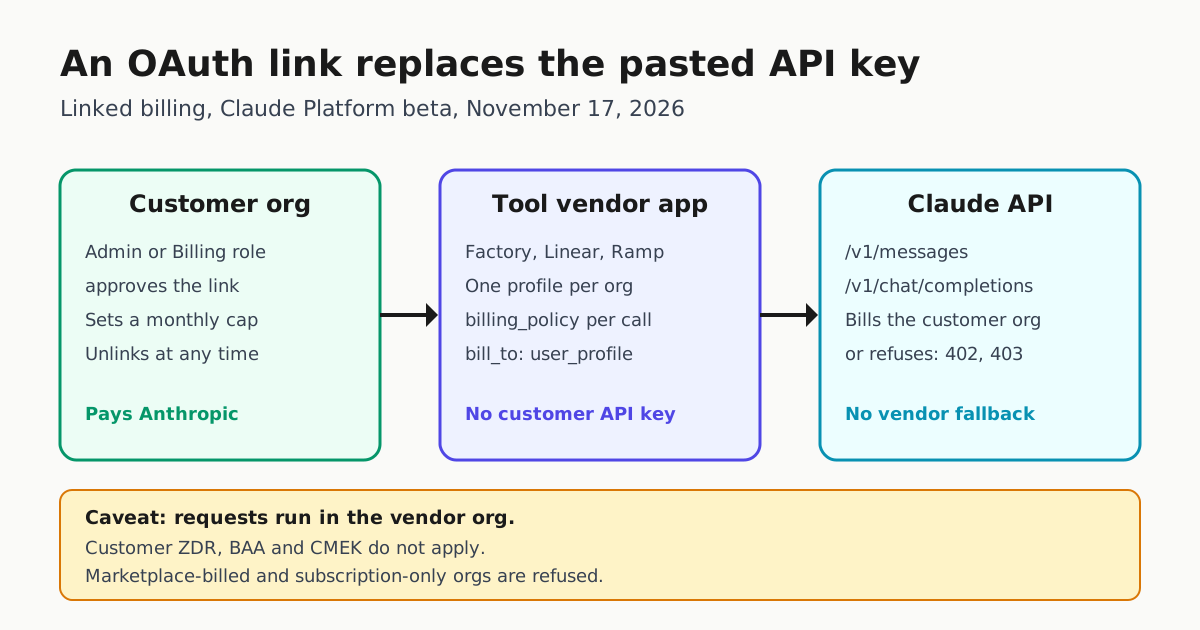
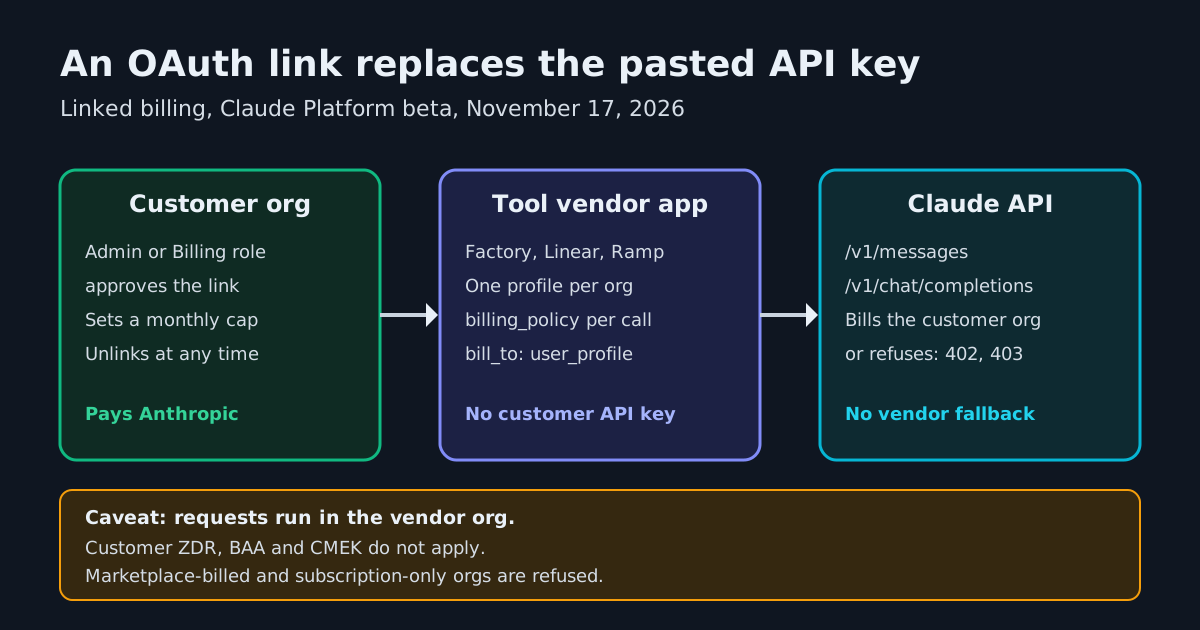
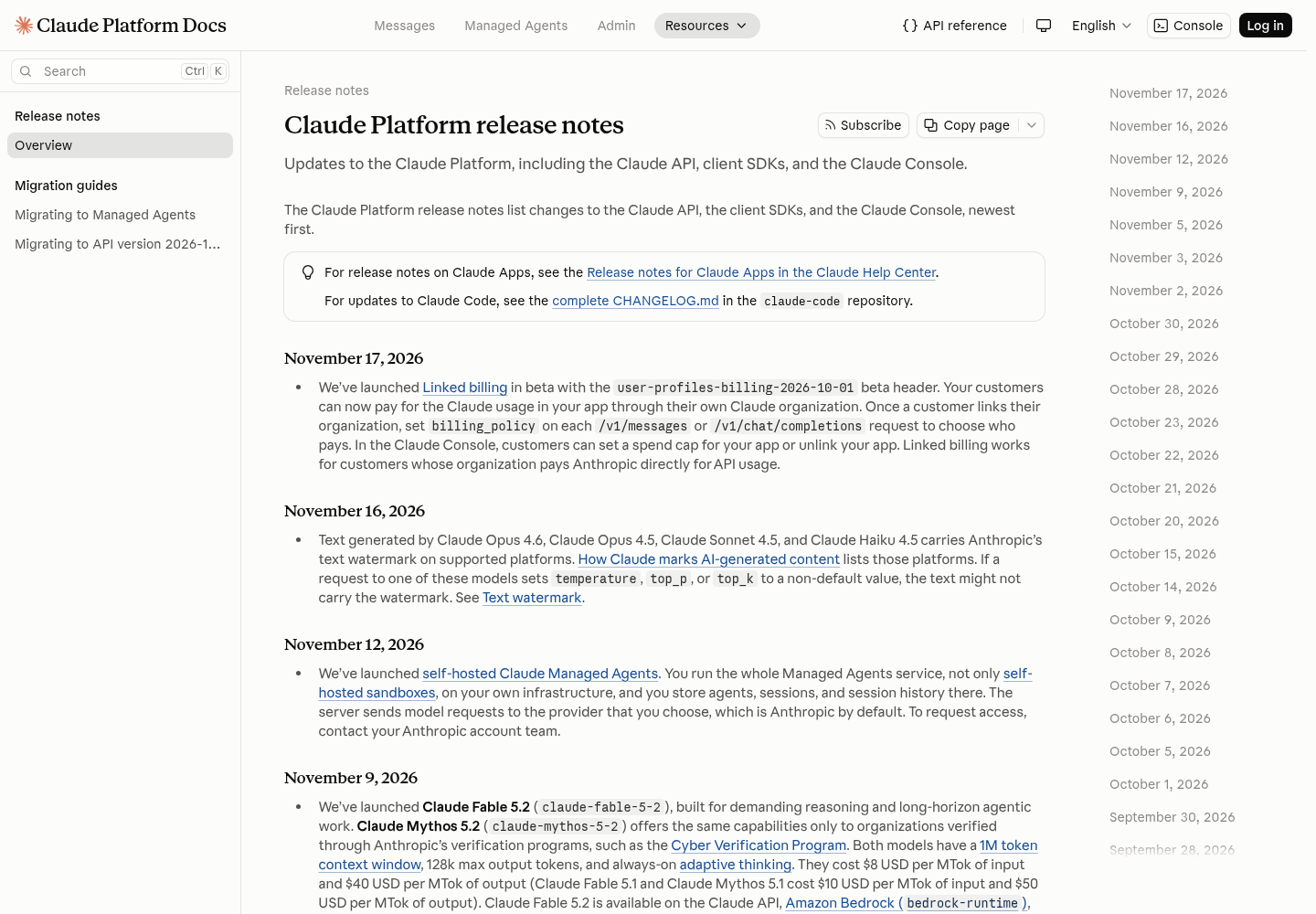
Anthropic has put Linked billing into beta on the Claude Platform. The @ClaudeDevs announcement on November 17, 2026 says users of tools like Factory, Linear and Ramp “can pay for Claude API usage through their Claude Platform organization, without sharing an API key.” The Claude Platform release notes carry the same date and add the details developers need: a user-profiles-billing-2026-10-01 beta header, a per-request billing_policy field, and Console controls that let customers set a spend cap or unlink an app.
This changes how teams pay for AI coding and agent tools. Many of these products ask you to bring your own key: you paste an Anthropic API key into the vendor’s settings page, and the vendor stores a long-lived secret that can spend your money. With Linked billing, an administrator approves an OAuth link once. The vendor never holds your key, and you can cap or end its spending from your own Console.
What a customer approves
According to the Linked billing guide, the vendor adds a “Link your Claude organization” button. The user signs in to Claude, picks an organization and approves. The approver must hold the Admin or Billing role in that organization. The approval page has four steps: choose the organization (shown only when there is a choice), read how billing works, set a monthly spend limit, then click Link and authorize.
After that, the customer manages the vendor from a Linked platforms page in the Claude Console. There they can see what the app has cost this month, set or change a monthly cap in whole US dollars, set a default cap for every linked app, and unlink at any time. When the app’s spend reaches its cap, requests billed to the customer are refused with a 402 until 00:00 UTC on the first of the next month, or until the customer raises the cap. The vendor can’t read the cap. Anthropic also doesn’t notify the vendor when a customer unlinks: no webhook, no email.
The link belongs to the whole organization, not to the person who approved it. If that person leaves, the connection stays active.
Who can’t use it yet
Eligibility is narrower than the announcement suggests. The guide sets these rules:
| Customer situation | Result |
|---|---|
| Pays Anthropic directly (prepaid credits or invoiced) | Eligible |
| Billed through AWS, Google Cloud or Azure marketplaces | Refused: 403 user_profile_not_billable |
| Has only a Claude subscription plan | Refused: 403 user_profile_not_billable |
| Monthly API credits from Max, Ultra or Team plans | Can’t pay for these requests |
| Partner, VC or startup program credits | Not eligible |
| Needs HIPAA, FERPA or CMEK coverage for this usage | Anthropic says not to link |
That last row matters most for regulated teams. Linked requests run in the vendor’s organization, so the vendor’s rate limits, model access, data retention and encryption keys apply. Your own zero data retention, BAA and customer-managed keys do not carry over. Linked billing changes who pays. It doesn’t change where your data is processed.
What tool builders change
On the vendor side, the guide calls a link a connection between one of the vendor’s user profiles and the customer’s organization. Each request then chooses who pays. To bill the customer, send the beta header, the profile ID header and a billing_policy:
client.beta.messages.create(
    model="claude-opus-5-5",
    max_tokens=1024,
    messages=[{"role": "user", "content": prompt}],
    betas=["user-profiles-billing-2026-10-01"],
    extra_headers={"anthropic-user-profile-id": user_profile_id},
    extra_body={"billing_policy": {"type": "billing_policy", "bill_to": "user_profile"}},
)
Use bill_to: "self", or leave out billing_policy, to pay for a request yourself. Supported endpoints are /v1/messages and /v1/chat/completions. Message Batches can’t bill a customer. Billable code execution features also return a 400 when bill_to is user_profile.
The auth setup has no shared secret at all. The OAuth reference requires pushed authorization requests, PKCE with S256, and private_key_jwt client assertions signed by the vendor’s own identity provider. Anthropic issues no client secrets. A request_uri lasts 10 minutes, an authorization code 5 minutes, an access token up to an hour and a refresh token up to a year. Before customers outside the vendor’s test list can link, the vendor publishes the app. Unless the vendor has invoiced billing, that means proving its domain with a DNS TXT record and passing Anthropic review. While an app is in testing, caps are limited to $50.
The sharp edges
- One credential can bill everyone. By default, the vendor’s operator service account can bill every linked customer. If a request names the wrong profile ID, the guide says Anthropic bills that profile’s organization “and no error tells you.” Per-connection access tokens, which can bill only one customer, are optional. Turning off operator-only authentication requires asking the Anthropic account team during the beta.
- Refusal, not fallback. When a request marked for the customer can’t be billed to them, the API refuses it rather than charging the vendor. The main errors are
403 user_profile_not_billable,402 linked_organization_spend_limit_reached(a cap or no usable credit; the response doesn’t say which) and402 linked_organization_billing_unavailable. A successful response doesn’t say who paid, so vendors must keep their own records. - Refresh tokens are fragile. Sending a used refresh token again more than 30 seconds after its first use ends the connection, and the customer has to link again. The guide tells vendors to turn off automatic HTTP retries on refresh calls.
What to do now
If you buy agent tools, check whether your organization pays Anthropic directly before you expect this option. Decide who in your org holds Admin or Billing approval rights. Set a per-app cap on day one, and set a default cap for any app that doesn’t have one. Once a tool supports linking, replace the API key you pasted into it, then revoke that key. If keys have leaked from a tool before, as in our OpenCode key rotation coverage, linking removes that exposure for future usage.
Linked spend still needs watching. The Console’s per-app cost view supplements an agent cost alerting setup but doesn’t replace it. If you charge costs back to teams, add a vendor-billed column to your chargeback reconciliation.
If you build a tool, keep user profiles one-to-one with customer organizations. Prefer per-connection tokens wherever a sandbox or single-tenant deployment touches customer traffic. Write “linked” rather than “billing active” in your UI, because a completed link does not guarantee that Anthropic can bill the customer.
Sources
- ClaudeDevs on X: "Linked billing is now in beta on the Claude Platform. Now users of tools like Factory, Linear, and Ramp can pay for Claude API usage through their Claude Platform organization, without sharing an API key." / X
- Claude Platform release notes - Claude Platform Docs
- Linked billing - Claude Platform Docs
- OAuth reference - Claude Platform Docs