Claude Duet Can Now Monitor, Approve and Steer Claude Code Sessions From Your Phone
Claude Duet can now check, approve changes in and send updates to Claude Code sessions running locally or in the cloud, from your phone. What changed, what was already possible via Remote Control, and which guardrails still apply.
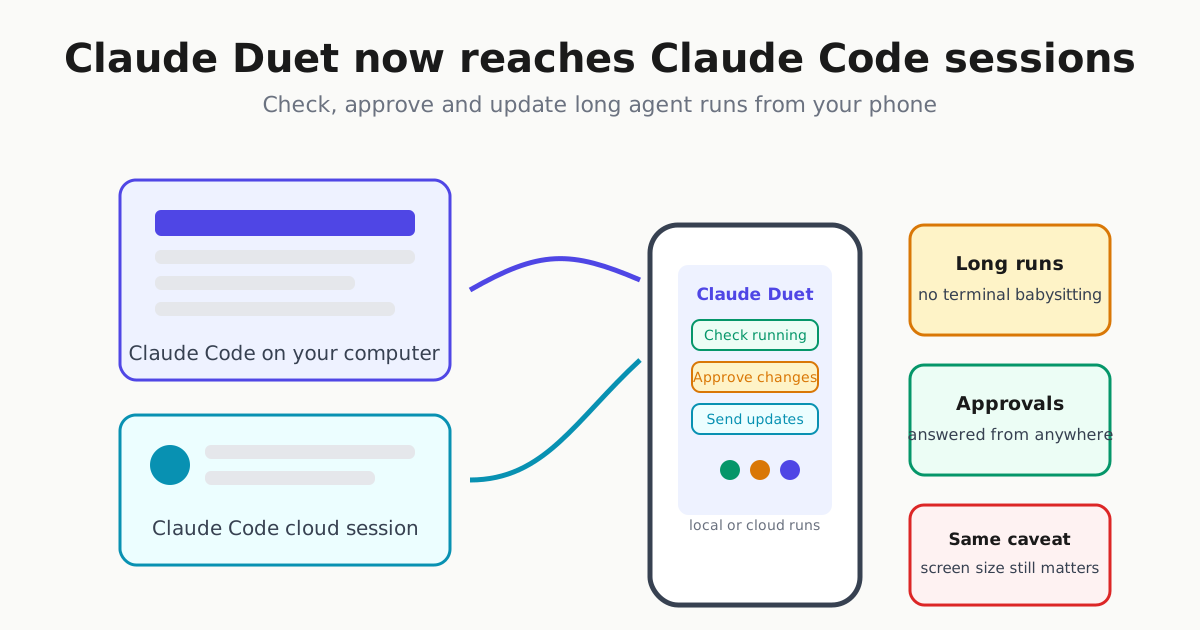
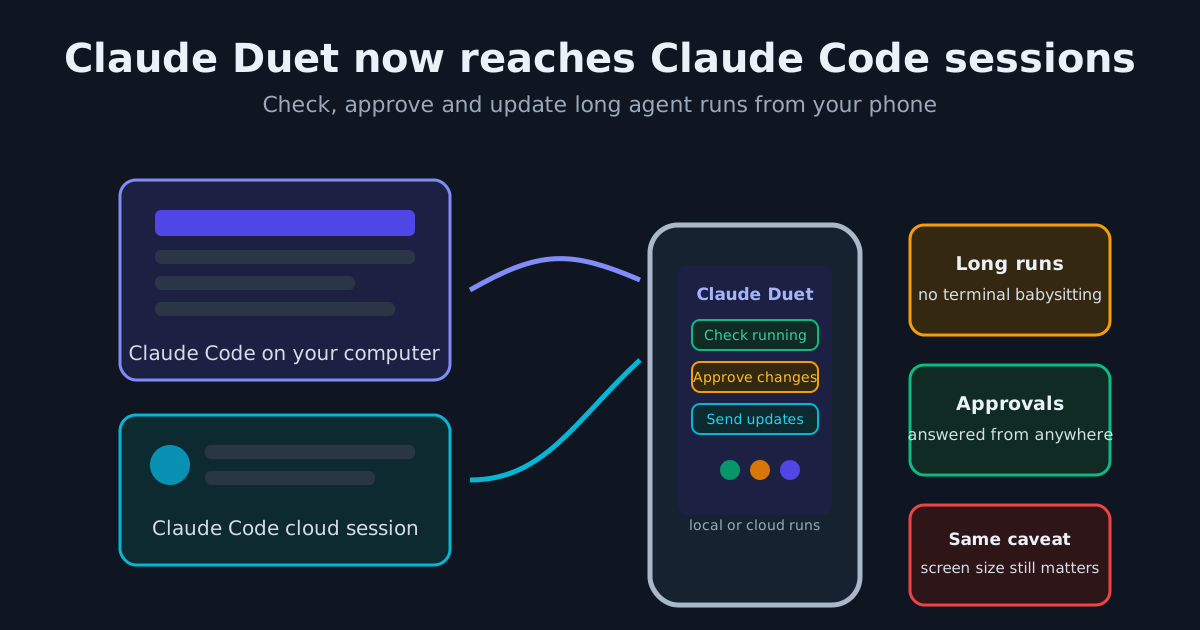
Anthropic has connected two pieces of its mobile agent story. On November 6, Anthropic engineer David Sutton announced that Claude Duet — the company’s phone-first companion agent — now works with Claude Code sessions. “Check what’s running, approve changes and send updates - all from your phone,” Sutton wrote, adding that it “works with sessions on your computer or in the cloud.”
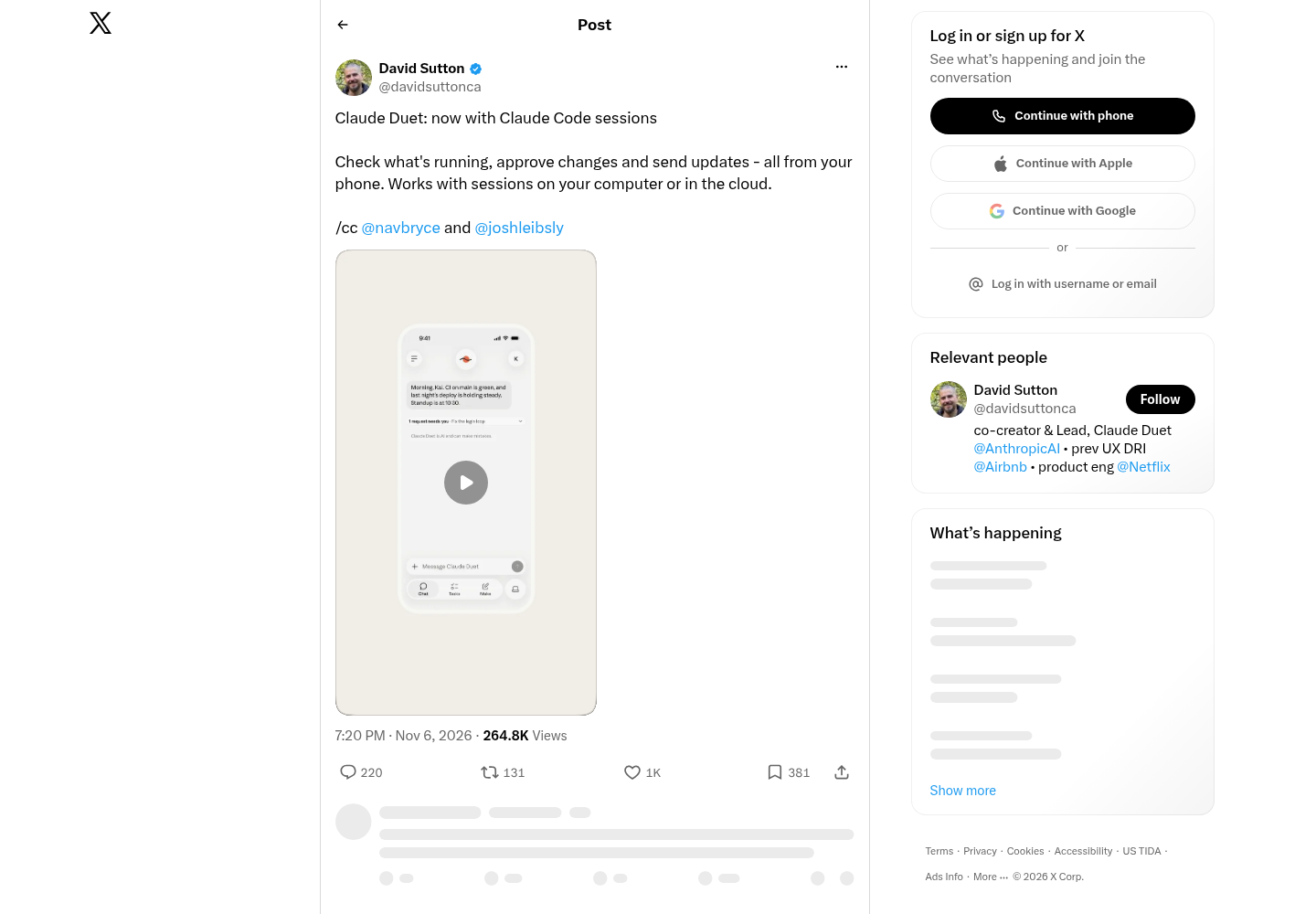
That one-line feature delta matters more than it looks, but not because mobile steering is new. Claude Code’s Remote Control has let you drive a local session from your phone since February, permission prompts included. What is new is the direction of the bridge: Claude Code sessions are now reachable through Duet itself, turning the general-purpose companion agent into a supervision surface for the harness many developers already run all day.
What actually shipped
The change, as stated in the announcement, is that Duet can now see and interact with Claude Code sessions in three ways:
| Action from the phone | What it covers | Where the session runs |
|---|---|---|
| Check what’s running | Live visibility into active sessions | Your computer or the cloud |
| Approve changes | Answer permission prompts remotely | Your computer or the cloud |
| Send updates | Steer or follow up mid-run | Your computer or the cloud |
The announcement does not specify version requirements, pricing tiers or rollout stages for the integration, so treat those as open questions until Anthropic publishes product documentation. What it does establish is the scope: both local sessions on your own machine and cloud sessions.
The mobile groundwork was already laid
This builds on surfaces Anthropic has been shipping all year. The official Claude Code documentation describes a surfaces model where “sessions aren’t tied to a single surface”: Remote Control lets you “step away from your desk and keep working from your phone or any browser,” Dispatch lets you “dispatch a task from your phone and open the Desktop session it creates,” and claude --cloud followed by the Claude mobile app moves a task from local to cloud. In the other direction, claude --teleport pulls a long-running web or mobile session back into your terminal.
Duet closes a different gap. Remote Control and Dispatch are surfaces of Claude Code itself — windows onto a session. Duet is a companion agent with its own briefs and its own attention model, and now a bridge into those sessions. The Verge, reporting on Duet’s October 21 launch as a research preview, described an agent built around Claude Opus 5.5 that sends a morning brief, watches connected apps during the day, “messages you only when something needs your attention,” and asks approval “before any big step, like sending a payment or deleting something.” Availability at launch was US Pro and Max subscribers, who joined through a waitlist.
The workflow the announcement points at is straightforward: kick off a long refactor or overnight test-fix loop, step away from the desk, then check Duet from your phone, answer an approval and send a follow-up instruction without reopening a laptop. One distinction matters here. The three actions are confirmed; whether Duet will also notify you unprompted when a Claude Code session needs an approval — the way The Verge describes it messaging you about other connected apps — is not stated in the announcement. Until Anthropic documents that, plan on checking in rather than counting on a push.
Why it matters: the always-on oversight race
Every vendor shipping long-running coding agents has the same problem: the agent works for hours, the human has a life. OpenAI’s Dots, Meta’s Muse and Anthropic’s Duet are all competing to be the reachable supervision layer — the thing in your pocket that notices the agent stalled, asks permission, or reports that the PR is ready. Claude Code sessions, with parallel subagents, scheduled tasks and cloud runs that “keep running even when your computer is off,” generate exactly the kind of long, interruptible work that needs a mobile front end.
The practical consequence for operators is a reduction in terminal babysitting. A session that would otherwise block on a permission prompt for six hours while you are in meetings can proceed because the approval can be answered from your phone. If you run Remote Control today, Duet becomes a second path to the same sessions; if you run cloud sessions — which as of the same week can configure their own environments and keep API keys out of the model — they gain a second mobile front end alongside the Claude app.
The caveats that survive the announcement
Two cautions are worth writing down before you route approvals through Duet.
First, Duet is still a research preview that Anthropic itself calls an “early version” that “still might misread a thread or miscalibrate what’s urgent.” A supervision layer that misjudges urgency is one that can wake you at 2 a.m. or stay quiet when it shouldn’t. The approval-flow promise is real, but so is the calibration risk.
Second, remote approval is a policy question, not just a convenience. A phone screen is a poor place to evaluate a large diff, and an approval tapped from a train is still an approval. Our earlier guidance on remote approval from small screens applies: decide in advance which classes of change you will approve from a phone and which wait for a desk. On data residency, keep the caveats separate: for Remote Control, Anthropic documents that the session transcript is stored on Anthropic servers while the connection is active — see runs locally is not stays local. For Duet, no supplied evidence says how Claude Code session data travels or is retained, so treat Duet’s transport and retention behavior as unverified until Anthropic documents it.
Neither caveat is a reason to ignore the change. They are the runbook around it: know which sessions Duet can see, set an approval threshold, and keep consequential reviews on a big screen.
The direction
The pattern across 2026 is that the phone is becoming a primary console for agent work rather than a read-only companion. Anthropic now has local control (Remote Control), cloud execution (cloud sessions), task dispatch from mobile, and — with this change — a companion agent that can reach Claude Code sessions from the same pocket-sized surface. The vendors that win the always-on oversight race will be the ones whose mobile surface developers actually trust with an approval. This week, Anthropic widened that surface.
Sources
- David Sutton on X: "Claude Duet: now with Claude Code sessions Check what's running, approve changes and send updates - all from your phone. Works with sessions on your computer or in the cloud. /cc @navbryce and @joshleibsly" / X
- Overview - Claude Code Docs
- Anthropic takes on Muse with Claude Duet, its new AI agent | The Verge