Qwen Code v0.28.0 Makes the Shared Agent Loop the Default and Ships Codex-Style Managed Worktrees
Qwen Code v0.28.0 makes the shared agent loop the default for headless sessions, the Ink TUI and subagents, turns Codex-style managed worktree sessions on by default, and adds native qwen4-max support. Here is what operators should check before upgrading unattended lanes.
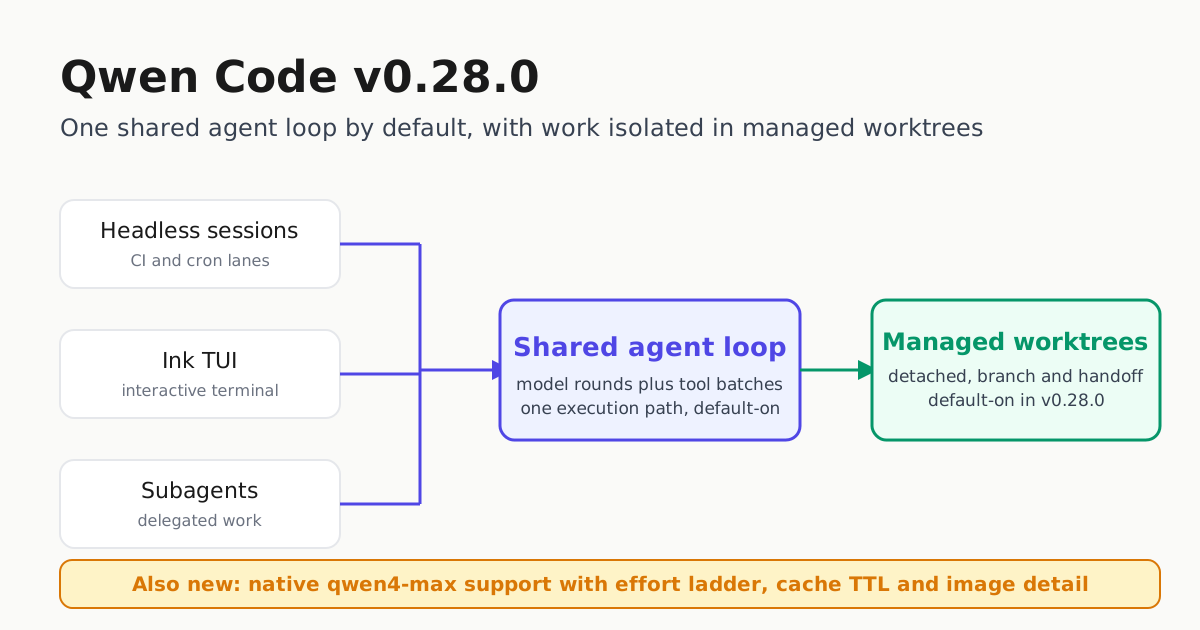
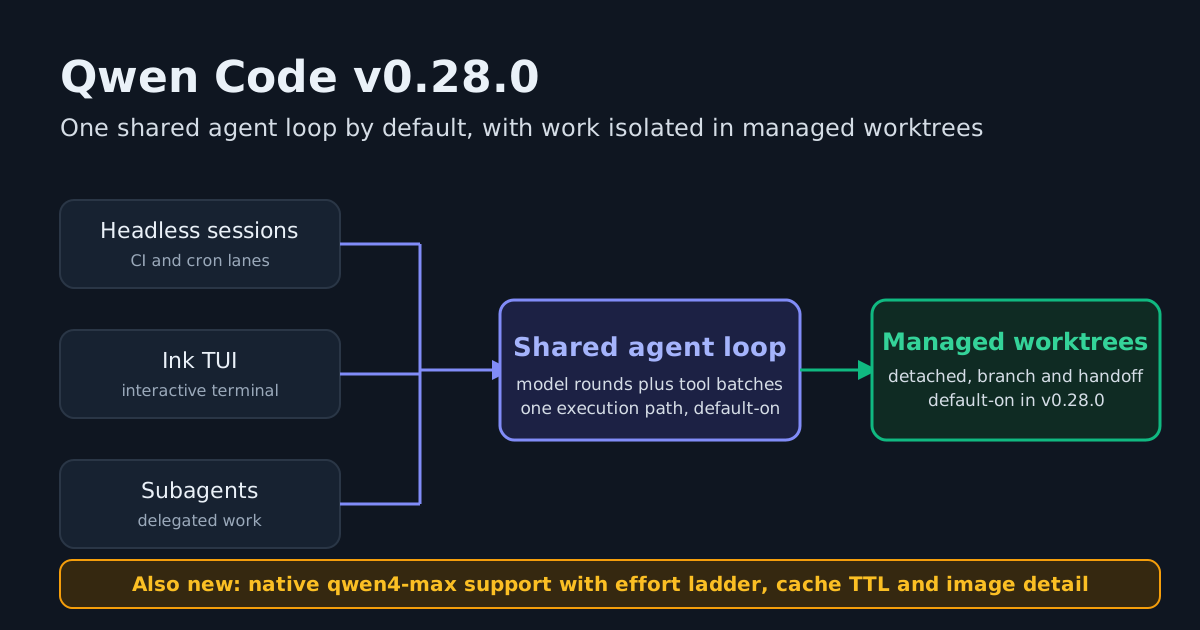
Qwen Code v0.28.0, released on GitHub on 17 November 2026, is a harness release aimed squarely at unattended operation. Three defaults change at once: headless sessions and the Ink TUI now run on the shared agent loop by default, subagents join that same loop by default, and Codex-style managed worktree sessions — detached, with branch creation and handoff — ship default-on. The release notes list “no known breaking changes,” but that undersells the operational shift. CI lanes, cron jobs and managed sessions that upgrade will quietly start executing on a different code path and isolating their work in worktrees unless an operator pins the old behavior.
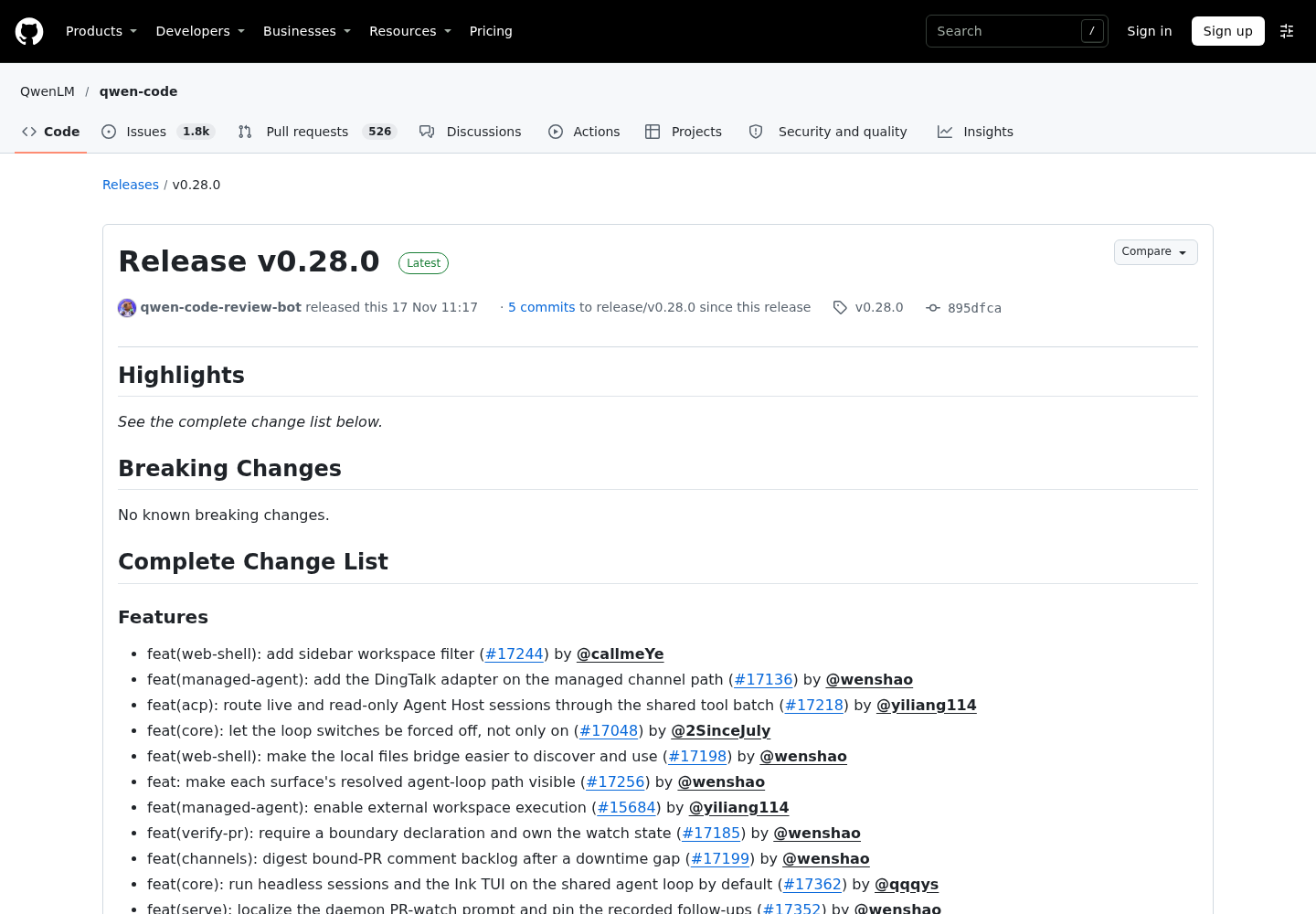
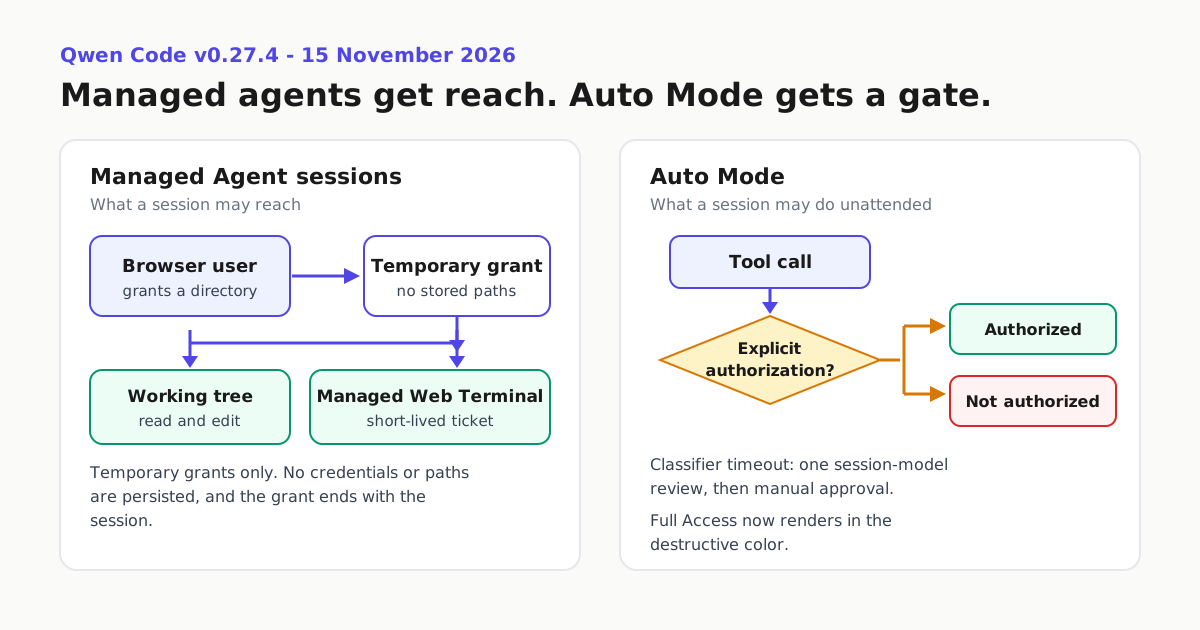
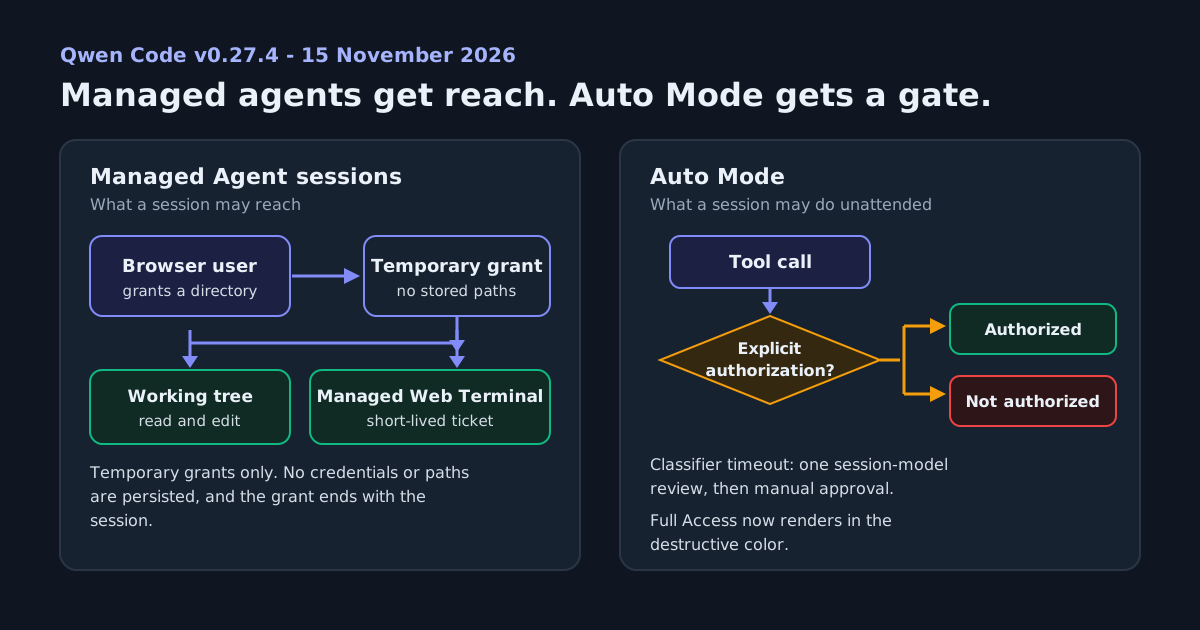
The release follows v0.27.4 by two days and now sits at the top of the Qwen Code releases page.
One loop for every surface
Until now, Qwen Code’s shared agent loop — the unified path that runs model rounds and tool batches together — was opt-in per surface, typically behind experimental.unifiedAgentLoop. v0.28.0 flips the default. Headless sessions (qwen -p, CI runners, cron lanes) and the interactive Ink TUI now resolve to the shared loop out of the box, and subagents do too.
Three companion changes matter for operators:
- The loop switches can now be forced off, not only on, so a lane that misbehaves on the shared path can be pinned back to the legacy loop with an environment override such as
headless,acp=0. - Each surface’s resolved agent-loop path is now visible, so you can confirm which loop a given lane actually runs instead of inferring it from settings.
- Cancelled tool results are now recorded correctly on the headless shared loop, and compaction retains the latest complete operation, so interrupted unattended runs lose less context.
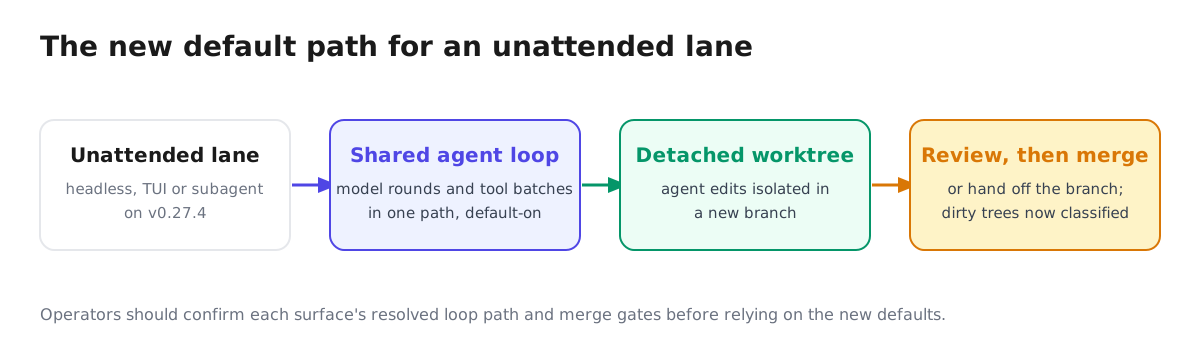
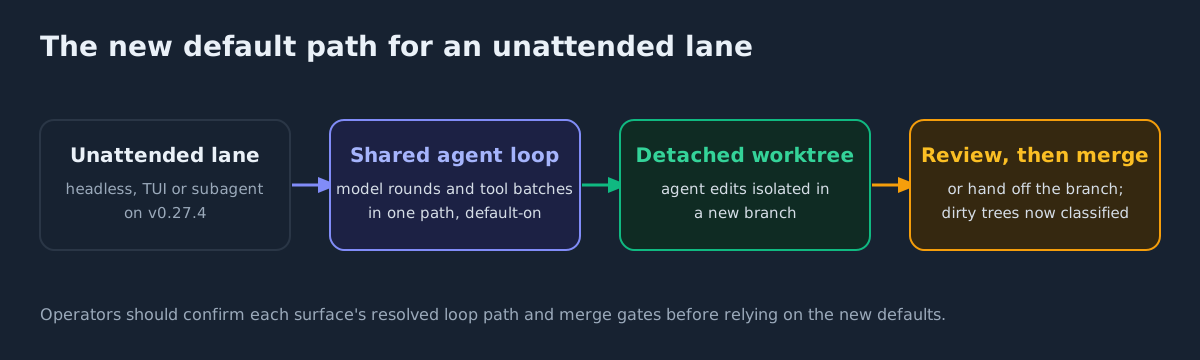
The practical consequence: one execution path to test, one place where loop behavior gets fixed, and far fewer “works in the TUI, hangs headless” divergences. The risk is the mirror image — any unattended lane that implicitly depended on a legacy loop quirk changes behavior the moment it upgrades, with no error to alert you.
Managed worktree sessions are on by default
The second default-on feature brings a Codex-style workflow to Qwen Code: managed worktree sessions that run detached, create a branch, and hand off the result. An agent working a managed session now isolates its edits in a worktree branch rather than touching the checkout directly, which makes review-and-merge the natural endpoint of every unattended run.
Around it, the serve layer gained the pieces that make branch-per-task fleets practical: create_sub_session can run a sub-session in another workspace and can follow up on a sub-session the caller created, and managed agents gained external workspace execution. The Web Shell also resolves dirty-tree checkout refusals in the branch picker and classifies directory-collision refusals after merges — the polish you want when branches are being created automatically.
First-class qwen4-max support
v0.28.0 adds native qwen4-max support with an effort ladder, cache TTL and image detail. That plugs Qwen Code into the model Alibaba announced on 16 November: a MoE architecture with native vision and a 1M-token context, priced at $1.50 per million input tokens and $4.50 per million output, with implicit caching at $0.075 per million — 70% below the previous generation. Alibaba’s internal evaluation claims Qwen4-Max beats Qwen3.8-Max with up to ~50% fewer tokens and a 60%+ lower average cost per task. If you run long-horizon agent lanes, the effort ladder plus cache TTL are the knobs that determine what that actually costs you; our Qwen4-Max pricing breakdown covers the token-plan angle.
Managed channels keep widening
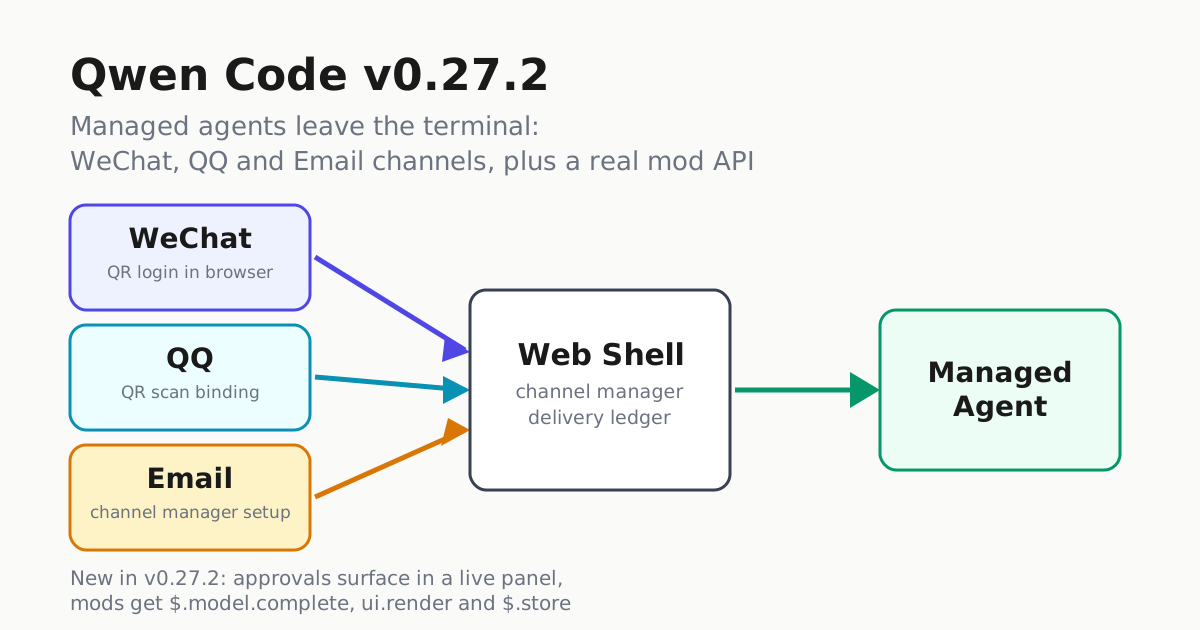
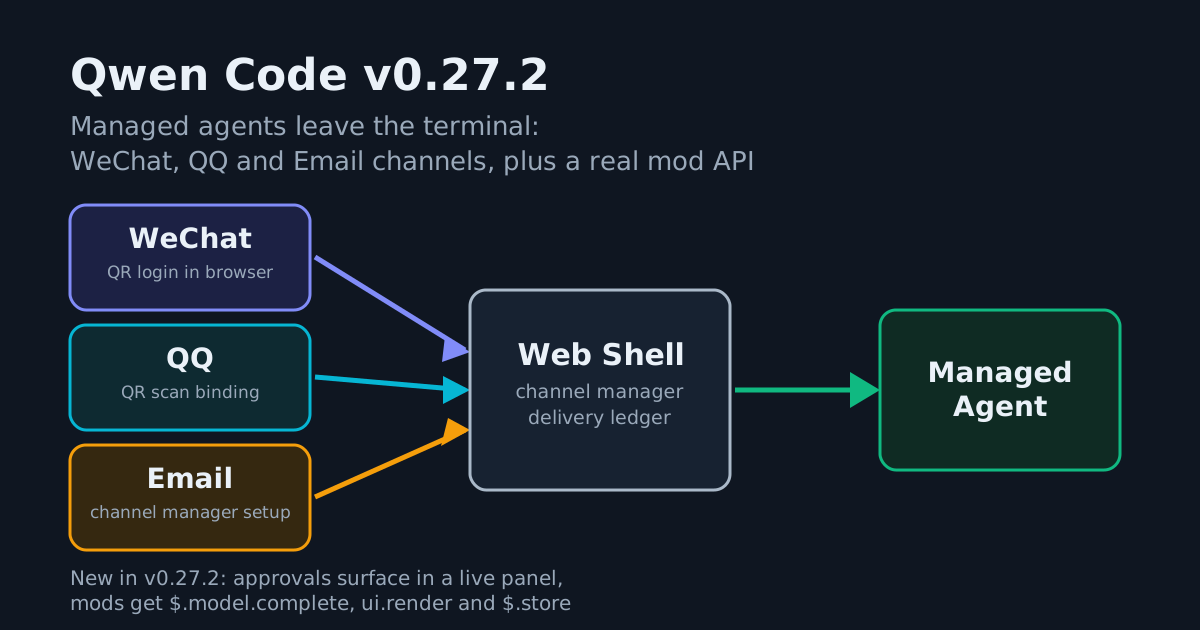
On the managed-channel path, v0.28.0 adds a DingTalk adapter and an Aone Code channel plugin with polling event-stream inbound, joining the existing Feishu, WeCom and email channels. The DingTalk line also picked up hardening in this cycle: refused webhooks are evicted with admission diagnostics, every managed persist is guarded by its side-effect position, reply chunks get individual send budgets, and the SDK heartbeat interval is retired on socket close. Teams driving managed agents from DingTalk or Aone Code can now treat those as first-class inbound surfaces rather than webhook afterthoughts.
Before you upgrade
Defaults this broad deserve a canary, not a blanket rollout:
- Identify your unattended lanes. Headless CI jobs,
qwen -pcron work, and managed sessions all change loop paths on upgrade. - Check the resolved loop path per surface using the new visibility feature before and after upgrading one lane.
- Pin back any lane that regresses. Because loop switches can now be forced off, a broken lane can stay on the legacy path while you file the issue.
- Watch for new branches. With worktree sessions default-on, expect managed sessions to create branches; make sure your merge gates and the branch picker’s dirty-tree handling match how your team reviews agent output.
- Review qwen4-max economics if you switch models: run one representative task at your usual effort tier and compare cost per completed task, not per token.
Qwen Code remains an open-source, terminal-first agentic coding tool from Alibaba’s Qwen team, and this release continues its pattern of shipping managed-agent infrastructure ahead of most terminal harnesses. The direction is clear: one loop across every surface, and branches to contain the work. Our CLI upgrade canary guide has the drift-catching checklist for exactly this kind of default change.
Sources
- Release Release v0.28.0 · QwenLM/qwen-code · GitHub
- Releases · QwenLM/qwen-code · GitHub
- Qwen Code overview | Qwen Code Docs
- Qwen on X: "📢 Meet Qwen4-Max, your new AI teammate for work, creativity, and discovery! Qwen4-Max is built on a new MoE architecture with native vision and a 1M-token context window. Highlights: - Outperforms Qwen3.8-Max with up to ~50% fewer tokens, while average cost per task drops over 60% in…