Mistral Launches Voxtral 3: A Voice Agent SDK With Tool Calling, EU Hosting and Sub-Second Turns
Mistral ships Voxtral 3: a voice agent SDK combining transcription, TTS, and tool calling in one streaming pipeline, available EU-hosted or self-deployed.
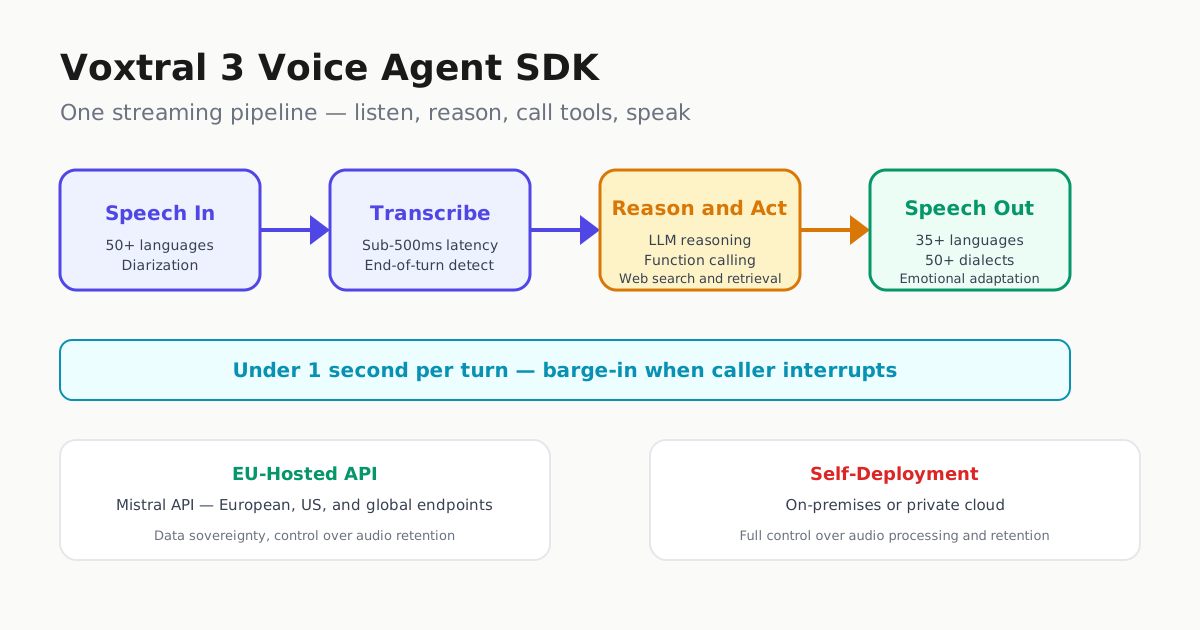
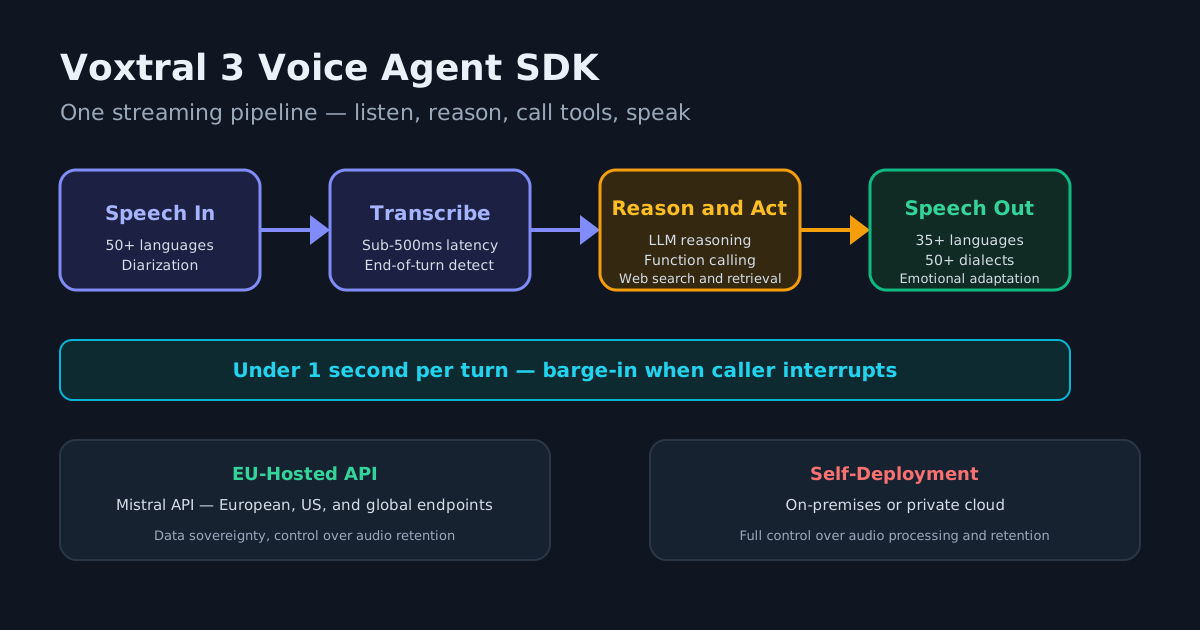
Mistral launched Voxtral 3 on October 20, a family of speech-to-text and text-to-speech models paired with a voice agent SDK that combines listening, reasoning, tool calling and speaking into a single real-time streaming pipeline. The stack runs on Mistral’s EU-hosted API or on your own infrastructure, with sub-second turn times, barge-in support, and coverage across 50-plus languages for transcription and 35-plus for speech. The launch sits near the top of Mistral’s news feed alongside the recent Timestral models and the Mistral Large 4 announcement.
What ships
Voxtral 3 includes four models and a voice agent runtime built on LiveKit:
- Voxtral Small Transcribe 3 — the highest-accuracy transcription model, supporting 50-plus languages with speaker diarization and context biasing for domain-specific vocabulary. Priced at $0.004 per minute.
- Voxtral Mini Transcribe 3 — a 4B-parameter efficient variant at $0.0035 per minute for batch workloads.
- Voxtral Mini Transcribe Realtime 3 — built for agentic use cases, delivering transcription at sub-500ms latency across 40-plus languages at $0.008 per minute. It includes native end-of-turn detection that combines acoustic and semantic signals to determine when a caller has finished speaking, minimizing false cut-offs.
- Voxtral Speech 3 — a text-to-speech model covering 35-plus languages and 50-plus dialects, with emotional adaptation, instruction following, and pronunciation control. Priced at $13 per 1 million characters for both batch and realtime.
The voice agent SDK connects these stages into one streaming pipeline. A caller speaks, Voxtral Transcribe Realtime 3 converts it to text and detects turn boundaries, a general-purpose LLM reasons and calls tools, and Voxtral Speech 3 replies — all without any stage waiting for the previous one to finish. Mistral says each turn completes in under one second, and the agent stops talking when the caller cuts in.
Tool calling during a call
The SDK supports function calling, web search, and retrieval over your own systems during live conversations. In the example Mistral provides, a patient gives an agent a referral number, the agent calls a get_referral function to retrieve a doctor’s letter in French, translates it for the caller, then calls book_appointment to reserve a slot — all inside a single phone call. The agent connects over SIP for telephony and WebRTC for browsers and apps, integrating with existing IVR and contact-center software.
Each stage in the pipeline is a separate model. You can swap the LLM, change the voice, or switch languages without rewriting the agent. The voice agent API costs $0.04 per minute when using Mistral Small 4 for reasoning, or $0.08 per minute with any other reasoning model.
| Model | Price |
|---|---|
| Voxtral Mini Transcribe 3 (batch) | $0.0035/min |
| Voxtral Small Transcribe 3 | $0.0040/min |
| Voxtral Mini Transcribe Realtime 3 | $0.008/min |
| Voxtral Speech 3 (batch and realtime) | $13/1M chars |
| Voice agent API with Mistral Small 4 | $0.04/min |
| Voice agent API with any other model | $0.08/min |
Benchmarks and positioning
Mistral claims Voxtral Small Transcribe 3 achieves state-of-the-art results on multilingual transcription and diarization. On the FLEURS 45-language benchmark, it records a 4.1 percent forced word error rate, outperforming Whisper large-v3 (16.0 percent), Gemini 3.5 Transcribe (6.1 percent), and Scribe v2 (4.9 percent). On public diarization benchmarks, it scores an 18.4 percent concatenated minimum permutation WER, ahead of dedicated diarization systems including Pyannote Orchestrator (19.0 percent).
For text-to-speech, Mistral’s chart on Voice Code Bench — a third-party benchmark by BeSimple AI focused on enterprise customer-support failure states involving numbers and unique names — shows Voxtral Speech 3 with a leading quality-per-dollar position, costing less than ElevenLabs Flash, OpenAI TTS-1, Deepgram, and Gemini Flash. Voice presets ship in 18 languages covering diverse dialects including Emirati Arabic, Brazilian Portuguese, and both American and British English.
Pro Voice, a premium feature, reproduces a speaker’s distinctive character, emotional range, and style across languages using just 30 minutes of audio, targeting professional use cases where basic voice cloning is insufficient.
Why it matters for agent builders
Voxtral 3 gives teams building voice agents a stack that runs end-to-end in Europe or on their own hardware — a concrete alternative to ElevenLabs Realtime and OpenAI Realtime. The SDK architecture — separate swappable models for transcription, reasoning, and speech — means builders are not locked into one model provider for the whole pipeline. The barge-in and end-of-turn detection address two persistent pain points in voice agent design: awkward pauses and agents that keep talking after the human interrupts.
For Automater readers experimenting with voice-driven development workflows, the tool-calling capability is the most consequential piece. An agent that can query APIs, search the web, and write to business systems during a call moves voice from a speech-to-text-and-back novelty into a channel where real work gets done — booking appointments, checking records, retrieving documents — without a screen.
Mistral announced Voxtral 3 on X the same day. The models and SDK are available now through Mistral’s API and Studio playgrounds, with self-deployment available by contacting Mistral’s team.