
Deno Joins Cloudflare: Runtime Support Ends After a Year, Deploy Shuts Down After Six Months
The Deno team is moving to Cloudflare to improve self-hosted Workers and Durable Objects. Existing runtime and hosting users face separate support deadlines while the combined platform remains a development plan.
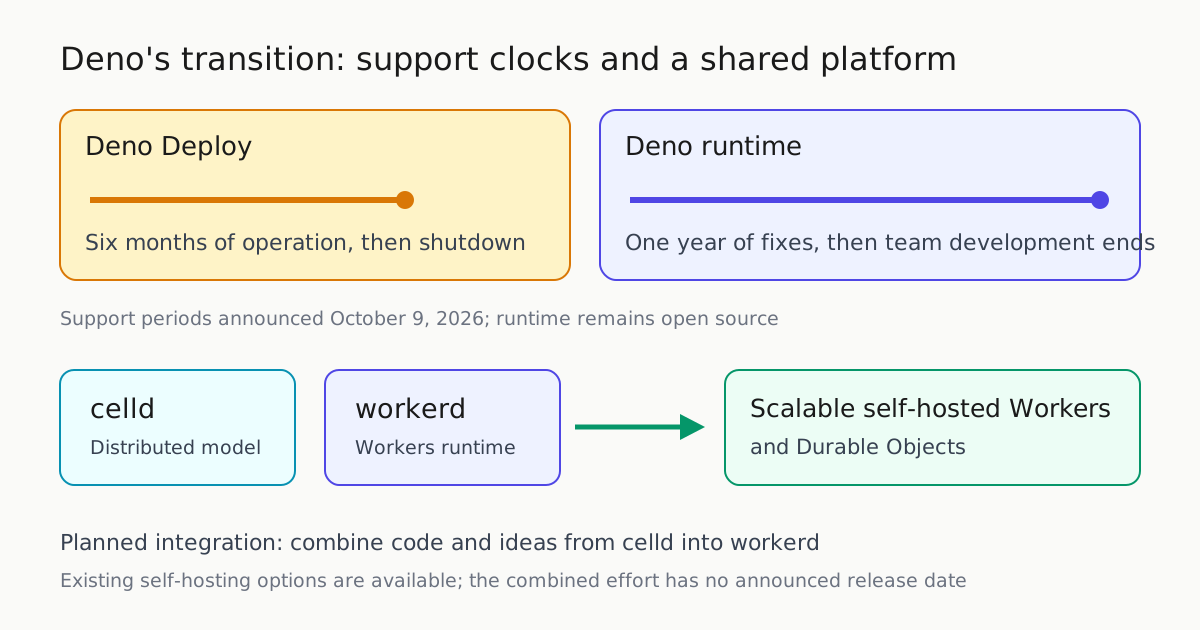
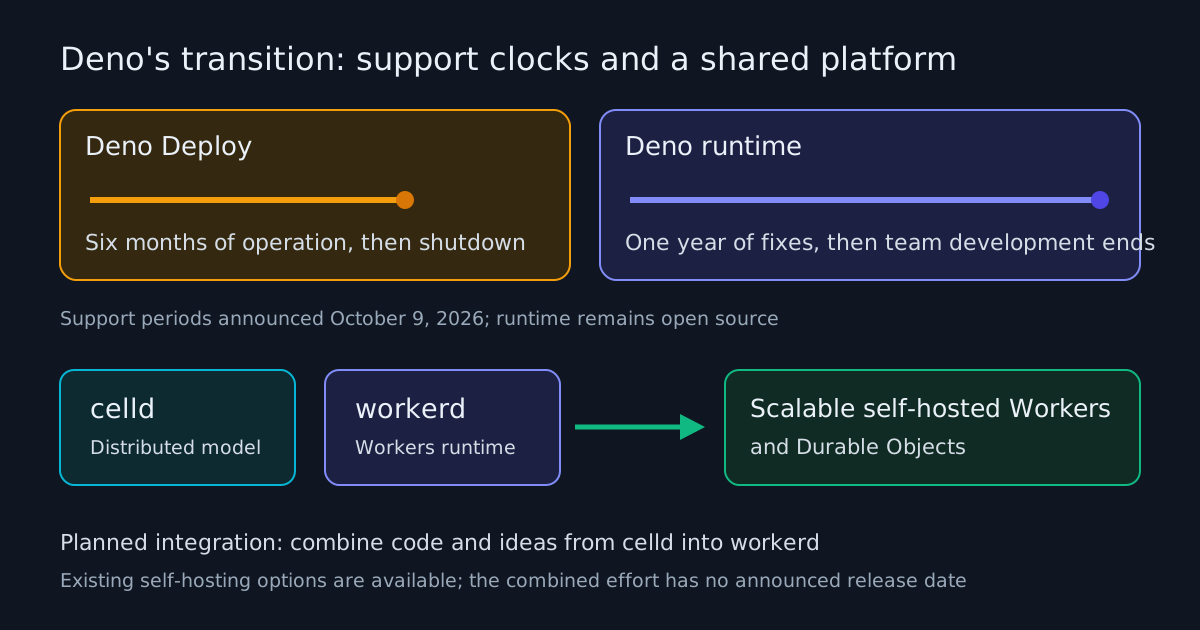
The Deno team is joining Cloudflare and redirecting its development effort toward self-hosted Workers and Durable Objects, leaving existing Deno users with two different transition clocks. In its October 9 announcement, Deno says the runtime will receive another year of monthly bug fixes and security updates before the team ends its development. Deno Deploy will keep operating for six months before shutting down.
Simon Willison’s October 9 report describes the move as Cloudflare acquiring Deno outright. The companies’ announcements focus on the team joining Cloudflare and its future development priorities.
The move matters to AI infrastructure because Deno explicitly identifies agent harnesses as a target for the work. But the immediate, concrete commitments concern support and migration. A combined, fully supported self-hosting platform is the announced direction; the sources do not establish that it has already shipped.
Two deadlines, different consequences
Deno’s runtime and hosted service should be treated separately. Ending the team’s runtime development does not mean existing binaries suddenly stop executing. Deno will remain open source, and the announcement welcomes others who want to continue development. That invitation is not a commitment that a successor maintainer will provide security updates after the announced year.
Deploy’s deadline is more direct: the service will shut down after six months. Deno promises migration support for paying customers moving to Cloudflare Workers. It does not describe that support as a universal migration service, nor does the announcement provide a detailed compatibility checklist or an exact shutdown timestamp.
| Component | Announced commitment | Practical implication |
|---|---|---|
| Deno runtime | Another year of monthly bug fixes and security updates, followed by the team ending development | Plan for future maintenance or replacement of the runtime dependency |
| Deno Deploy | Six more months of operation, then shutdown | Hosted applications need a migration plan |
| JSR | Continues operating; infrastructure moves to Cloudflare | The registry is not included in the announced shutdown |
| rusty_v8 | Continued support and work toward integration into workerd | Support continues, while integration remains future work |
These periods are stated relative to the announcement. Teams should obtain specific operational dates and support arrangements rather than treating an inferred calendar anniversary as a contractual cutoff.
Willison’s report also highlights the runtime support limit and the self-hosting goal. He points to Deno’s permissions system as a valuable feature. For teams using Deno to constrain agent tools, that is a reminder to inventory the behavior they depend on before choosing a replacement. Runtime compatibility alone does not establish equivalent security controls.
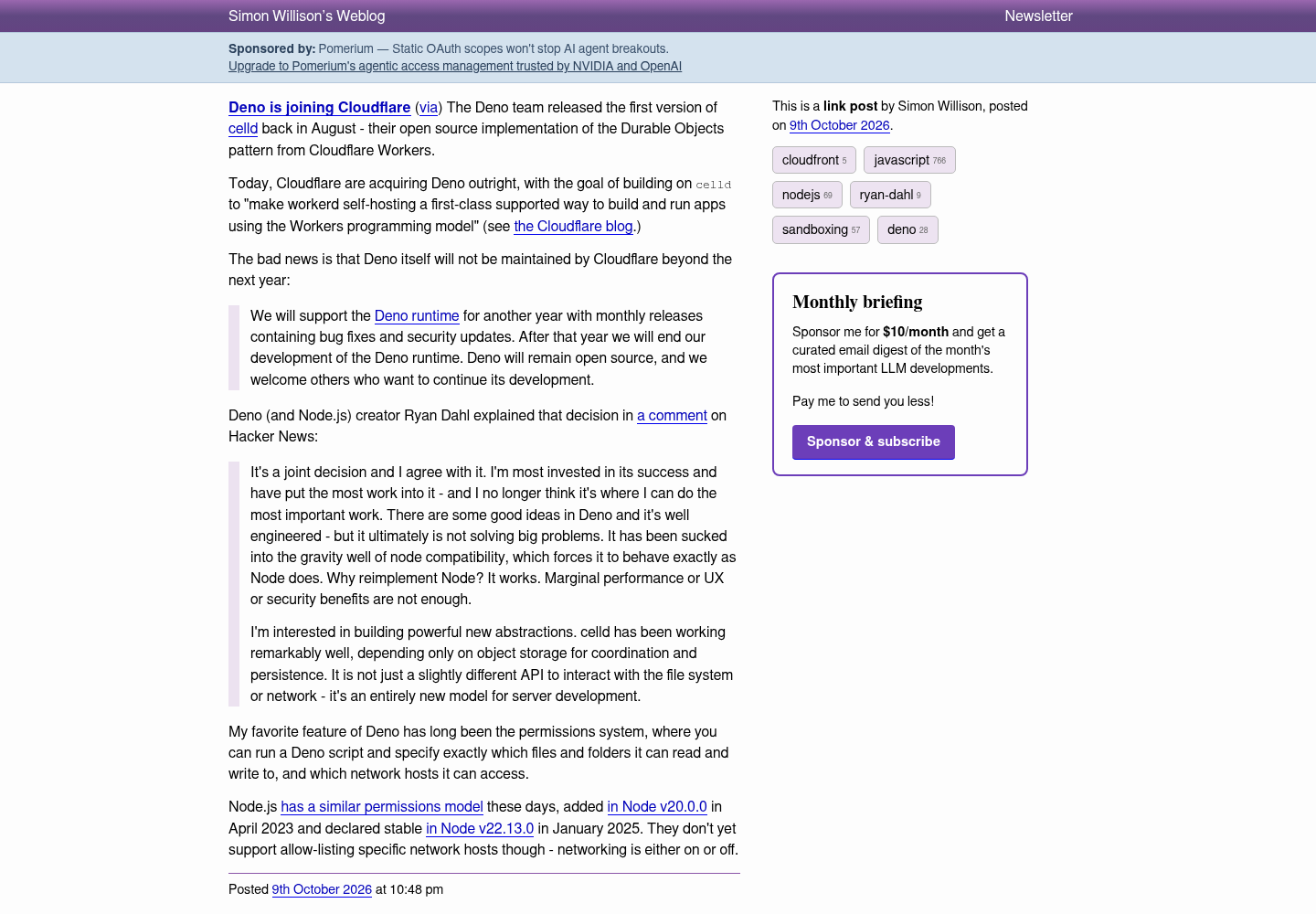
Source: Simon Willison’s Weblog, “Deno is joining Cloudflare,” October 9, 2026.
What Cloudflare wants to build
The joint Cloudflare post explains the technical motivation. Cloudflare’s open-source Workers runtime, workerd, already exists, but its Durable Objects implementation is limited to a single instance. Kenton Varda describes that limitation as a gap in its production readiness for scalable self-hosting.
Deno’s celld addresses the distributed version of that problem. Ryan Dahl describes a Rust binary with object storage as its only external service dependency, designed to handle applications distributed across machines. The proposed work brings code and ideas from celld into workerd, with Dahl and Bert Belder leading an effort to make self-hosting a first-class supported option.
The central abstraction is a Durable Object: an individually addressable unit of JavaScript execution with its own database and support for WebSockets. In the companies’ chat example, assigning an object to each channel makes partitioning state and connections part of the application design. Placement, routing and durable storage then become platform responsibilities rather than infrastructure each application assembles independently.
Cloudflare says developers can self-host celld or workerd today and promises more announcements in the coming months. Those existing options should not be confused with completion of the proposed integration. The post supplies no release date, benchmark or service guarantee for the combined effort.
Why agent builders should pay attention
Dahl’s Deno announcement explicitly connects Durable Objects to agent harnesses through persistent state, serverless execution, WebSockets and a high-level JavaScript interface. The potential benefit is a simpler foundation for coordinating ongoing agent work across machines. That remains an architectural proposition, not evidence of measured agent performance or lower operating costs.
For existing users, the useful response is concrete: identify services running on Deploy, separate those hosting dependencies from runtime dependencies, and test migration candidates against actual application behavior. Agent tools deserve particular attention to permissions, network access, persistence and recovery after interruption.
This also fits the portability question examined in our agent harness portability guide: ownership of the application loop depends on more than access to source code. Operators still need a maintained runtime, deployable services and a tested way to move state. Cloudflare’s announcement offers a direction for improving that foundation. Deno’s support deadlines make evaluating it an immediate planning task.