
Google Deep Review Goes Public: Two Free Agentic Document Reviews a Week, a Gemini-Keyed API and an Antigravity Pattern
Google Research opened Deep Review, its multi-agent document verification system piloted on 16,000+ conference manuscripts, to everyone. Two free reviews a week, PDF and text input, no training on uploads, one-year storage, and a Gemini API path for CI pipelines.
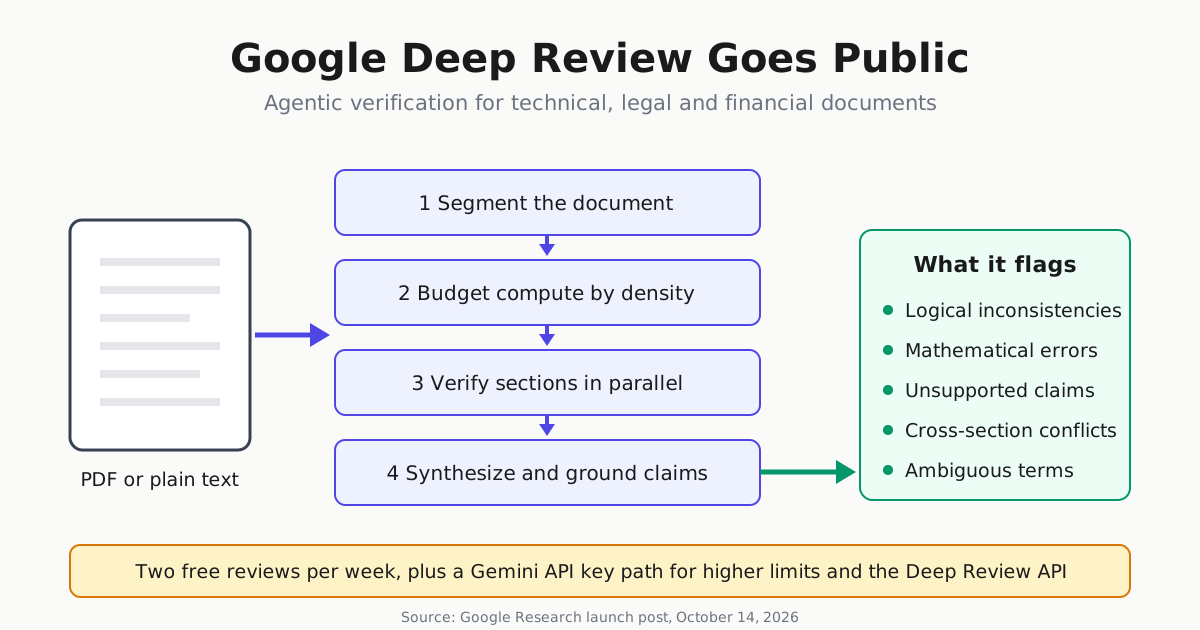
Google Research has opened Deep Review to the public: an agentic system that reads a complex document and returns grounded checks of its logic, mathematics and claims. Announced October 14, 2026 alongside the Research@ 2026 overview, the release frames the tool as an answer to what Google calls the validation bottleneck — generative AI accelerates drafting far faster than human capacity to verify the output. The overview says the expansion is meant “to help people verify a variety of technical documents from legal agreements to financial reports.”
The practical headline for readers: every user gets two free document reviews per week, high-volume users can connect a Gemini API key for higher limits, and a programmatic Deep Review API targets continuous integration and drafting workflows.
Piloted on 16,000+ conference manuscripts
Deep Review is the evolution of Google’s Paper Assistant Tool (PAT), an opt-in experiment that gave authors private, pre-submission feedback through partnerships with STOC 2026, ICML 2026, NeurIPS 2026 and ICLR 2027. The launch post says more than 16,000 manuscripts received feedback, that the analysis was completely decoupled from official conference review, and that PAT collected no training data and deleted papers promptly after each program. Those figures are company-reported deployment counts: they establish the scale of the pilots, not independently measured review accuracy. The pressure statistic behind the pitch: submissions to ICLR, NeurIPS and ICML topped 74,000 this year, up from roughly 45,000 in 2025. Google also credits added Gemini 4 Argon support with lifting the tool’s capabilities beyond earlier PAT iterations — relevant given Argon’s rollout across Google’s API, Cloud and Antigravity.
A four-stage pipeline instead of one big prompt
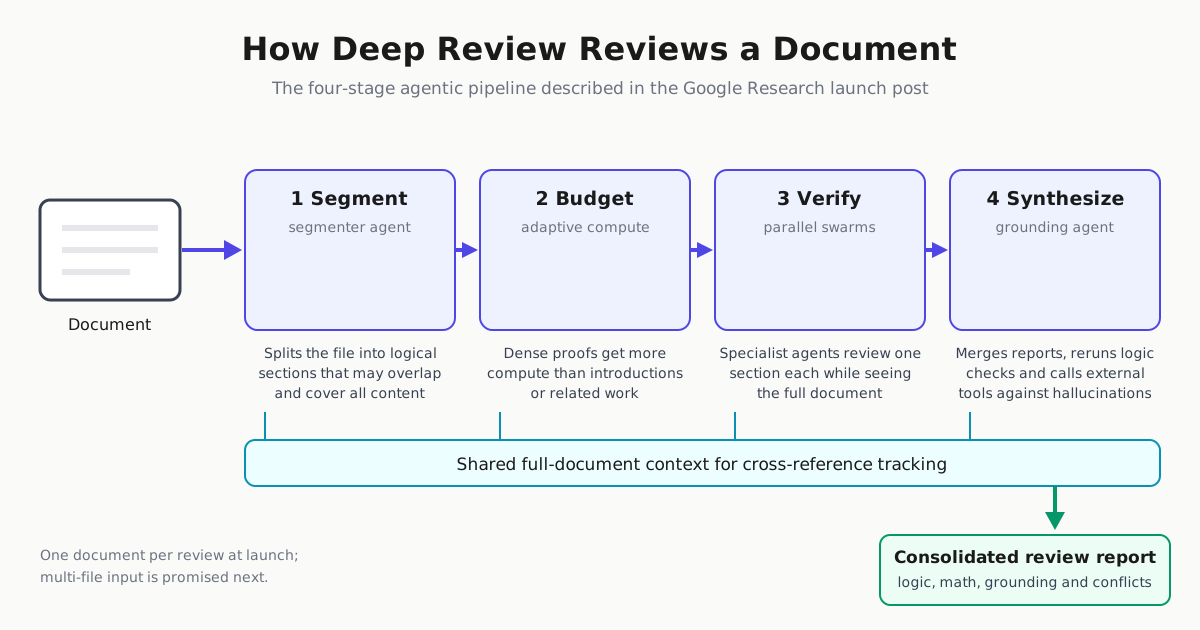
Google argues single-prompt LLM calls fail on long documents because they exhaust their reasoning budget, miss cross-section dependencies, or accept nuanced claims without scrutiny. Deep Review splits the work into four stages: a segmenter agent decomposes the document into logical, possibly overlapping sections covering all content; the pipeline allocates compute by information density, so dense proofs get more budget than introductions; specialized agents review sections in parallel while retaining full-document context for cross-references; and a synthesis agent consolidates reports, reruns logical checks and performs external grounding and tool calls against hallucinations.
What you get at launch
| Item | Detail at launch |
|---|---|
| Free tier | Two complimentary document reviews per week, worldwide |
| Higher limits | Connect your own Gemini API key |
| Programmatic access | Deep Review API for CI and drafting workflows |
| Input formats | PDF and plain text; multi-file input “coming soon” |
| Scope | One document per review for now |
| Domains | Research papers, design documents, presentations, legal and financial documents |
On privacy, the launch post is explicit: uploaded documents are never used to train, fine-tune or improve Google models, and are stored for one year solely to display them back to the user in the Deep Review UI. Superpower Daily’s coverage correctly stresses the second half of that sentence — no training does not mean no storage, and a year of retention on legal or financial uploads is a policy question teams should weigh before pointing the tool at client material.
Beyond papers: contracts, decks and design docs
Google’s stated use cases extend well past academia: design documents (surface unstated architectural assumptions and edge cases), presentations (check that transitions flow and bullet takeaways match the charts), and legal and financial documents (check consistency across clauses and data tables, flag ambiguous terms, ground claims against supporting evidence). The one-document-at-a-time limit matters here: a contract reviewed alongside its exhibits, or a proposal against its spreadsheets, is exactly the multi-file case Google says is still ahead.
The Antigravity angle for agent builders
Google is also shipping a Teamwork Deep Document Review Pattern inside Antigravity, built on its Teamwork multi-agent orchestration framework: a document-review implementation pattern inspired by Deep Review, with a multi-agent hierarchy, self-correction and segment-based rubrics, invocable with the /teamwork-preview command. For teams already running Google’s agentic stack — see our field note on the Antigravity era of Google’s agentic coding — that means a Deep Review-inspired review pattern can be invoked inside the IDE. It is an implementation pattern built on Teamwork orchestration, not the hosted Deep Review service itself, so treat its output as a complement to the portal rather than an equivalent of it.
How to use it, and what not to expect
Concrete moves readers can make this week:
- Stress-test before you submit or send. Run a manuscript, design doc or proposal through a free review before human reviewers see it; the pilots were built for exactly this pre-deadline window.
- Consistency-check dense documents. For contracts and financial reports, treat the output as a list of internal inconsistencies and ungrounded claims to verify, not a verdict.
- Budget the API path. The free tier covers casual use; recurring CI or drafting-pipeline checks ride on your Gemini API key. The launch post confirms the key unlocks higher usage limits and programmatic integration, but it publishes no Deep Review pricing or billing rates, so treat cost as unspecified and confirm it against your Gemini billing terms before committing pipelines.
- Gate uploads by sensitivity. One-year storage for UI display, even without training use, may rule out the most sensitive documents until your policy catches up.
Google and independent coverage both stress the limits: the process surfaces issues but does not guarantee errors are caught, and higher-level judgments stay with people. Used that way — as a systematic pre-pass that spends compute on the cognitively burdensome parts of review — Deep Review is one of the more consequential agentic releases of the week.
Sources: Google Research: Analyzing technical documents with Deep Review · Google Research: Research@ 2026, 10 ways we’re amplifying human ingenuity · Superpower Daily: Google opens Deep Review to the public with two free document checks a week