
Google Ships Gemini 4 Argon Across API, Cloud and Antigravity, With Pricing That Doubles Nov 30
Google's frontier model is live today: paid API lanes get gemini-4-argon, Antigravity stays Ultra-only, the Gemini app needs Pro, and the $2/$10 intro rate per million tokens doubles on November 30, 2026.
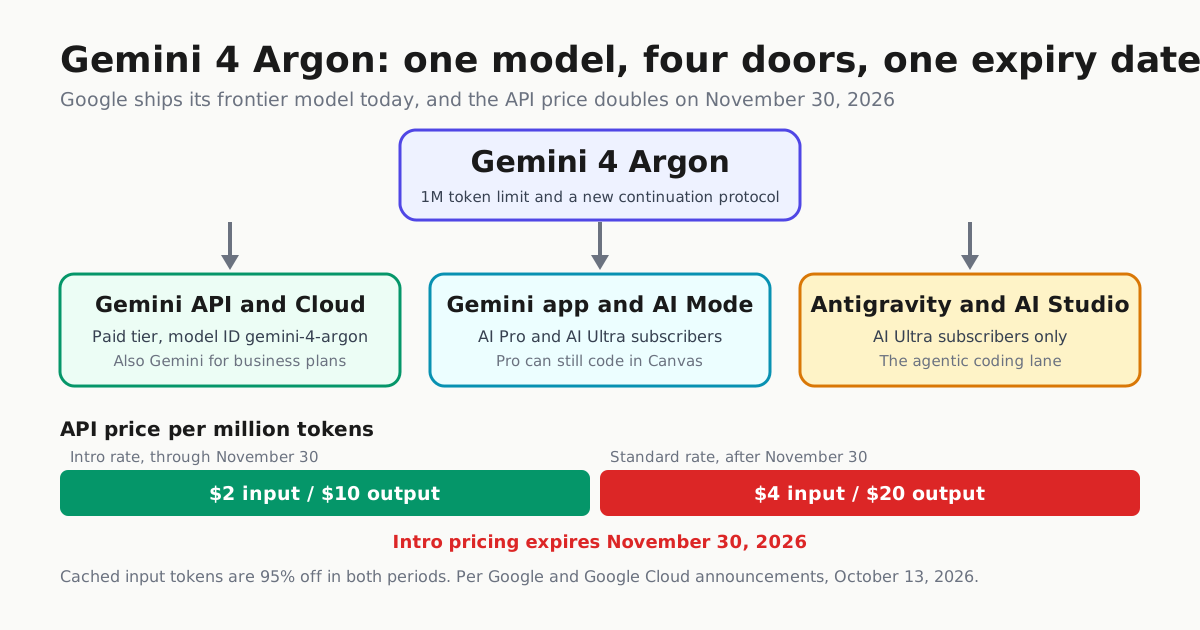
Google released Gemini 4 Argon globally today, and the rollout touches every lane an AI-tooling operator cares about: a paid API tier with a new model ID, enterprise availability on Google Cloud, and an Ultra-only gate around Antigravity, the company’s agentic coding surface.
The official announcement places Argon with developers and enterprises via the API in AI Studio and the Gemini platform, with Google AI Ultra subscribers in Antigravity, and with AI Ultra and Pro subscribers in the Gemini app and AI Mode in Search. Google Cloud’s companion post confirms the same day-one surfaces for enterprises: Gemini for business on the web, desktop and mobile, the API under model ID gemini-4-argon, AI Studio, and Antigravity.
Who actually gets it today
The gating is stricter than “available for everyone” suggests. Ars Technica reports that the Gemini app requires AI Pro ($20 per month) or AI Ultra (starting at $99 per month), and that Antigravity and AI Studio are Ultra-only for now. Pro subscribers can still generate code in the Gemini app’s Canvas mode, but the multi-threaded agentic workflows are locked behind Ultra. Google has not said when, or whether, Plus or free users get access, and it is keeping Gemini 3.1 Pro around in the meantime.
| Surface | Who gets Argon today |
|---|---|
| Gemini API paid tier | All paying developers, model ID gemini-4-argon |
| Google Cloud and Gemini for business | Enterprise plans on web, desktop and mobile |
| Antigravity and AI Studio | AI Ultra subscribers only |
| Gemini app and AI Mode in Search | AI Pro and AI Ultra subscribers |
| Plus and free tiers | No date announced |
The price card has two numbers
Argon launches at an introductory $2 per million input tokens and $10 per million output tokens, with cached input tokens at 95% off. On November 30, 2026, that becomes $4 and $20. The Verge puts the introductory rate at roughly a fifth of the per-token cost of OpenAI’s GPT-6 Astra and Anthropic’s Fable 5, and notes it stays cheaper than those rivals even after doubling — but also cautions that per-token comparisons mislead, because models spend different numbers of tokens on the same task.
That caution is why the practical move is to budget the standard rate and treat the intro rate as a discount. Price any workflow you build against Argon in the next seven weeks at $4/$20, not $2/$10.
What changes for coding agents
Google pitches Argon as a long-horizon worker: a 1M unified input-output token limit through the Gemini API, plus a new continuation protocol the company tells developers to read up on before wiring long runs. The developers blog also documents day-one support across the google-genai SDKs in the Interactions API, and Google Cloud says its code-optimization and discovery agent AlphaEvolve now runs on Argon.
The evidence Google offers for agentic coding is its own internal use. The company reports more than 35% higher agentic code submissions in Antigravity with code rollbacks cut by nearly a third, an architectural refactor across hundreds of files in Chromium’s 40 million-line codebase that turned months of work into weeks, and overnight autonomous optimizations to the open-source Agent Development Kit — now live in google/adk-python — that cut in-memory session prep time by 40% and sped up cold imports by 21%.
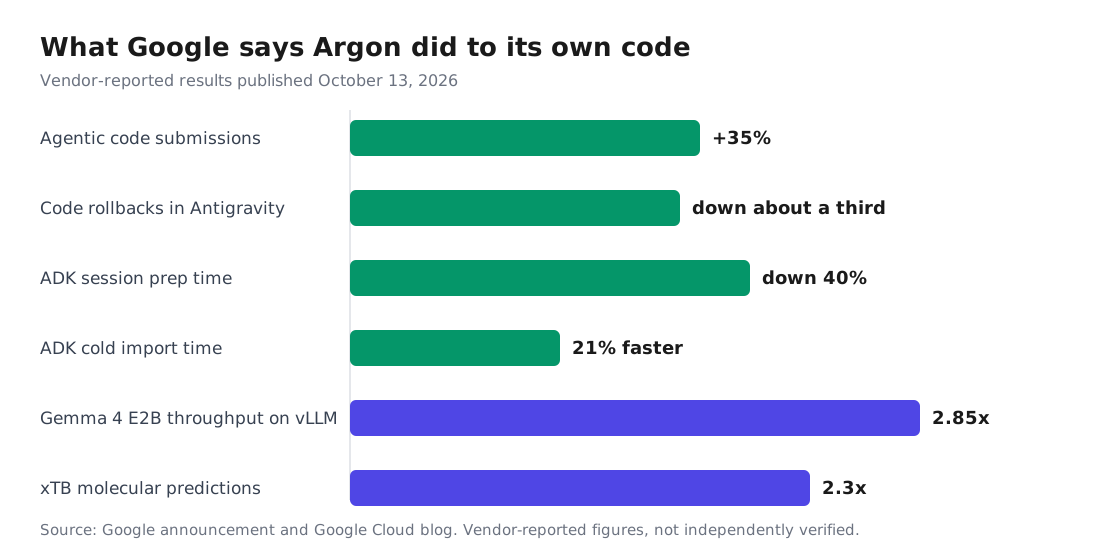
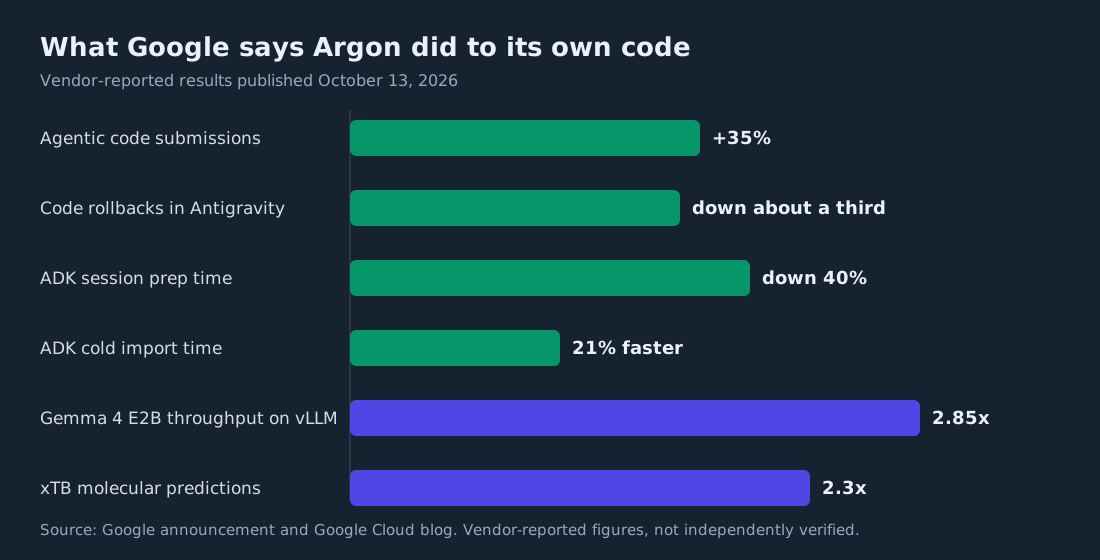
Those are vendor numbers, gathered by the vendor, on the vendor’s own codebases. The pattern they describe — a model that holds context across hundreds of files and reduces the rollback rate — is exactly the capability profile agentic harnesses need, but treat the magnitudes as claims until independent benchmarks land.
Security posture is part of the product
Two numbers matter for anyone pointing Argon at untrusted input. Google says it leads the Gray Swan Indirect Prompt Injection benchmark with a 0.7% attack success rate across 15 adaptive attempts, and ties for first on CWE-Bench v1 at 68% for remediating security vulnerabilities. The model still blocks offensive cyber tasks: defensive work is routed through CodeMender or your own security harness, while vetted defenders can apply to the Fairwind Program for unmitigated access — an expansion Google says now reaches hundreds of additional partners.
Google also says it trained Argon to respect system boundaries and pause for human confirmation before irreversible steps, with shortcut attempts at 2% on coding benchmarks and an automated misalignment monitor that reads agent reasoning in real time. If you run unattended overnight lanes, read that monitor story closely; it is the same class of control harness-level oversight is supposed to give you.
The robotics lane
A separate Google developers blog post documents Argon as a general physical-reasoning model: 87% on the Embodied Reasoning (ERQA) benchmark, which Google says beats every other frontier model, and a Video-to-Sim-to-Real pipeline that watched raw video of a human playing cornhole, built the simulation code itself, and transferred the skill to Apptronik’s Apollo humanoid — which then sank seven consecutive shots in a real-world trial. The post ships representative prompts for MuJoCo digital twins, zero-shot arm control, hindsight labeling and paper-sketch-to-simulation workflows.
Context and caveats
This is Google’s first major frontier release since Gemini 3 in late 2025, and it lands one day after Meta’s Muse Wonder Full models. Every benchmark and productivity figure in this story is either a Google claim or a quote from early-access customers such as GitLab, Harvey, ServiceNow and Figma. The lanes are open today; the leaderboard is still the vendor’s own scoreboard.
The operator checklist is short. Point a paid API lane at gemini-4-argon and meter it against both price cards. Budget an AI Ultra seat if your agentic coding runs through Antigravity. Read the continuation protocol documentation before wiring million-token runs. And put November 30 in the calendar before the intro price does it for you.
Sources
- Gemini 4 Argon is now available for everyone
- Gemini 4 Argon available on Google Cloud | Google Cloud Blog
- Google finally releases Gemini 4 Argon | The Verge
- Gemini 4 Argon begins rolling out in Gemini app and Antigravity, but only if you pay - Ars Technica
- Gemini 4 Argon for Robotics - Google Developers Blog