AEO for AI Agents: Get Classified as AI Before You Chase Citations
Directories and answer engines decide whether your agent product counts as AI before they cite it. Build the classification sheet that gets you past that gate.

Go deeper. Build your own.
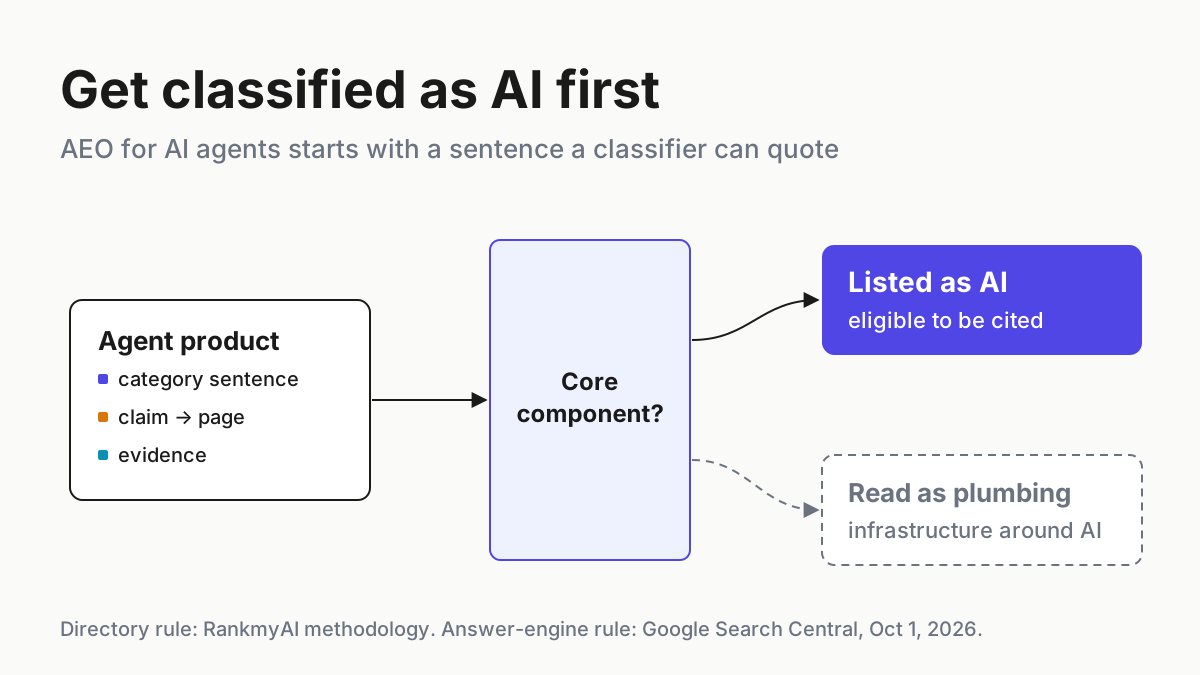
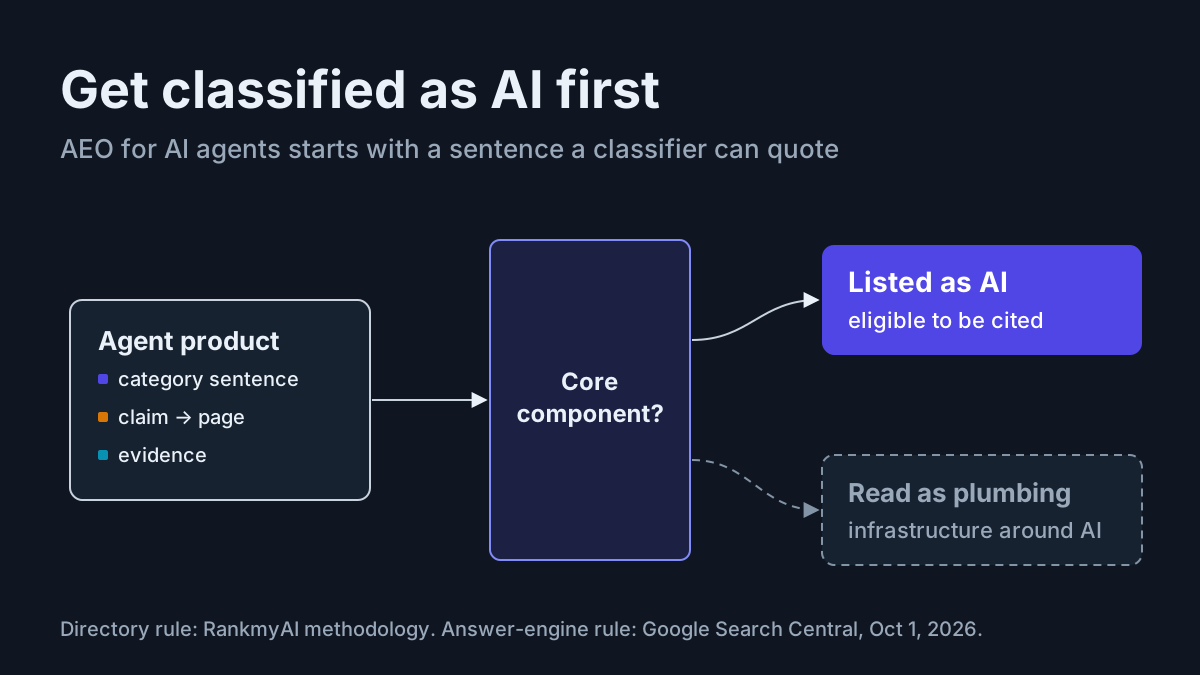
A directory that tracks more than 63,000 AI tools asks one question before it looks at your traffic, your funding or your reviews: does this product integrate artificial intelligence as a core component? Agent software can fail that question while calling models all day, because the product page describes the plumbing (sessions, queues, dashboards, approvals) and never says what the model does.
That is the first job of AEO for AI agents. Answer-engine optimization usually starts with citations: which page an AI Overview quotes, which brand a chatbot names. For a team that ships agent tooling, the earlier gate is classification. Directory reviewers, and the AI classifiers they run, decide whether your product counts as AI before anyone ranks it, and an answer engine can only quote the description you actually published.
The fix is a document. Keep a versioned classification sheet per product: one category sentence that names the AI functionality in directory language, a claim-to-page table so every AI claim has a public URL, a discovery checklist built on what Google, Lighthouse and the directories say in October 2026, and a rejection-response playbook you run once, with evidence.
RankmyAI’s AI-tool test and Google’s Oct 1 content rule
Two public rule-sets decide most of this, and a third tool audits files that neither of them asks for.
The directory rule. RankmyAI’s methodology page defines an AI tool as “any product or service that integrates artificial intelligence as a core component,” and applies that “broadly to include all tools that demonstrate measurable AI functionality,” with examples running “from text generation to predictive modeling, computer vision, and natural language processing.” Rankings then run on web traffic, cumulative investment and weighted review scores. The page says “We aim to manually verify whether each tool uses AI as a core component,” pairs those manual checks with AI-powered classification, concedes that errors may still occur, and describes no submission or appeal process. It is undated and cites March 2025 data.
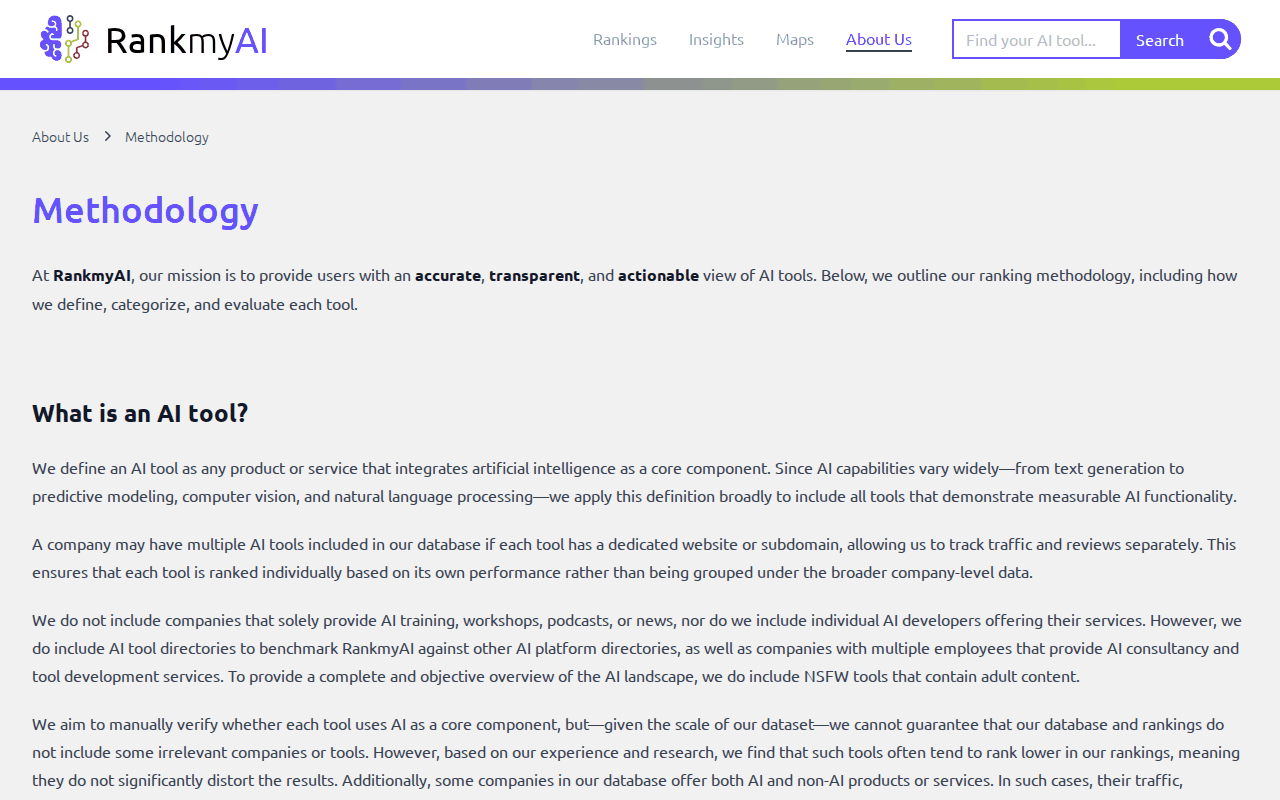 Screenshot: RankmyAI, “Methodology” (“What is an AI tool?” section; undated page citing March 2025 data), captured Oct 5, 2026.
Read that definition the way a classifier would. A product that manages AI tools (routes their sessions, queues their approvals, watches their quotas) can read as infrastructure around AI rather than a tool that embodies it. That is a pattern teams shipping agent software keep running into: directories that score AI tools reject tools that manage AI rather than embody it. The model work may be real. The page never said where it happens.
The answer-engine rule. On Oct 1, 2026, Google updated its guidance on using generative AI content: “It is critical to manually factcheck and review all AI-generated content for accuracy and trustworthiness before publishing.” The review “also applies to metadata like <title> elements, meta description elements, structured data, and alternate texts for images.” If an agent drafted your product page’s title tag, a person now signs it.
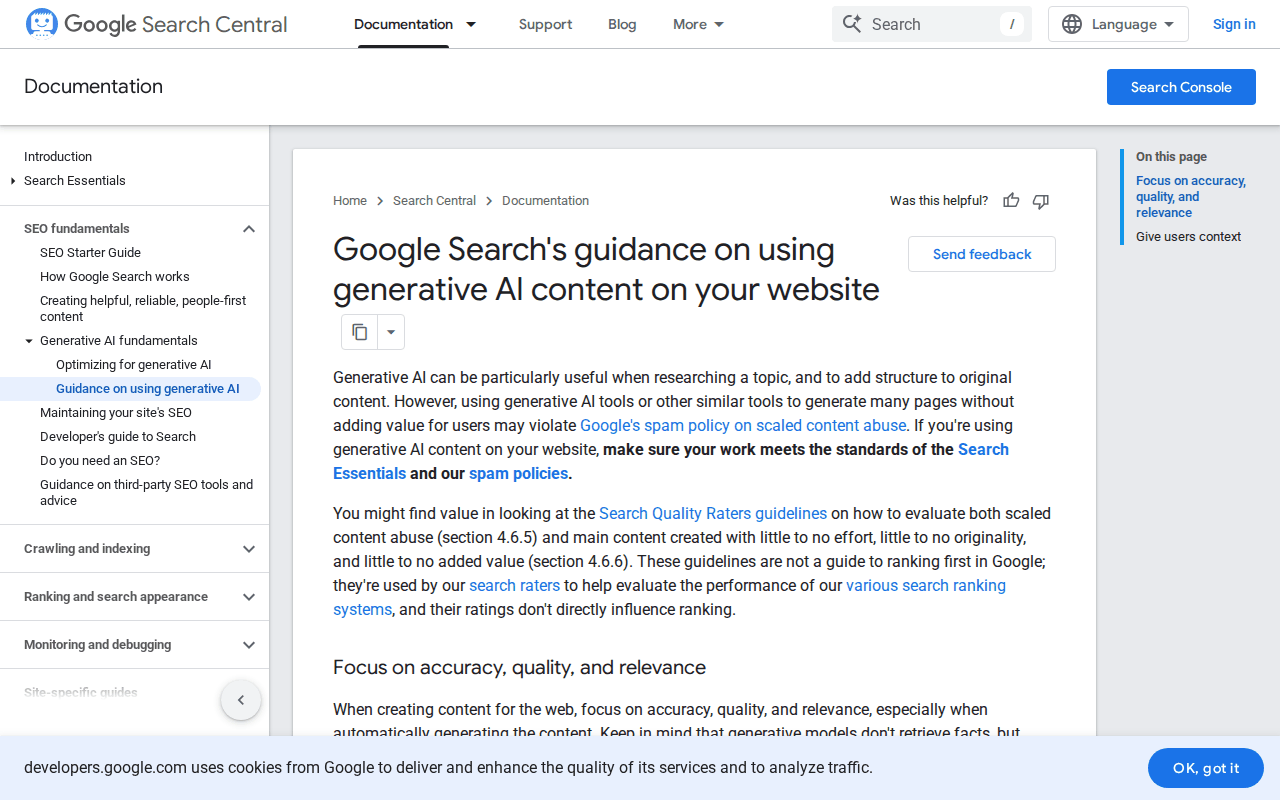 Screenshot: Google Search Central, “Google Search’s guidance on using generative AI content on your website” (last updated Oct 1, 2026), captured Oct 5, 2026.
Google’s AI features page, last updated Dec 10, 2025 and still current, sets the other boundary: “There are no additional requirements to appear in AI Overviews or AI Mode,” and “You don’t need to create new machine readable files, AI text files, or markup to appear in these features.” Eligibility is the ordinary kind: the page is indexed and eligible to show a snippet.
The audit that is not a ranking signal. Chrome’s Lighthouse has checked for llms.txt under an experimental agentic-browsing category since May 2026; PPC Land’s report on the addition noted that a missing file is marked not applicable because the file stays optional. Lighthouse 13.5, released Sep 18, added an audit for the Agentic Resource Discovery spec (ARD v0.91, published Aug 26, canonical path /.well-known/ard.json) and grouped the llms.txt and ARD checks under “agent discovery.” The category shows a pass ratio rather than a 0–100 score, and Search Engine Journal notes that Lighthouse still defaults to the legacy ai-catalog.json path. It is a developer audit, not a Google Search ranking signal.
Why agent products fail the “core component” test
Acting agents moved the AI out of view. A writing assistant shows model output on screen, so the AI is visibly the product. An agent console shows sessions, states and buttons, while the model work happens inside the agents it supervises or in features the page buries: summarizing a transcript, scoring a pending tool call for risk, deciding which run needs a human. A reviewer skimming the homepage sees a dashboard.
The second trap is borrowed credibility. The page says “works with” and lists five coding agents, letting other vendors’ logos carry the AI claim. To a classifier, logos of other people’s AI are evidence that you sit next to AI. Use the vocabulary from companion vs harness vs computer to say which layer your product occupies, then say what your own model calls do.
The classification sheet: a runbook for AEO for AI agents
Keep the sheet in the repo next to the marketing site, one file per product, reviewed like config. Each step ends in something you can check before a reviewer does.
1. Record how you are classified today
Before you rewrite anything, capture the current verdicts so you can tell later whether the sheet changed them. Spend thirty minutes and write down, verbatim:
- Directory listings. Every directory where you are listed or have submitted: the category it put you in, the one-line description it shows, and the status (listed, pending, rejected, never answered).
- Answer-engine descriptions. Ask two or three answer engines the questions a buyer would ask (
what is <product>,tools that <do the job your sentence names>) and paste the answers with the date. Note whether each one calls you an AI tool, a developer tool or something vaguer. - Your own words. The homepage H1, the meta description and the first 100 words of the docs overview, exactly as shipped today.
Put all three under a baseline: key in the sheet. After the new category sentence ships, rerun the same questions monthly. Answer engines vary from run to run, so look for a change in category across several runs rather than one flattering quote.
2. Write one category sentence a classifier can quote
Directory reviewers and AI classifiers both work from a sentence. Give them one that answers RankmyAI’s question directly: what AI is the core component, and what does it measurably do?
<Product> is a <category noun> that uses <model type> to <AI verb> <object>,
so <who> can <outcome>. The model runs <where: hosted API, local, on device>.
Rules for the sentence:
- Name the model work with a verb a reviewer can test. Classifies, summarizes, drafts, ranks, extracts, predicts. “Manages,” “orchestrates,” “connects” and “monitors” describe plumbing.
- Say where the model runs. Your own calls to a hosted model, a local model, or the user’s agent. “Core component” is about your product, not the agents you supervise.
- Use one wording everywhere. The same sentence goes in the first 100 words of the homepage, the docs overview, and every directory form. Two phrasings give a classifier two products.
- Pick the category whose definition your sentence satisfies. When a form offers both an AI category and a developer-tools category, choose AI only if the sentence earns it, and keep the other as a secondary tag.
The rewrites below are illustrative. Use only verbs your product actually performs.
| Draft phrasing | How a classifier can read it | Rewrite that names the AI |
|---|---|---|
| “An approval inbox for your agents” | A queue around other vendors’ AI | “Uses a language model to score each pending agent action for risk and summarize it for the approver” |
| “Observability for AI agents” | Logging and dashboards | “Uses an LLM to cluster failed agent runs by likely cause and draft the incident note” |
| “One place to run all your agents” | A launcher | “Uses learned routing to pick a model per task from each model’s cost and success history” |
| “Works with five coding agents” | An integration list | Keep it, under the sentence, as compatibility, never as the AI claim |
3. Map every AI claim to a public page
No claim without a page. A classifier, a human reviewer and an answer engine all need text they can quote at a URL they can load without signing in.
| Claim (from the sentence) | Public page and anchor | Sentence a classifier can quote | Evidence type | Owner | Reviewed |
|---|---|---|---|---|---|
| Scores pending actions for risk | /docs/risk-scoring#how-it-works |
“Each pending action gets a risk score from a language model before it reaches you.” | Docs + example output | PM | 2026-10-05 |
| Drafts the approver summary | /docs/summaries#example |
“The summary is generated from the tool call, its arguments and the session’s last ten turns.” | Docs + screenshot | DevRel | 2026-10-05 |
| Model runs on a hosted API | /security#model-calls |
“Model calls go to the provider you configure; nothing runs on our servers.” | Docs | Eng | 2026-10-05 |
(Illustrative rows for a hypothetical approval inbox.)
Then hold the table to four rules:
- Public, indexed, no login. A demo video can support a claim. It can’t be the only place the claim lives.
- One anchor per claim, so a reviewer lands on the sentence instead of hunting for it.
- Write the page or drop the claim. Either is fine. A claim with no page is not.
- One site or subdomain per listed tool. RankmyAI says a company “may have multiple AI tools included in our database if each tool has a dedicated website or subdomain, allowing us to track traffic and reviews separately.” A product line on one URL ranks as one tool.
4. Run the discovery checklist against what the rules actually say
Most AEO advice for agent products adds files. Start from the requirements that exist, then add only what describes something real.
- Every page in the claim table is indexed and snippet-eligible: no
noindex, and nonosnippeton the sections that carry the category sentence. Google’s AI features page lists no other requirement. - A named person reviewed every AI-drafted title, meta description, structured-data block and image alt text, and the review date is in the sheet. That is the Oct 1 rule, applied to your own pages.
- Structured data is ordinary schema.org that matches visible text. Google says no special markup exists for AI features, so don’t invent one.
- If you ship llms.txt, it follows v2 (modified Aug 10, 2026), points at the same pages as the claim table, and is discoverable through
rel="alternate" type="text/markdown"orrel="describedby". Treat it as optional hygiene: Google says no AI text file is required, and Lighthouse marks a missing one as not applicable. - An ARD entry exists only for a resource an agent can actually call, such as an MCP server or an A2A agent. No entry for a dashboard, a pricing page or a blog.
- If you ship llms.txt or ARD, Lighthouse’s agent-discovery audits pass in CI, and nobody reports the pass ratio as an SEO metric.
- No self-ranking “best of” page with your product at number one.
The last box has data behind it. PPC Land, reporting Lily Ray’s analysis on Oct 5, found that AI Overviews cite 38% fewer self-ranking “best of” listicles, and that self-ranking brands were left out of 83% of AI Overview recommendations. If you want a place in a roundup, earn it in someone else’s, written to a rubric a reader can rerun, like daily-driver testing of agentic AI tools.
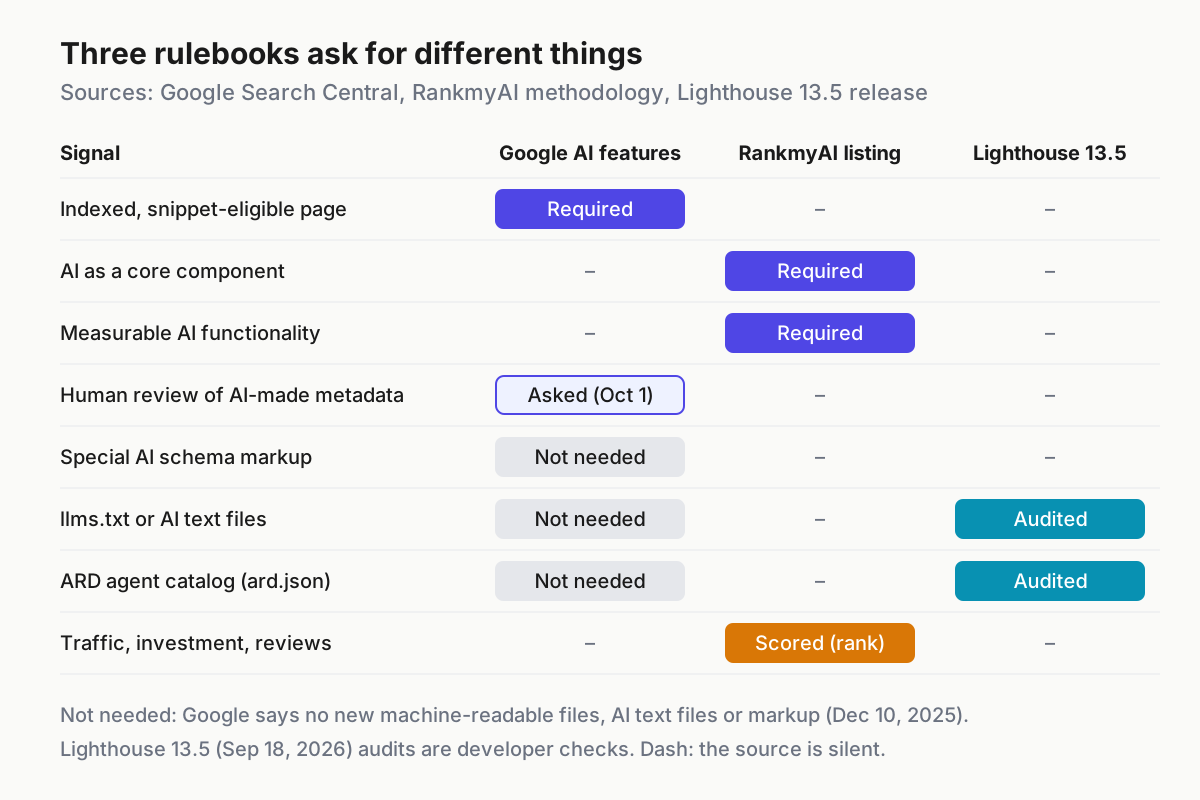
 Three rulebooks, three jobs: Google needs indexable pages, RankmyAI needs a core AI component, Lighthouse audits files neither one requires. Sources: Google Search Central (Dec 10, 2025; Oct 1, 2026), RankmyAI methodology, Lighthouse 13.5 (Sep 18, 2026).
If you do publish an ARD entry for a real callable resource, keep it small and true. The spec requires identifier, displayName and type (an IANA media type such as application/mcp-server-card+json) and recommends two to five representativeQueries plus capabilities. There is no “is AI” flag; the artifact type does the classifying.
{
  "identifier": "https://example.com/mcp/triage",
  "displayName": "Example Triage MCP server",
  "type": "application/mcp-server-card+json",
  "representativeQueries": [
    "score this pending agent action for risk",
    "summarize the last failed agent run"
  ],
  "capabilities": ["risk-scoring", "run-summaries"]
}
This entry is illustrative. Check the surrounding document structure against the v0.91 spec before you publish, and serve it at the canonical path rather than the legacy one Lighthouse probes by default.
5. Answer a rejection with evidence, once
RankmyAI describes no appeal process, and directories in general owe you nothing. Treat a resubmission as one documented attempt.
- Name the criterion. Record the reason the directory gave in your private log. If it gave none, assume the core-component test.
- Fix the page before you write back. A reply that argues taxonomy over an unchanged homepage earns the same answer.
- Map each criterion to evidence. One URL and one quotable sentence per criterion, pulled straight from the claim table.
- Resubmit once, URLs first. Short, factual, no adjectives.
- Log the outcome with the sheet version you submitted. If the answer is still no, stop. Spend the effort on directories whose definition fits, and on your own pages, which answer engines read either way.
Subject: Re-review request: <Product>, sheet v<date>

Criterion: AI as a core component with measurable AI functionality.
What the AI does: <category sentence, verbatim>
Evidence:
  1. <URL#anchor>  "<quotable sentence>"
  2. <URL#anchor>  "<quotable sentence>"
Changed since the first submission: <one line>
This is our only resubmission.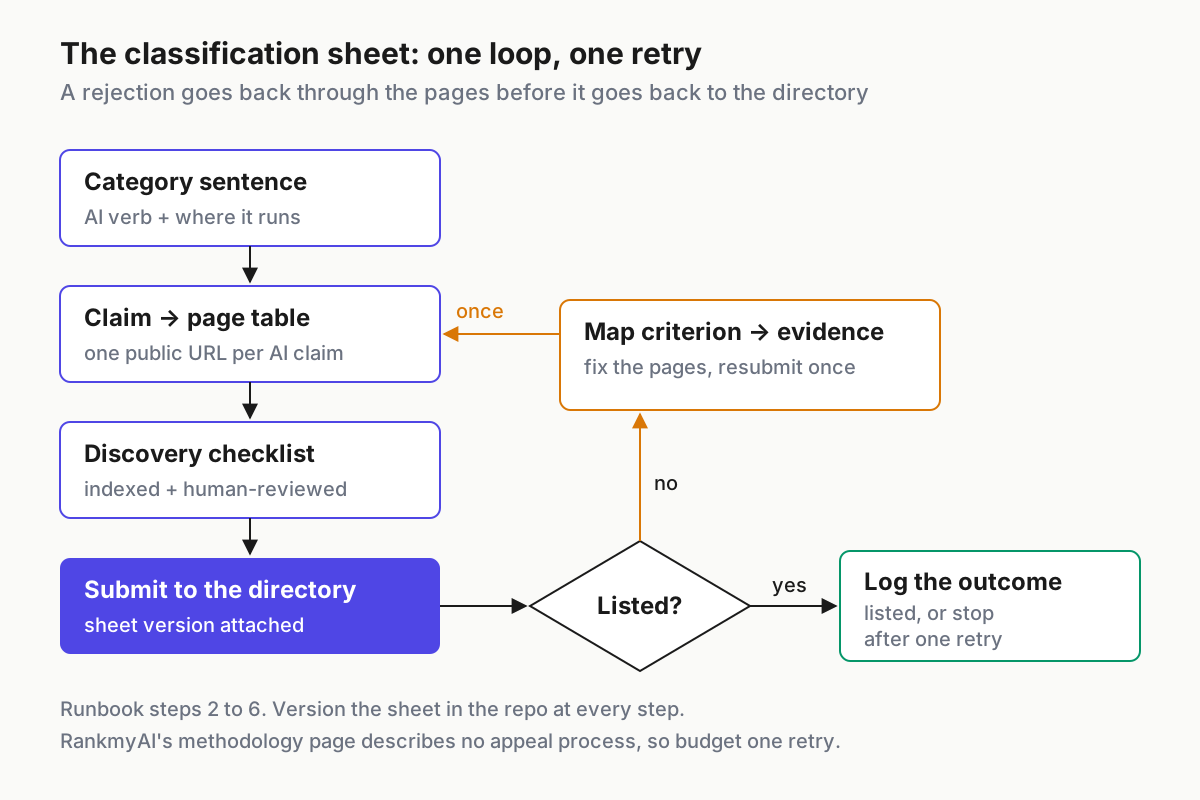
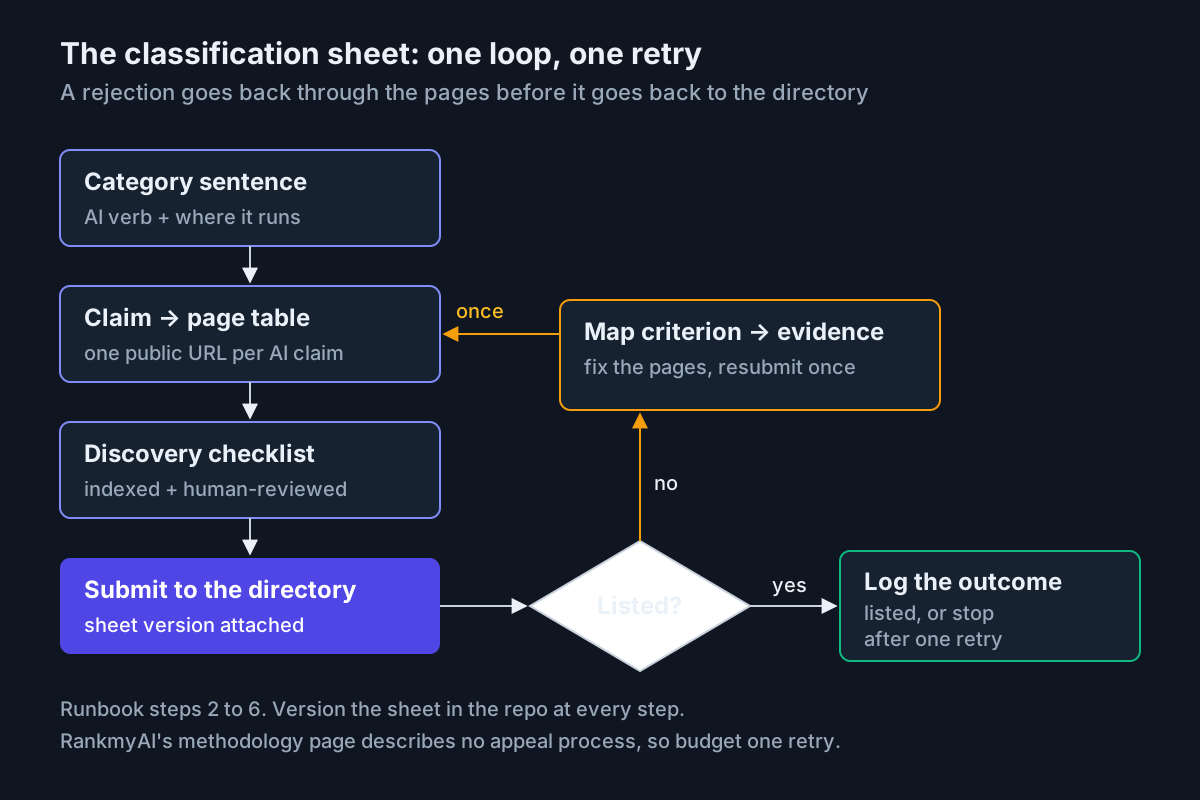 The sheet is a loop with one retry: a rejection sends you back to the pages before it sends you back to the inbox.
6. Version the sheet like config
A sheet that lives in a slide deck drifts from the site within a release. Put it in the repo, one file per product such as classification/example-triage.yaml, and review it in pull requests. The file below is illustrative.
version: 2026-10-05
owner: product-marketing
category_sentence: >-
  Example Triage is an approval inbox for coding agents that uses a
  language model to score each pending action for risk and summarize
  it for the approver. Model calls go to the provider you configure.
claims:
  - claim: scores pending agent actions for risk
    page: https://example.com/docs/risk-scoring#how-it-works
    quote: "Each pending action gets a risk score from a language model."
    reviewed_by: jdoe
    reviewed_on: 2026-10-05
discovery:
  indexed_and_snippet_eligible: true
  metadata_human_reviewed_on: 2026-10-05
  llms_txt: v2
  ard_entries: [triage-mcp]
baseline:
  captured_on: 2026-10-05
  answer_engine_category: developer tool
  directory_status: {other-directory: listed under developer tools}
submissions:
  - directory: example-directory
    submitted: 2026-10-06
    sheet_version: 2026-10-05
    criterion_cited: core component
    resubmitted: false
    outcome: pending
Re-review the sheet when the homepage hero copy changes, when an AI feature ships or is removed, when you switch model providers, after any rejection, and once a quarter regardless.
Failure modes in agent-product classification, and the signal for each
| Failure | Signal you’ll see | Fix |
|---|---|---|
| Category sentence describes plumbing | Rejection cites the core-component test, or the listing lands under developer tools | Rewrite with a testable AI verb |
| AI claims live behind a login or in a video | Answer engines describe you with your integration partners’ words, or not at all | Publish a docs page per claim |
| AI-drafted metadata shipped unreviewed | Title or meta contradicts the page; snippet differs from the sentence | Add reviewer and date to the sheet |
| ARD or llms.txt for surfaces that aren’t callable | Lighthouse passes while agent requests hit 404s | Delete entries without a live resource |
| Pass ratio reported as SEO progress | Audit dashboard improves, impressions stay flat | Report the two numbers separately |
| Self-ranking listicle | Citations fall on that page first | Rewrite as a neutral comparison or remove it |
| Repeated resubmission | Silence | Stop after one, log it |
Two of these deserve a second look because they fail quietly. The unreviewed-metadata failure is now a written Google expectation, so treat it like a release blocker rather than a style note. And the listicle failure compounds: it costs the page its citations and teaches a classifier that your self-description is promotional.
Citations also decay on their own. GreenFlag Digital’s ChatGPT citation study (Sep 21, personal finance only) found that half of 215 top-cited pages from October 2025 got zero citations eleven months later, while first-party brand pages rose from 2% to 22% of top citations. Its line: “A citation is rented, not owned.” A single vertical proves little on its own, but it supports the sheet’s order of work: own the first-party page, then chase the citation.
Classification is fleet inventory facing outward
The classification sheet is the public twin of inventory you already keep. The weekly MCP server inventory lists what your agents can call inside the building; an ARD entry lists the subset outsiders can call; the claim table lists what you say the AI does. When those three disagree, the fleet and the marketing site describe different products, and a classifier will believe the marketing site.
Teams that run a multi-agent command center already think in this shape: every surface has an owner, a state and a last-reviewed date. Apply the same discipline to the pages a classifier reads, then carry it downstream. The next two pieces in this batch do exactly that, one attributing the desktop install rather than the demo click, the other writing the pricing page as a contract about what stays free.
FAQ
What is AEO for AI agents?
AEO for AI agents is answer-engine optimization for products built on or around agents. Before chasing citations in AI Overviews or chatbots, the product has to be classified as AI: a category sentence naming the model work, public pages proving each claim, human-reviewed metadata, and discovery files only for resources agents can call.
Do I need llms.txt to appear in Google AI Overviews?
No. Google’s AI features page says you don’t need new machine-readable files, AI text files or markup to appear in AI Overviews or AI Mode; pages need to be indexed and snippet-eligible. Lighthouse audits llms.txt under agent discovery, but that is a developer check, not a Search ranking signal.
Why do AI tool directories reject agent management tools?
Directories such as RankmyAI admit products that integrate AI as a core component with measurable AI functionality. A tool that manages other AI tools can read as infrastructure around AI. State what your own model calls do, prove each claim on a public page, then resubmit once with evidence.
Sources
- RankmyAI: Methodology (“What is an AI tool?”) (undated; cites March 2025 data)
- Google Search Central: Guidance on using generative AI content on your website (last updated Oct 1, 2026)
- Google Search Central: AI features and your website (last updated Dec 10, 2025)
- GoogleChrome/lighthouse v13.5.0 release notes (Sep 18, 2026)
- Agentic Resource Discovery Specification v0.91 (Aug 26, 2026)
- Search Engine Journal: Lighthouse adds an audit for AI agent resource discovery (Sep 21, 2026)
- The /llms.txt file, v2 (modified Aug 10, 2026)
- PPC Land: Google adds llms.txt to Lighthouse as agentic web standards heat up (May 30, 2026)
- PPC Land: AI Overviews cut self-ranking listicle citations 38% (Oct 5, 2026)
- GreenFlag Digital: ChatGPT citation study (Sep 21, 2026)