Sierra Doubles to a $30B Valuation in Six Months, Betting Enterprises Will Pay Agents per Outcome
Sierra raised $1.75B at a $30B valuation six months after its last round. What the outcome-priced agent platform's numbers tell teams building or buying enterprise agents.
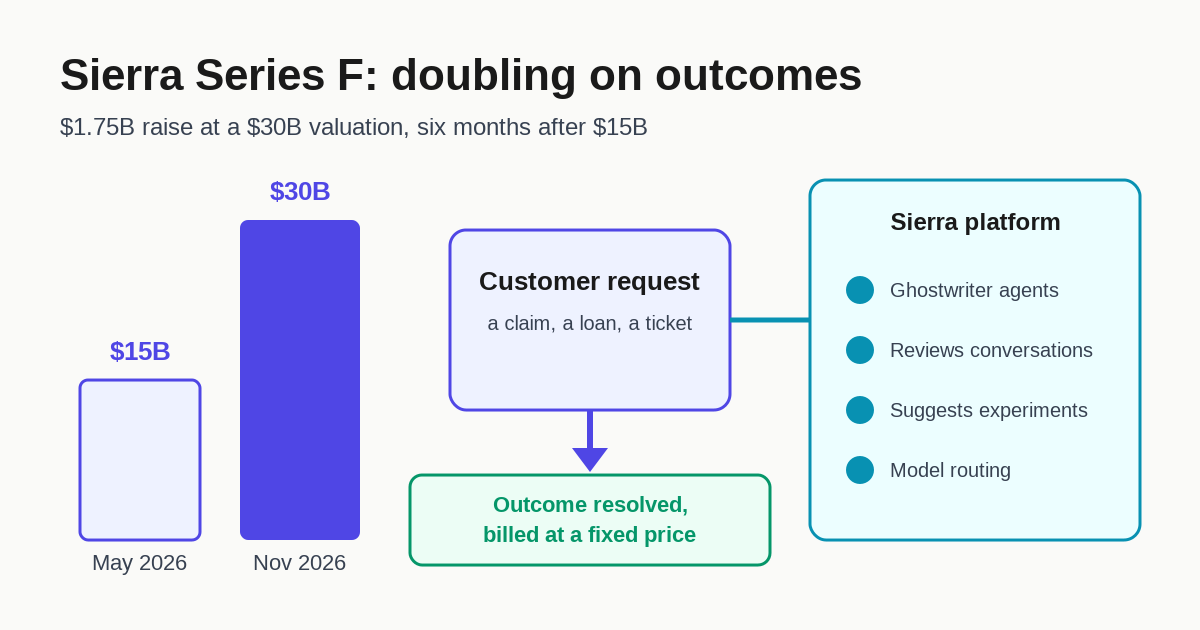
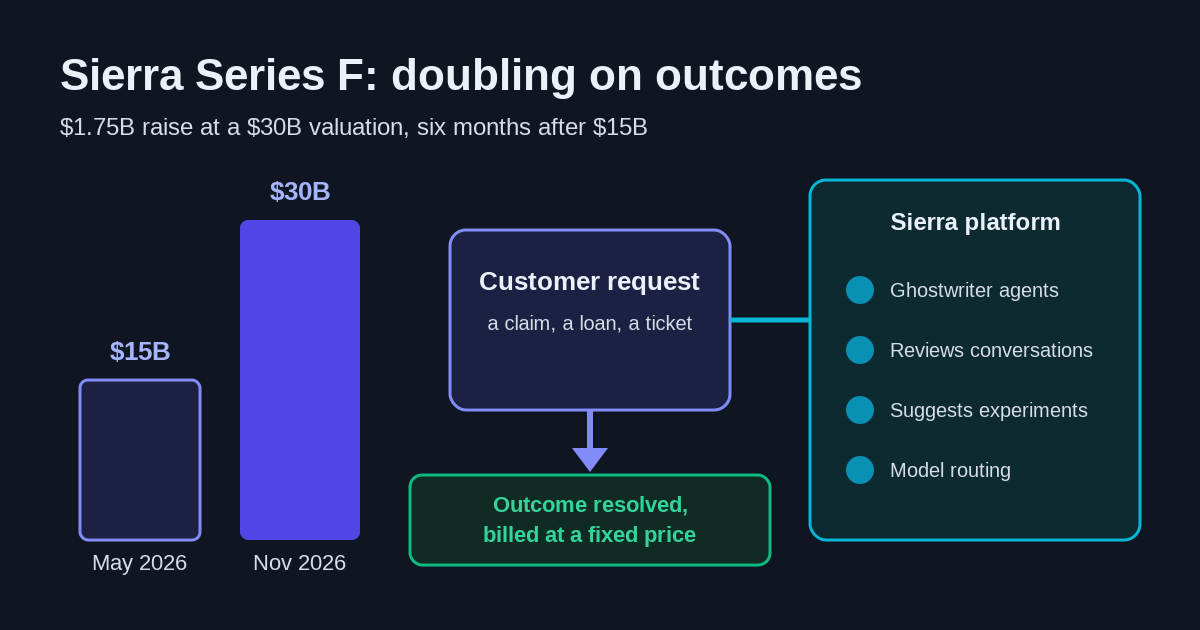
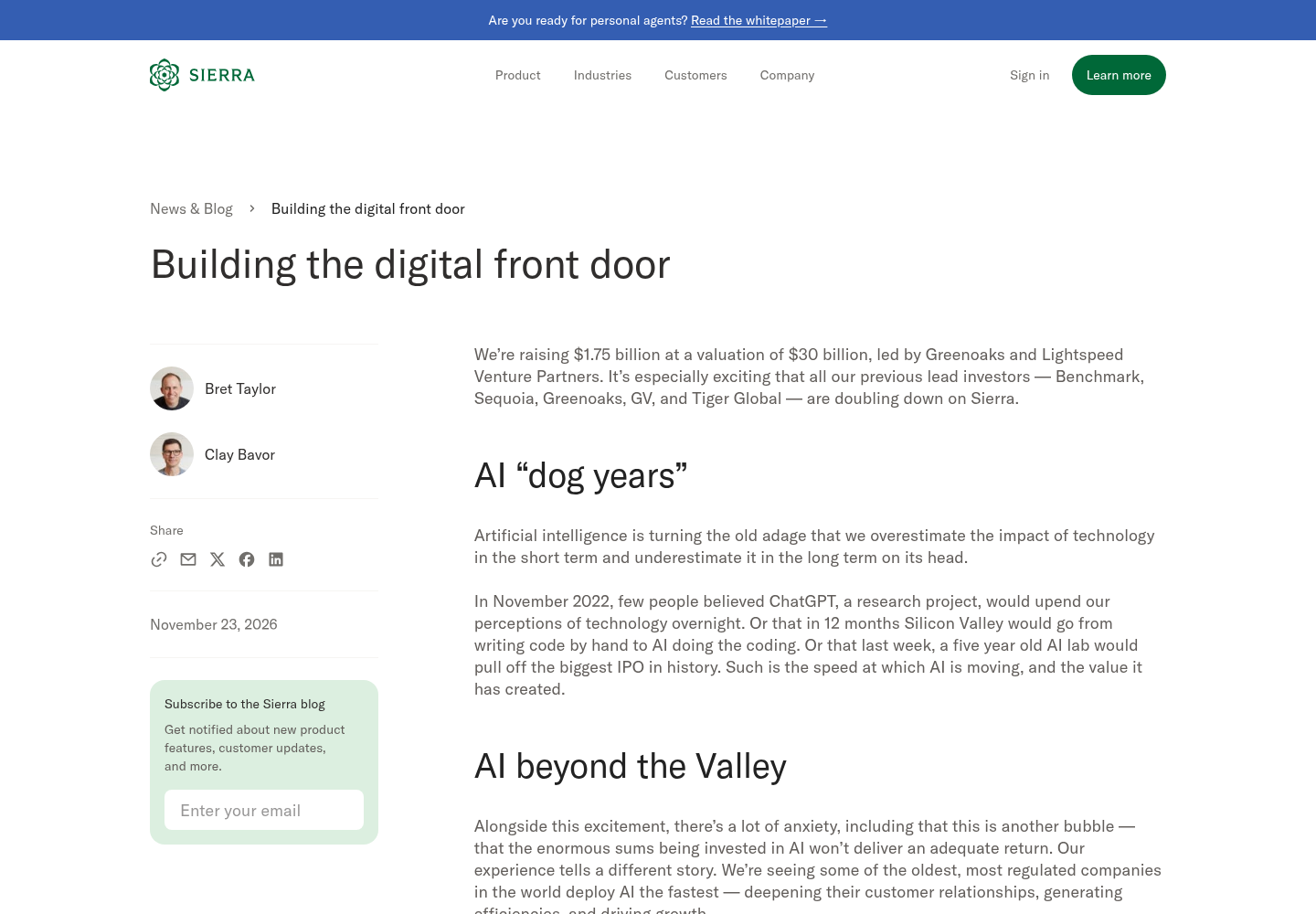
Sierra, the enterprise customer-agent platform co-founded by Bret Taylor and Clay Bavor, announced a $1.75 billion Series F on November 23, led by Greenoaks and Lightspeed Venture Partners, at a $30 billion valuation. The round arrives roughly six months after a round that valued the company at $15 billion — a doubling TechCrunch reports. Every previous lead investor — Benchmark, Sequoia, Greenoaks, GV and Tiger Global — participated.
What is actually being valued
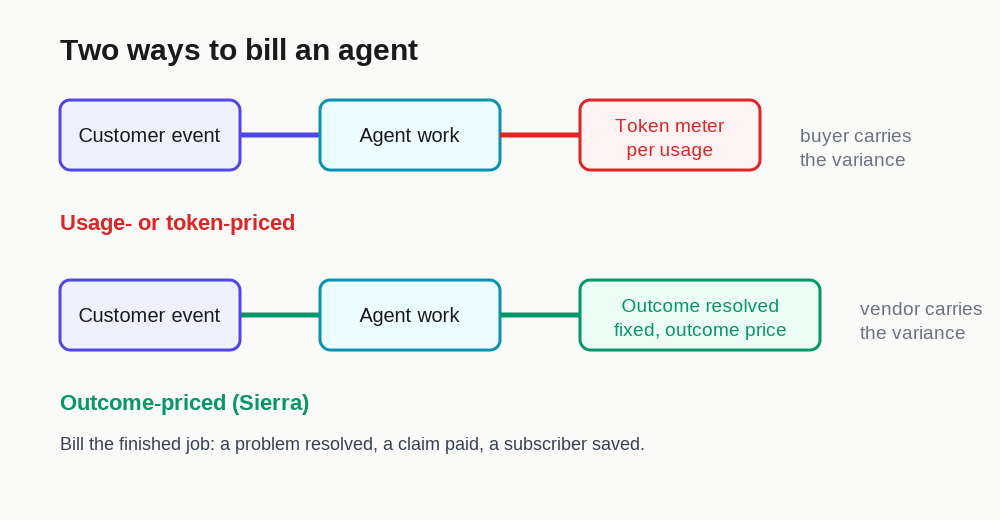
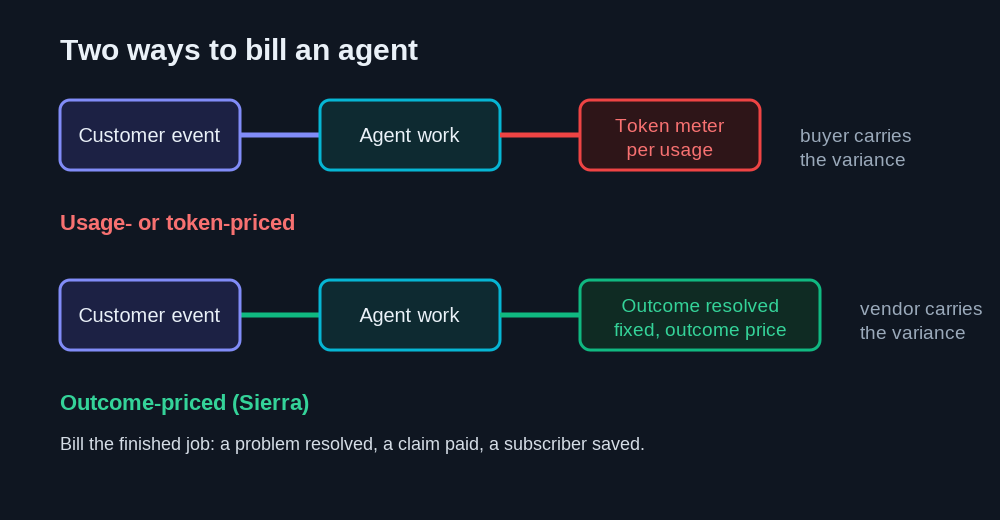
Two numbers in Sierra’s announcement matter more than the round size. First, the company says it passed $400 million in ARR in about two and a half years, and TechCrunch separately notes run-rate revenue doubled to that figure within five months. Second — and more consequential for operators — is how Sierra bills: it charges for outcomes, not usage or tokens. A problem resolved, a loan originated, a driver onboarded, a claim paid, a subscriber saved. That aligns the platform’s revenue with the business event the agent produces, and it shifts the cost of usage variance onto the vendor — a pricing model few agent vendors offer.
Sierra attributes its traction to three platform choices worth studying if you build or procure agents:
| Sierra’s claim | Operator takeaway |
|---|---|
| Outcome-based pricing (per resolution, not per token) | Vendor risk shifts to the vendor; demand measurable outcome definitions before signing |
| Ghostwriter, an “AI to build AI” that builds, tests, deploys and continuously improves agents | Agent lifecycle work (reviewing conversations, suggesting experiments) is being automated too |
| A “constellation of models” abstracting model choice and token spend | Model routing is becoming a platform feature, not a buyer decision |
TechCrunch adds context on scale: Sierra serves almost half of the Fortune 50, with customers including BNY, HSBC, Singtel, Wells Fargo, JPMorganChase, Pearson, Next and Cox Automotive. Sierra’s own post emphasizes the same pattern from the other side — some of the oldest, most regulated companies (Cigna dates to 1792, JPMorganChase to 1799, HSBC to 1865) are deploying AI fastest.
Why the valuation doubled
Independent of the raise, Crunchbase’s Current Valuation Model had already estimated Sierra’s value at $31.5 billion, up from close to $16 billion at its May 2026 round — nearly identical to the price the new round set. Crunchbase’s broader finding is striking: of roughly 1,900 unicorns, only about 12% are estimated to be down more than $100 million since their last round, and just 24 companies have gained more than $10 billion. Sierra sits in that tiny top cohort alongside Thinking Machines Lab and Physical Intelligence.
The competitive backdrop also explains the pace. TechCrunch tallies the CX-agent category’s valuations: ElevenLabs at $22 billion, Wonderful at $5 billion, Decagon at $4.5 billion, Parloa at $3 billion. Measured against that field, Sierra’s six-month doubling puts it at the fast end of the CX-agent re-ratings — and its $30 billion makes it the clear category leader in customer-experience automation. The company says the new capital goes into the technology stack for servicing agents and into sales capacity to sign enterprise contracts faster than rivals.
The part operators should watch
The most technically interesting line in TechCrunch’s coverage: as personal and work agents interact with enterprise systems, Sierra is helping define agent protocols with Meta, Stripe and Walmart. That is the same frontier covered in our piece on Walmart’s MCP storefront gateway and our guide to deciding what each front door lets a customer’s agent do. Sierra’s bet is that every company will need a controlled surface through which outside agents resolve customer outcomes — and that the vendor owning that surface charges by the outcome.
Sierra co-founder Clay Bavor has also pushed back on the replacement narrative, arguing at the HumanX conference that most Sierra customers reassign employees rather than cut them.
What it means for buyers and builders
For teams buying: outcome pricing is now proven at $400M-ARR scale, so push vendors on it — and be ready to define outcomes precisely enough to be billed. For teams building: the valuation pace confirms that the agent platform layer (build, test, deploy, improve, route models) is where capital is concentrating, echoing what we saw when LangChain raised $300M at $3B and what Menlo’s enterprise-AI numbers showed about agent spend overall. The open question is durability: Crunchbase itself cautions that estimated uplifts only become real when future rounds, secondaries or exits pay them. Sierra’s next test is whether outcome-priced agents keep compounding once the enterprises piloting them start auditing what each resolved outcome actually cost — the same discipline behind pricing the finished job, not the token.