LangChain Raises $300M at $3B Led by CapitalG: The Agent Platform Layer Gets Its Anchor Tenant
LangChain's CapitalG-led Series C at $3B doubles its valuation within a year, backed by 7,000 LangSmith customers. What the round and the Nov. 20 release event mean for agent platform buyers.
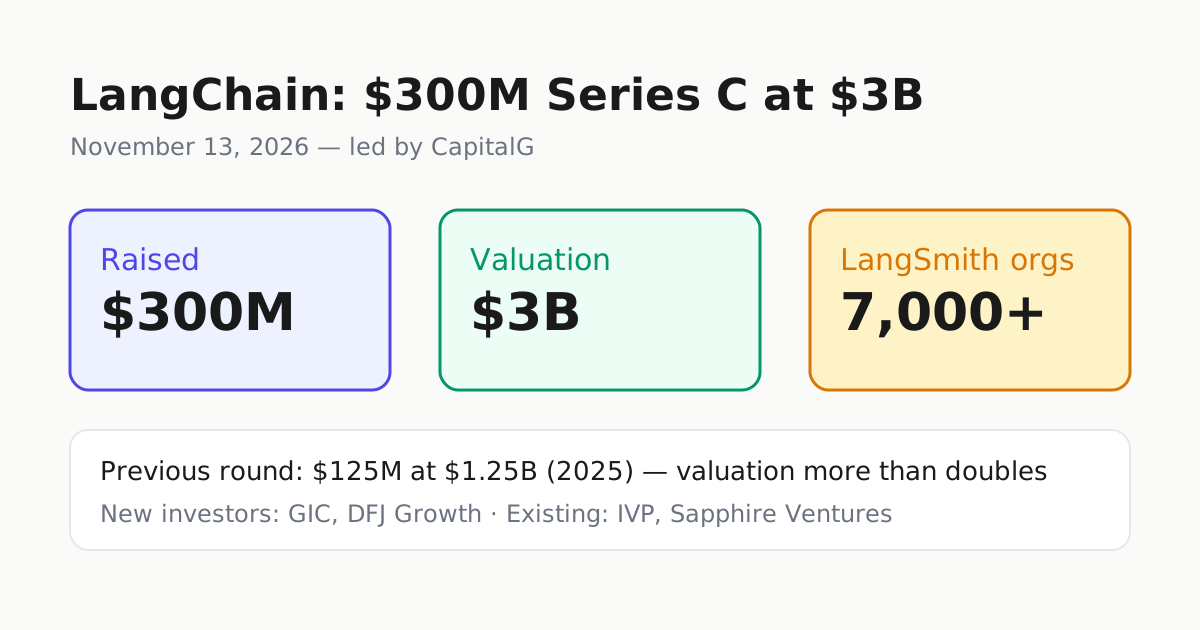
LangChain raised $300M at a $3B valuation on Friday, November 13, in a Series C led by CapitalG — Alphabet’s growth fund — with new investors GIC and DFJ Growth and existing investors IVP and Sapphire Ventures participating (LangChain announcement, TechCrunch). The round more than doubles the $1.25B valuation set roughly a year ago, and it lands on one of the biggest claims in the agent tooling market: more than 7,000 organizations now use LangSmith.
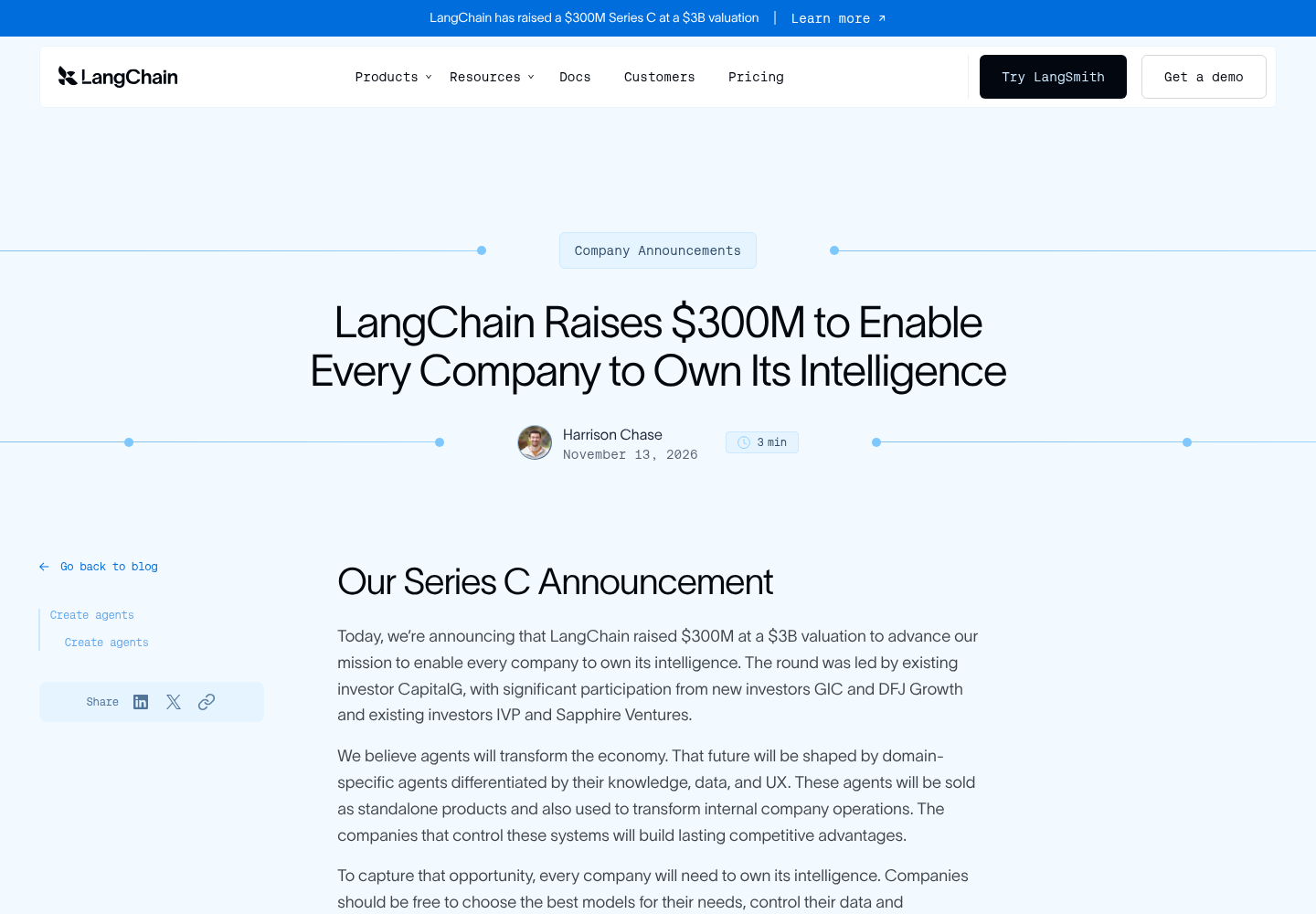
Screenshot: the LangChain company announcement, “LangChain Raises $300M to Enable Every Company to Own Its Intelligence,” by Harrison Chase, November 13, 2026.
Why this round is a market signal, not just a number
Crunchbase’s weekly roundup ranks this among the week’s ten largest US rounds — tied with Path Robotics’ $300M, behind Mirendil’s $1B Series A and Mercor’s $750M Series D — in a week where the vast majority of big rounds were AI-related (Crunchbase News). What separates LangChain from those peers is that it is not selling a model or a labor pool. It is selling the layer that runs, improves and governs agents — infrastructure that, at the claimed 7,000-customer scale, sits underneath a meaningful fraction of production agent fleets.
The funding trajectory also tells a pivot story. LangChain began in 2022 as the open-source glue for things early LLMs did badly — web search, API calls, database access. As frontier labs absorbed those tasks into their own harnesses, LangChain moved up the stack to agent management, and TechCrunch notes it found its stride there with the message of letting businesses own their own intelligence (TechCrunch). For teams that invested in LangGraph and LangChain early, the $3B valuation is evidence that the layer they bet on is now a durable, Alphabet-backed business rather than a venture-subsidized experiment — our LangGraph review covers what that bet buys in practice.
The evidence behind the 7,000-customer claim
Customer counts are company claims, but the announcement names specific deployments with concrete numbers (LangChain announcement):
| Customer | Claimed use of LangSmith |
|---|---|
| Clay | Monitors hundreds of millions of agent runs per month to improve agents |
| Workday | Runs and governs agents org-wide; cut new-agent deployment from five months to under a day |
| NVIDIA, Toyota, Salesforce | Named as Fortune 500 enterprise users |
| Harvey, Rippling, Listen Labs | Named as fast-growing startup users |
The Workday number is the one operators should weigh most. A deployment cycle dropping from five months to under a day is a governance-and-tooling claim, not a model-quality claim — and it is exactly the kind of result that gets an agent platform re-upped at enterprise renewal time. LangChain structures the platform around three pillars: Agent Runtime (Deep Agents, LangGraph, Agent Server, Sandboxes, Managed Agents and Fleet), Agent Improvement (Observability, Evaluation, the LangSmith Engine automation agent, and Fine-Tuning), and Agent Governance (LLM and Tool Gateways for model budgets, fallbacks, data protection and tool access).
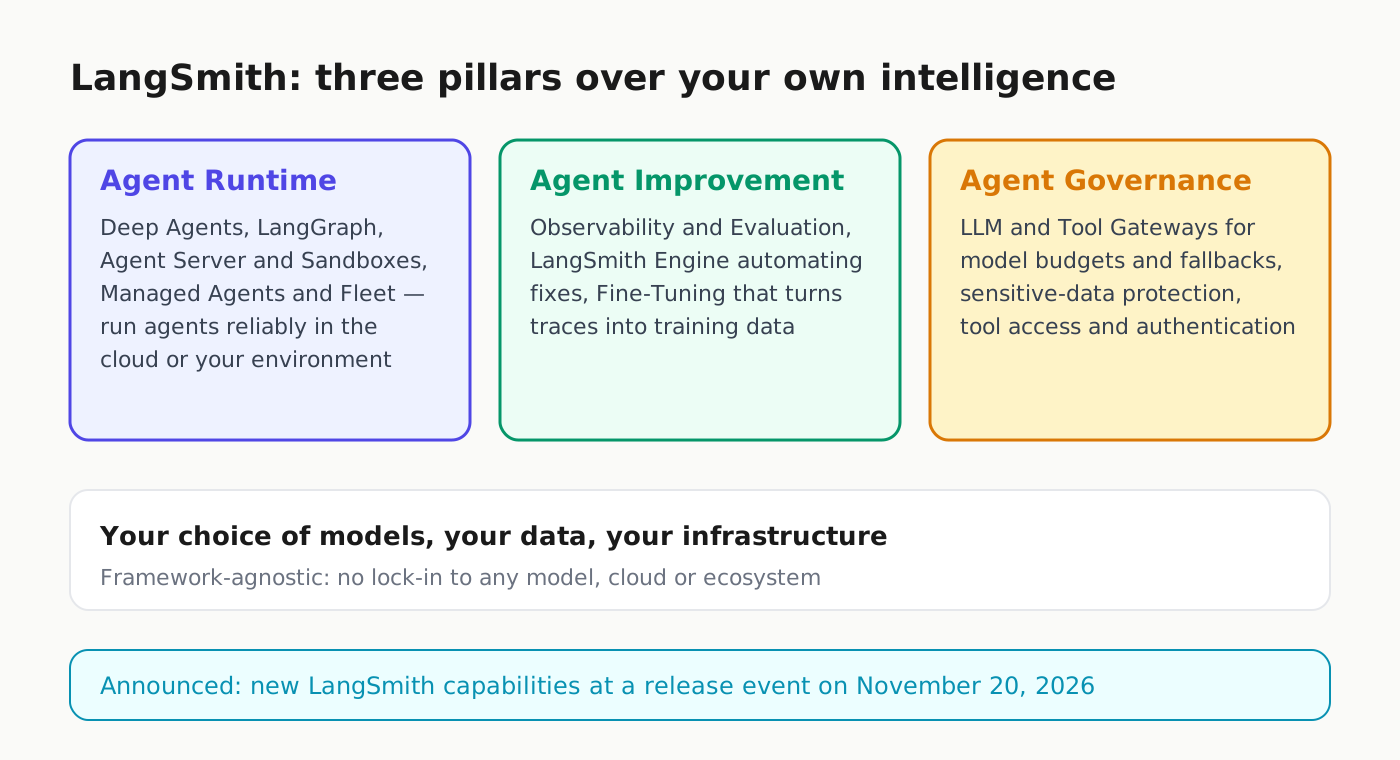
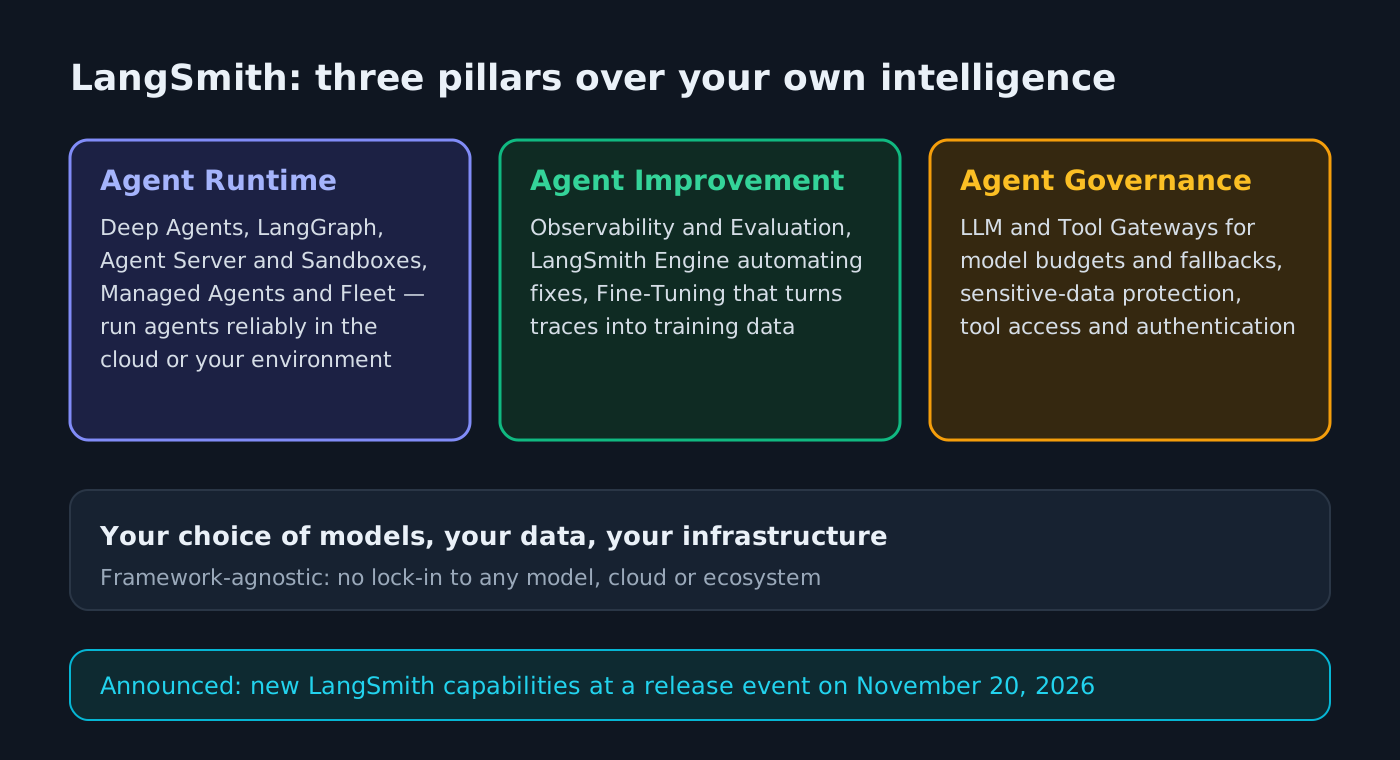
Diagram: the three pillars as described in the announcement, positioned above customers’ own models, data and infrastructure. Illustration: Automater Newsroom.
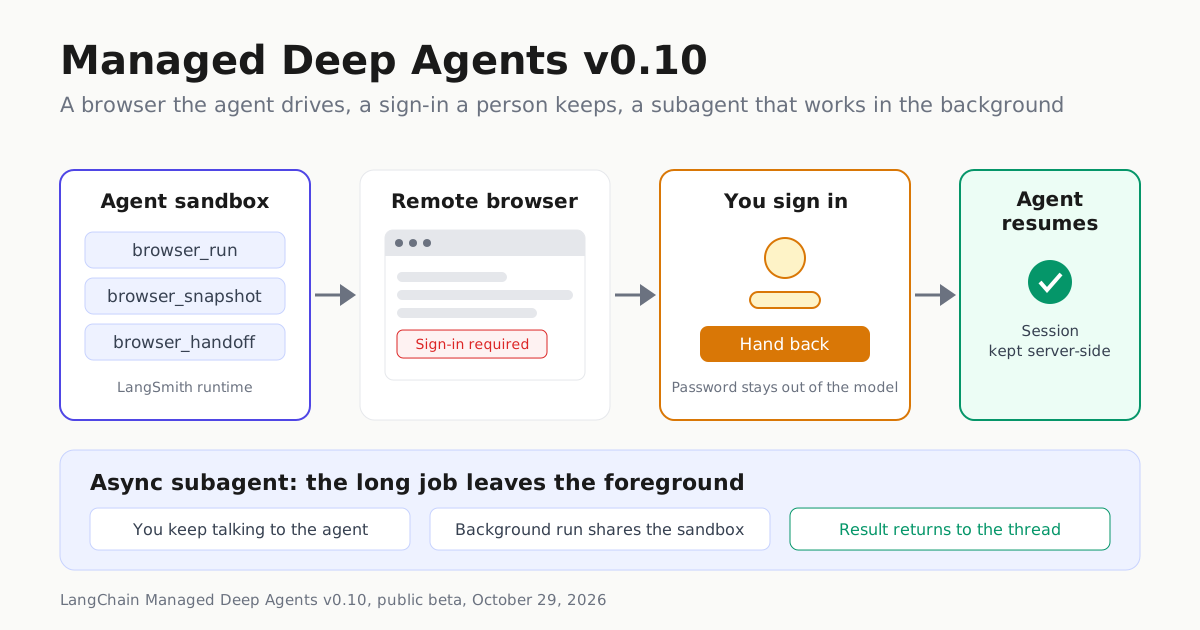
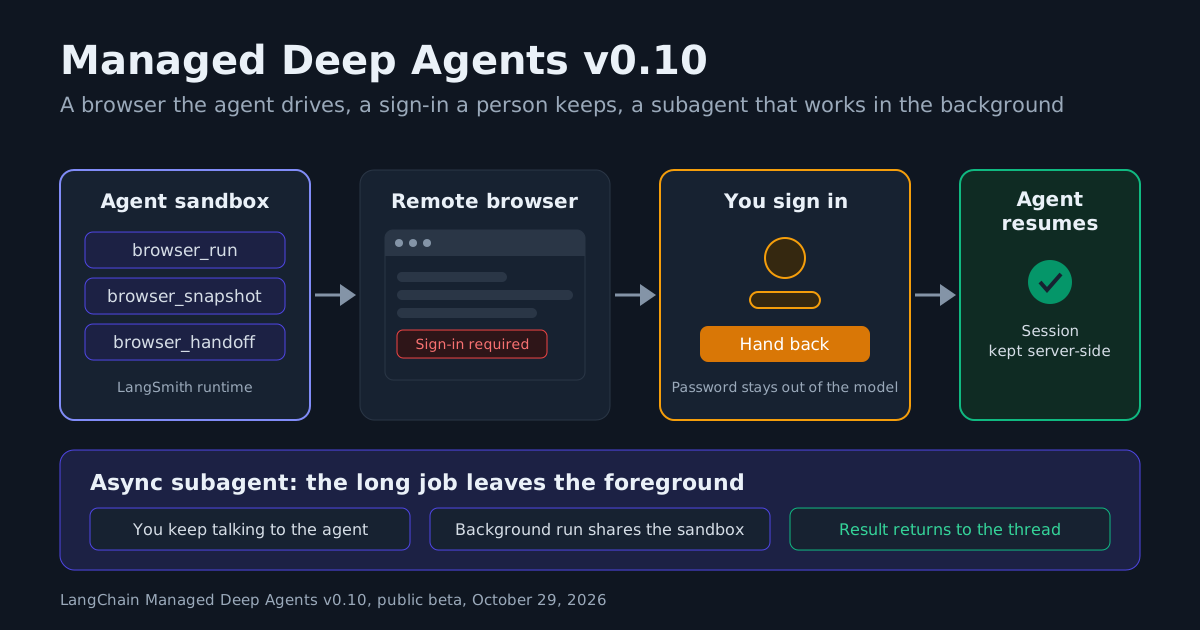
If you have followed LangChain’s recent releases — Engine v2, Managed Deep Agents and fine-tuning from traces shipped in September — the pillars are a packaging of an existing roadmap, not a new product line. That matters for the funding story: the round is underwriting scale and the enterprise governance push, not a pivot.
The framework-agnostic bet, and what it competes against
LangChain’s positioning is explicitly not locking users into any particular model, cloud or ecosystem — a direct contrast with the major clouds and frontier labs, which all now ship their own agent platforms (TechCrunch). The catch is that plenty of startups pitch the same neutrality, and TechCrunch flags newcomer Mintive as one competitor doing well. The 7,000-customer figure and a CapitalG-led round are LangChain’s answer to that crowding.
For teams deciding between LangSmith and a cloud-native or lab-native agent platform, the decision is now less about whether the neutral layer survives — $300M and Alphabet’s growth fund say it will for years — and more about which governance surface you want to own. The market is large enough to fund several: Menlo Ventures’ 2026 numbers put enterprise AI spend at $177B, with coding agents alone a $34B market. We have argued before that the agent gateway is becoming the enterprise control plane, and LangChain’s LLM and Tool Gateways are its claim on that seat.
Mark November 20
The announcement closes with a date: a special release event on Friday, November 20 to preview new LangSmith capabilities built on this foundation (LangChain announcement). Given the round was announced one week ahead of it, expect the event to be the commercial follow-through — likely deepening the Runtime, Improvement and Governance pillars rather than opening a new front. We will cover what actually ships versus what gets demoed.
Context on market size: enterprise AI spend figures come from Menlo Ventures’ 2026 survey as covered previously; customer counts and pillar descriptions are LangChain’s own announcement.