Lightning Labs' pi402 Lets Coding Agents Pay for Their Own Inference in Bitcoin, Per Token
Lightning Labs' pi402 pays for LLM inference in bitcoin per token from inside a coding agent, with built-in spend caps and no API keys, accounts or Lightning node needed.
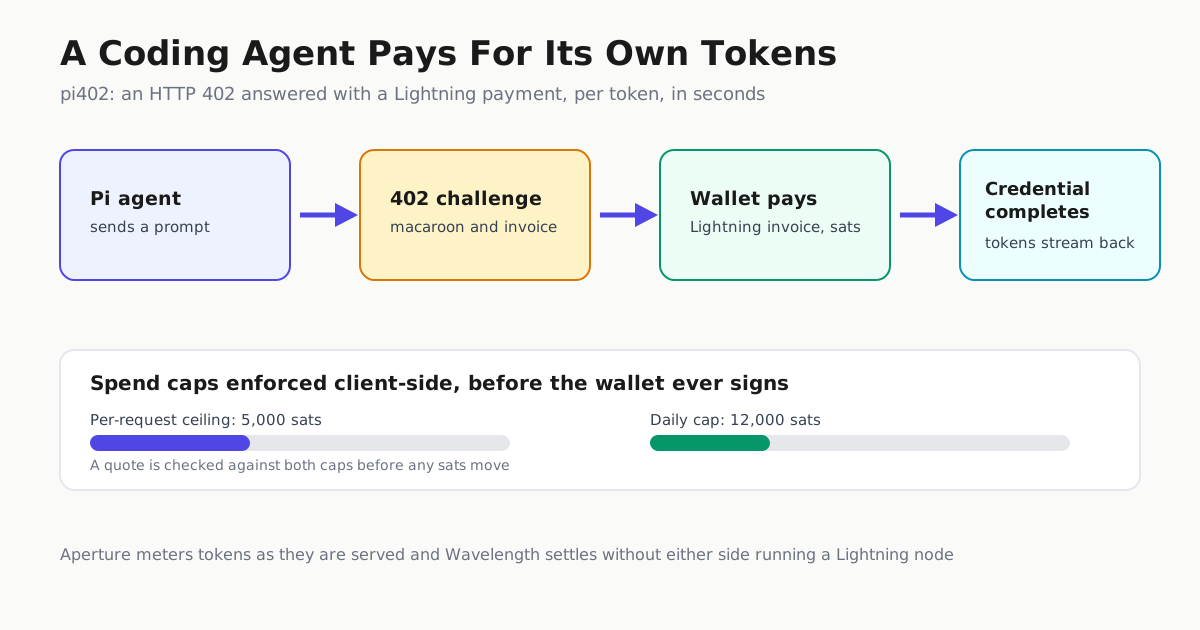
Lightning Labs published pi402 on November 12, 2026: an open-source extension for the Pi coding-agent harness that pays for its own LLM inference in Bitcoin, one token at a time, with no account, no API key and no card on file. When a model call comes back with an HTTP 402, the agent’s own embedded wallet settles the invoice over the Lightning Network and the request completes, invisibly to whoever is prompting the agent.
For anyone running autonomous or budget-capped agent fleets, the practical change is where the spend limit lives. Instead of a usage dashboard on a vendor’s website, pi402 enforces a per-request ceiling and a daily cap inside the harness itself, checked against each quote before the wallet ever signs a payment. Fund the agent with a fixed amount of sats and that amount is the hard ceiling for what it can spend that day, full stop.
Why Lightning instead of a card
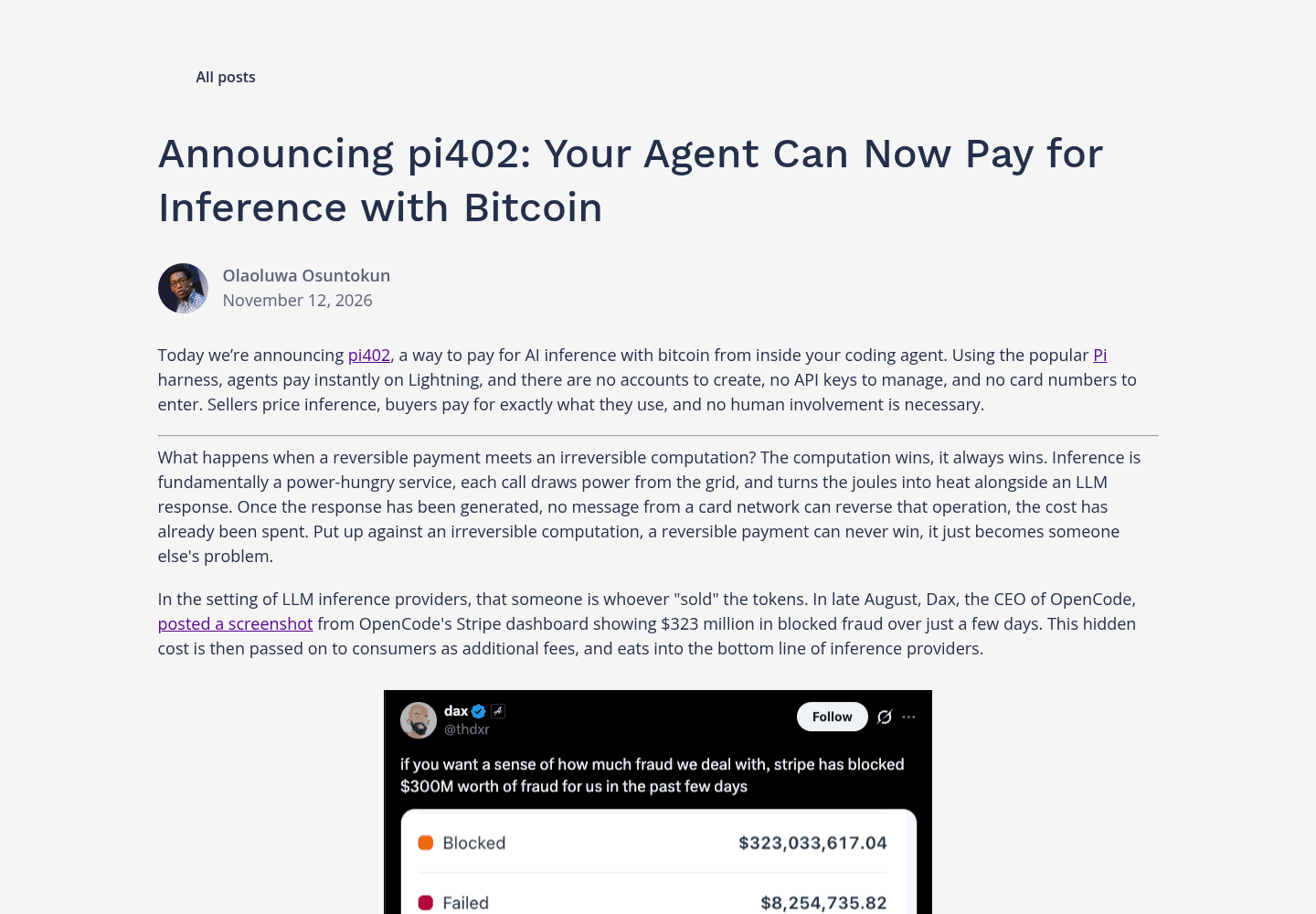
Lightning Labs’ announcement post frames the problem in terms sellers of inference already feel: a card payment is reversible for 60 to 120 days, but the GPU time behind a completed response is spent the moment it’s served. The post cites CEO Dax of OpenCode posting a screenshot of blocked card fraud in the hundreds of millions of dollars over a few days on OpenCode’s own Stripe dashboard — a claim from Lightning Labs’ own writeup, not independently verified here, but it is the company’s stated reason for betting on a non-reversible rail. A Lightning payment settles in seconds and finally; there’s no chargeback to defend against because there’s nothing left to reverse.
How the payment becomes the API key
The mechanism is L402, the HTTP-402-based scheme Lightning Labs has run in production since 2020. An unauthenticated request gets a 402 response carrying a macaroon (a cryptographic bearer credential) and a Lightning invoice. The macaroon commits to the invoice’s payment hash as a caveat; paying the invoice reveals a preimage, and macaroon-plus-preimage together form a complete, valid credential. Per Lightning Labs’ protocol docs, the server can verify that credential statelessly, with no database lookup and no account to have created in the first place.
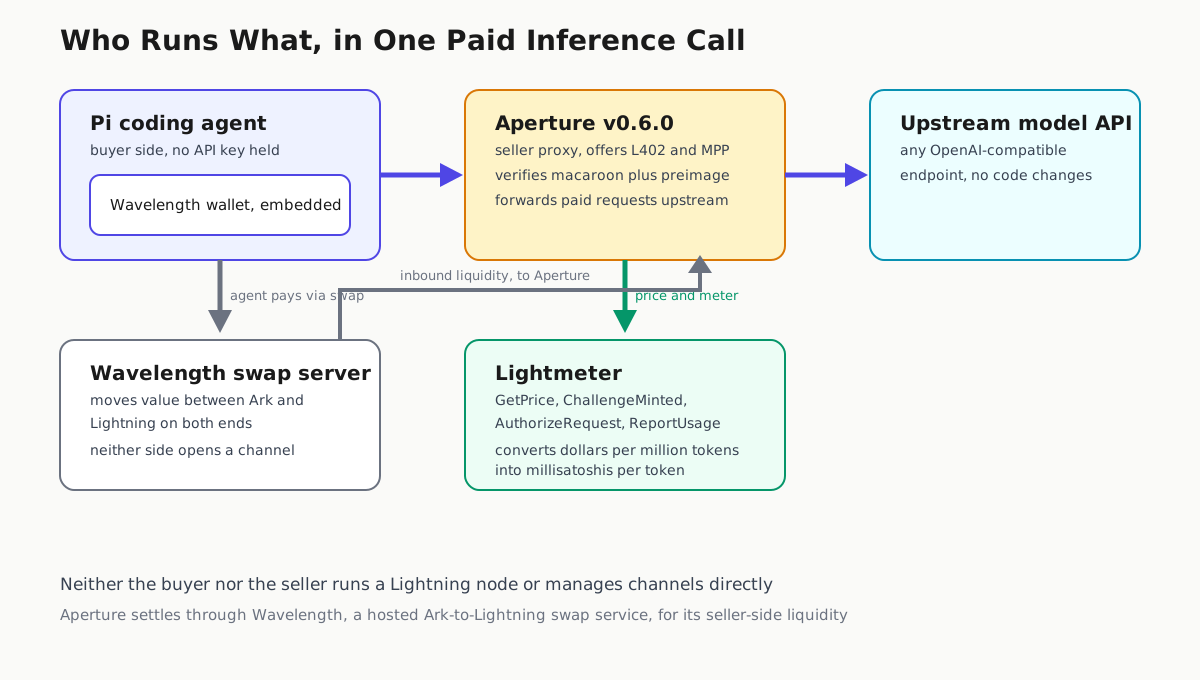
pi402 also answers a newer, competing standard. Stripe and Tempo have proposed the Payment HTTP Authentication Scheme, an IETF draft (MPP) with a similar shape but native support for session-style running balances. Lightning Labs’ reverse proxy, Aperture, now ships both in its v0.6.0 release, advertising L402 and MPP on the same 402 challenge and letting the buyer’s client pick whichever it understands. pi402 takes the MPP offer when a seller makes one and falls back to L402 otherwise, though the pi402.tech site notes session-style MPP isn’t usable yet because the swap-backed wallet can’t mint a return invoice.
| L402 | MPP (Payment HTTP Authentication) | |
|---|---|---|
| Credential | Macaroon + preimage | Payload carrying the preimage |
| Intent supported | Pay once, reuse until refused | charge (per challenge) or session (running balance) |
| Origin | Lightning Labs, since 2020 | IETF draft co-authored by Stripe and Tempo |
Metering by the token, not the request
A chat completion can cost a seller a few dozen tokens or a few thousand, and the seller only learns which after serving it. pi402’s companion tool, Lightmeter, converts a model’s published dollar-per-million-token rate into millisatoshis per token and runs four checks around every call: quote the bundle price before the 402 is minted, book the bundle against the credential, authorize each request against the remaining balance, then debit the usage the upstream actually reported once the response finishes. At roughly 1 msat per input token and 2 msat per output token, Lightning Labs’ post works out to about $0.80 and $1.61 per million tokens at current exchange rates — in the range of what metered API billing already charges, but settled per call instead of billed on a cycle.
A wallet inside the harness, on both sides
The part that removes the usual Lightning tax — running a node, managing channels, sourcing inbound liquidity — is Wavelength, Lightning Labs’ hosted wallet service, embedded directly into Pi via a WASM extension. A new /fund command inside Pi prints an invoice that lands in the agent’s wallet within seconds; /deposit returns an on-chain address for slower transfers that get swept in automatically. On the seller side, Aperture mints its challenge invoices from a Wavelength wallet instead of an in-house lnd node, with the swap server crediting Aperture’s seller-side wallet with inbound liquidity directly, so standing up a paid API doesn’t require running Lightning infrastructure either.
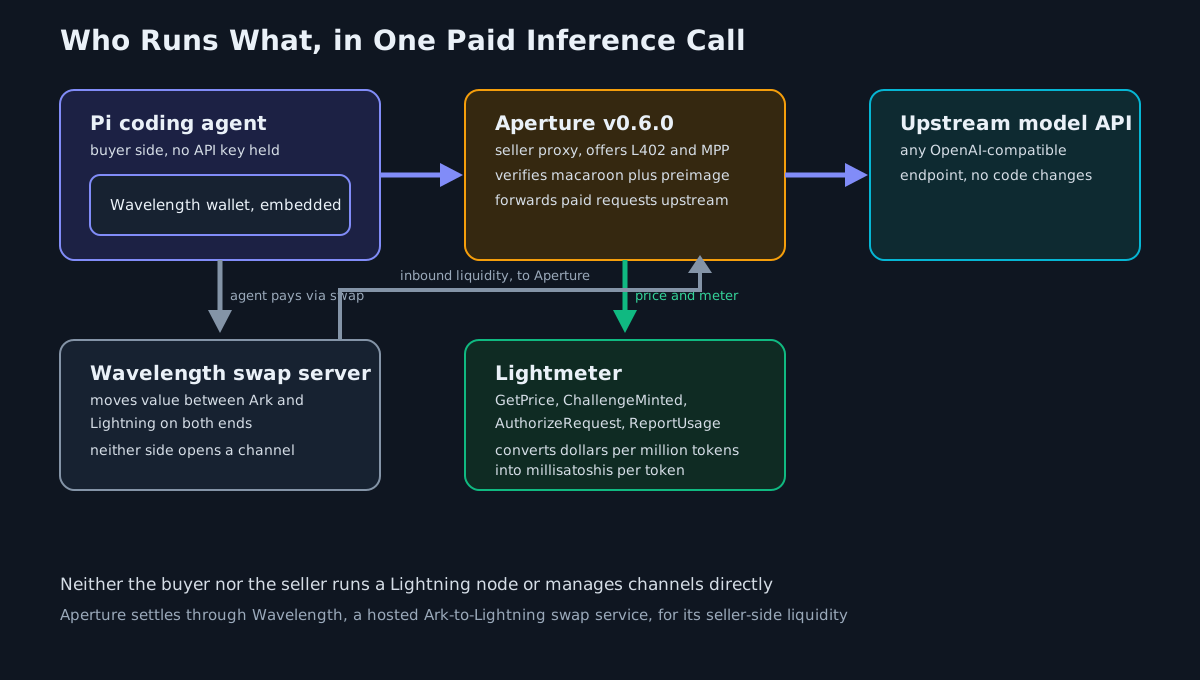
Operators who want to try it can be a buyer with:
pi install npm:@lightninglabs/pi-402
export PI402_MAX_SAT_PER_REQUEST=5000
export PI402_DAILY_CAP_SAT=12000
# inside Pi:
/fund 20000
Selling means putting Aperture and a price server in front of any OpenAI-compatible endpoint, which — per the project’s own framing — requires no change to the model API being sold.
What’s untested
pi402 is a day-one open-source release with no hosted endpoint and, as of this writing, no independent benchmarking of its claims about fraud costs or pricing parity with metered APIs — those numbers come from Lightning Labs itself. The MPP session mode that would let an agent run a standing balance against a seller isn’t functional yet. And the broader pattern it’s testing — a payment rail where the credential and the receipt are the same object — is one more operators of agent fleets will want to watch rather than one with years of production mileage behind this particular integration. For teams already thinking about how agents pay for mid-task services or comparing token-based billing against credit-based plans, pi402 is a concrete, inspectable alternative to add to that comparison, not yet a replacement for the meters most fleets already run — see also how operators are tracking multiple billing meters per job.