Expo Simulators Reaches General Availability: Cloud iOS Simulators Let Agents Verify Mobile Changes Without a Mac
Expo opened cloud iOS and Android simulators to all paid customers on Nov 12, letting Claude Code, Cursor and Codex install, run and attach PR evidence.
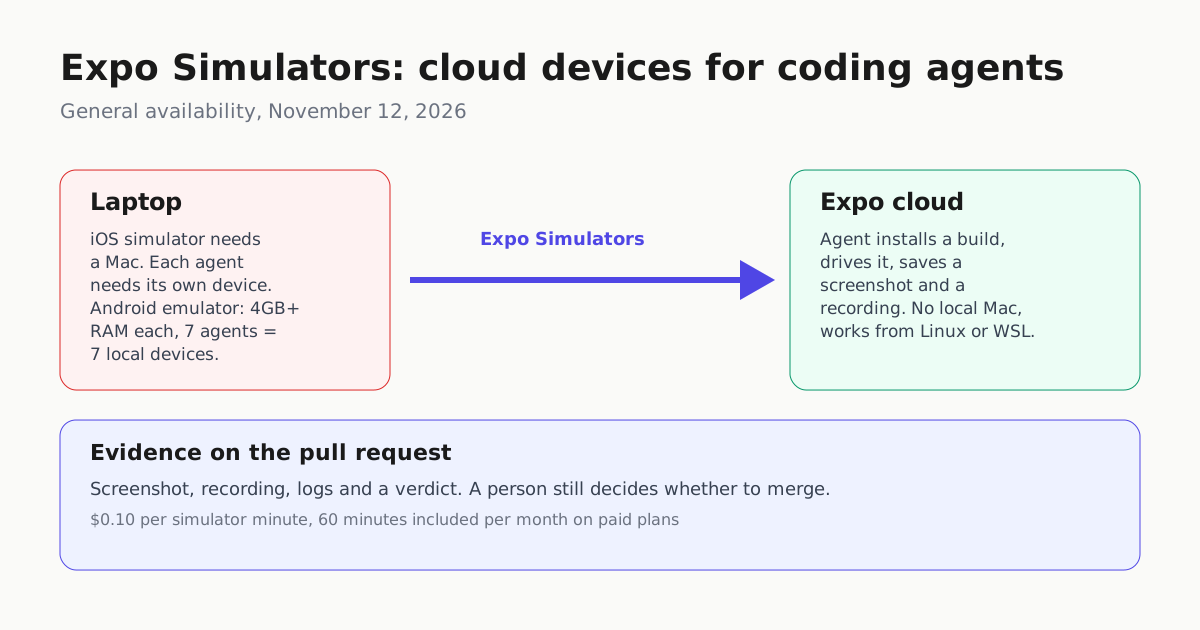
Expo opened Expo Simulators to everyone on its paid plans on November 12, 2026, moving the product out of the limited-access preview it opened on September 14. The service gives AI coding agents cloud iOS simulators and Android emulators to install a build, drive it, and return screenshots, recordings and logs as evidence on a pull request. As of November 10, Expo’s own blog was still pointing developers to a waitlist, so today’s change is the first time any paid customer, not a vetted preview tester, can start a session.
The bottleneck Expo is targeting
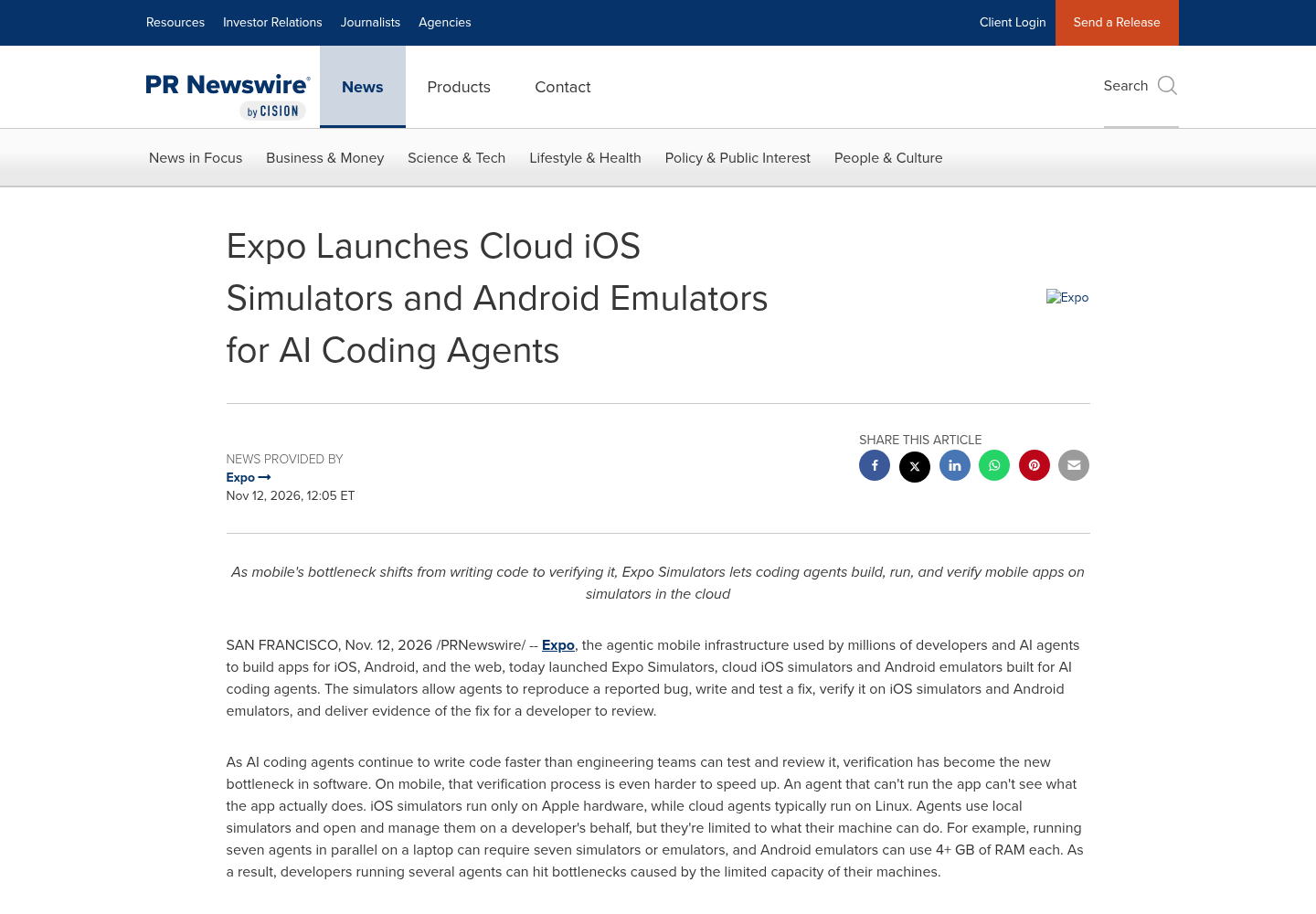
Expo’s pitch is specific: code generation has outpaced verification, and mobile makes verification structurally harder than it is on the web. iOS simulators run only on Apple hardware, while coding agents typically execute in Linux cloud sandboxes. An agent that cannot launch the app can inspect the diff but cannot confirm the diff fixes anything. Local simulators and emulators are also capacity-bound: Expo says seven agents running in parallel on one laptop can need seven simulators or emulators, and a single Android emulator can use 4 GB or more of RAM, which caps how many agents a developer can run at once (PR Newswire).
Expo Simulators moves that device compute off the developer’s machine. Sessions run on Expo’s infrastructure and are reachable from Linux, from Windows through WSL, or from a cloud sandbox — with no local Mac required even for the iOS Simulator (Unite.AI).
How an agent actually uses it
Expo’s documentation lays out a concrete loop, not just a hosted screen: build, install, launch, inspect, fix, re-verify (Expo docs). A bug report filed in a tool like Linear can trigger an agentic workflow where a coding agent reproduces the issue, writes a fix, and starts a remote device session with the eas-simulator skill. The agent then drives the running app through agent-device, Argent, or Appium — tools that return an accessibility snapshot the agent can act on, not just pixels — and saves screenshots or a screen recording as it goes (Expo agentic workflows docs).
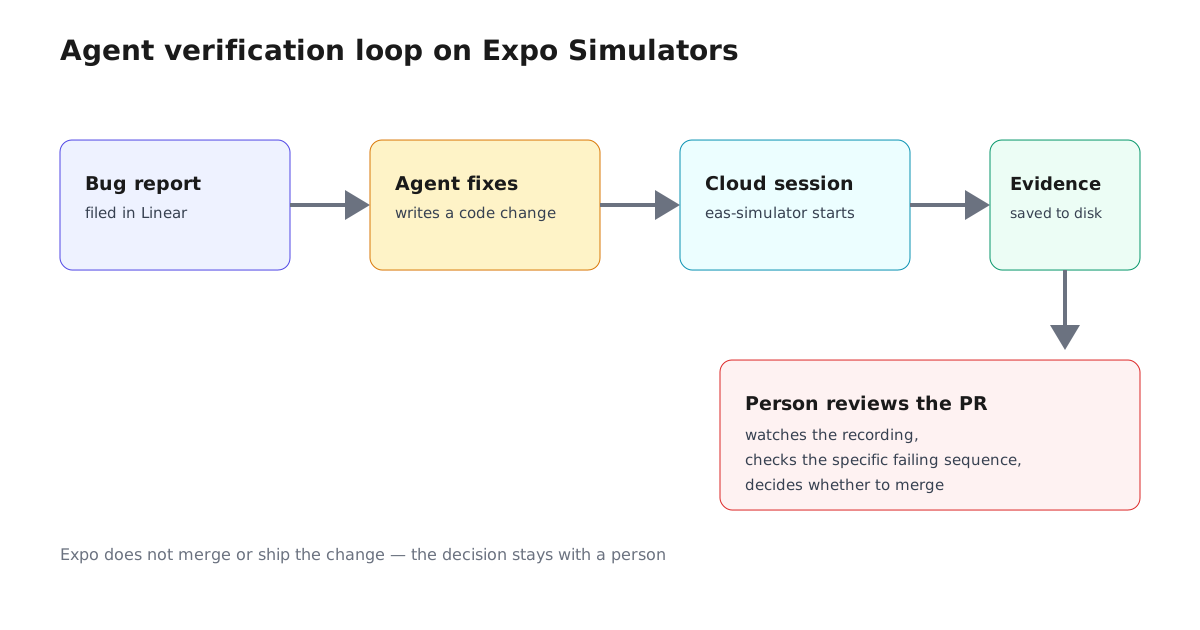
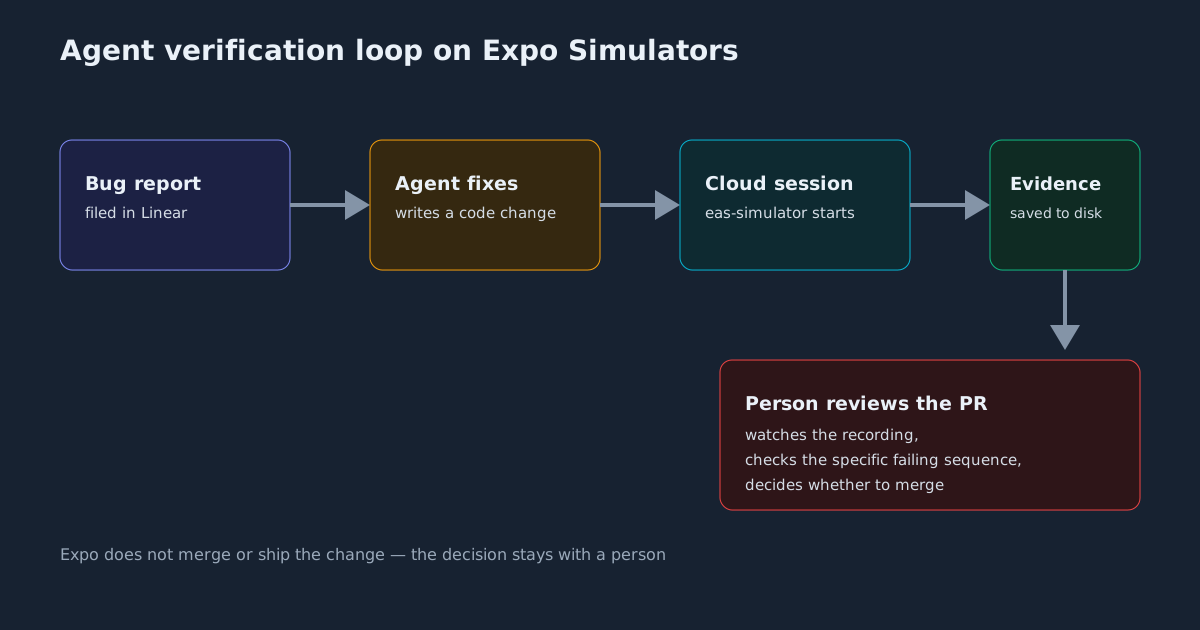
That evidence, plus a pass/fail verdict, lands on the pull request. Teammates can open the running build from a link with no TestFlight step. Expo’s co-founder and CTO James Ide framed the division of labor this way: “The agent was the fast part. Expo Simulators gives every agent a simulator, so a fix arrives for review already tested on several simulators, and the only decision left is whether it’s the right code. Watch it run, then merge” (PR Newswire).
Expo Simulators adds no model of its own — it’s a device runtime and an evidence pipeline that plugs into agents teams already run, including Cursor, Claude Code, and Codex. This is the same verification-first shift covered in our broader look at testing agentic software, where the bottleneck in agent-driven development keeps moving from writing code to checking it.
What it costs and what it doesn’t cover
| Detail | Value |
|---|---|
| Price | $0.10 per simulator-minute (iOS or Android) |
| Included minutes | 60/month on Starter, Production, Enterprise plans, through 2027 |
| Max session length | 115 minutes on paid plans |
| Needs a Mac for iOS? | No — remote session, browser preview available |
| Provides physical devices? | No — simulators and emulators only |
Two limitations matter for anyone wiring this into CI rather than clicking through a demo. First, Expo’s own limitations page states that session recordings can miss frames, so a clean-looking recording cannot prove or disprove a brief stutter — a profiler is still the right tool for timing questions. Second, a non-interactive CLI command returning does not stop the remote device; the session keeps billing until it’s explicitly stopped or hits a duration or idle limit, which makes cleanup part of cost control for any automated or fan-out workflow (Unite.AI).
A same-day review from Business Upturn pushes on the review side of that evidence: a passing recording only covers the exact sequence it recorded, and reviewers should ask for the specific before-and-after sequence that reproduces the original bug — not accept a generic “PASS” as proof the whole app works. The piece also flags that simulators can’t reproduce camera, biometrics, SIM, or carrier-dependent behavior, so a real-device pass or device-cloud run is still required before store submission (Business Upturn).
What’s next
Expo says its next release, Agent Sessions, will let enterprises trigger agents from sources like customer feedback while guarding against prompt injection — the risk that malicious input directs an agent to expose data. Expo expects to share details by the end of November 2026; it’s a disclosed roadmap item, not part of today’s launch.
For teams already running coding agents against React Native or Expo projects, the practical takeaway is narrower than “AI ships mobile apps now”: it’s that an agent’s claim of a working fix can now come with a recording and a browser-preview link attached to the PR, on infrastructure that doesn’t require every laptop in the building to run its own emulator. Teams evaluating this alongside a broader Expo setup for coding agents or comparing it to other emulator options for agent-driven integration tests should treat the verdict Expo Simulators returns the same way Business Upturn recommends: as narrow, checkable evidence for one reproducible case, not a release decision.
Sources
- Expo Launches Cloud iOS Simulators and Android Emulators for AI Coding Agents
- Best cloud mobile simulators for CI and AI coding agents — Articles — Expo
- Introduction to agentic workflows - Expo documentation
- Expo Opens Paid-Plan Access to Cloud Simulators for AI Coding Agents – Unite.AI
- Expo Simulators: what a passing demo does not prove · Business Upturn