Nvidia's Board Prepares to Oust Jensen Huang, With No Successor in Place
Nvidia's board is preparing to oust founder-CEO Jensen Huang, Semafor and the WSJ report. Some directors favor CFO Colette Kress as interim chief if he is removed — no decision has been announced, and there is no succession plan.
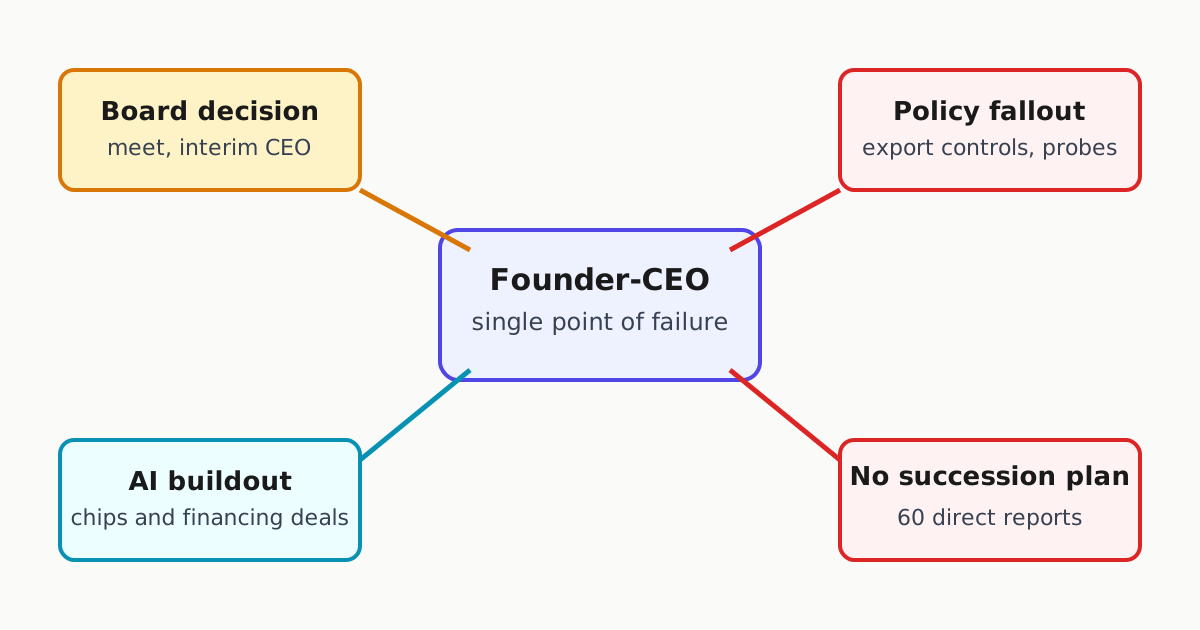
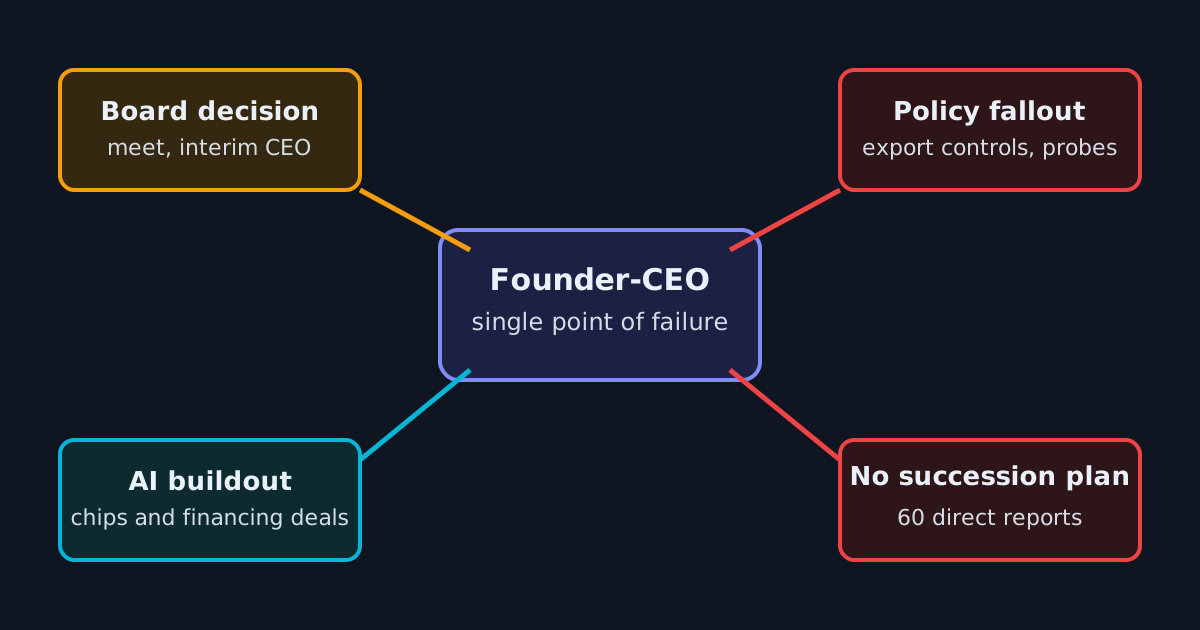
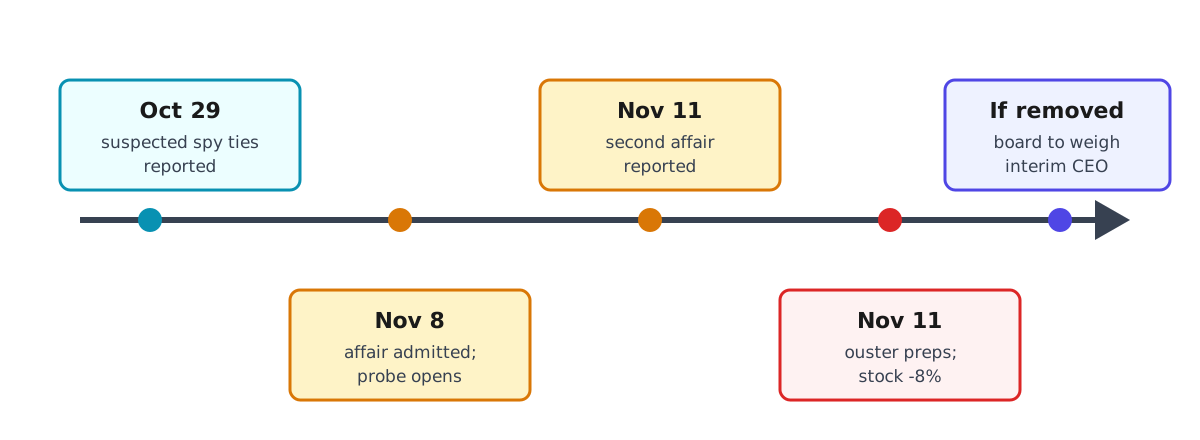
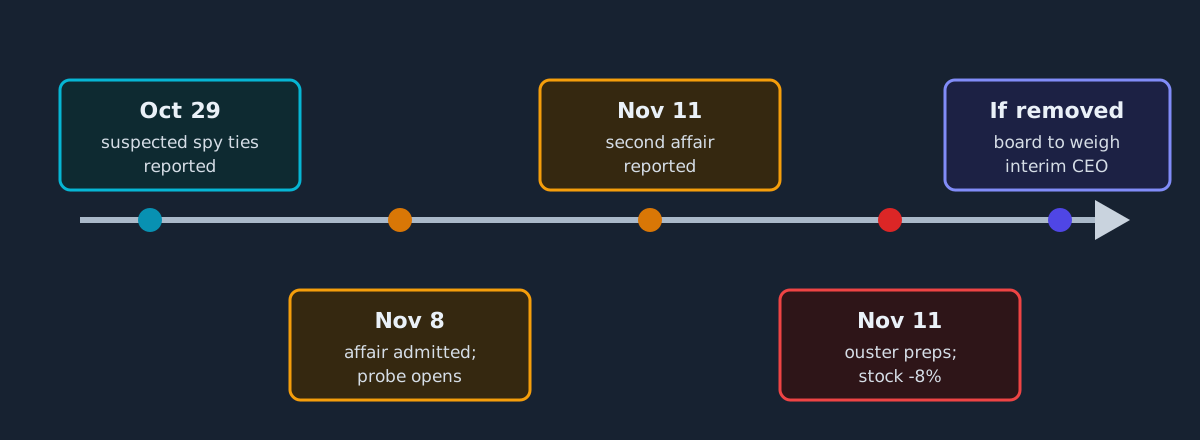
Nvidia’s board has moved from investigating Jensen Huang to preparing to remove him. Semafor reported on November 11 that directors were scheduled to meet that Wednesday evening, that some members favor CFO Colette Kress as interim CEO if the founder is ousted, and that the board briefed the White House on its plans. As of that reporting, the full board had yet to make a decision. The company has also tapped an outside search firm, with Apple hardware chief Johny Srouji among the candidates being considered, according to the report.
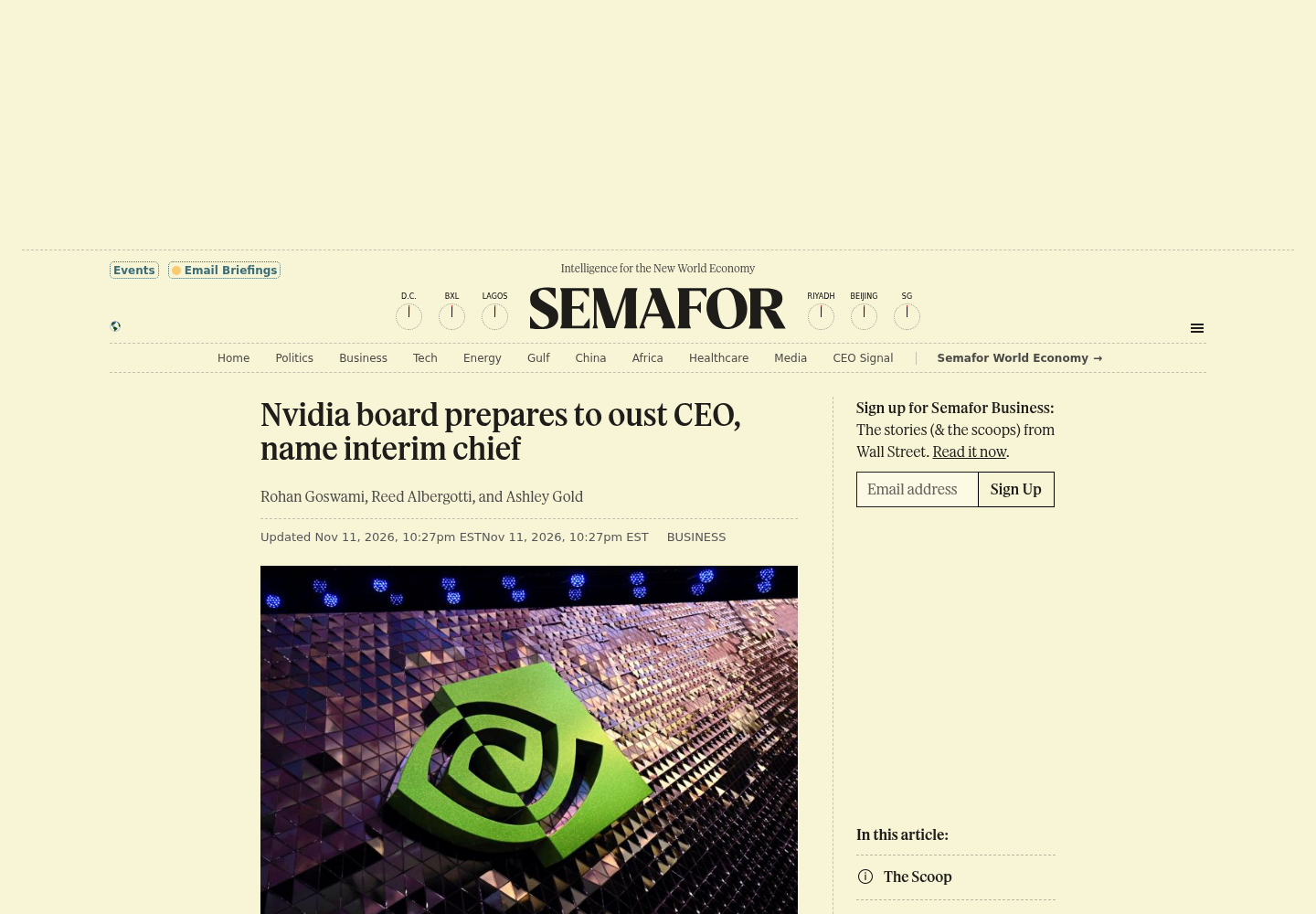
The trigger was a New York Times report, relayed by The Verge, of a second alleged affair — this time with Kimberly Powell, Nvidia’s vice president of health care, an executive who reports directly to Huang. That came days after Huang publicly admitted an affair with Alice Huang, a Megaspeed executive U.S. officials suspect is a Chinese spy, and the board opened a Wachtell Lipton-led probe into whether he divulged corporate secrets or endangered national security. Nvidia has not confirmed the second affair, and the board has not announced a final decision; what is reported is preparation, not a completed removal.
Why the market reacted immediately
Nvidia stock fell more than 8% in after-hours trading to a 52-week low, Semafor reported; TechCrunch’s timeline puts the stock down about 11% over five days. The sources establish the decline alongside the reports, not its precise cause. But for a company whose market value sits near $4 trillion, the episode highlights a structural risk investors now have to price: there is no succession plan. Huang famously delegates very little and keeps roughly 60 direct reports, and TechCrunch notes the company has never had an obvious successor.
That makes the interim question unusually consequential. Kress is the insider most often named, though analysts quoted in TechCrunch’s successor rundown question whether she is a natural innovator-successor. The same piece notes the board could keep Huang on as chairman — a role Nvidia does not currently have — while prediction-market traders on Kalshi put his odds of surviving the week at about 30%.
The blast radius reaches beyond Nvidia
Three consequences matter for people who don’t hold the stock:
AI infrastructure financing. Nvidia is not just a chip supplier anymore. As Semafor notes, it has entered billions of dollars worth of financing deals underwriting the AI buildout — direct stakes in the ecosystem’s expansion. A leadership vacuum at the top of that stack introduces counterparty and roadmap uncertainty for hyperscalers, neoclouds and anyone whose GPU capacity plans run through Nvidia. The company’s strategy spans silicon through software — CUDA, and its agent runtime work like Agent Substrate — layers a new leader would inherit.
Export-control enforcement. Sens. Elizabeth Warren and Chris Coons sent a letter to Trump cabinet members on Wednesday asking them to preserve documents on Nvidia chip exports to China and on Huang’s relationship with the suspected operative, writing that the incident “raises significant concerns about the federal government’s ability to effectively enforce our export controls.” Their letter claims officials at the White House, State Department and Commerce Department were aware of concerns about Nvidia and Megaspeed yet did not block the flow of advanced AI chips. Separately, TechCrunch reports House China Committee Chairman John Moolenaar said Huang would likely be subpoenaed if he does not appear for a closed-door briefing. Megaspeed reportedly purchased $4.8 billion in Nvidia chips over two years, and reporting on the suspected smuggling network is now part of the record driving congressional scrutiny.
Governance precedent for founder-led AI companies. The board briefed the White House before its meeting — an extraordinary step that reflects how entangled Nvidia has become with U.S. AI strategy. If the board does remove a founder-CEO who is also the industry’s chief salesman, mid-probe and before the investigation concludes, it would set a marker for how other AI firms weigh personal conduct against national-security exposure.
What is confirmed versus reported
Confirmed: Huang’s public admission of an affair; the independent investigation; the stock decline; the senators’ preservation letter; Nvidia’s silence (spokespeople did not comment to Semafor, and the company did not respond to The Verge).
Reported by major outlets, citing unnamed sources: the board’s preparation to oust Huang, the November 11 Wednesday-evening meeting, Kress as interim candidate, the outside search firm and Srouji’s candidacy, and the second affair with Powell. None of these has been confirmed by Nvidia, and the board had yet to decide as of the November 11 reporting.
For operators, the practical read is continuity risk at the most important supplier in the AI stack — not a product change. Nothing in the reporting indicates near-term disruption to chip supply or software support. But procurement teams locking multi-year GPU commitments, and investors underwriting the AI buildout alongside Nvidia’s own financing arm, now carry a governance variable that no roadmap briefing covers. Succession at a company this central to AI infrastructure was always a single point of failure; this week it became a live one.