NVIDIA Research: You May Not Need Long Context, and Late Tokens May Cost Up to 7x More
NVIDIA Research's new technical report argues that frequent context compaction costs almost no task accuracy, and that later tokens can cost up to 7x more to generate. What the preprint shows, what it does not, and what to test in your own fleet.
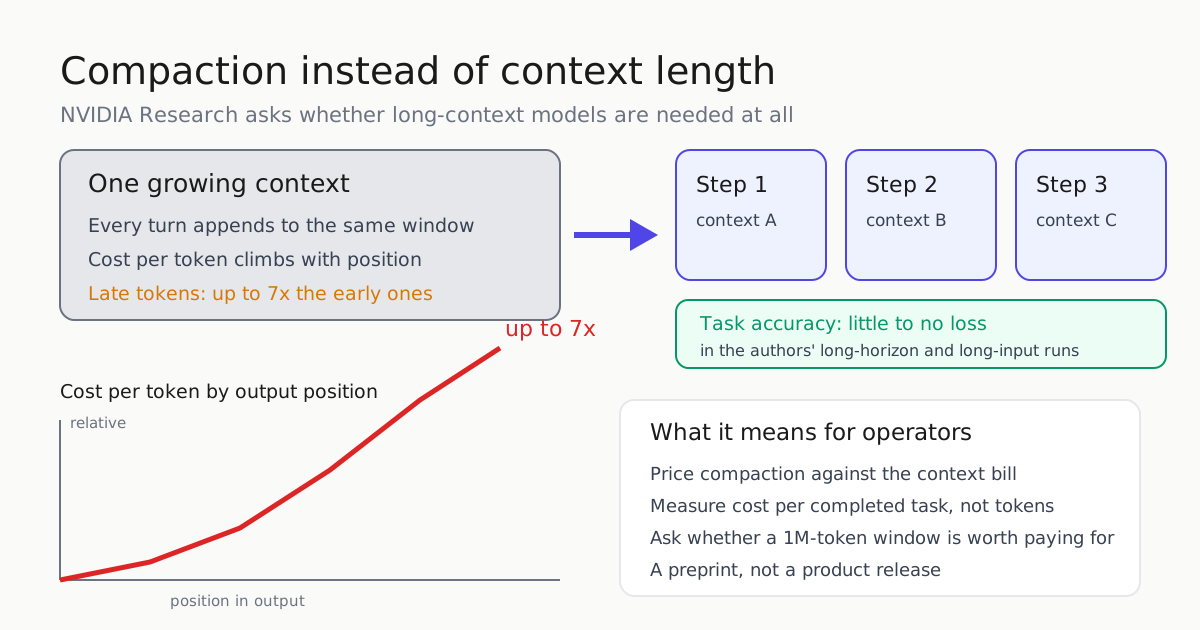
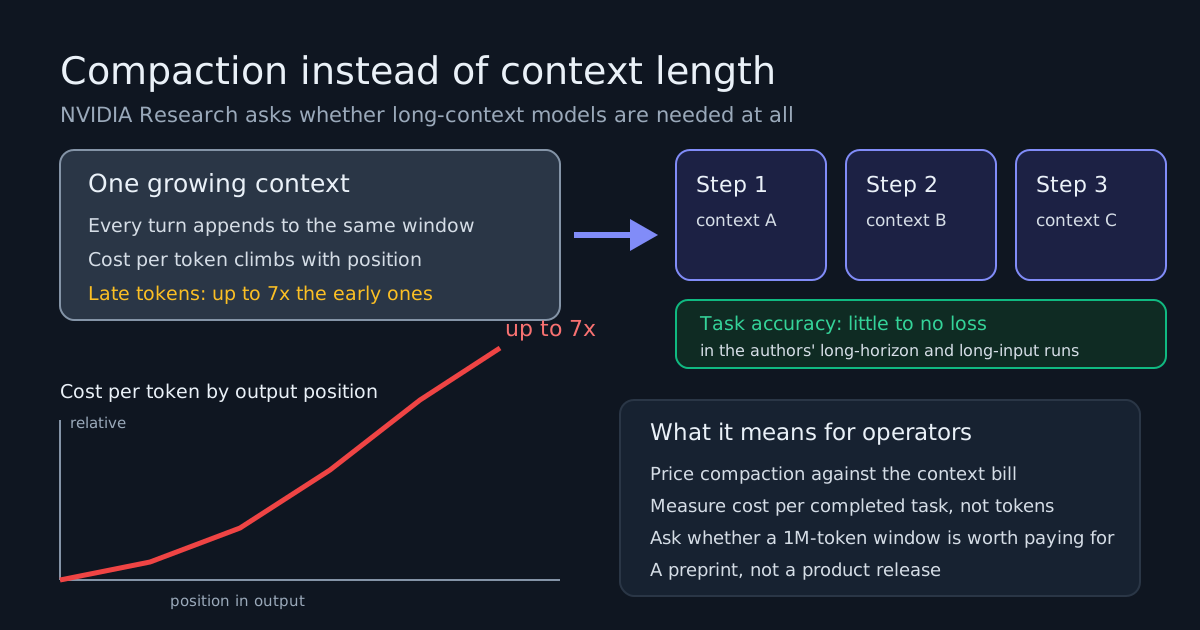
NVIDIA Research is arguing in public that a core assumption of agent infrastructure is wrong: that bigger context windows are a feature worth paying for.
The paper is “You don’t need long context”, arXiv:2611.05306, a technical report submitted on 3 November 2026 by Peter Belcak, Saurav Muralidharan, Jindong Jiang, Yonggan Fu, Wonmin Byeon, Hanrong Ye, Ryan Angilly, Ali Taghibakhshi, Shih-Yang Liu, Siru Ouyang, Greg Heinrich and Pavlo Molchanov. arXiv lists it as “Technical report. 31 pages, 8 figures.”
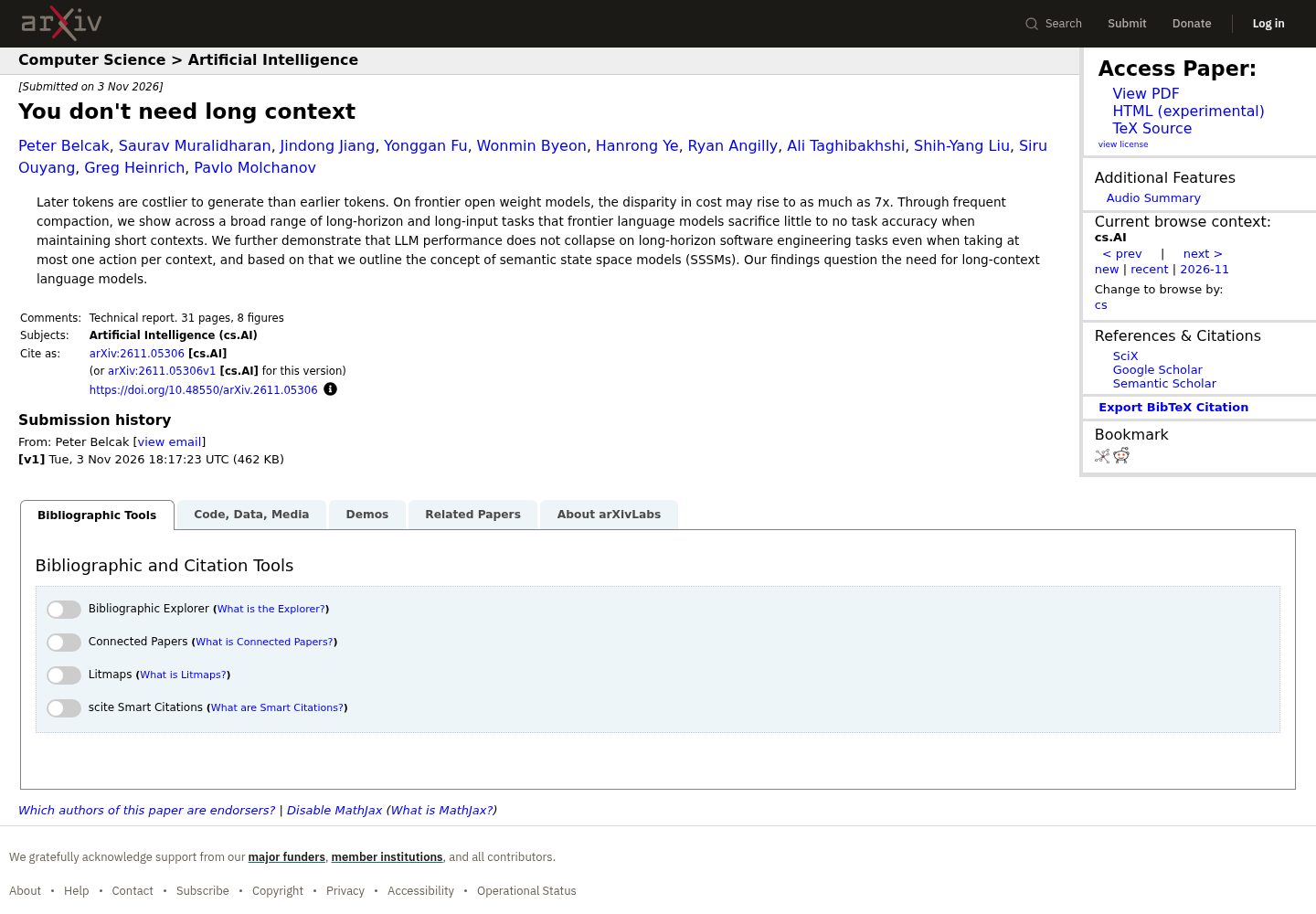
Three claims carry the argument, and they are worth separating from one another because each fails differently.
The three claims
| Claim | What the abstract states | What the abstract does not state |
|---|---|---|
| Later tokens are costlier | The cost disparity “may rise to as much as 7x” on frontier open-weight models | Which models, which pricing basis, or the shape of the curve |
| Frequent compaction is nearly free | Frontier models “sacrifice little to no task accuracy” when maintaining short contexts across a broad range of long-horizon and long-input tasks | Which tasks, how many runs, or any error bars |
| One action per context is enough | Performance “does not collapse” on long-horizon software engineering tasks when taking at most one action per context | Which harnesses, repositories or model families were used |
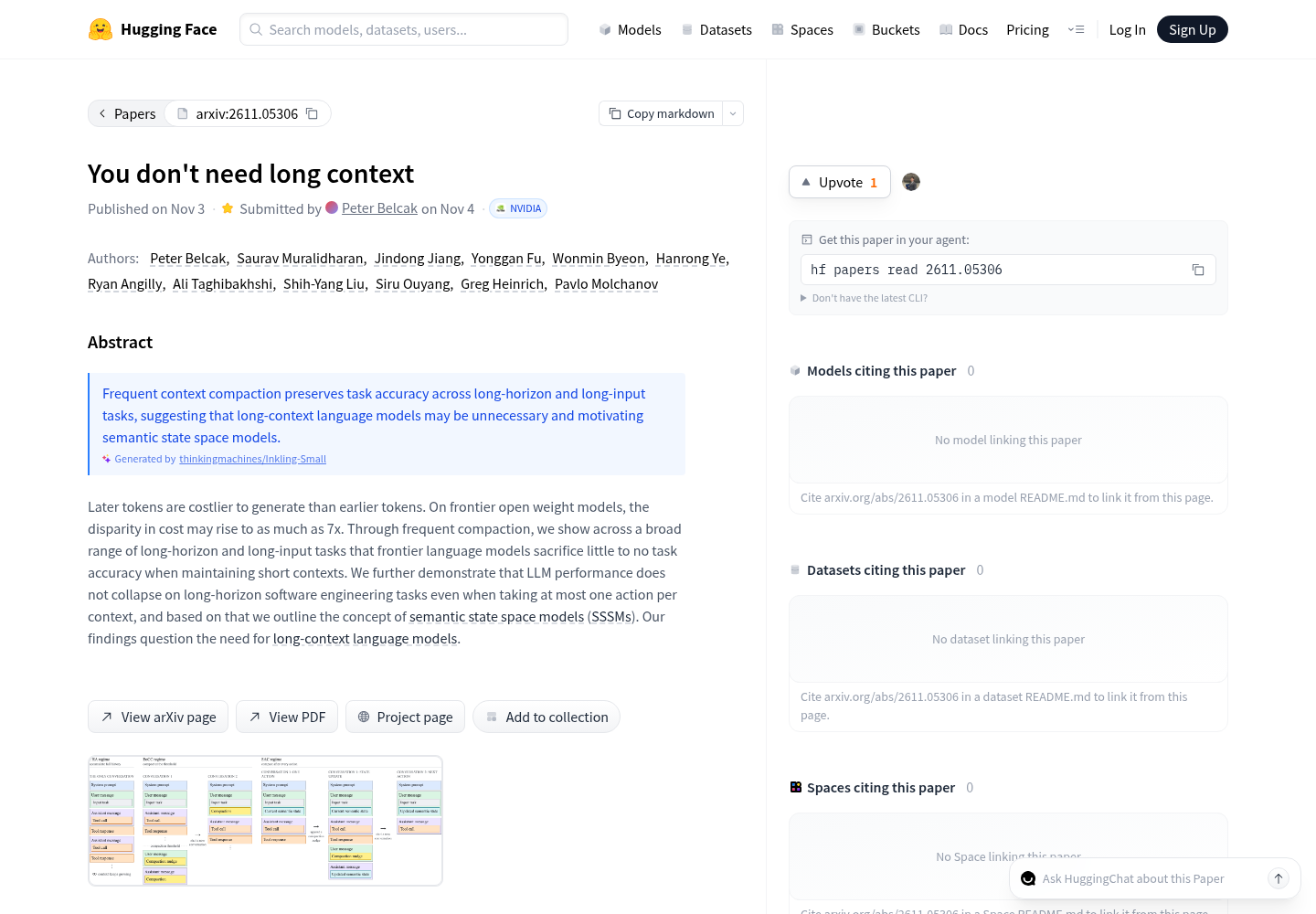
None of this is an availability announcement. There is no product, no feature flag and no API in the abstract. This is a preprint from one lab, the numbers are the authors’ own, and the Hugging Face paper page shows zero models and zero datasets citing it at capture time, which is what you would expect the day after submission.
Why later tokens cost more
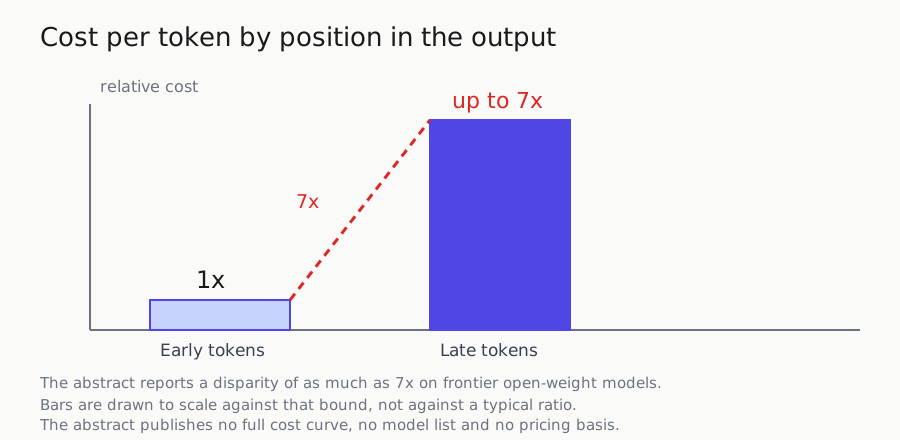
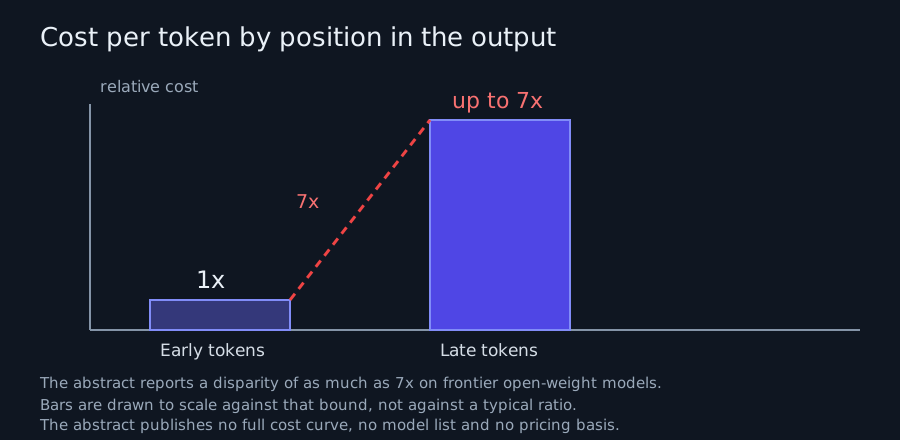
The first claim is the most immediately checkable, and it is the most consequential for anyone running agents at volume. If the marginal token in a long response costs multiples of the first token, then the pricing model that assumes a roughly flat per-token rate is wrong for agent workloads. The expensive part of an agent bill is not the opening turn. It is the long tail of a session that keeps appending to one window.
The abstract names no mechanism; it states only that later tokens are costlier to generate. In ordinary serving economics, cost per token climbs with prefix length as attention over a growing context gets more expensive to compute - that is operator-side context, not something the report itself asserts. What is missing is the part operators actually need - dollars per completed task at a given context length. NVIDIA’s own Local Frontier Intelligence page lists the paper under “Relevant work” alongside the lab’s AgentBaton, EdgeWise and Star Elastic work, and frames the same agenda: frontier intelligence delivered locally, with actionable knowledge held in context and systems rather than only in weights.
Compaction as a default, not an emergency
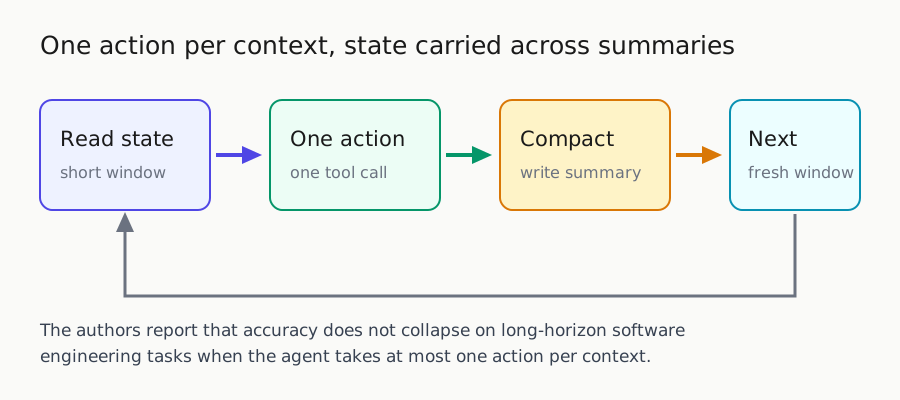
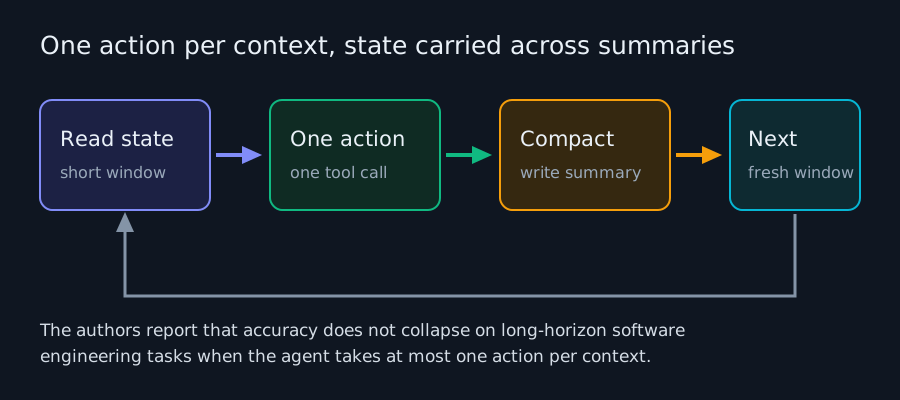
The second claim is the one that changes fleet defaults. Frequent compaction, the report says, costs essentially nothing in task accuracy across long-horizon and long-input tasks. The third pushes it further: on long-horizon software engineering tasks, performance does not collapse even when the agent takes at most one action per context.
Together these describe a different architecture from the one most harnesses ship today. Not “keep the transcript until it overflows, then summarize in a panic,” but “keep a short working context, write state out, and start the next context from a summary.” The report closes by outlining semantic state space models (SSSMs), a proposed framing in which context is treated as a state that is deliberately written and reset rather than a transcript that is merely tolerated.
This is not the first work in the direction. Microsoft Research’s Fork-and-Flush reset reported a similar result for keeping the files while wiping the chat, and OpenAI’s Agents API ships background compaction as a shipping product feature. What is new here is the cost argument attached to compaction, plus a single-lab claim that long-context models may not be needed at all.
What an operator should do with this
The safe operational reading is not “turn off long context.” It is “price compaction against the context bill, and start measuring it.”
A minimal compaction loop looks roughly like this - illustrative pseudo-code, not from the paper:
def run(task, short_window=32_000):
    state = load(task)
    while not done(state):
        action = model(state, max_context=short_window)
        state = compact(state, action)  # keep task-relevant facts, drop the transcript
    return state
Three things are worth doing now:
- Measure cost per completed task on a lane that compacts aggressively against one that does not. Our coverage of cost per completed task versus token price is the yardstick, not dollars per million tokens.
- Audit what your compaction step actually preserves. A summary that drops the name of the failing test is a silent accuracy loss, and “little to no accuracy” says nothing about your summary format.
- Re-check whether you are paying for context you never read, especially on a tier with a large advertised window.
The caveats
This is one lab’s preprint, on the authors’ own numbers, with no independent validation yet. The abstract names no benchmarks, no model families and no evaluation protocol, so a reader cannot yet check whether “little to no task accuracy” holds under a harness with a different tool set, a different summary format or a different failure mode. The 7x figure is explicitly a bound - “may rise to as much as 7x” - not a typical ratio.
The right posture is to treat this as a strong hypothesis with a cheap experiment attached, not as a reason to cancel a 1M-token contract. The experiment is cheap: run the same task with a short window and frequent compaction, and compare accuracy and dollars per completed task against your current lane. If the paper is right, you will find the accuracy curve flat and the bill lower. If it is wrong, you will have learned that for a fraction of the price of a wrong architecture decision.
Related reading: Claude Code context window explained and context engineering for agents that don’t forget.