ClickHouse Managed Postgres Goes GA, and the Xata Acquisition Points at Agent-Scale Databases
ClickHouse Managed Postgres goes GA, Xata adds copy-on-write branching and scale-to-zero, and a planned agent tier plus a billing change land with it.
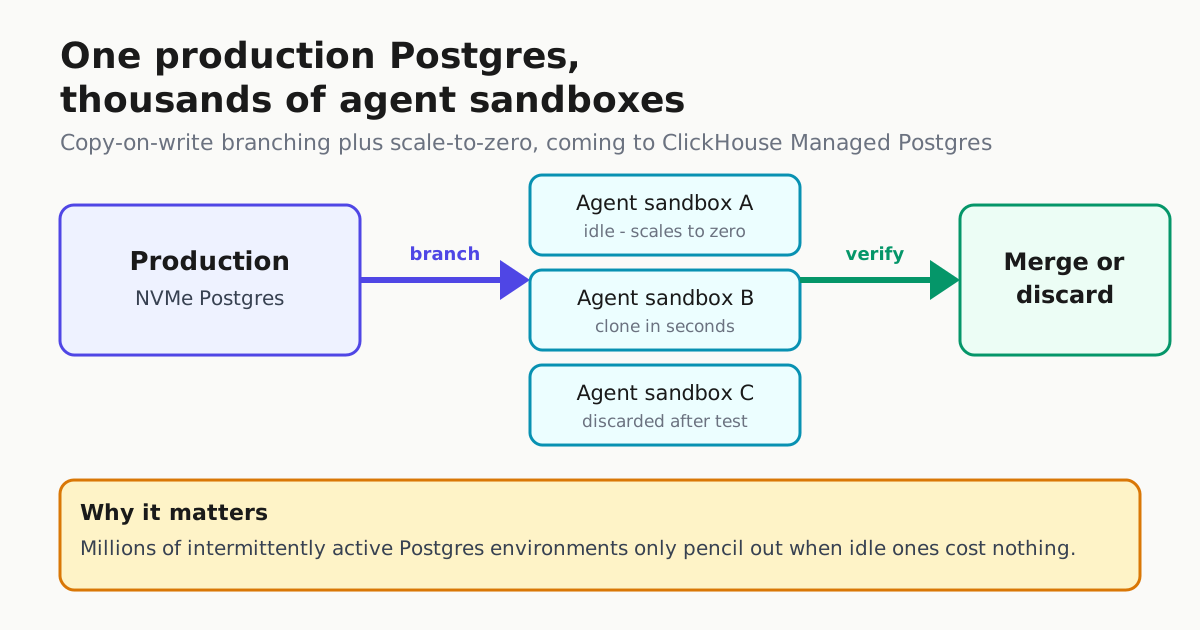
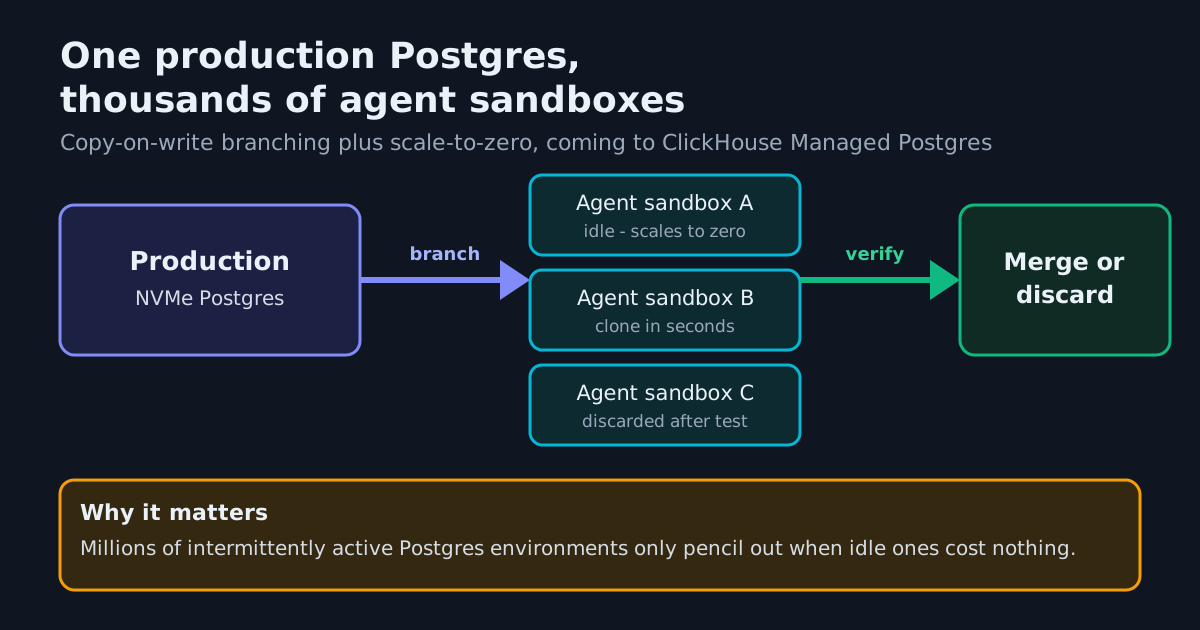
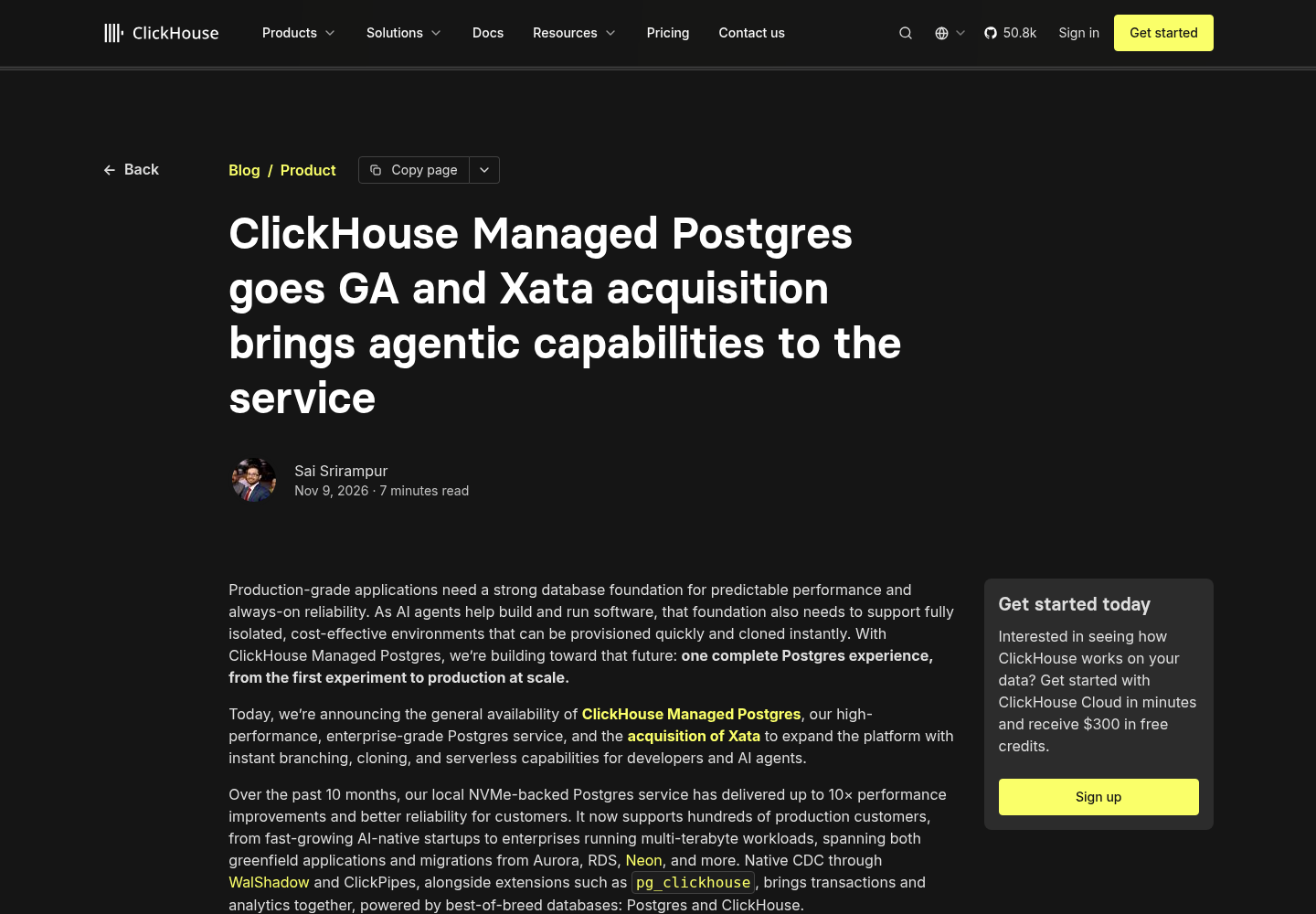
ClickHouse has taken its Managed Postgres service to general availability and acquired Xata, the company behind an agent-native, branchable Postgres platform. Announced Nov. 9, the move pairs local NVMe-backed production Postgres with Xata’s copy-on-write storage, instant branching and scale-to-zero economics — a combination aimed squarely at teams whose databases are provisioned and discarded by coding agents rather than by people.
What shipped today
The GA service is generally available on AWS today, with GCP still in private preview. It runs Postgres on local NVMe storage, which ClickHouse says delivers 2–10x performance improvements for OLTP workloads, and it now serves hundreds of production customers including multi-terabyte workloads and migrations from Aurora, RDS and Neon. Clay, one of the named customers, powers its next-generation platform on it.
The platform side is the more operational story:
| Capability | What you get |
|---|---|
| Replication to analytics | WalShadow consumes physical WAL for sub-second replication into ClickHouse; ClickPipes is a no-extra-cost alternative |
| Federated queries | pg_clickhouse lets apps query ClickHouse through the Postgres interface |
| HA | Up to two standbys across availability zones, automatic failover, PITR, automated backups |
| Scaling | Built-in PgBouncer pooling and dedicated read replicas |
| Automation | OpenAPI, Terraform and the ClickHouse CLI for programmatic (and agent-driven) control |
For agent operators, the Terraform/OpenAPI/CLI surface matters as much as the performance numbers: agents that manage their own infrastructure need a programmatic database API, not a console.
The billing change existing users should check
GA ends the beta discount. Backup storage and public network egress become billable, which ClickHouse says it communicated to existing customers and expects to be “modest for most.” If you ran a beta workload with large backups or heavy egress — common when replicating into an analytics pipeline — it is worth checking the pricing calculator before the next invoice. Native ClickHouse connectivity and ClickPipes replication remain included.
Why the Xata acquisition matters for agent workflows
The acquisition targets the pattern our Postgres MCP setup guide has long recommended manually: give each agent run an isolated, disposable database instead of a shared one. Xata’s Xatastor storage layer provides copy-on-write branching, so a developer — or an agent — can clone a production-shaped Postgres in seconds, test a migration or a feature against real data, and throw it away. Automatic idling and scale-to-zero keep hundreds of parallel branches from costing like hundreds of production instances.
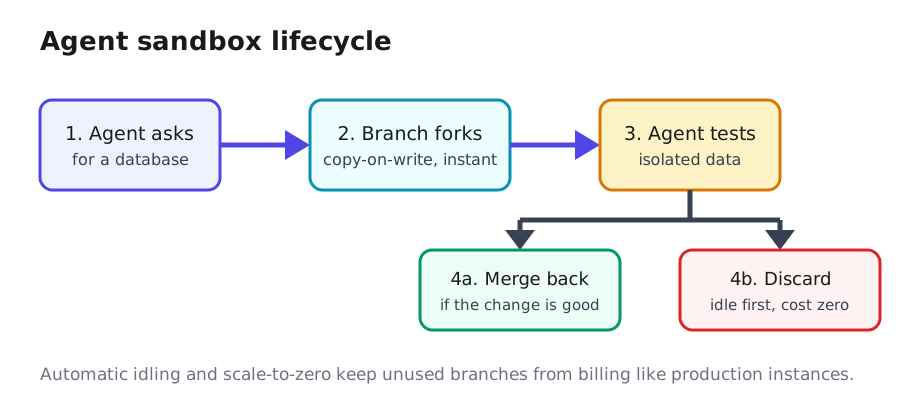
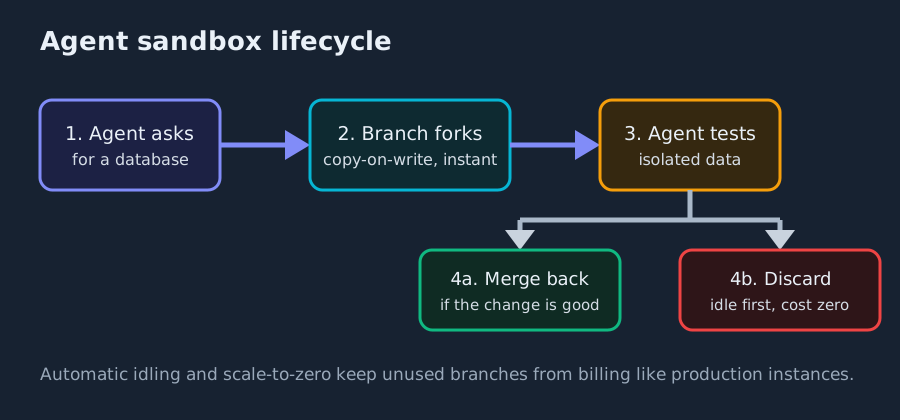
ClickHouse lays out two integration paths:
- Instant branches on NVMe production Postgres. Branch and clone isolated copies of production data with automatic idling, unified inside ClickHouse Cloud. David AI, a joint customer quoted in the announcement, says its developers and AI coding agents already run this workflow across two platforms today; the integration makes it native.
- A dedicated tier for agents. A new tier within Managed Postgres will support agent sandboxing, agent memory and agent-first workloads where elastic compute and ephemeral environments matter. ClickHouse’s stated goal is making it “economically to run millions of intermittently active Postgres environments.”
That second point is the strategic one. Agent fleets don’t need one big database; they need thousands of small ones that exist for minutes. Copy-on-write plus scale-to-zero is the cost model that makes that viable, and it echoes what we’ve seen from Vercel Drives for agent filesystems and Databricks’ Lakebase branching demos for agentic SDLC. The database layer is consolidating around the same primitive: branch, test, discard.
Part of a bigger platform push
The ClickHouse blog index shows this landing as part of the vendor’s largest expansion: Managed Postgres GA, ClickHouse Observability entering public beta, ClickHouse Security in private preview (built on RunReveal), and Langfuse launching an open-source AI Gateway on the same day. Read together, ClickHouse is assembling an agent-era data stack — transactional Postgres, analytics, observability, security telemetry and LLM gateway cost tracking — under one vendor and one cloud console.
What to do now
- On beta Managed Postgres? Audit backup sizes and egress against the new billing model.
- Need branchable Postgres today? ClickHouse says it is actively onboarding customers to Xata now; full integration is “coming months.”
- Running agent sandboxes on ad-hoc databases? The planned agent tier’s scale-to-zero economics are worth tracking against your current per-environment cost, and pairs naturally with the isolation practices in our Claude Code sandbox guide.
The open-source ClickHouse engine underneath (Apache 2.0, 50.8k GitHub stars) continues on its own release train; what’s new here is the managed Postgres-and-analytics surface and, soon, a database tier designed for workloads whose defining trait is that they don’t last.
Sources
- ClickHouse Managed Postgres goes GA and Xata acquisition brings agentic capabilities to the service | ClickHouse
- Learn about the latest ClickHouse tips, tricks and company announcements. | ClickHouse
- GitHub - ClickHouse/ClickHouse: ClickHouse® is a real-time analytics database management system · GitHub