Red Hat OpenShift 5 Goes GA: Lightspeed Becomes an Agent That Investigates Your Cluster — and Still Waits for Your Approval
OpenShift Lightspeed becomes a supervised cluster agent under GA MCP gateway governance, while autonomous alert investigation, VM sandboxing and agentic updates stay in technology preview and all AI capabilities remain opt-in.
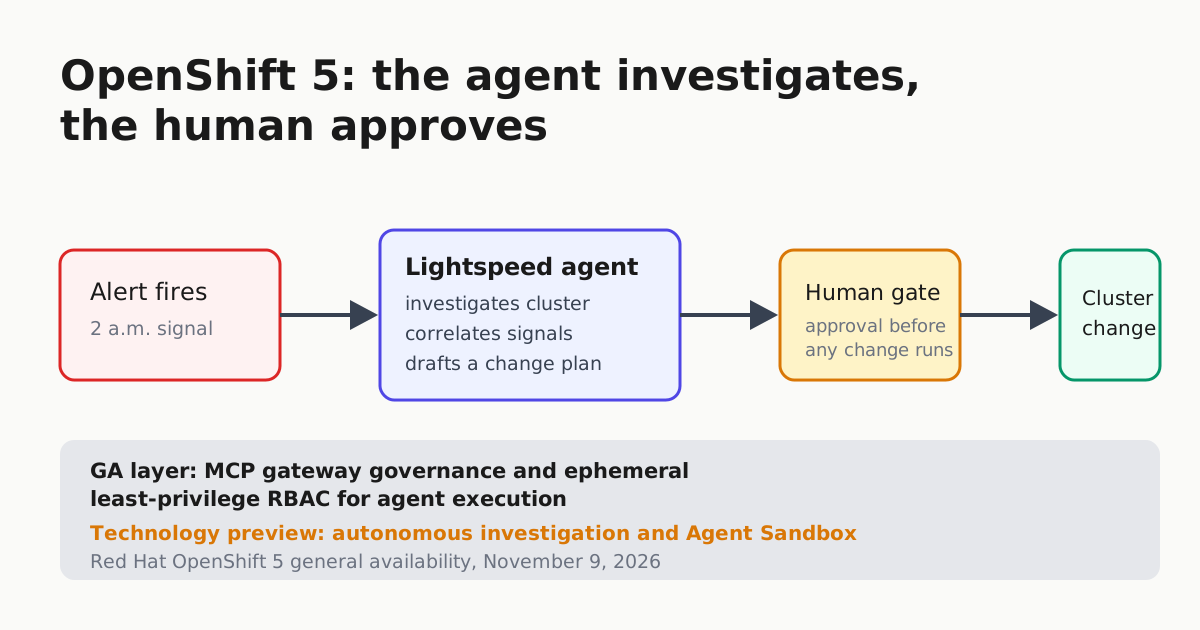
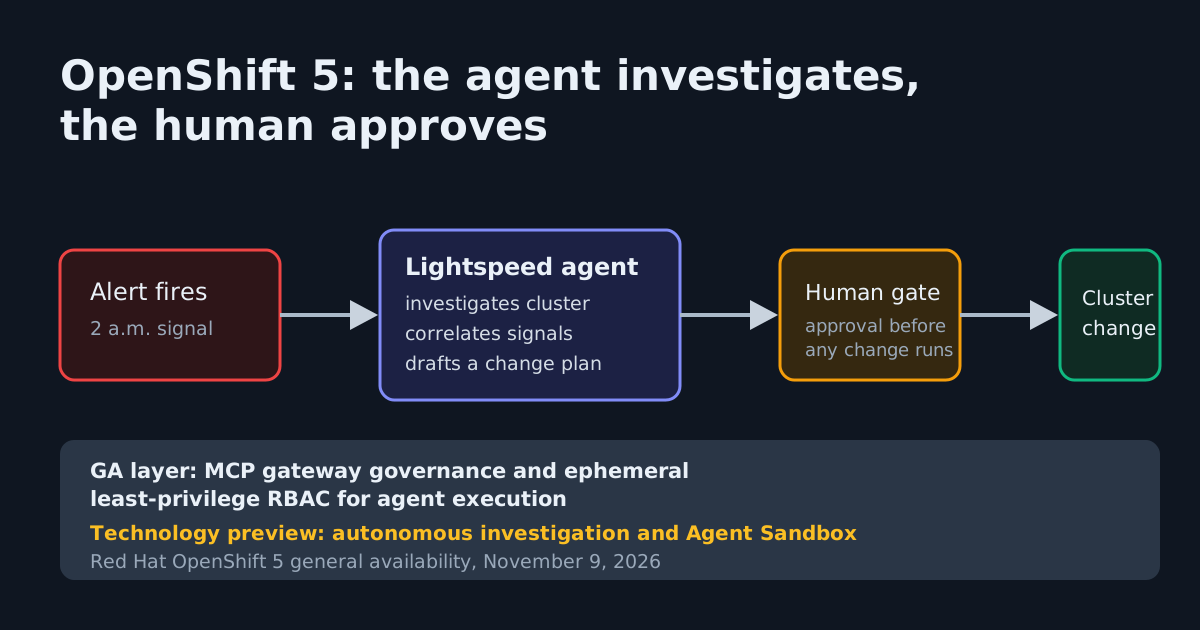
Red Hat shipped OpenShift 5 today, and the headline is not the Kubernetes version underneath it. The platform’s troubleshooting, update planning and dashboard-building workflows now run as supervised agent workflows: OpenShift Lightspeed moves from a chat assistant to an agent that investigates a cluster, lays out findings and prepares a change — then waits for a human to approve it before anything runs.
For the teams that will host coding agents and MCP workloads on this platform, the interesting part is less the feature list than the guardrail pattern Red Hat shipped here: agents do the legwork, a human owns the blast radius, and the plumbing that carries agent tool calls is governed rather than ad hoc. It is the same pattern our earlier coverage of the MCP gateway going GA described at the transport layer, now applied to a whole platform release.
What actually moved into agent hands
Red Hat splits the release into what is generally available and what is still preview, and the split matters for anyone planning to adopt it this quarter:
| Capability | Status | What it does |
|---|---|---|
| Lightspeed-augmented troubleshooting | GA | Describe a symptom in plain language; the agent traces a probable root cause and proposes a concrete fix |
| Autonomous alert investigation | Tech preview | On a firing alert, the agent investigates signals, formulates and verifies a resolution, then holds for approval |
| Perses dashboards from chat | GA | Ask for a chart instead of writing PromQL; the Cluster Observability operator builds the panel |
| Update risk analysis | GA | Pre-checks and real-time monitoring map conflicts and blast radius before a change window opens |
| Agentic updates | Tech preview | Lightspeed compiles an “agentic run” plan that an administrator reviews before the upgrade starts |
| AI-assisted installation | Developer preview | A cluster-creator skill walks Claude, Codex, Cursor or Goose through initial setup interactively |
The practical question for an on-call team is where the delegation boundary sits. Red Hat’s answer splits by mode: supervised troubleshooting proposes a fix and stops; autonomous alert investigation, still in technology preview, does more of the legwork but still cannot run a change without an approval. Either way, the operator’s review surface is the same artifact — findings plus a proposed next step — so the skill worth building on your team is reading an agent’s evidence trail quickly, not diagnosing from raw dashboards.
The guardrails are the story
Two design choices distinguish this from a chatbot bolted onto a console.
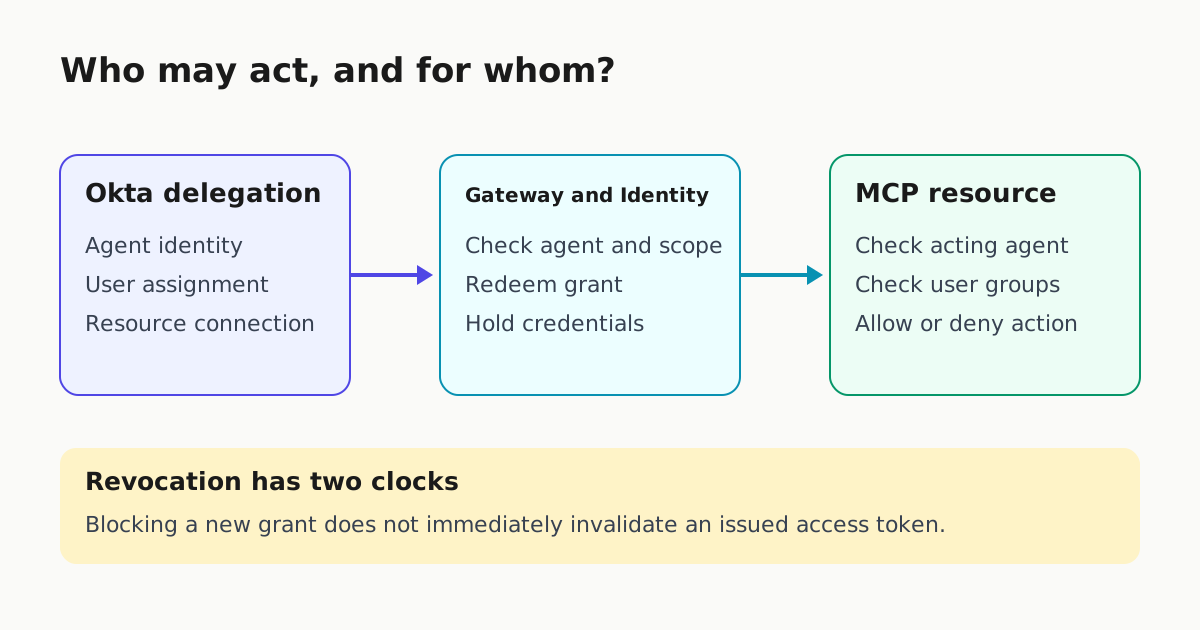
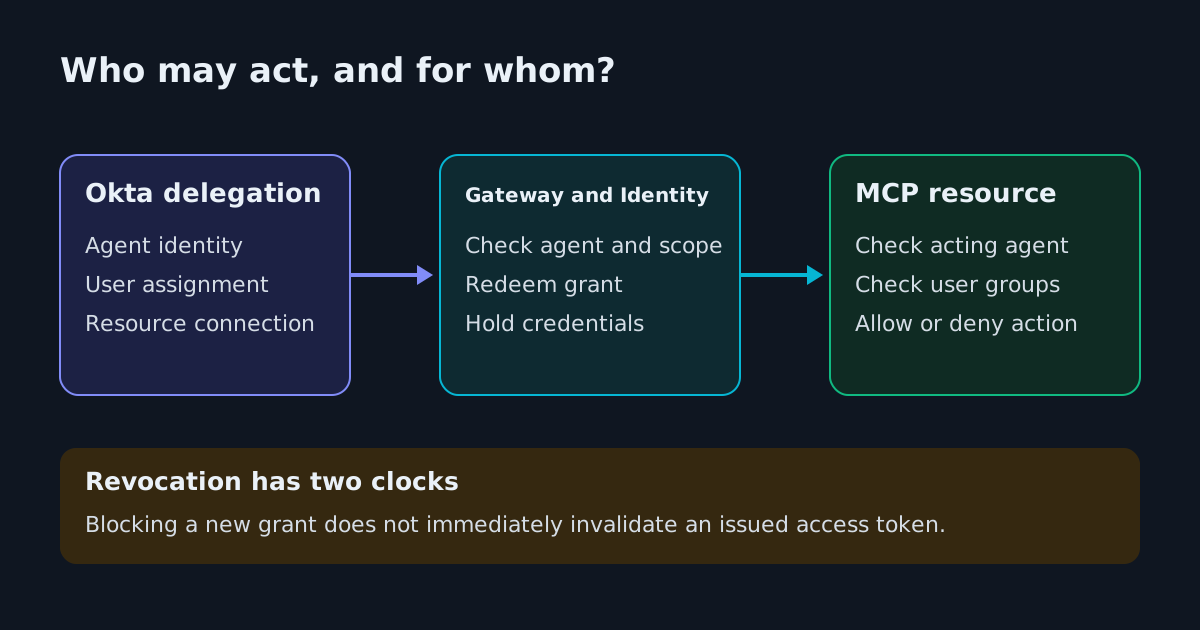
First, the agent’s execution context is deliberately ephemeral. Red Hat describes a short-lived, security-focused execution environment with temporary RBAC permissions enforcing least privilege, so an investigation does not leave standing credentials behind. State-changing actions pass through governance at the GA MCP gateway with human-in-the-loop approval, plus real-time guardrails validating prompts, payloads and tool calls. That is exactly the operational rule that an agent should be treated as a privileged user with scoped, revocable identity — access for the duration of a task, not a permanent role.
Second, the code agents write and run is treated as untrusted by default. The Red Hat build of Agent Sandbox (technology preview) uses OpenShift sandboxed containers to isolate agent workloads inside VMs — a hard boundary against unreviewed, agent-generated code reaching the broader cluster. That is the same threat model as any coding agent running npm install or executing its own fix scripts on your infrastructure, and it maps to the supervised-workflow anatomy where each delegated step has an explicit owner and an explicit stop point.
The MCP plumbing also hit GA: the MCP server for OpenShift plus the MCP gateway via Red Hat Connectivity Link mean platform APIs are reachable by agents through channels security teams can actually govern, rather than through ad hoc service accounts.
Update from 4.22 is deliberately boring
Adoption friction was clearly a design constraint. Red Hat describes the update from OpenShift 4.22 as “uneventful” — an in-place minor-release-style update with no migration plan. An existing cluster stays on RHEL CoreOS 9 while new 5.0 clusters default to CoreOS 10, with coexistence of the two coming in a future release so node OS moves happen on your schedule.
The lifecycle math changed too, and it is the part finance and compliance teams will care about: standard support per release extends from 18 months to 24, and Extended Life Cycle releases (replacing EUS) carry up to 5 years of total support on a 3-year major-release cadence aligned roughly a year behind RHEL. A new update planner for operators surfaces compatibility and end-of-life status centrally — Red Hat’s own example shows operators running past their support end dates.
What to do with it
- If you run OpenShift 4.22: start the in-place update path and re-check your update calendar against the 24-month and ELC lifecycle changes before you budget 2027 platform work.
- If triage eats your on-call: the GA troubleshooting and dashboard workflows are the low-risk entry point — supervised mode proposes, you confirm, and nothing autonomous touches the cluster.
- If you plan to run coding agents on the cluster: the MCP gateway and ephemeral RBAC execution are the GA pieces to evaluate first; Agent Sandbox is still technology preview. Adopt the agent features with the same approval gates you would demand of a human contractor, and inventory which service accounts your agents currently hold — permanent standing access is the failure mode this release is engineered to avoid.
- If you are on ROSA: agentic troubleshooting is live in the ROSA console with answers grounded in official OpenShift and ROSA documentation, and OpenShift 5 arrives on the hosted control plane architecture.
All AI capabilities are opt-in per Red Hat, which is the right posture while autonomous troubleshooting and agentic updates sit in technology preview. The supervised GA tier is where the practical value is today.
Sources: What’s new in Red Hat OpenShift 5, Red Hat OpenShift 5: The intelligent application platform, and How OpenShift 5 transforms ROSA operations.