Google Launches Gemini Decisions API: Gemini Decision 1 Scores Up to 1,000 Questions per Call at $0.10 per Million Input Tokens
Google's new Decisions API and Gemini Decision 1 model return probabilities and confidence scores for bounded choices instead of generated text. It is live in AI Studio and on Vercel's AI Gateway, and the benchmark claims come from Google itself.
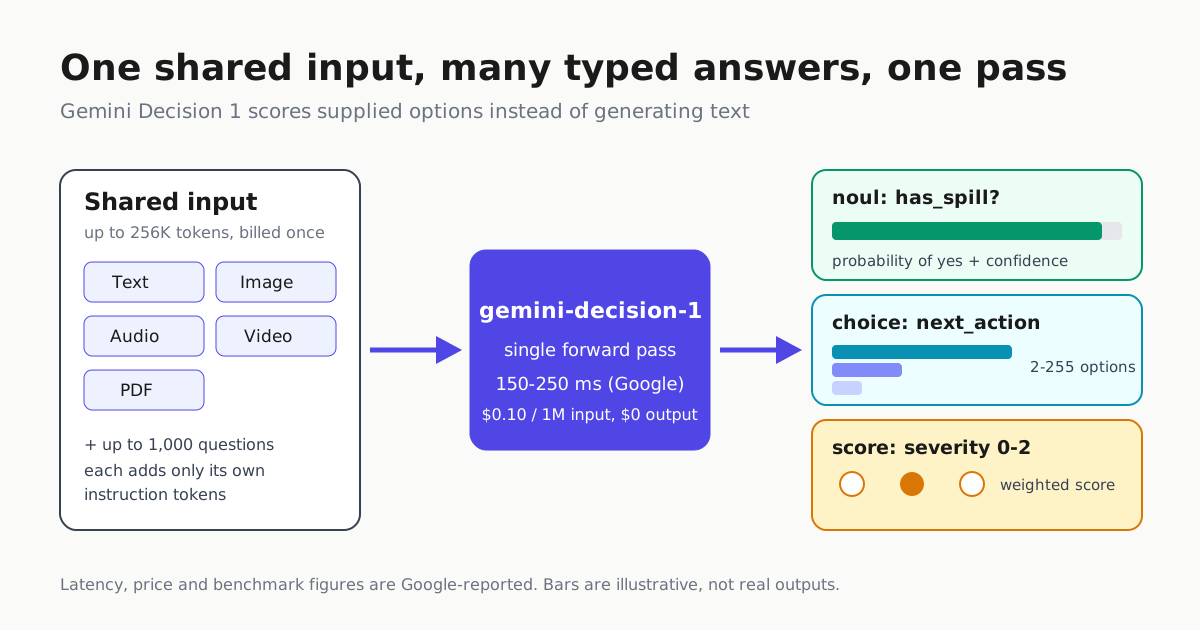
Google has shipped a model that doesn’t write answers. The Gemini Decisions API, announced on Nov. 11, 2026 by Google DeepMind’s Min Choi and Felix Yu, is a new endpoint served by Gemini Decision 1 (gemini-decision-1). You give it one multimodal input and up to 1,000 closed-set questions. It returns a probability and a confidence score for each answer, and Google says one request takes 150-250 ms end to end.
Agent builders already run small checks of this kind in front of real work: which tool should run, which model tier should take this request, does this content break policy. Google is now selling that layer as its own product, priced at $0.10 per million input tokens with no charge for output.
What shipped, and where
The API is available now through the Gemini API in Google AI Studio. It has Python, JavaScript and REST guides and a no-cost tier for prototyping. Google lists four uses for it: tool selection, policy checks, model routing and context grading. One input can mix text, images, audio, video and PDFs, up to 256K tokens.
Availability differs by surface:
| Surface | Status per primary or vendor source |
|---|---|
| Gemini API / Google AI Studio | Live, with a free prototyping tier |
| Vercel AI Gateway | Live as google/gemini-decision-1 (Vercel changelog) |
| OpenRouter, LangChain, LiteLLM, Pydantic AI, Pipecat, LiveKit, OpenCode | Google says integrations are “rolling out”; OpenRouter has a model page |
| Gemini in Google Cloud | “Coming soon”, not available yet |
If your company buys AI through Google Cloud rather than AI Studio keys, you can’t use this through Cloud yet. Google has announced it there but hasn’t shipped it.
How a call works
Gemini Decision 1 doesn’t decode an answer token by token. It scores the options you supply in a single forward pass. A single request can mix three question types:
| Type | What it returns |
|---|---|
noul (yes/no) |
Probability that the condition holds |
choice (2-255 options) |
Winning option plus normalized probabilities for every candidate |
score (ordered rubric) |
Continuous weighted score plus per-level probabilities |
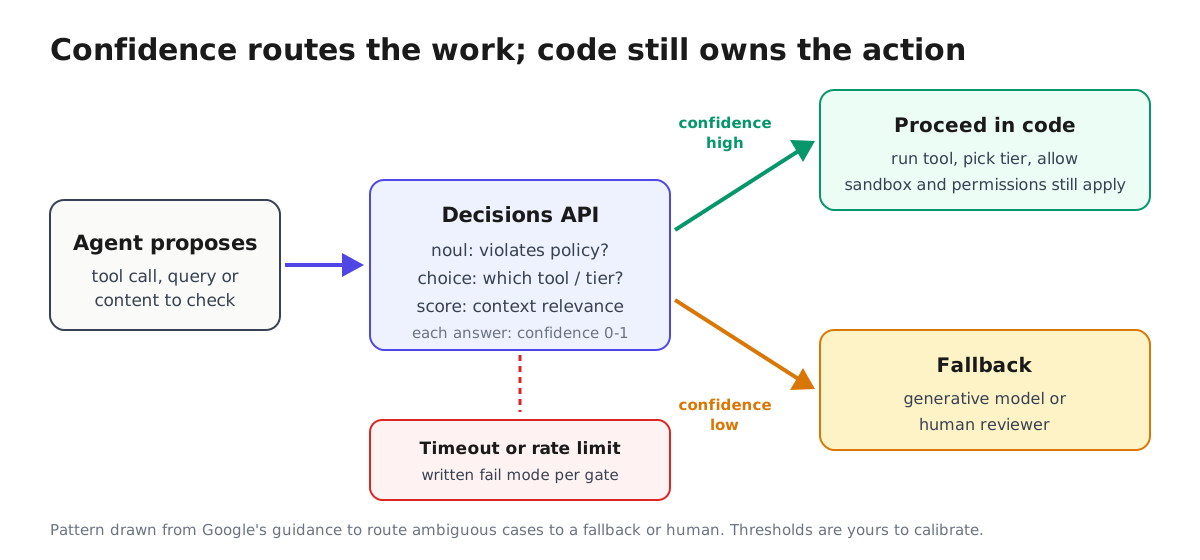
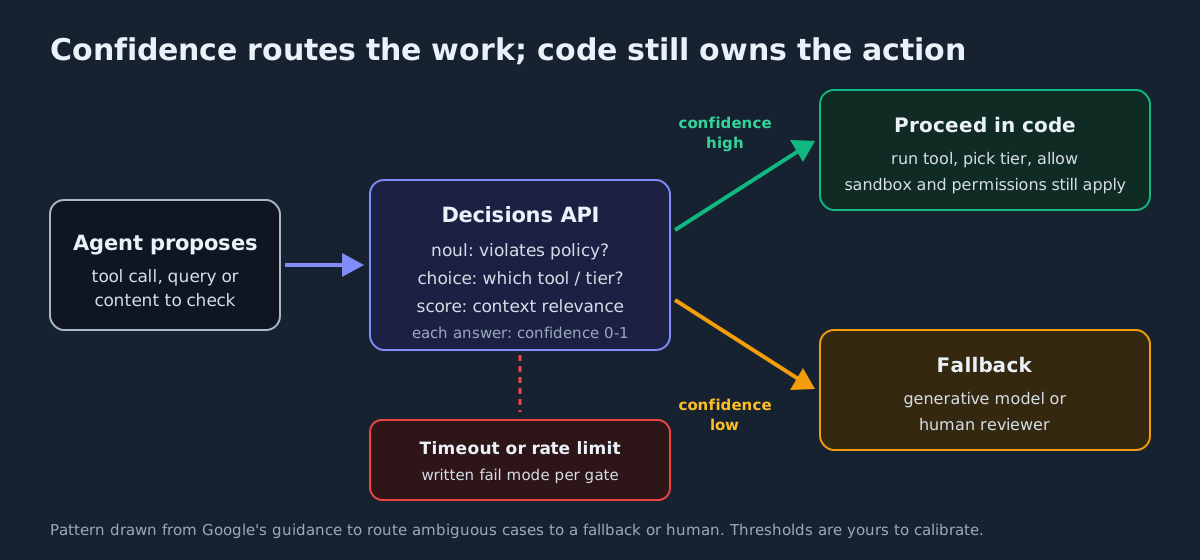
Every answer carries a confidence score from 0 to 1. Google says the point is to let “your code route ambiguous cases to a fallback or human reviewer.” This is a shortened version of Google’s own example:
result = client.decisions.create(
    model="gemini-decision-1",
    input=[{"type": "image", "uri": "...spill.jpg", "mime_type": "image/jpeg"},
           {"type": "text", "text": "Breakroom counter check before the 9 AM client meeting."}],
    questions={
        "has_spill": {"type": "noul", "instructions": "Is there an uncleaned liquid spill on the counter?"},
        "severity": {"type": "score", "instructions": "Rate the severity of the counter mess.",
                     "criteria": ["Clean and ready.", "Minor localized spill.", "Major spill or safety hazard."]},
    },
)
The bill is all input
Google bills the shared input once per request, however many questions you ask. Each question adds only the tokens in its own instructions and criteria. There are no output tokens, no thinking tokens and no separate fees for transcription or OCR. Here is a rough example (our arithmetic, not a Google figure). A 2,000-token input with 20 questions of about 50 tokens each comes to roughly 3,000 input tokens, or about $0.0003 per request. A million such gate checks would cost about $300.
Google says that across its shared benchmark suite, the Decisions API is “nearly 5x cheaper” than running Gemini 3.5 Flash-Lite through the Interactions API. According to AlphaSignal’s write-up, that comparison holds even when Flash-Lite is credited with zero billed output tokens. AlphaSignal adds that real savings will depend on input size, how many questions you batch per call, retries and how often you fall back.
What the evidence doesn’t settle yet
The benchmarks are Google’s own. Google says Gemini Decision 1 “leads across the suite” on agent routing, reasoning, ranking and multimodal benchmarks, with the lowest calibration error. Nobody has reproduced those results independently. Calibration is the property this product depends on: a well-calibrated 0.7 should be right about 70% of the time. Check it against your own labeled traffic before a threshold controls a tool call. Our coverage of Artificial Analysis’ Decision Index v2 shows how third parties have started scoring this category.
The latency numbers have conditions. Google gives a median of 50-100 ms of model compute (150-250 ms end to end) for inputs up to 16K tokens, and says latency stays “nearly flat” from 1 to 100 questions per request. Google doesn’t give latency figures for inputs near the 256K limit or for requests near 1,000 questions.
Modality support depends on the surface. Vercel says PDF, audio and video inputs work only through AI SDK 7. Its TypeSafe-compatible API and its Decisions API accept only text and images. AlphaSignal reports that the BenchLM model card lists only text, images and PDFs as inputs.
Field names change between surfaces. Google calls the yes/no type noul. Vercel’s AI SDK example uses type: 'boolean' and calls it through experimental_decide. We saw the same mismatch with an earlier decision model in our endpoint-dialect runbook. Policy code that reads the wrong field name won’t throw an error. It just goes down the wrong branch.
Why it matters
AlphaSignal reports that OpenAI put a Decisions API into public beta on Oct. 6 and that Microsoft released Microsoft-Decision-1 on Oct. 9. Google is the third major lab to sell a model that returns a decision instead of text. What sets it apart is native multimodal input and a published price with no output charge.
Google names some internal users. It says Gemini Notebook routes queries between model tiers with the API and serves everyday queries with “up to 40% lower latency.” It also says Google Search uses the API as a safety layer for MCP tools. Both claims come from Google and haven’t been checked by anyone else.
For agent teams, Google’s announcement suggests a practical next step:
- Run it in shadow mode first. Log its answers next to your current router or classifier and compare decisions, not raw probabilities. Our shadow-mode guide describes this setup.
- Use confidence to choose the route, not as permission to act. Low-confidence answers should go to a fallback, and destructive tools should keep their sandbox and permission rules whatever the gate says. See confidence gates before the tool runs.
- Write down what each gate does when the API times out or rate-limits you before it goes into production. The fail-mode table covers this.
- Check that your surface supports the modalities you send, because Vercel and Google document different input support.
The launch is real and you can use it today. Until someone reproduces the accuracy and calibration numbers on independent data, treat them as Google’s claims.