Google Releases Gemini Omni 1.2 Flash With 15-Second Video Generation, Conversational Editing, and 30% Price Cut
Google launched Gemini Omni 1.2 Flash with 15-second clips, conversational editing, and a 30% price cut to $0.07 per second for 720p video on Google Cloud.
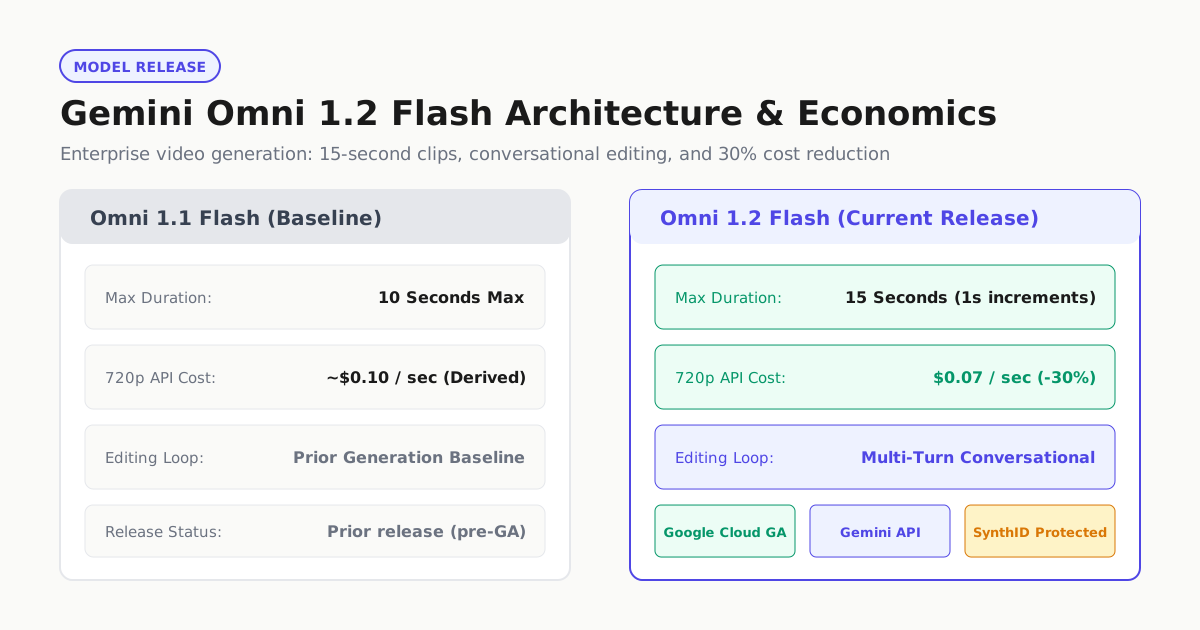
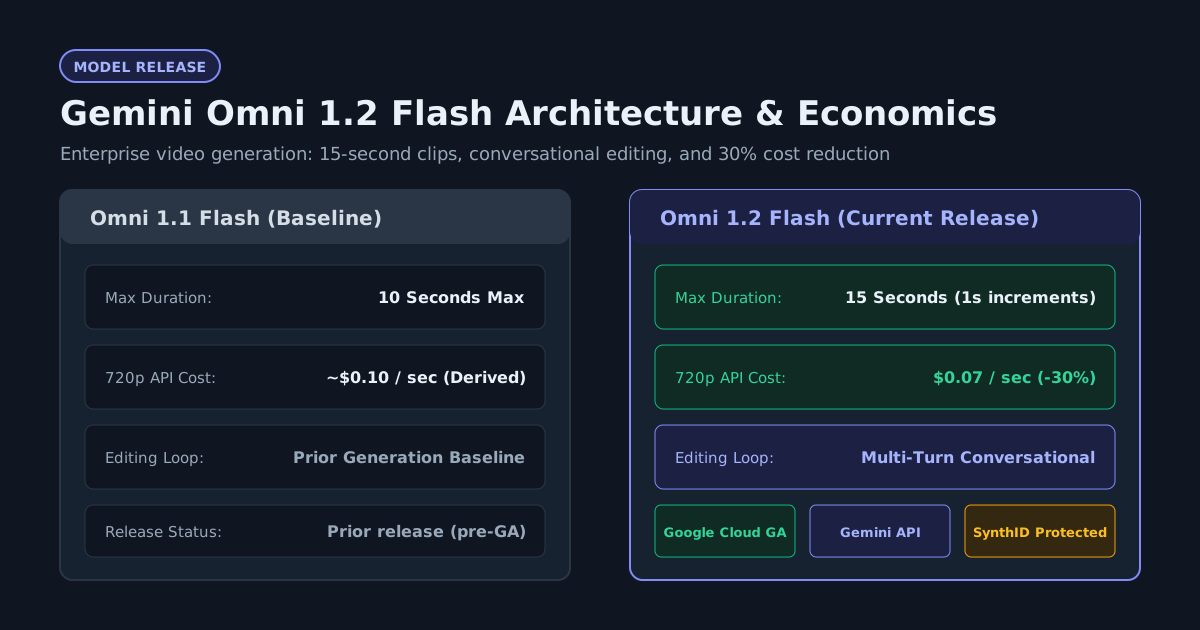
Google has officially released Gemini Omni 1.2 Flash to general availability, introducing key duration, editing, and pricing updates for automated video generation workflows. Announced simultaneously on Google’s Keyword blog and the Google Cloud Blog, the updated model extends native video generation from 10 seconds up to 15 seconds, enables conversational multi-turn editing, improves reference adherence, and reduces API generation pricing by 30% to $0.07 per second for 720p output. The model is immediately accessible across the Google Cloud console, Google AI Studio, and the Gemini API, alongside features in Google Vids and Google Ads. While Google DeepMind’s announcement noted general availability across Gemini for business, Google Cloud’s deployment guidance clarified that in-chat video creation within Gemini for business is listed as coming soon.
The release directly addresses two practical constraints in generative video pipelines: clip duration limits and the operational cost of revising existing scenes. By supporting native 15-second generation alongside turn-by-turn conversational adjustments, the release allows production teams to modify camera angles, lighting, and backgrounds without restarting generations from scratch.
Developer access was confirmed concurrently by Google AI Studio on X, highlighting immediate availability in AI Studio and the Gemini API, while Google DeepMind pointed developers to interactive starter apps on The Keyword.
Longer Native Clips and Camera Control
In its previous Gemini Omni 1.1 iteration, native video generation was capped at 10 seconds, often requiring automated workflows to stitch multiple clips together for complete commercial cuts. Gemini Omni 1.2 Flash expands single-pass generation up to 15 seconds, allowing operators to set clip duration in one-second increments between 3 and 15 seconds.
Beyond clip duration, Google highlighted improved motion continuity and camera stability across extended shots. In published product demonstrations, Google showcased continuous camera movements, including first-person view flythroughs through architectural spaces and unbroken zoom-outs from tight close-ups to expansive landscapes, reporting significantly fewer unwanted jump cuts and steadier scale across transitions. At the same time, Google noted that development remains ongoing to address challenging physical dynamics, including fast sports action, rapid script changes, and complex physics, acknowledging subtle variations across frame transitions in its consistency demonstrations.
Conversational Multi-Turn Video Refinement
The primary workflow update in Gemini Omni 1.2 Flash is conversational multi-turn editing. In conventional video architectures, modifying an element—such as swapping a background or shifting lighting—often meant re-prompting and generating an entirely new video, introducing unpredictable changes to approved elements.
Under the new conversational interface, operators can refine an existing generation turn by turn:
- Background Replacement: Swapping an environment—such as moving from a pavilion tent to a forest or castle—while maintaining character performances, lighting interactions, and camera framing.
- Lighting and Style Adjustments: Altering atmospheric conditions, weather, or time of day across the 15-second clip without restarting the scene.
- Aspect Ratio Adjustments: Switching the aspect ratio across conversational turns to support multiple distribution formats without beginning generation from scratch.
This conversational feedback loop supports automated content pipelines that require isolated adjustments. In production environments that use AI character pipeline approval gates, isolating visual modifications across turns helps teams verify revisions before approving downstream marketing assets.
Economics and the Three-Stage Production Pipeline
Alongside workflow changes, Google Cloud reduced base pricing by 30% compared to Gemini Omni 1.1 Flash, setting the rate at $0.07 per second of generated 720p video, with proportional savings at other resolutions.
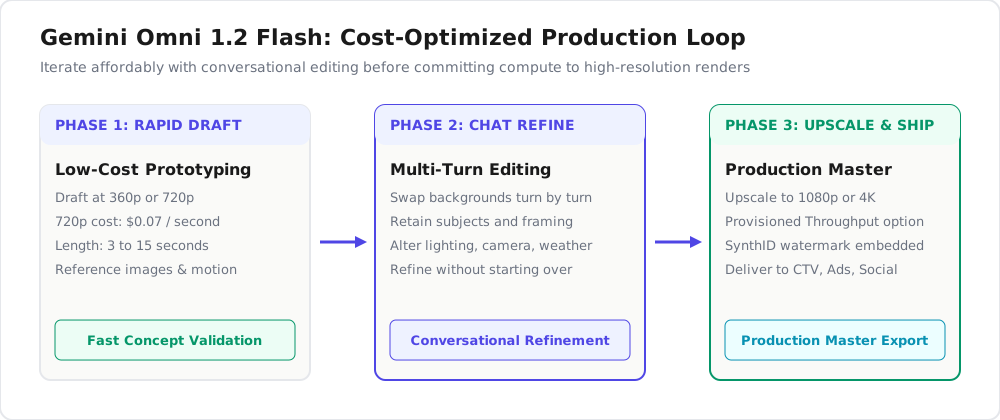
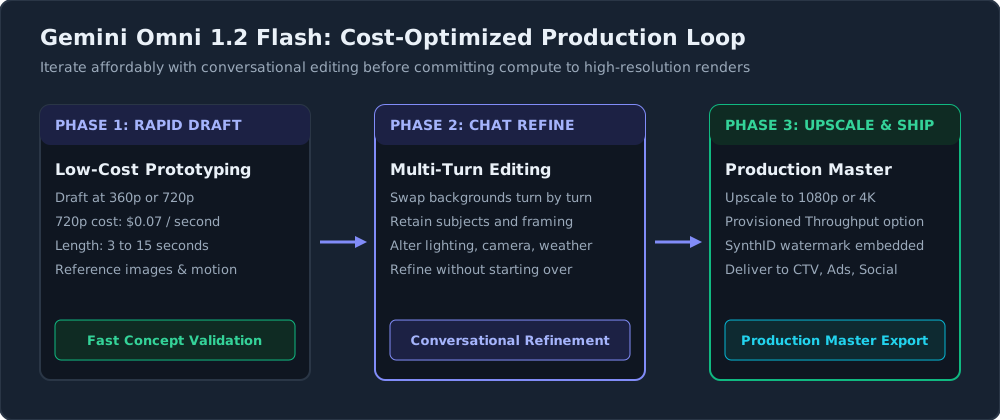
To manage compute spend, Google recommends a three-stage drafting and rendering structure:
- Rapid Drafting: Teams generate initial concepts at 360p or 720p resolution, evaluating narrative pacing, framing, and motion arcs at lower baseline compute cost.
- Conversational Refinement: Operators apply multi-turn instructions to refine specific elements, adjusting backgrounds, camera angles, or lighting without restarting from scratch.
- Production Master Upscaling: Once approved, teams upscale validated generations to 1080p or 4K resolution for final distribution across advertising channels and video platforms.
| Feature / Metric | Gemini Omni 1.1 Flash | Gemini Omni 1.2 Flash |
|---|---|---|
| Max Clip Duration | 10 seconds max | 15 seconds (1-second increments) |
| 720p API Price | ~$0.10 / second (derived) | $0.07 / second (-30%) |
| Editing Workflow | Baseline prompt generation | Multi-turn conversational chat |
| Reference Guidance | Baseline reference inputs | Images, 3s video, audio references |
| Enterprise Governance | Not established by these sources | Provisioned Throughput & SynthID |
Reference Adherence and Audio Conditioning
Brand consistency remains essential for automated commercial video. Gemini Omni 1.2 Flash expands reference conditioning, allowing creators to guide generation using character photos, product packshots, motion clips up to three seconds long, and audio reference cues. Google reports that brand colors, garment silhouettes, packaging typography, and facial features maintain closer alignment across 360-degree rotations and camera transitions.
Speech synthesis has also been updated to deliver more natural dialogue timing, clearer lip-sync, and distinct multi-speaker conditioning for animated scenes and explainer videos. Google Cloud specified that audio reference conditioning is currently gated behind an enterprise allowlist. Every generated clip automatically incorporates imperceptible SynthID digital watermarks to support content provenance verification.
Enterprise Ecosystem and Adoption
In its announcement, Google Cloud highlighted early feedback across commercial platforms evaluating and integrating Gemini Omni 1.2 Flash. E-commerce tool Photoroom reported using the model within its Video Ad Maker to convert catalog photos into product videos backed by enterprise service-level agreements. invideo reported positive prompt adherence and full-scene 15-second generation during internal evaluations, while QuickFrame AI reported generating complete 15-second Connected TV commercial spots in a single run. Creative platforms including Picsart, Krea, FLORA, Artlist, and Runway also tested reference adherence, concept iteration, and scene styling capabilities.
Following the recent release of Gemini 4 Carbon for agentic coding and security, the launch of Gemini Omni 1.2 Flash expands Google’s enterprise model lineup into high-throughput video generation. By pairing $0.07 per second 720p pricing with conversational refinement controls, the model provides developers with a cost-controlled foundation for automated video generation pipelines.
Sources
- Gemini Omni 1.2 Flash: 15-second video and lower pricing
- Gemini Omni 1.2 Flash now GA: cost-effective video | Google Cloud Blog
- Google AI Studio on X: "introducing gemini omni 1.2 flash, now available in ai studio and the gemini api what's new: - fast & 30% lower cost - longer clips - edit in conversation - more natural speech - more controllable shots" / X