Claude Personal Finance Beta Links U.S. Bank Accounts Through Plaid, Read-Only
Anthropic is rolling Personal Finance out in beta to U.S. Pro, Max, and Ultra subscribers. The tool connects bank and card accounts through Plaid, answers from balances and up to two years of transactions, and cannot move or invest the money.
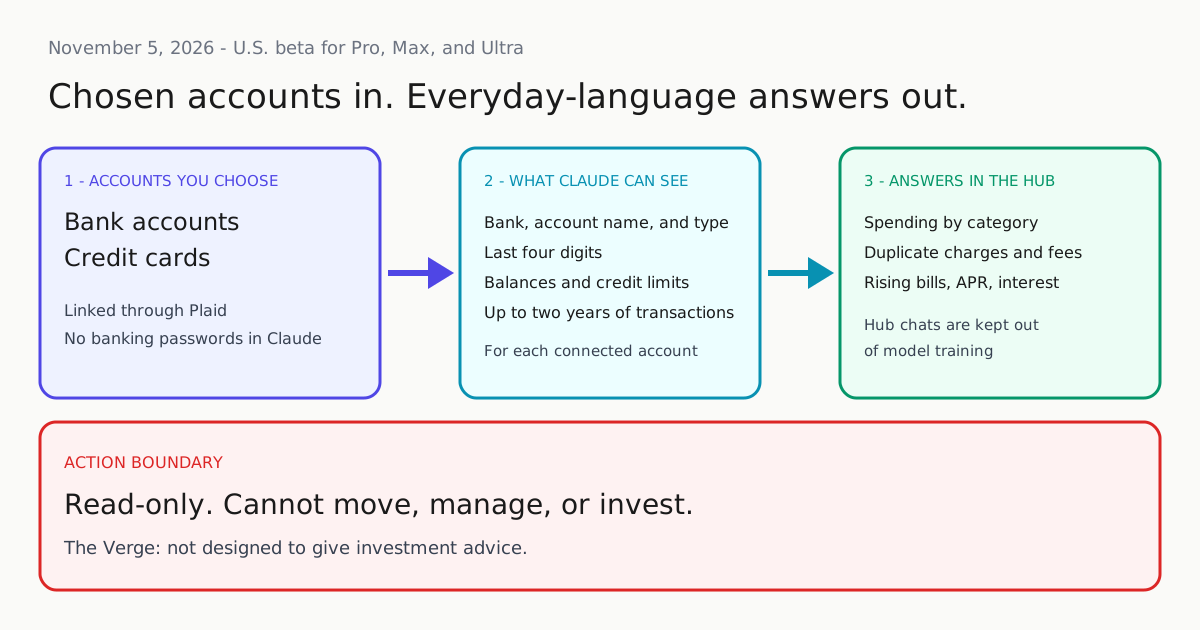
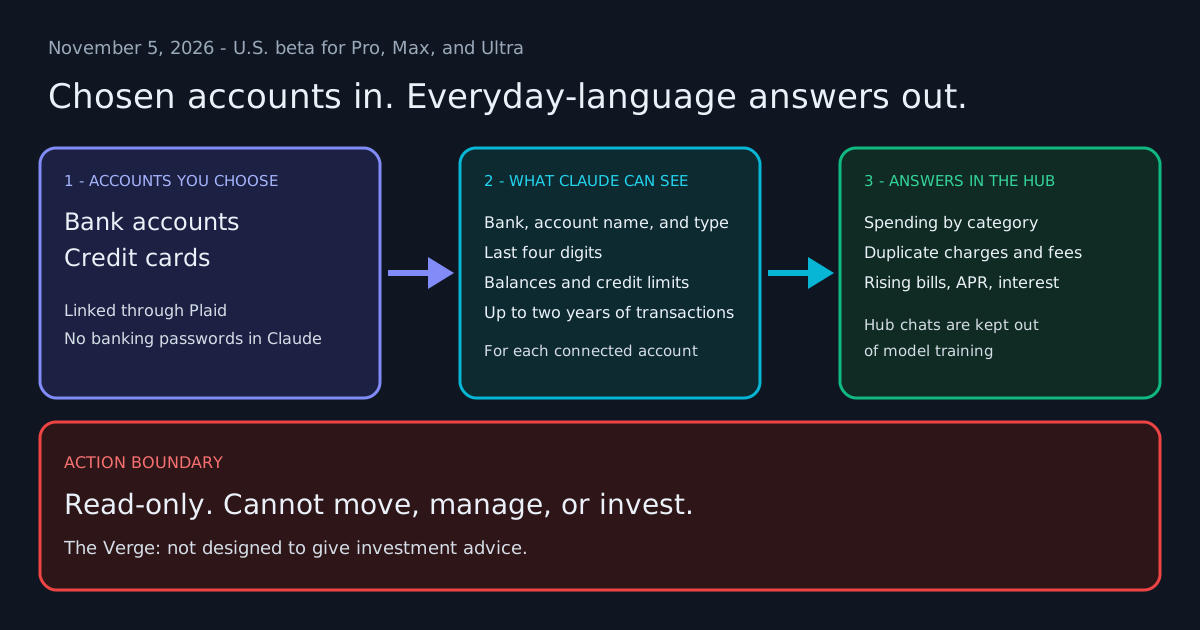
Anthropic began a U.S. beta of Personal Finance in Claude on November 5, 2026. Paying subscribers can connect bank and credit card accounts through Plaid and ask questions answered from their balances and transactions. TechCrunch, The Verge, and Anthropic’s @claudeai post align on the action limit: access is read-only, and the tool cannot move, manage, or invest the user’s money.
The X post, timestamped 6:00 p.m. on November 5, introduces Personal Finance “in beta in the US” and tells people to connect the accounts they choose. TechCrunch says the beta starts rolling out this week to Pro, Max, and Ultra in the U.S. The Verge, timestamped 6:00 p.m. UTC that day, reports the same plans and country. Subscribers outside that U.S. paid group are outside the rollout these sources describe.
What a connected account exposes
For each linked account, TechCrunch and The Verge attribute one field list to Anthropic: the bank’s name, the account name and type, the last four digits of the account number, balances, credit limits, and up to two years of transaction history. The Verge adds how the bridge is built. Plaid facilitates the connection, so Claude does not see banking passwords, and the bank is spared unvetted bots crawling the account.
The opt-in is selective. “The accounts you choose,” in the X post, means a person can leave some accounts unlinked. Each account that is linked still brings the full list: up to two years of transaction history, plus balances and credit limits. Merchant names, amounts, and recurring charges are this article’s reading of what that transaction history contains.
| What reaches Claude | Scope reported from Anthropic |
|---|---|
| Institution and account labels | Bank name, account name, account type, last four digits |
| Current position | Balances and credit limits |
| History | Up to two years of transactions |
| Moving funds | Read-only: cannot move, manage, or invest money |
| Investment advice | The Verge: not designed to give investment advice |
TechCrunch states the moving-funds line in Anthropic’s terms: Personal Finance cannot move, manage, or invest users’ money. The Verge adds that the tool “isn’t designed to give investment advice.” The @claudeai post states the read-only limit and the three verbs in the company’s own voice.
Questions the beta answers from those fields
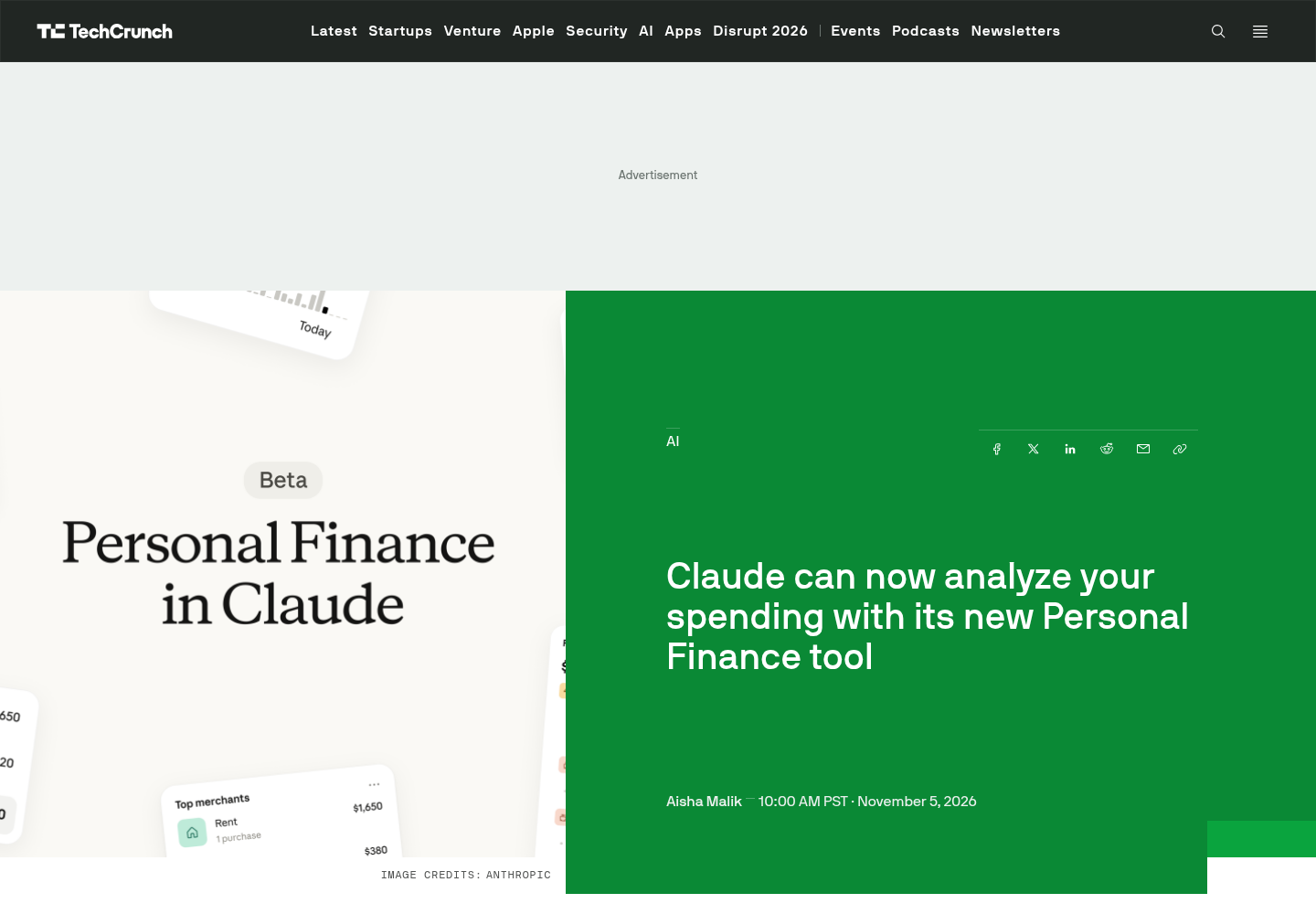
TechCrunch quotes Anthropic’s blog: “Claude gives you answers in everyday language, from your balances and transactions, and explains any term that’s new to you.” The same passage says Personal Finance has no ads or sponsored recommendations and does not offer credit cards, loans, or savings accounts of its own, “so your money questions get a straight answer.”
The example in both news stories is “Where did my money go this month?” Claude totals spending across connected accounts and sorts it by category. TechCrunch’s categories include rent and utilities, food and drink, and shopping. The Verge’s include rent and utilities, shopping, and food. TechCrunch says a person can follow up with “Is that more than usual?” or “Anything else I’m missing?”
Beyond that monthly sort, TechCrunch says the tool flags duplicate charges, unexpected fees, and steadily increasing bills, and that someone can ask whether they are spending more than they earn. It can explain APR and calculate interest paid over the past year from the connected history. The Verge describes three further questions: bills left before the next payday, whether a large purchase such as a holiday trip is affordable, and how much the user could save each month.
Hub training, plans, and an exploratory handoff
TechCrunch reports a training limit the X post does not mention: chats in the Personal Finance hub are not used to train Anthropic’s models. The limit covers hub conversations. A retention window, subprocessor list, and Plaid revocation path are absent from these three sources, so connect-time terms are where those details have to be read.
Eligibility is just as specific. The beta is for Pro, Max, and Ultra subscribers in the United States, rolling out this week. Automater’s Claude Ultra vs Max vs Pro comparison measures those three tiers for Claude Code usage. A reader already on one of them, in the U.S., matches the group named for Personal Finance. The November 5 stories give no date for anyone else.
TechCrunch sets the launch beside Claude for Legal and Claude for Financial Services, both introduced earlier this year. Personal Finance is the consumer account link in that vertical push: a person’s own bank and card accounts, inside a chat hub, with the field list above. The same paragraph treats Claude for Financial Services as an earlier, separate product.
The Verge quotes the close of Anthropic’s press release:
Personal Finance is a first step. For life’s bigger money decisions, we think people are best served by Claude working alongside the licensed professionals and regulated firms they trust. We’re exploring how to make that possible in Claude, and we’d like to hear from banks, wealth managers, and financial services companies who want to help shape it.
Anthropic calls the beta a first step and says work that would place Claude alongside licensed professionals is still being explored. The invitation to banks and wealth managers is a partnership request. Neither TechCrunch nor The Verge names a firm already in that program, and neither describes a live advisory handoff on November 5.
Where a read-only link stops
Read-only is the permission on the bank connection. After Claude writes a category split, a fee flag, or an interest total, the result is text. A copy into notes, a paste into another chat, or a second agent that shares a filesystem can carry that text onward.
People running Claude beside other agents inherit that hop once an account is connected. Automater’s context-boundary matrix for a shared agent computer tags bank and card balances as financial data and defaults that tag to deny on shared channels. Revoke the aggregator link at the source before auditing where a summary was copied. The connector’s read-only limit covers what it may do to the account. Where the written answer may travel is a separate control.
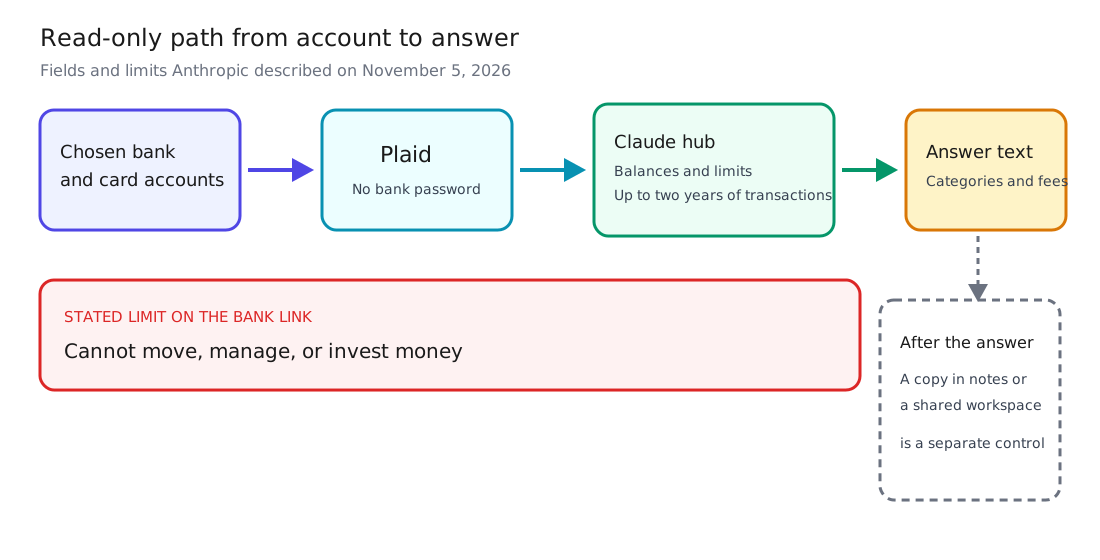
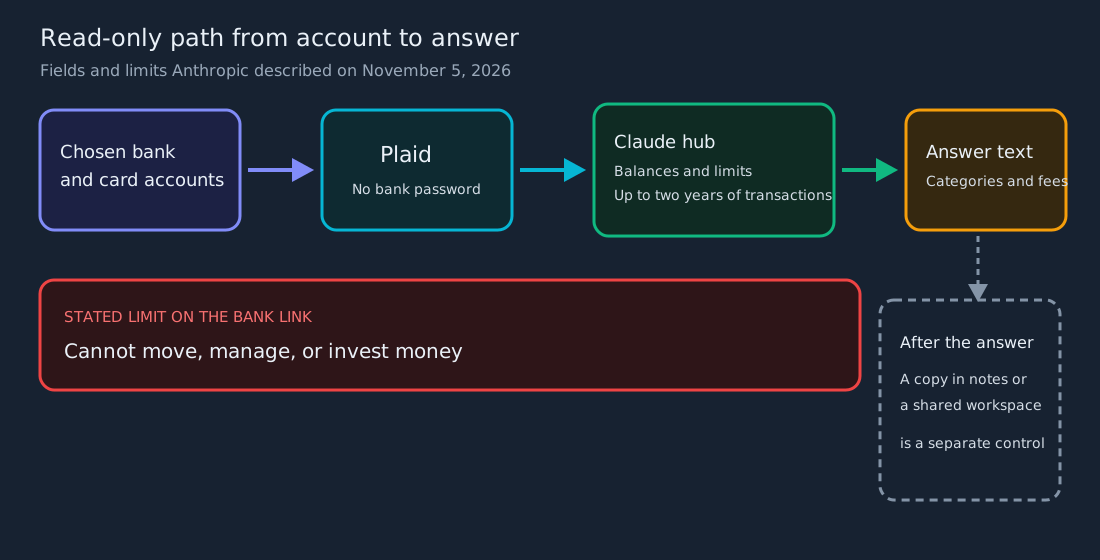
The diagram shows that path: chosen accounts and the field list go in, an answer comes out, and moving or investing money stays off the link.
TechCrunch and The Verge call the launch catch-up to a ChatGPT tool OpenAI introduced in May, also through Plaid. That comparison rests on their reports; OpenAI’s May post is outside this source set. The Claude record here is the November 5 beta: chosen accounts, the field list, read-only access, hub chats kept out of training, and a U.S. rollout for Pro, Max, and Ultra.
Sources
- Claude can now analyze your spending with its new Personal Finance tool | TechCrunch
- Claude AI can plug directly into your bank account | The Verge
- Claude on X: "Introducing Personal Finance in Claude, in beta in the US. Connect the accounts you choose, and Claude answers your money questions in everyday language, from your own balances and transactions. Access is read-only, and Claude can't move, manage, or invest your money." / X