Amazon Bedrock AgentCore's Web Answer Is Generally Available: One MCP Tool Call Returns a Cited Answer
AWS moved Web Answer on Amazon Bedrock AgentCore to general availability on Nov. 5, 2026. One MCP tool call returns a synthesized, cited answer for agents.
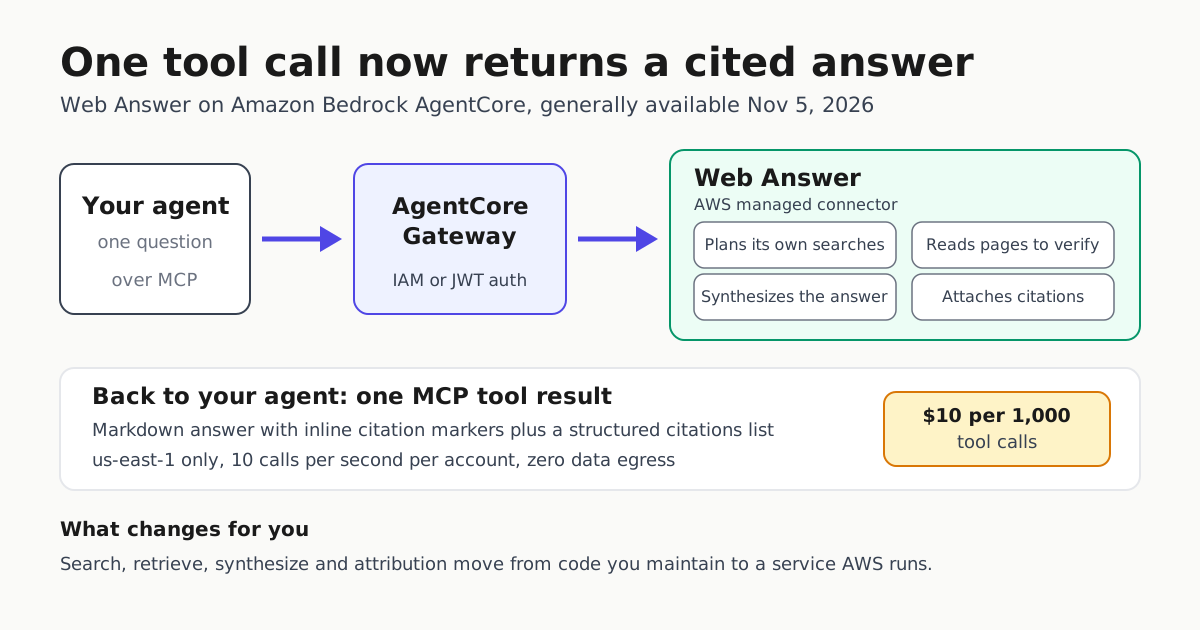
Amazon Bedrock AgentCore now has a managed answer engine. On Nov. 5, 2026, AWS announced the general availability of Web Answer on Amazon Bedrock AgentCore and published a same-day walkthrough, Getting started with Web Answer on Amazon Bedrock AgentCore. The announcement itself is short: one tool call returns a synthesized, grounded, cited answer to a natural-language question, so agent builders no longer assemble a search, retrieve, synthesis and citation pipeline themselves.
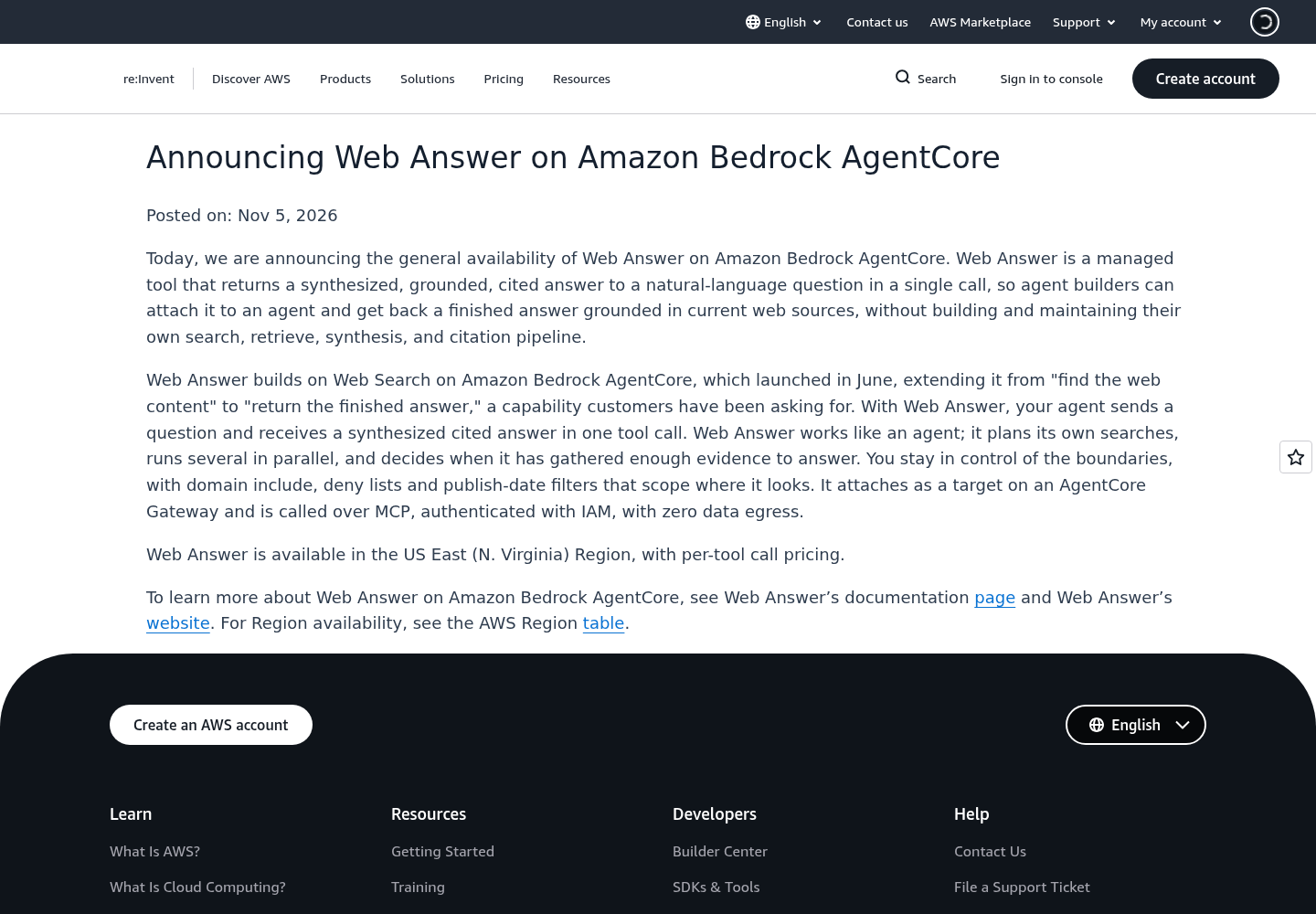
The pipeline it collapses
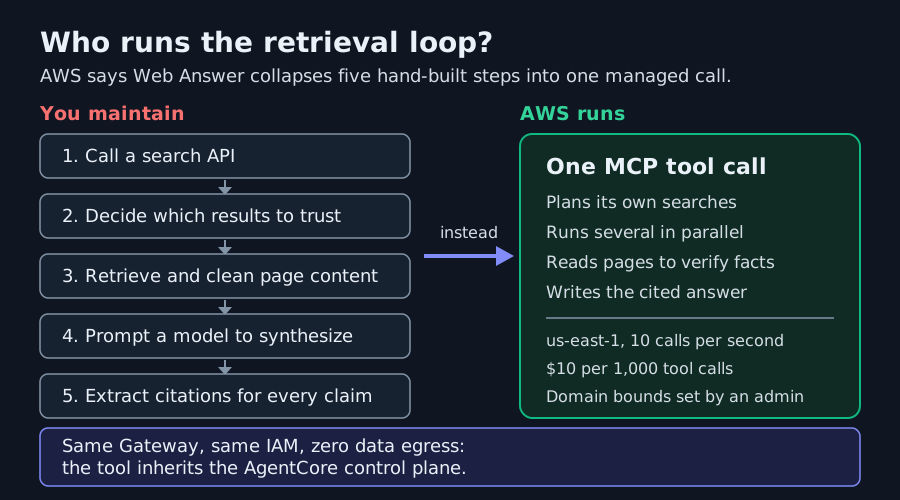
AWS names the five steps it assumes you wrote yourself: call a search API, decide which results to trust, retrieve and clean page content, prompt a model to synthesize, and engineer citation extraction so the output traces back to a source. It names the failure mode of each: hallucination when evidence is thin, stale content when the index moves, broken attribution when a claim and its source drift apart.
Web Answer moves all five inside a service AWS operates. It plans its own searches, runs several in parallel, reads key pages to check facts, searches again when the evidence is insufficient, and writes an answer that ties each claim to a source URL. It runs new searches for every question, and its model is given today’s date so it can search for up-to-date information.
The dividing line between this and the older Web Search tool on AgentCore, which launched in June, is who runs the model.
| Web Search | Web Answer | |
|---|---|---|
| Returns | Ranked URLs, titles, snippets, metadata | A synthesized answer with citations |
| Who synthesizes | Your model | AWS runs the model and the retrieval loop |
| Use it when | You want control over how results are processed | The question is a sub-task inside a bigger agent |
Many teams will use both: Web Search for broad research where raw results matter, Web Answer for specific factual questions where the cited answer is the deliverable.
What comes back
The response is an ordinary MCP tool result with two parts: content, which holds markdown text with inline citation markers such as [1], and structuredContent.answer, which carries the same text alongside a structured citations list where each entry holds a source URL and, when available, the domain.
{
  "content": [
    { "type": "text", "text": "Banks must hold Common Equity Tier 1 capital of at least 4.5% of risk-weighted assets [[1](https://www.bis.org/...)]..." }
  ],
  "structuredContent": {
    "answer": [
      { "text": "Banks must hold Common Equity Tier 1 capital of at least 4.5%...", "citations": [{ "domain": "bis.org", "url": "https://www.bis.org/..." }] }
    ]
  },
  "isError": false,
  "_meta": { "latencyMs": 5210 }
}
That structured block matters more than it first looks. It is the difference between a citation a model printed and a citation your code can validate, log and attach to an audit record.
Wiring it up
The integration is a Gateway target, not a new SDK. A Gateway administrator grants the Gateway service role one permission, bedrock-agentcore:InvokeWebAnswer, against the AWS-owned ARN arn:aws:bedrock-agentcore:us-east-1:aws:tool/web-answer.v1, then adds Web Answer as a connector target:
target_response = gateway_client.create_gateway_target(
    name="web-answer-tool",
    gatewayIdentifier=gateway_id,
    targetConfiguration={
        "mcp": {
            "connector": {
                "source": {"connectorId": "web-answer"},
                "configurations": [{"name": "WebAnswer", "parameterValues": {}}],
            }
        }
    },
    credentialProviderConfigurations=[{"credentialProviderType": "GATEWAY_IAM_ROLE"}],
)
Wait until get_gateway_target reports the target status as READY, and the tool then appears to any attached agent over MCP through tools/list and tools/call. AWS says the same path works with Strands Agents, LangChain, LangGraph and CrewAI. Besides the question, each call accepts an optional domain filter, a published-date range and a country to localize results; the agent’s filter combines with the target’s filter, so it can narrow but never widen.
Controls and limits
The tool inherits the AgentCore control plane: no separate API key to provision, rotate or manage, since callers authenticate to the Gateway with IAM SigV4 or a JSON Web Token; an interface VPC endpoint for PrivateLink traffic; zero data egress; CloudWatch metrics from the first call; and admin-time policy bounds where an agent can narrow the domain filter but never widen it. The Gateway service role needs only the InvokeWebAnswer permission, not bedrock:InvokeModel, because the agent’s own model runs under the agent’s identity.
Three hard numbers decide whether it fits your workload:
- Region: us-east-1 only for now, with more regions described as coming soon.
- Rate limit: 10 transactions per second per account in US East (N. Virginia).
- Price: $10 per 1,000 tool calls, billed separately from Gateway and model usage.
At that rate, 10,000 questions cost $100 in tool calls. That is small next to a hand-built pipeline paying for search traffic, page fetches and a synthesis model on every query, but it is not free, and it is a line item your finance team should see before fan-out.
Where it fits, and how you would audit it
AWS names financial services, healthcare, customer service, legal and compliance, and internal enterprise copilots as target use cases. The appeal is identical in each: an answer whose every claim maps to a source. For a compliance agent, the difference between a list of ten ranked links and a traceable answer is the difference between a useful tool and an unusable one.
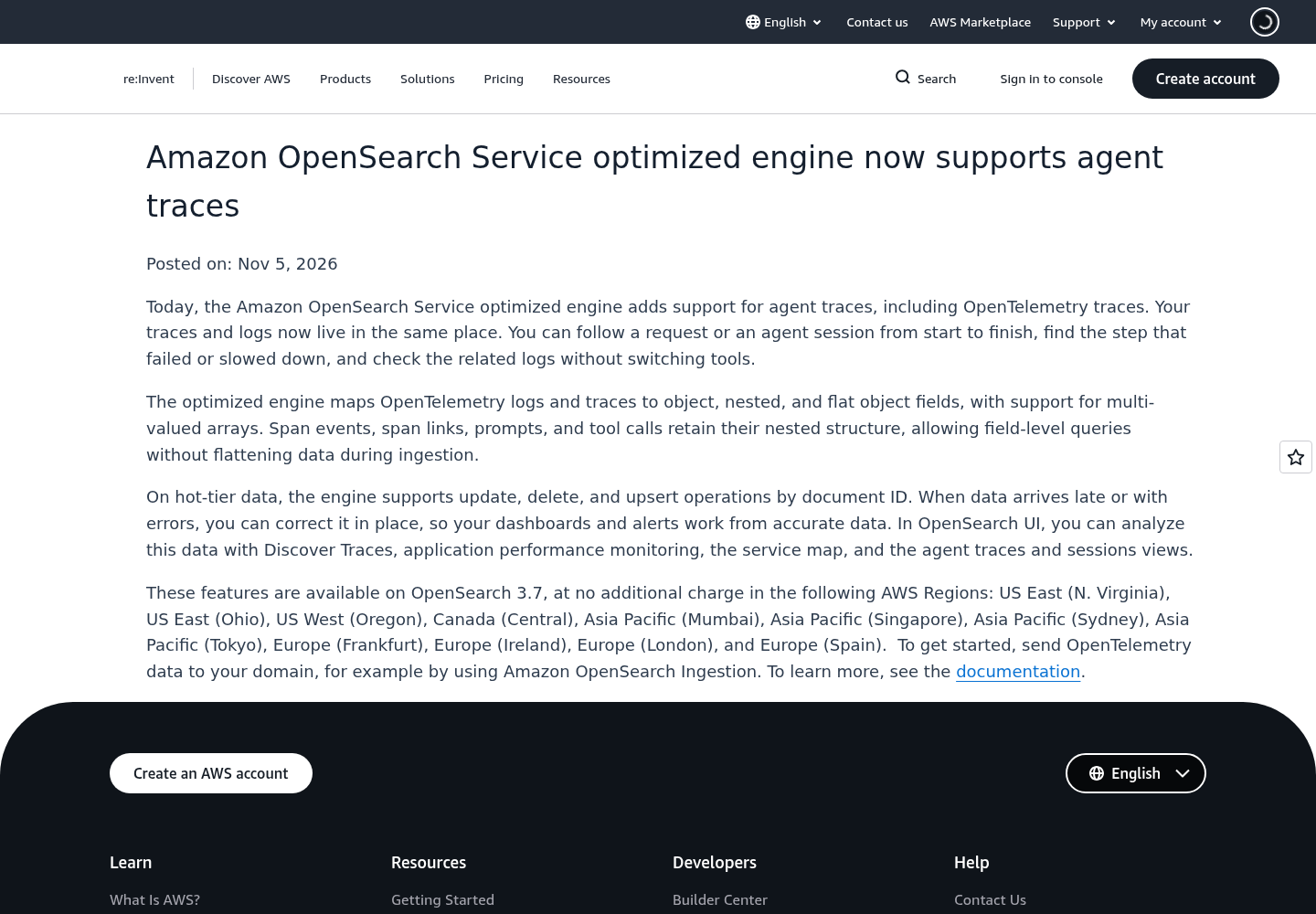
Auditing that answer is where a second AWS release from the same day helps. The Amazon OpenSearch Service optimized engine now supports agent traces, also posted Nov. 5, 2026, puts OpenTelemetry logs and traces next to agent traces on OpenSearch 3.7, with span events, span links, prompts and tool calls keeping their nested structure, and adds Discover Traces, application performance monitoring and agent session views in the OpenSearch UI, at no additional charge in the listed Regions.
What to do on Monday
- Add Web Answer as a Gateway target on a scratch gateway and time one question end to end before moving production traffic. Setup is three steps, and the first is a policy attachment.
- Keep Web Search for the questions where your own model needs to see raw results, and use Web Answer for the sub-task where the answer itself is the output.
- Set the target-level domain filter at setup time. Agents can narrow it later, but only the admin-time bound holds.
- Write the per-call budget down. $10 per 1,000 calls under a 10-transaction-per-second account ceiling is a different cost and latency shape than a self-hosted search API.
Operators already running on Bedrock AgentCore can start with the AgentCore CLI 1.0 terminal path, and the agent gateway as control plane explains why the Gateway’s permission and filter model is the part to read before enabling anything.