
AWS TorchNeuron Makes Trainium a Native PyTorch Device — One Line to Switch
AWS's TorchNeuron makes Trainium a native PyTorch device: one-line device switching, torch.compile and distributed APIs on Trainium2/3, and real limits to know before you switch.
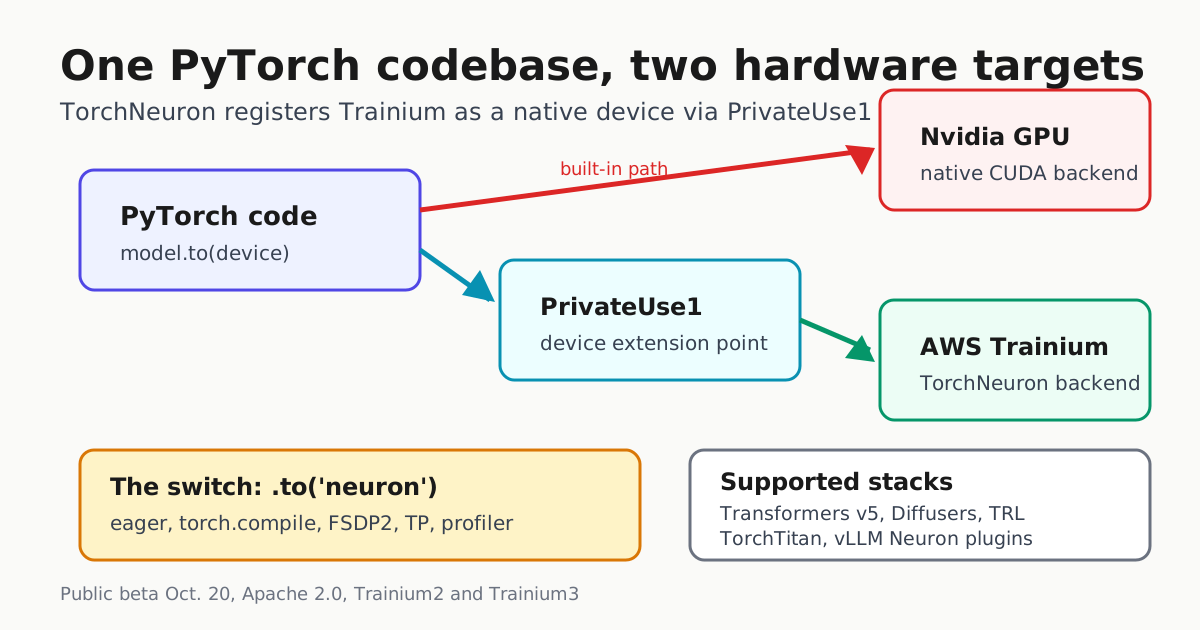
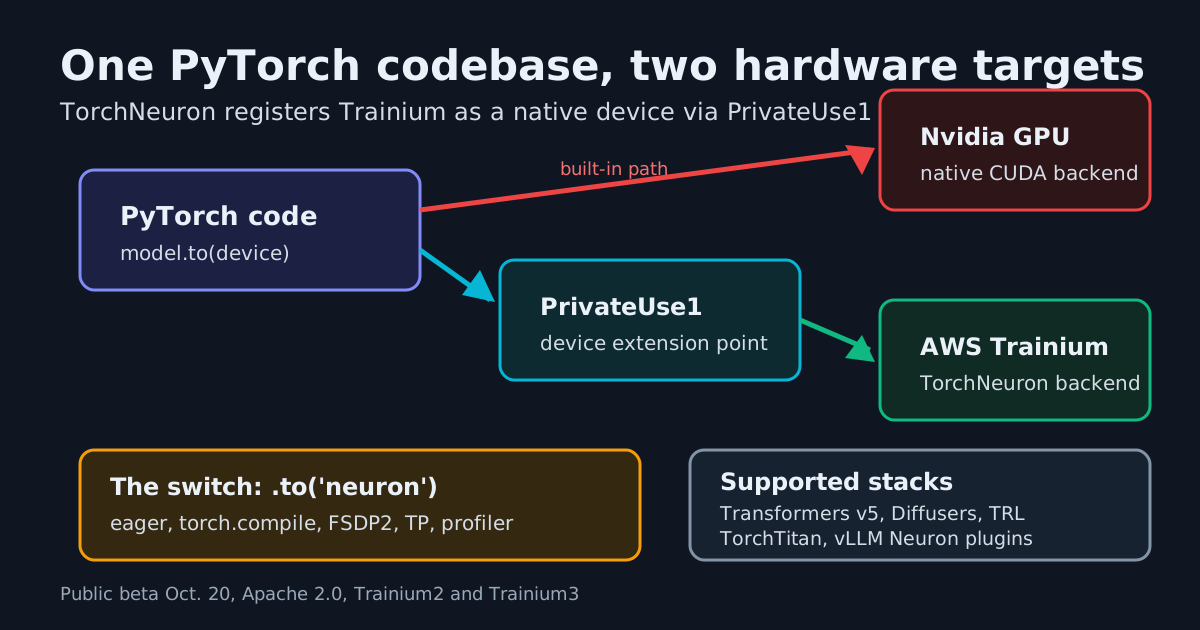
AWS has shipped the piece of software it has been missing in its fight against Nvidia’s GPU dominance: TorchNeuron, a native PyTorch backend for its Trainium accelerators. Announced on the PyTorch blog and open-sourced under Apache 2.0 as a public beta starting Oct. 20, it lets ordinary PyTorch training and serving code run on Trainium2 and Trainium3 with what amounts to a one-line change.
Why this matters
Nvidia’s moat is not only silicon. It is CUDA, the software stack that makes PyTorch code run on GPUs by default. TechCrunch’s coverage notes that AWS puts roughly 85% of AI apps on PyTorch, and that Nvidia spent years making sure CUDA supports those apps seamlessly. TorchNeuron attacks that advantage directly: instead of adapting your code to Neuron-specific tooling, the backend registers Trainium through PyTorch’s official PrivateUse1 extension point and torch.accelerator APIs, so torch.nn, torch.autocast, torch.distributed and torch.profiler work as written.
Worth noting: this pattern is not unique. PyTorch users can already target AMD GPUs or Apple silicon with a similar configuration change. The difference is scale — Trainium is backed by AWS’s full cloud, and the same chip handles both training and inference, which AWS argues improves economics across a whole workload rather than per token.
What you can actually do
The headline workflow is device switching:
model = MyModel().to('neuron')   # the only change
optimizer = torch.optim.AdamW(model.parameters())
for batch in dataloader:
    optimizer.zero_grad()
    loss = criterion(model(batch), targets)
    loss.backward()
    optimizer.step()
For compiled paths, name the backend once, then move the model to the device and compile it as separate statements (Module.compile() modifies the model in place and returns None, so don’t reassign its result):
torch.compiler.set_default_backend("neuron")  # call once, before any compile
model = MyModel().to('neuron')
model.compile()  # no backend argument
Three execution tiers are supported:
| Mode | Use case | Notes |
|---|---|---|
| Eager | Research, debugging | Prints and breakpoints work; each op compiles its own NEFF file |
| Adaptive eager (experimental) | Faster iteration | Reduces launch cost, fuses ops, approaches compiled performance without code changes |
| torch.compile | Production | Dynamo captures the graph, lowered via Torch-MLIR to StableHLO and the Neuron compiler; FlexAttention supported natively |
Distributed training composes as written: DDP, FSDP2, SimpleFSDP, tensor and pipeline parallelism, ZeRO compositions, DTensor and DeviceMesh, with collectives running over Trainium’s dedicated collective cores and EFA networking. Streams and events map onto hardware queues. Custom kernels are possible through the Neuron Kernel Interface (NKI), with an open-source NKI-lib shipping FlashAttention and MoE kernels.
The ecosystem leverage is the practical part for anyone serving or fine-tuning open-weight models: Hugging Face Transformers v5, Diffusers, TRL and TorchTitan treat Trainium as a supported device, and vLLM Neuron plus vLLM Omni Neuron plugins serve LLMs and diffusion models on top of the same torch.compile support. Loading a checkpoint is just device_map="neuron".
The evidence and the gaps
AWS says it continuously sweeps 100,000 Hugging Face models — covering 99.9% of real-world usage by download count — in both eager and compile modes, and runs the PyTorch upstream test suites (about 154K outcomes in August 2026). Deepgram reports roughly 60% more input audio seconds per dollar than its GPU baselines after porting; AWS’s Colin Brace told TechCrunch the figure is 70% more audio per dollar at production-grade accuracy. Treat those as vendor and customer claims, not independent benchmarks.
Know the limits before you plan a migration:
- FP8 and TorchAO quantization are private beta, GA “next release.”
- Dynamic and symbolic shapes, sparse tensors, NestedTensor, forward-mode autograd and arbitrary attention masks are explicitly unsupported in release one.
- About 22K upstream test cases skip for lack of a native Neuron lowering of corner-case operators.
- Errors on non-default streams surface at the next synchronization point, not at the faulting op.
The bigger picture
AWS is also contributing upstream to remove CUDA-specific assumptions from PyTorch itself, which would benefit every accelerator vendor, not just Trainium. Meanwhile Nvidia is not standing still on the software front: a companion PyTorch post on Helion and NVIDIA CompileIQ shows validated 2–7% gains on already-optimized kernels by searching compiler-level controls below the kernel layer — a reminder that the optimization race now runs several layers deep on both sides.
For teams whose PyTorch training or serving stack is the bottleneck cost line, TorchNeuron turns “try Trainium” from a porting project into an experiment: install torch-neuronx, change a device string, and measure. The operators who win are the ones who price the finished job, not the token — the same discipline we have covered in pricing the operating bill and the open-weight scorecard. This also echoes Microsoft’s move to make Azure Maia its primary inference system: the cloud giants are all building software bridges around their own silicon.