Consistent AI Character Video Needs Approval Gates: The Viral Playbook, Rebuilt as an Agent Pipeline
A viral AI persona reached tens of millions of views with no label. Run character sheet, clip and schedule as gated stages with dated labels and a kill switch.

Go deeper. Build your own.
The first known post went up on Sep 17, 2026: a suited, bleach-blond man with a curled moustache, shadowboxing through Paris. Within two weeks the persona had tens of millions of views (reportedly 35.9M on one video, per Dexerto), a Solana meme coin that lost more than 99% of its value on Sep 21, and no creator anyone could name. Copycat guides now promise the recipe for consistent AI character video. None of them includes the step where someone decides whether a clip should go out at all.
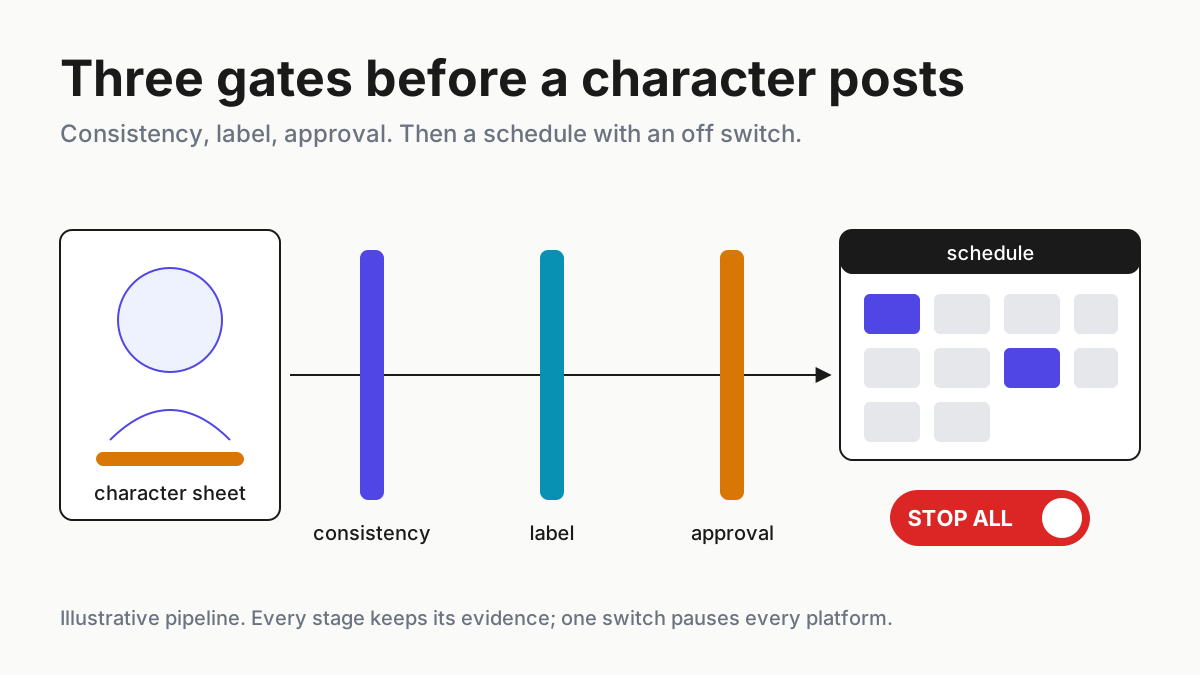
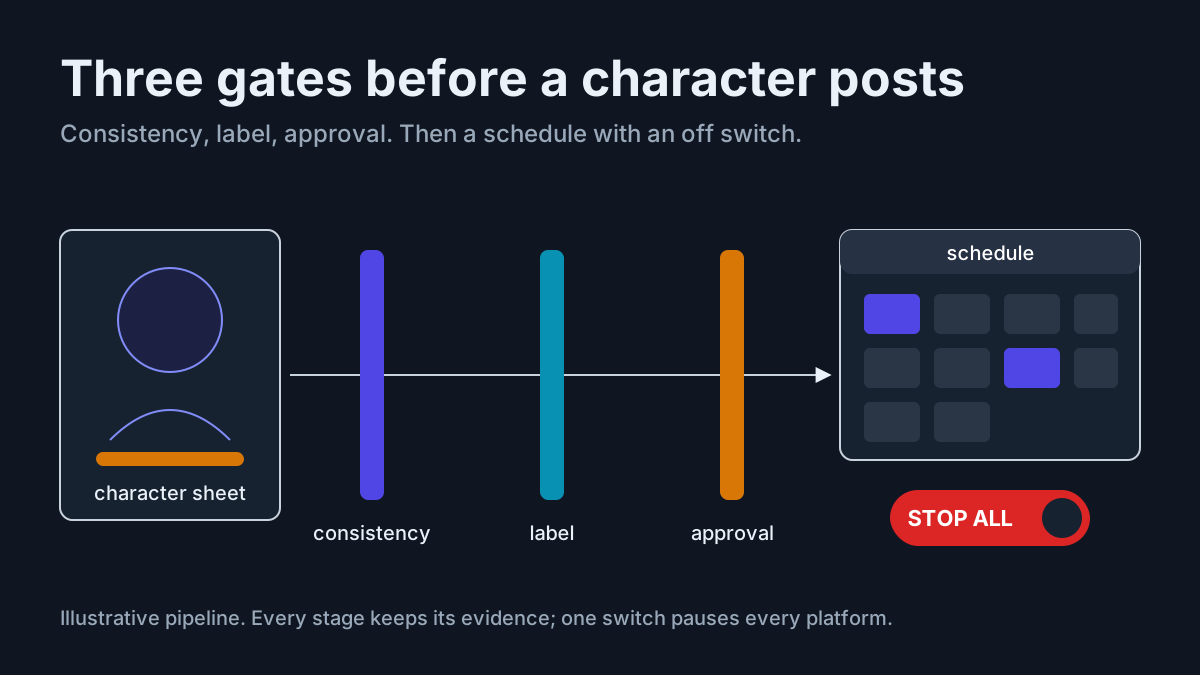
That step is the job if agents run the pipeline. When one agent renders the character, another cuts the clip and a third schedules posts across four platforms, the schedule becomes an approval queue whether you designed it as one or not. Each stage needs a consistency check, a disclosure step tied to a dated platform rule, a human approval before anything posts, kept evidence, and a switch that stops every queued post at once.
This playbook rebuilds the format as a three-stage pipeline with approval gates: character sheet, clip, scheduled post. It is a reconstruction, not the original creator’s method, and the persona is a cautionary case, not a model to copy.
Jean Phil, and the labeling rules that arrived before him
The persona, known as Jean Philanthrope or Jean Phil, runs as jean_philanthrope on Instagram and TikTok and as @JeanPhilMadame on X. Know Your Meme dates the first Instagram post to Sep 17, 2026, and notes the account has neither confirmed nor denied being AI. LADbible and EarlyGame relayed Dexerto’s figure of 35.9M views for one video; the platform and the time of that count were not stated. A larger total circulating on social media could not be traced to any source, so this piece doesn’t use it.
LADbible, citing Coinbase data, reported that the linked token peaked on Sep 21 and lost more than 99% the same day; critics called the account a front for the coin, a claim that stays with the critics.
Nobody knows who made it or how. The creator has never described the method.
Third-party guides, mostly from tool vendors, reconstruct it the same way: a multi-angle character reference sheet to lock the face, then video-to-video, where a real performer is filmed and the character is swapped in so the motion and camera work stay human, then short, frequent posts across platforms. That reconstruction is what the pipeline below gates. No source names the original’s tools, and this piece names none.
The rules for posting this kind of video were already in place. On May 27, 2026, YouTube said it would make AI labels more prominent and apply one automatically when it detects significant photorealistic AI that the creator did not disclose, with the label locked for content made with YouTube’s own AI tools or carrying C2PA metadata showing it is fully generative. On Aug 31, Instagram renamed its “AI creator” tag to “AI generated profile” and said it will limit the reach of profiles featuring an AI-generated person that skip the label, per Social Media Today. And EU AI Act Article 50 has applied since Aug 2, 2026: the deployer, meaning whoever posts, must disclose deepfakes, while providers’ machine-readable marking duty has a grace period to Dec 2, 2026 for generative systems already on the market, per Cooley.
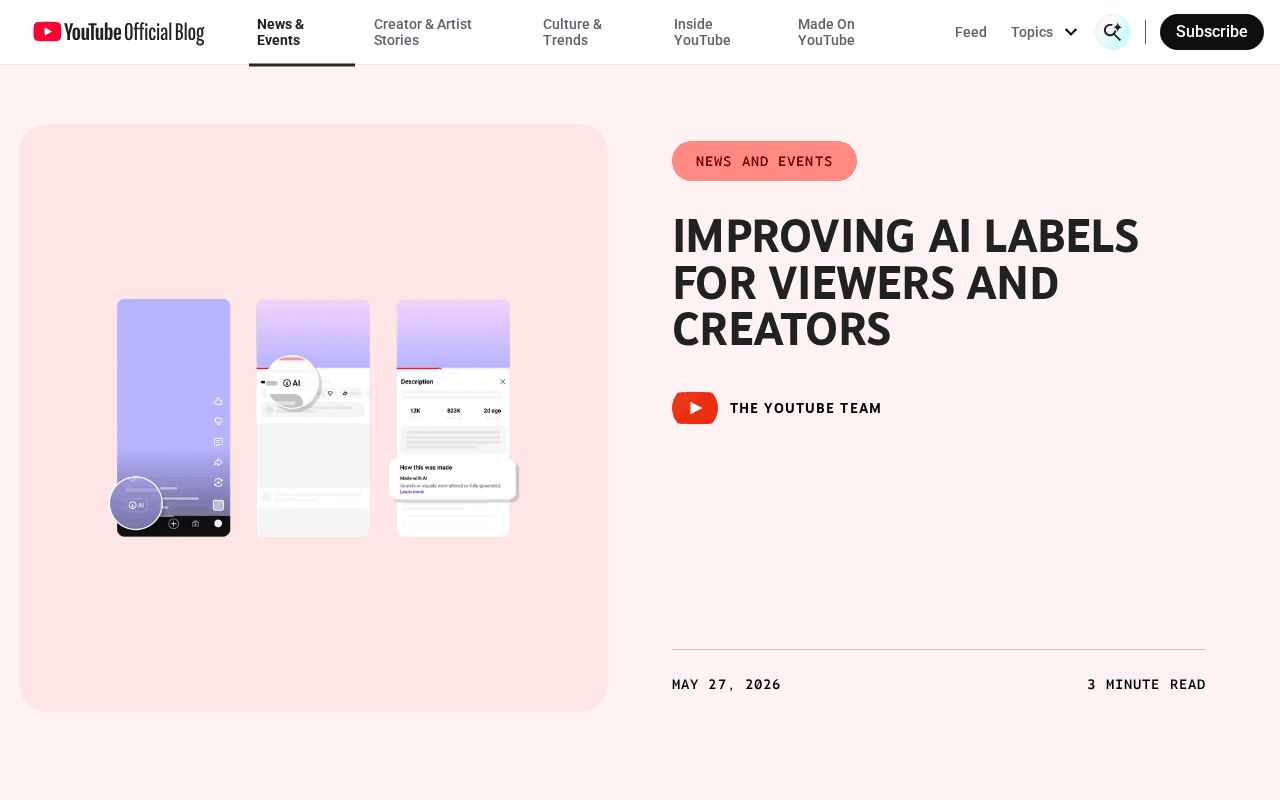 Screenshot: YouTube Official Blog, “Improving AI labels for viewers and creators” (May 27, 2026), captured Oct 7, 2026.
Why the posting agent is where the liability sits
Any multi-step agent pipeline has the same anatomy as this one, inputs, steps, a tool call, an output, and the explainer on agentic workflows covers it. What makes a media pipeline different is that its last tool call publishes. Everything upstream can be redone. A post that reaches a feed under a missing label, or with a token link in the caption, can’t be recalled from the screenshots.
So put the controls where publishing happens. The generation stages get consistency checks because drift is how you find out a model, a seed or a prompt changed. The posting stage gets the disclosure, the approval and the kill switch, because Article 50’s duty sits on the poster and the platforms’ label rules apply at upload.
Build the gated character pipeline in six steps
Step 1: Define the character and the performer before any render
The worked example uses an illustrative character: Odile, a fictional, deliberately stylized pastry chef in a mustard apron who demonstrates one technique per clip. She resembles no real person. Her motion comes from a hired performer, filmed in a rented kitchen, with a signed release covering motion transfer, the named platforms and a term.
Two decisions get made here, once, by a person. The character must not be a lookalike of anyone real; check the reference sheet against the performer and against public figures in the niche. And the performer’s release must be on file before their footage enters the pipeline, because a video-to-video step without one is someone else’s body under your character.
The voice gets the same treatment. If Odile speaks, the voice comes from a licensed sample or a voice actor with a release that names synthetic use, and the sheet records which. A character whose face is invented but whose voice is cloned from a real person without consent has the same problem as a lookalike, just harder to spot in a frame check. Write the term of each release into the evidence column, because releases expire and schedules don’t notice.
Step 2: Fill the three-stage gate table
This is the artifact. One row per stage; every column filled for Odile.
| Stage | Inputs | Consistency check (identity, voice, wardrobe, setting) | Disclosure or label step, and the dated rule it satisfies | Human approval before anything posts | Evidence kept (prompt, seed, source clip, label state) | Kill switch on the schedule |
|---|---|---|---|---|---|---|
| 1. Character sheet | Written brief, six reference angles, voice sample from a licensed voice, wardrobe list, kitchen set photos | Identity: face matches across all six angles; voice: timbre and accent fixed; wardrobe: mustard apron, white sleeves; setting: one kitchen | Mark the sheet “synthetic character” in the asset store; record which tool and version produced it, so the later C2PA trail has a start | Brand lead signs the sheet once; any change to the sheet re-opens sign-off | Sheet file hash, prompts, seeds, tool and version, sign-off name and date | Retiring the sheet blocks every downstream render that cites it |
| 2. Clip | Performer footage (release on file), approved sheet, script | Identity: face drift against the sheet under threshold on sampled frames; voice: matches the sample; wardrobe: no changes; setting: the approved kitchen only | Keep content-credential (C2PA) metadata through every edit and transcode; YouTube locks its label when C2PA shows fully generative content (May 27, 2026) | Editor approves the cut; a consistency failure stops the queue, not just the clip | Source clip ID, release ID, prompt, seed, drift score, metadata check result | Pausing the clip stage holds every clip not yet scheduled |
| 3. Scheduled post | Approved clip, caption, platform list, post time | Final frame check against the sheet; caption voice matches the character’s | YouTube altered-or-synthetic disclosure answered yes (May 27, 2026); Instagram “AI generated profile” label on the account (Aug 31, 2026); visible AI disclosure for EU audiences under Article 50 (from Aug 2, 2026); TikTok and X AI labels where offered | A named approver approves each post in the queue; no approval, no post | Label state per platform at post time, approver, caption text, link check result, post ID | One command pauses every queued post for the persona on every platform and writes a takedown log |
Character, stack and thresholds are illustrative; dates are from the sources above. Read the table by column, not just by row. The consistency column is what keeps the character consistent across hundreds of clips, which is what the copycat guides are selling. The label column is the one they leave out, and the approval column is where the operator’s job actually sits.
Step 3: Write the rule set the posting agent cannot skip
Put the rules where the posting agent reads them, and enforce them in the scheduler, not in a prompt. The shape below is illustrative.
persona: odile
rules:
  - no_post_without: [label_state_complete, human_approval]
  - consistency_failure: stop_queue        # stop everything, not just the failing clip
  - posting_agent_scopes: [schedule_post]  # no account settings, no bio, no DMs
  - money_links: deny                      # coin, token or affiliate links in bio or caption
  - performer_release: required_before_ingest
  - lookalike_check: required_at_sheet_signoff
caps:
  posts_per_persona_per_day: 3
  approvals_per_reviewer_per_day: 30
kill_switch:
  scope: all_platforms
  action: pause_all_queued_posts
  log: takedown_log
Three rules carry most of the weight. No post from a schedule without a label and an approval. A consistency failure stops the queue, because drift in one clip usually means a model, seed or prompt changed under every clip behind it. The posting agent holds only the posting scope, so it cannot edit the bio, add a link or change account labels; a person does those, on purpose.
The money-link rule is there because of how the original case ended. A coin link in a persona’s bio turns an audience into a market, and a scheduler with bio access can add one without anyone noticing.
Step 4: Run the consistency check as a stop, not a score
Sample frames from every clip and compare the face against the sheet. Compare the voice against the reference sample, the wardrobe against the list, and the setting against the approved set photos. Write the result as pass or fail against a threshold you set when the sheet was signed, and keep the score in the evidence column.
When a clip fails, stop the queue. It is tempting to drop the bad clip and post the rest, but a failed check is a symptom: a tool updated, a seed range shifted, or someone edited a prompt. The clips rendered alongside it probably carry the same drift at a level just under your threshold. Find the cause, re-render, and re-check the batch.
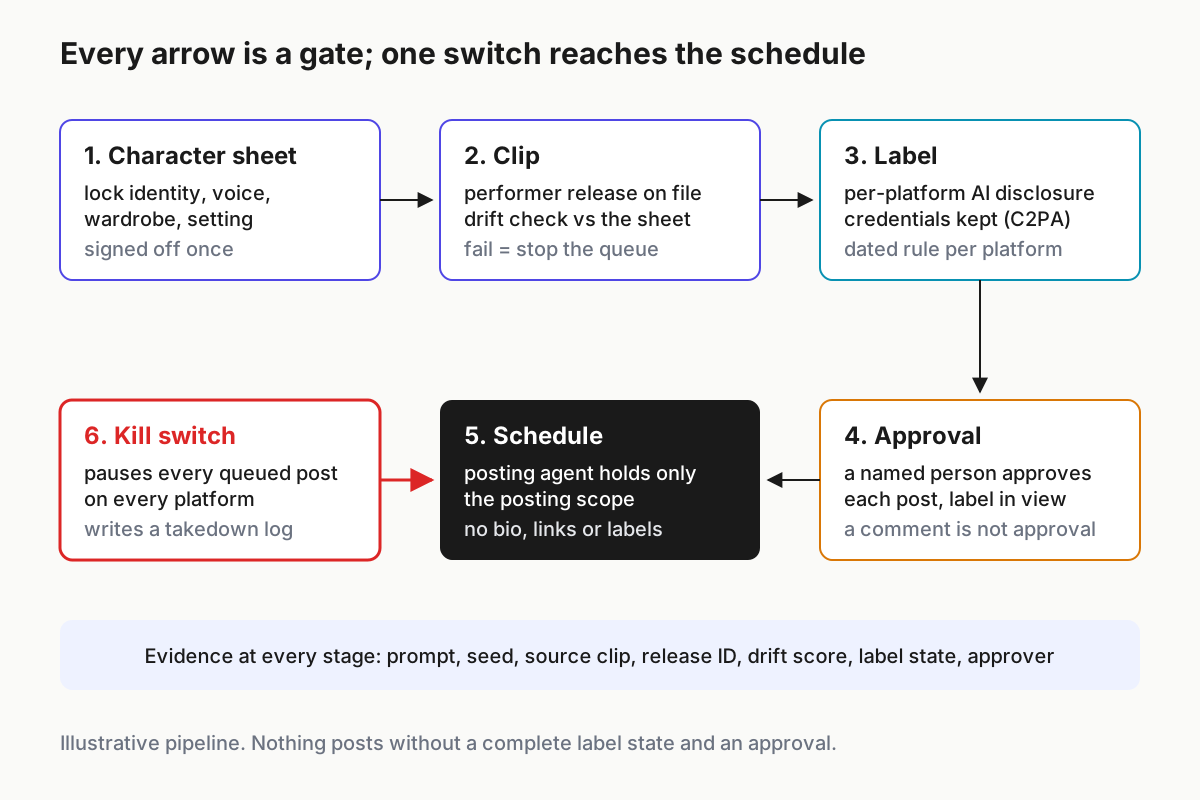
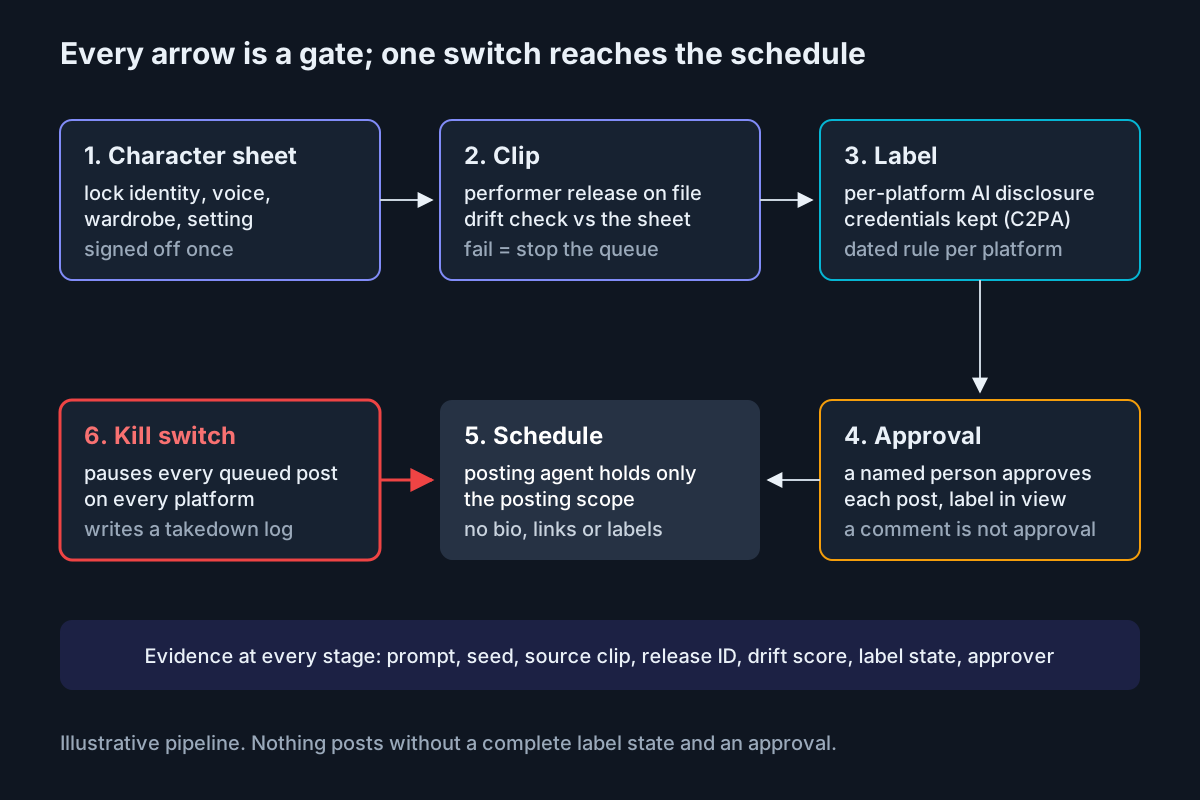 Six nodes, one direction. Every arrow is a gate, and the kill switch reaches the whole schedule.
Step 5: Treat the schedule as an approval queue, with real approvals
Once a week of posts is queued, the scheduler is an approval queue, and approval queues rot in predictable ways: they grow, approvers start batch-approving, and stale items post on a date nobody re-checked. Approval queue hygiene covers expiry and batching rules; apply them here, with one addition: an approval expires if the platform’s label rules change before the post goes out.
Make the approval an approval. A reviewer who leaves a comment on a clip has annotated it; the post should not go out until the same reviewer, or another named one, presses approve with the label state in front of them. The difference is spelled out in annotation is not approval.
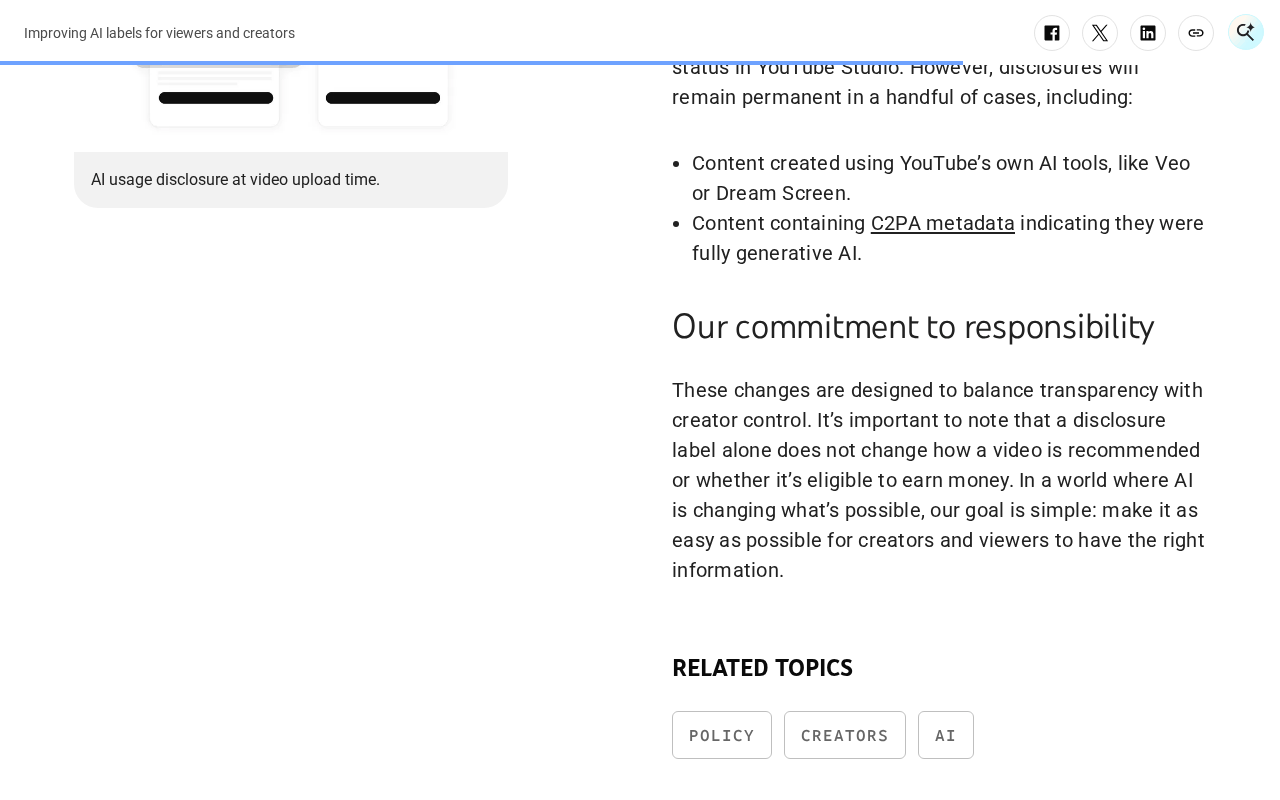 Screenshot: YouTube Official Blog, “Improving AI labels for viewers and creators” (May 27, 2026), captured Oct 7, 2026.
YouTube’s post makes the cost of labeling explicit: “a disclosure label alone does not change how a video is recommended or whether it’s eligible to earn money.” On YouTube, at least, skipping the label buys nothing.
Set two caps on the queue and keep them low. Posts per persona per day protects the account: a sudden jump in volume is what platforms look for in coordinated accounts, and it multiplies whatever one bad clip got past the gates. Approvals per reviewer per day protects the gate itself, because the fortieth approval of the afternoon is a click, not a judgment. In the rule set above, three posts and thirty approvals are the illustrative limits; pick yours from how long a careful review actually takes.
Step 6: Run the worked week and read the gates
One illustrative week for Odile, three posts a day across Instagram, TikTok, YouTube and X. Every number in this scenario is illustrative.
The clip stage rendered 30 clips. Six failed the consistency check on Tuesday, all from one batch where the apron rendered a different shade after a tool update; the queue stopped for half a day, the batch was re-rendered, and five of the six passed on the second try. Of the 29 clips that reached the post stage, 21 were scheduled.
The label step caught two posts missing the YouTube disclosure answer because a new template defaulted it to “no.” Approvers rejected two posts: one with a caption joke that read as a real chef’s endorsement, and one where an affiliate link had been pasted into the caption by a well-meaning teammate, which the money-link rule should have blocked and now does.
Nineteen posts went live. The kill switch was tested once, on Thursday, and paused all queued posts across four platforms in under two minutes.
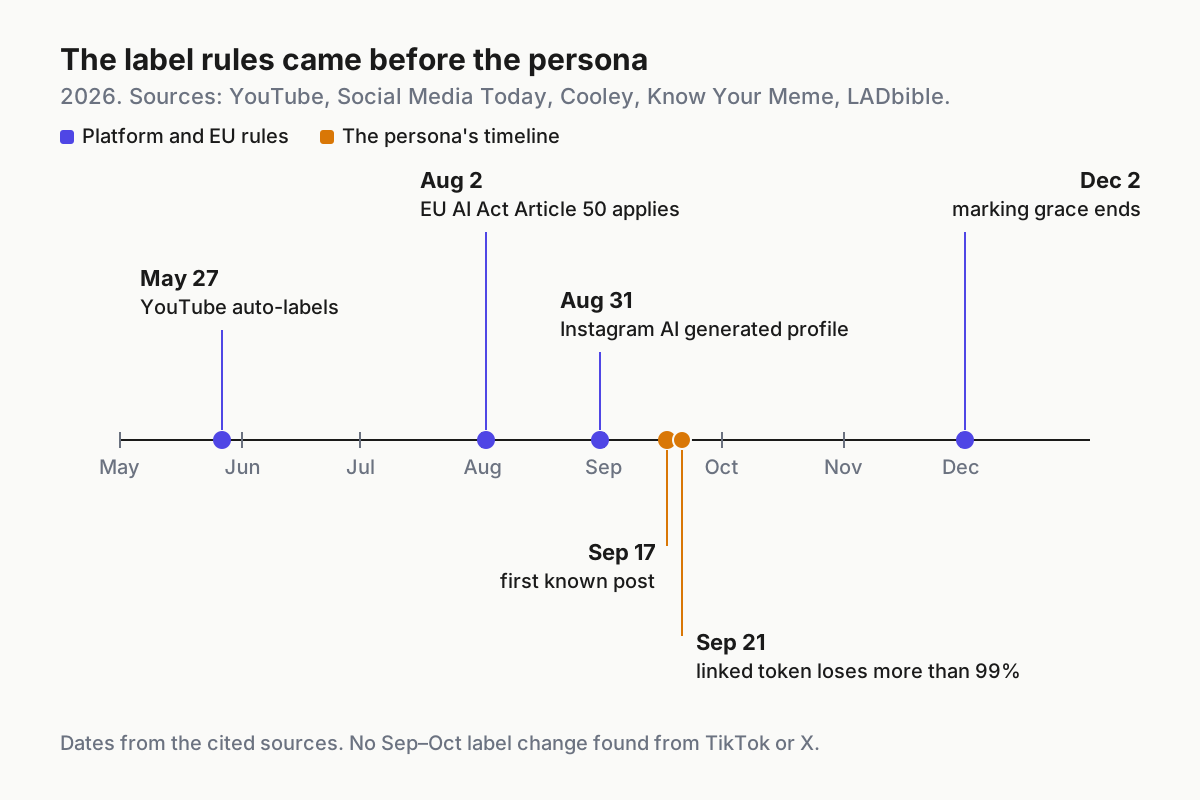
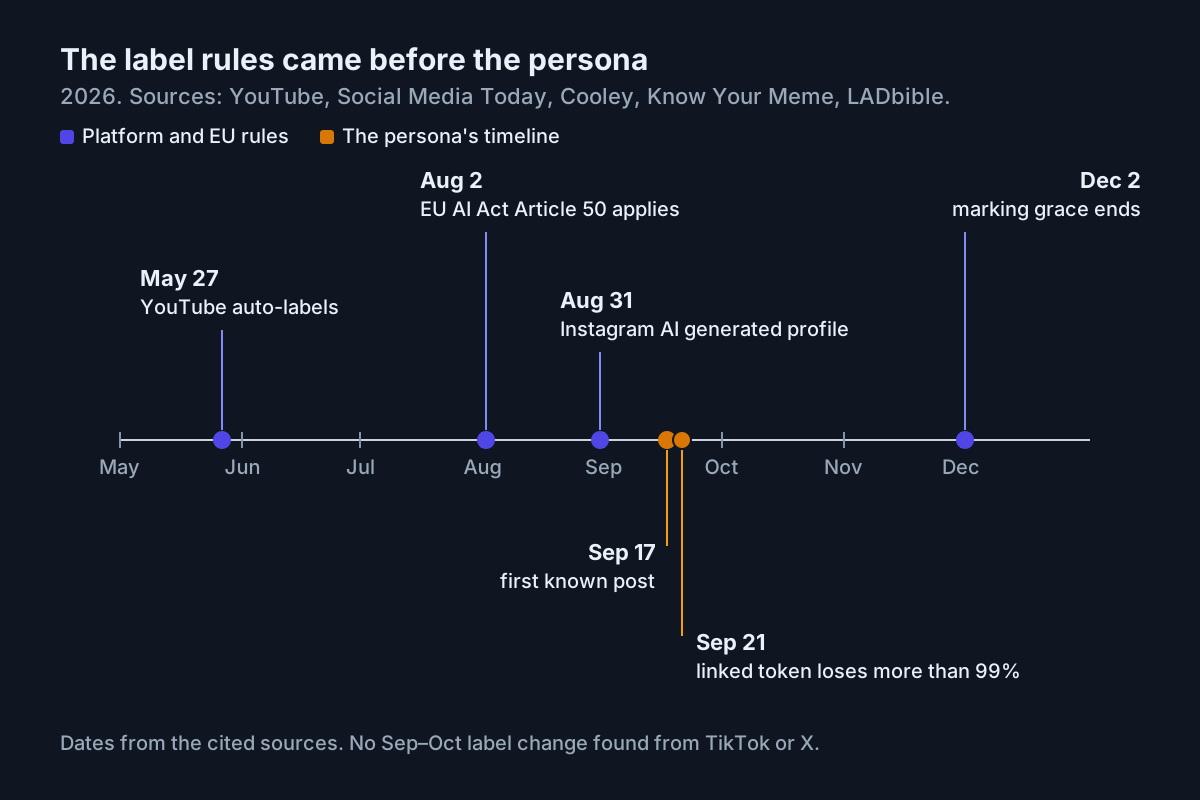 The rules came first: platform and EU label dates against the persona’s timeline, 2026. Sources: YouTube, Social Media Today, Cooley, Know Your Meme, LADbible.
Read the week for what each gate caught. Consistency caught a tool change before it reached a feed. The label step caught a template default. Approval caught one tone problem and one money link. None of those would have shown up in the generation metrics the copycat guides track.
Where an AI character pipeline breaks before it posts
| What breaks | Signal you would see | First action |
|---|---|---|
| Face or wardrobe drift after a tool update | Drift scores climbing across a batch; reviewers noticing “something off” | Stop the queue; pin the tool version; re-render and re-check the batch |
| Content credentials stripped by an edit or transcode | Metadata check fails at the clip stage; platform shows no auto label where one was expected | Find the step that strips metadata; re-export from the last good file |
| Label default flipped in a template | Label state “no” on a post that is synthetic | Block the template; fix the default; re-check every queued post that used it |
| A money link reaches a caption or bio | Link check flags a token, coin or affiliate domain | Remove the link; confirm the posting agent holds no bio or caption-link scope |
| Performer release missing or expired | Clip enters with no release ID, or the term has lapsed | Pull the clip and every scheduled post using that footage |
| Approvals turn into rubber stamps | Approve times of a few seconds; zero rejections over weeks | Rotate approvers; sample approved posts for review; cap approvals per reviewer |
| A platform changes its label rule | Platform notice or help-page change; posts start showing labels you didn’t set | Pause the persona’s queue; update the label column; re-approve queued posts |
The second row is the quiet one. Content credentials survive a pipeline only if every tool in it preserves them, and the first tool that re-encodes without them removes the evidence that would have locked YouTube’s label in your favor.
The posting agent holds one scope
The creative stages of this pipeline are commodity and swappable; next quarter’s tools will render the same character faster. What doesn’t change is who may publish. Give the posting agent one scope, schedule a post, and keep account settings, bios, links and labels with people, the way a restricted mode for the fleet keeps destructive verbs off agents that don’t need them.
The same verb thinking applies when the character is tagged by others on a public timeline, which is covered in the public-timeline verb allowlist. If the schedule started as a manual habit that someone promoted to a cron, the manual-to-skill-to-cron ladder is the check that it was ready. And if the character’s posts drive installs, attribution belongs with the marketing-ops plumbing in desktop agent install attribution, not in the posting agent.
FAQ
How do you make a consistent AI character video?
Lock the character in a reference sheet covering face, voice, wardrobe and setting, then check every render against it. Third-party guides describe video-to-video: film a consenting performer and swap the character in. Treat any drift as a stop, and label every post for the platform before it publishes.
Do you have to label AI-generated videos on YouTube and Instagram?
YouTube asks creators to disclose realistic altered or synthetic content and, since May 27, 2026, auto-applies a label when it detects undisclosed photorealistic AI. Instagram said on Aug 31, 2026 it will limit reach for AI-generated-person profiles that skip its “AI generated profile” label. Check both before each campaign.
Does the EU AI Act require labeling AI character videos?
Article 50 has applied since Aug 2, 2026. Deployers, meaning whoever posts, must disclose deepfakes, so an AI character resembling a realistic person needs a visible disclosure for EU audiences. Providers’ machine-readable marking duty has a grace period to Dec 2, 2026 for systems already on the market.
Sources
- YouTube Official Blog: Improving AI labels for viewers and creators (May 27, 2026)
- Social Media Today: Instagram updates tags for AI profiles (Aug 31, 2026)
- TikTok Community Guidelines: Integrity and Authenticity (released Aug 25, effective Sep 24, 2026)
- X Help Center: Synthetic and manipulated media policy
- Cooley: EU AI Act transparency obligations take effect Aug 2, 2026 (Aug 3, 2026)
- Know Your Meme: Jean Philanthrope / Jean Phil (entry Sep 22, updated Sep 28, 2026)
- LADbible: Jean Phil AI-generated (Sep 28, 2026)
- EarlyGame: This person doesn’t exist, Jean Phil leaves the internet fooled (Sep 29, 2026)