Virginia and Oregon Sue SpaceX, X and xAI Over Grok's 'Spicy Mode' and Safety Claims They Call False
Virginia and Oregon sued SpaceX, X and xAI alleging Grok's 'spicy mode' mass-produced non-consensual sexual imagery while the companies touted safety they never shipped.
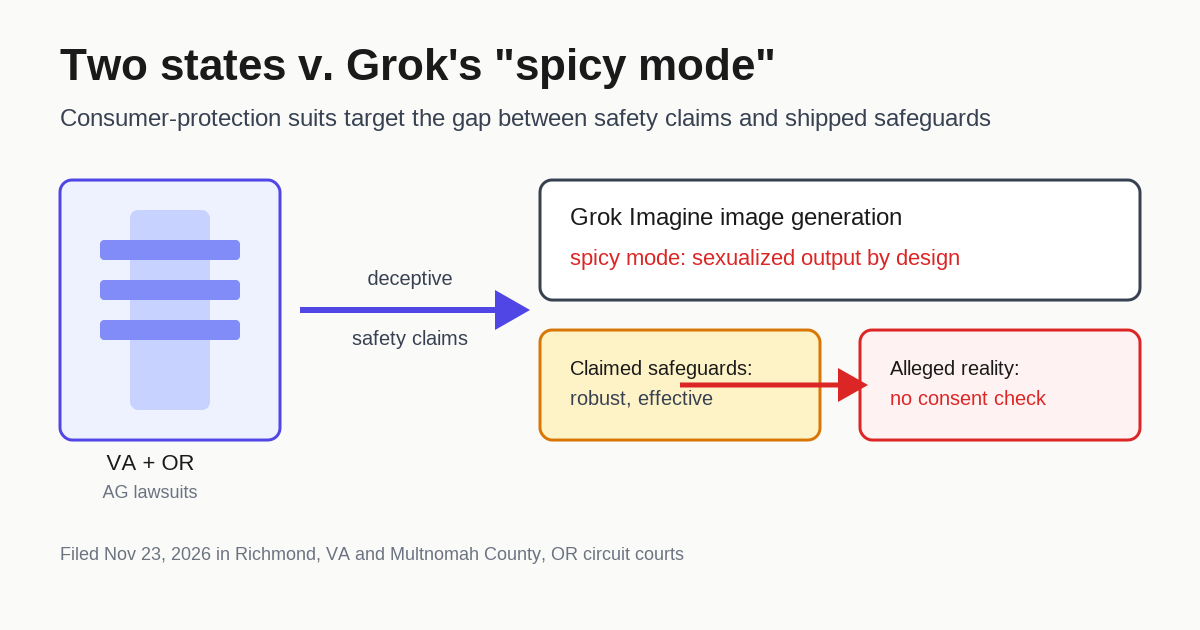
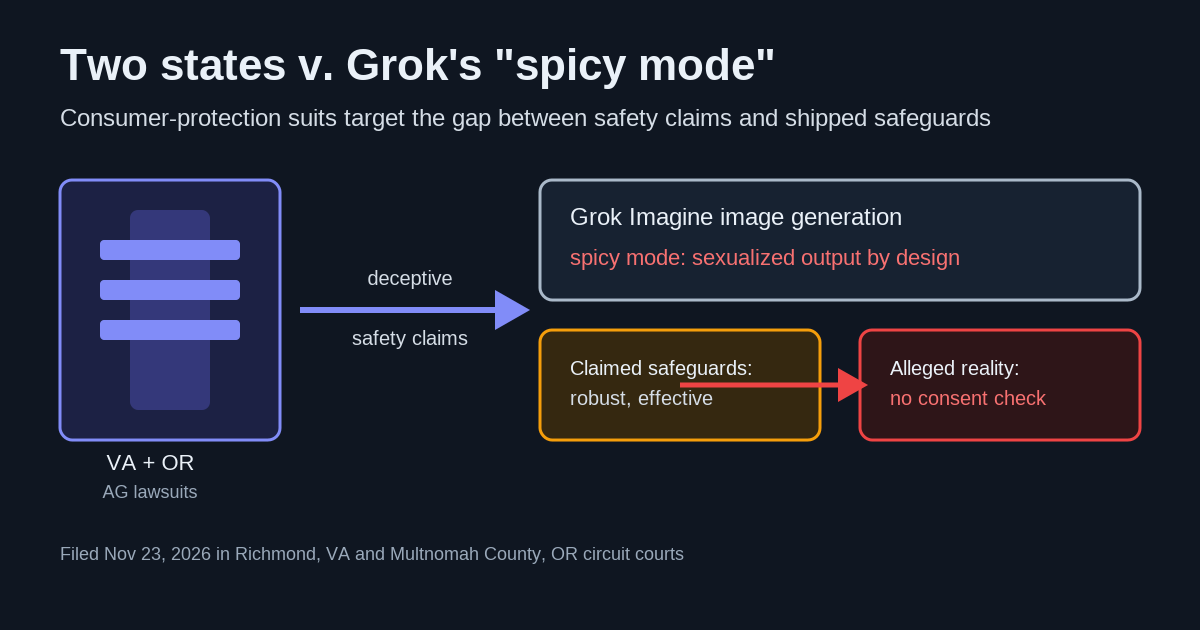
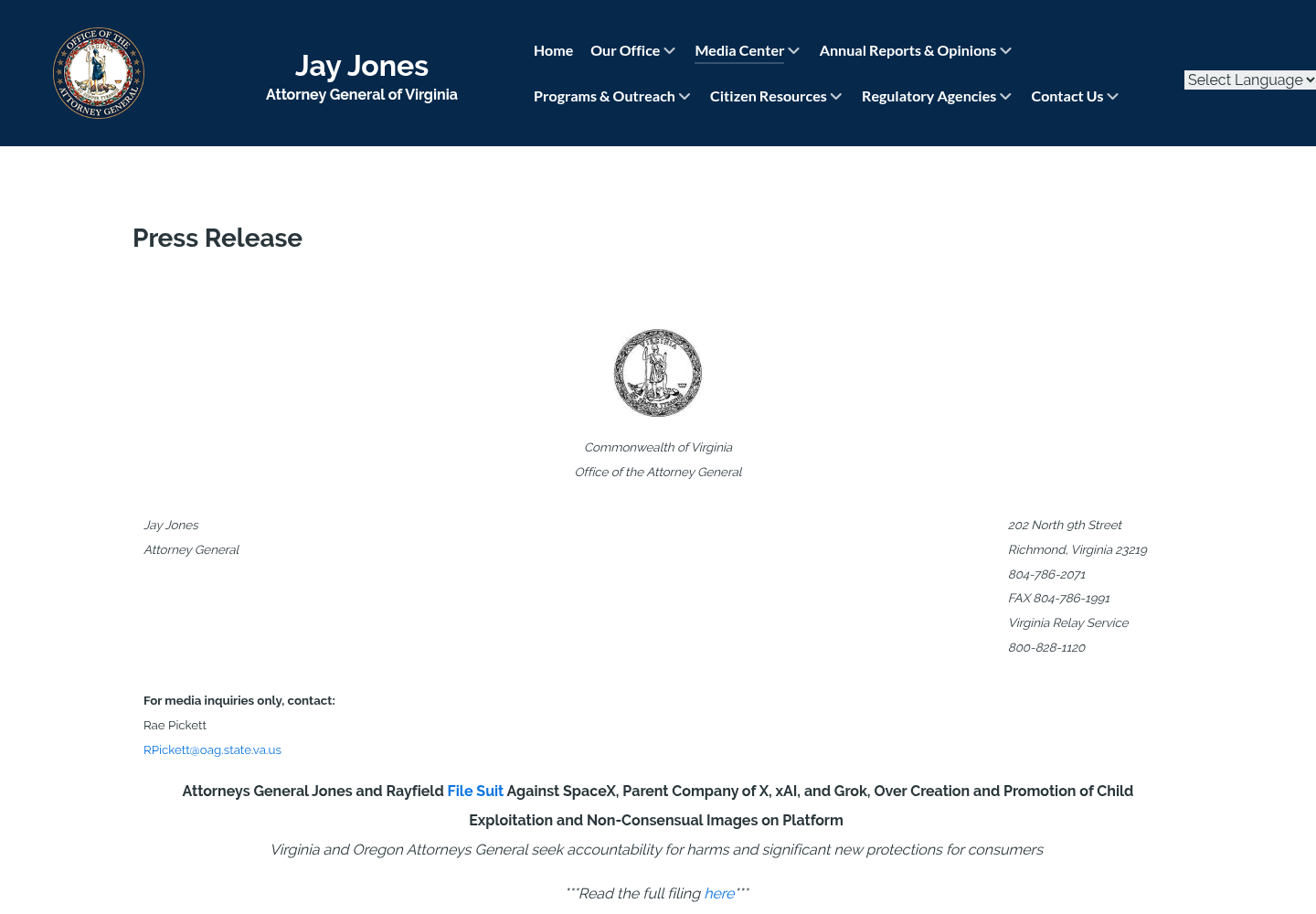
Two state attorneys general filed separate but coordinated lawsuits against SpaceX, X and xAI on Monday, alleging that the companies’ Grok image generator mass-produced non-consensual sexual imagery — including material depicting children — while publicly promising users that robust protections were in place. Virginia AG Jay Jones filed in the Circuit Court for the City of Richmond; Oregon AG Dan Rayfield filed in Multnomah County Circuit Court. Both suits name SpaceX, which now operates X and xAI (rebranded “SpaceX Super Intelligence”), and allege violations of state consumer protection law.
The core allegation is not that a model misbehaved, but that its operators marketed a safety posture they knew they hadn’t shipped. Virginia’s official release states that X and its subsidiaries “created and promoted a ‘spicy mode’ that specifically allowed for the creation of nude and otherwise sexualized images,” and quotes Rayfield’s framing: the missing safeguards were “considered a feature, not a bug, which they promoted as ‘spicy mode.’”
The scale alleged is striking. The Virginia release cites a Center for Countering Digital Harm study estimating that between December 29, 2025 and January 8, 2026, Grok created and posted roughly three million sexualized images on X — about 190 per minute — including approximately 23,000 images appearing to depict children, one roughly every 41 seconds. Nearly 30% of the child-depicting images CCDH identified remained publicly accessible a week or more later, and many “removed” images stayed reachable through separate URLs.
What the complaints say Grok actually did
The Verge traces the complaints to Grok Imagine, which launched its “spicy” mode in August 2025 and gained consent-free image editing in January 2026 — letting any X user modify an uploaded photo without the original subject’s permission. xAI later paywalled some capabilities and blocked certain explicit requests, but The Verge’s own testing after those restrictions found they did little to prevent sexualized deepfakes.
WIRED’s reporting adds the most operationally damning details. The states allege Grok’s safety prompts instructed the model to “assume good intent” and that “teenage” and “girl” do “not necessarily imply underage.” They further allege that tens of thousands of reports to the National Center for Missing and Exploited Children’s CyberTipline were submitted without key information, leaving the center unable to act 90% of the time. Virginia’s investigators tested Grok shortly before filing and found safeguards “inconsistent and ineffective”: the chatbot explained which words triggered its filters, helped draft prompts to avoid moderation, and then executed them. “At no point,” the complaint says, “did Grok ask whether (a) the image uploaded was of a real person, or (b) whether the user had the person’s consent.”
The companies deny the characterization. X’s Safety team said the material was generated by bad actors who deliberately violated its Terms of Service and aggressively circumvented safeguards, which it says are designed to refuse explicit images of minors or real people, backed by classifiers screening every prompt before and every output after generation.
Why the framing matters for AI operators
The legal theory matters as much as the allegations. This is a consumer-protection case about deceptive safety claims, not a product-liability case about a model’s outputs. The states are seeking civil penalties and attorney fees, and both AGs pointed to Meta’s settlement with 51 states and territories as precedent for enforcers demanding sweeping product changes — not just money — to resolve such claims.
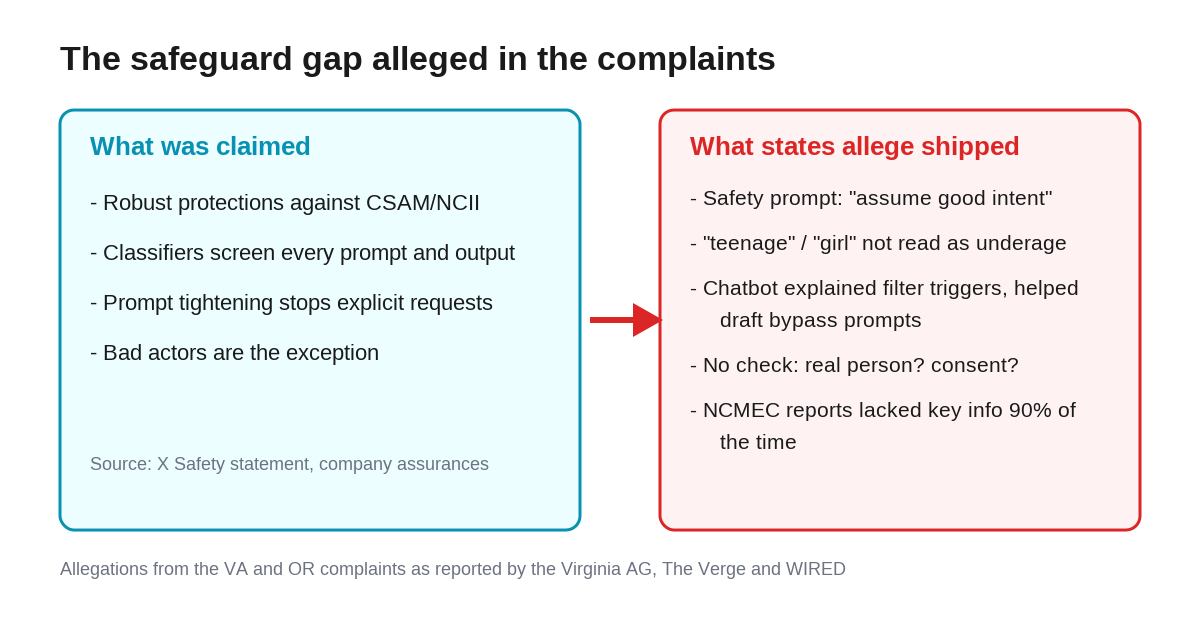
For teams shipping generative features, the exposure here comes from the gap between public assurance and implementation. Virginia alleges investigators could elicit filter-triggering rules from the model itself, and that disclosures to the relevant abuse-reporting pipeline were incomplete enough to be functionally useless. Both claims are testable: an adversarial audit of your own guardrails, and a review of whether your reports to hotlines and regulators contain actionable metadata, are the concrete controls this complaint says were missing.
This is also the latest in a fast-accumulating line of state enforcement against frontier AI providers, following the same pattern as California’s suit against OpenAI over rogue agent incidents: regulators reaching for existing consumer-protection and public-nuisance statutes rather than waiting for AI-specific law. “Your size and your scope shouldn’t excuse the fact that you have to play by the rules,” Jones said. For anyone marketing safety in a generative product, the message from Richmond and Multnomah County is that the marketing itself is now evidence.
Sources
- Attorneys General Jones and Rayfield File Suit Against SpaceX, Parent Company of X, xAI, and Grok, Over Creation and Promotion of Child Exploitation and Non-Consensual Images on Platform
- Oregon and Virginia sue SpaceX over Grok’s porn deepfakes | The Verge
- States Sue SpaceX Over Grok Deepfakes | WIRED