LangChain's Knowledge Factory: Working Agents Flag What They Don't Know, a Curator Agent Fixes It That Night
LangChain's production loop: a working agent flags the knowledge it cannot find, and a background curator agent repairs it from raw sources and traces at night.
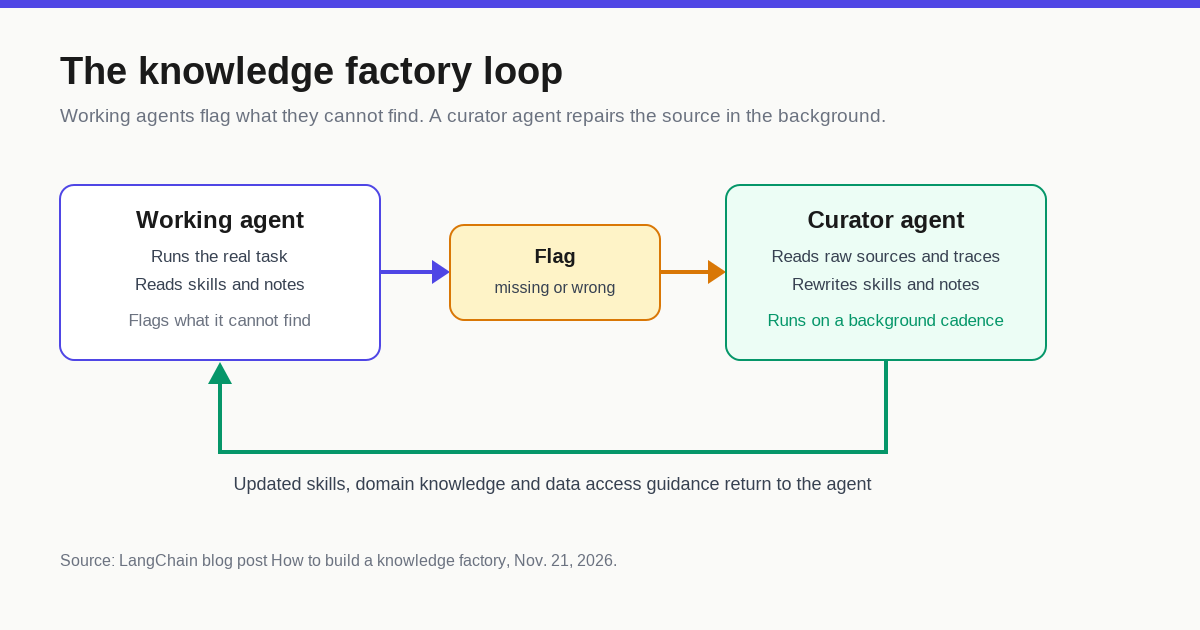
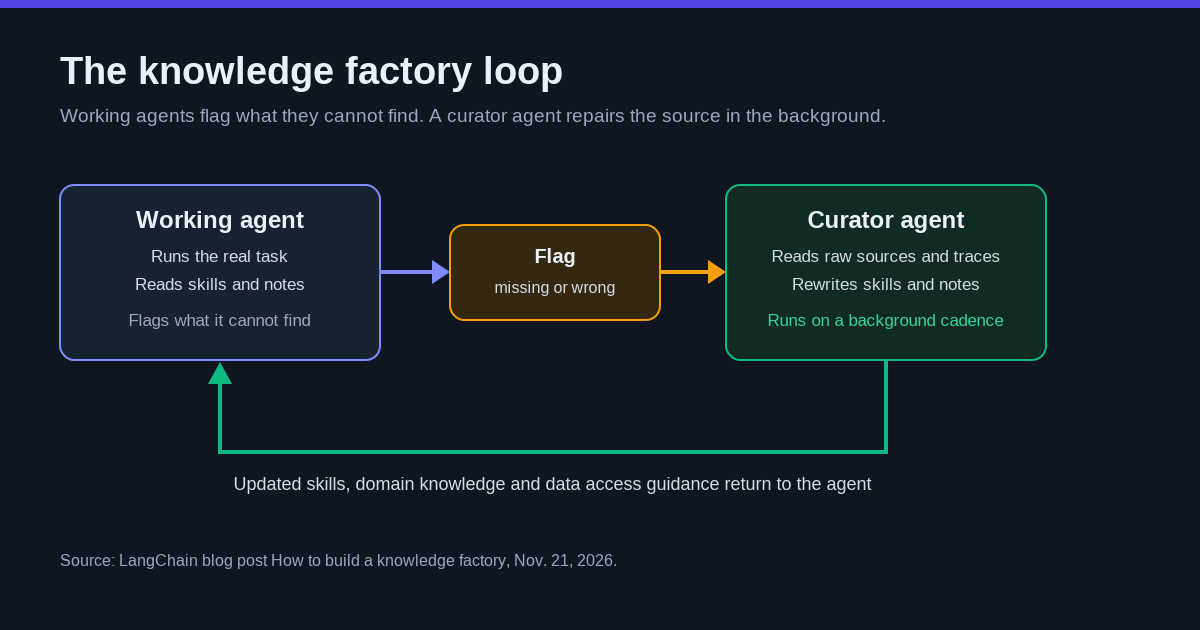
On November 21, 2026, Harrison Chase published How to build a knowledge factory. It is not a product release. It is an account of a system LangChain runs internally: what keeps an agent useful in a company is not a better model or a longer context window, it is company knowledge that stays current, and that upkeep can go to a second agent instead of to the people doing the work.
The post is the newest featured entry on the LangChain blog index, published in the same week as From tasks to goals and the LangSmith Tool Gateway post. Both point the same way: agent behavior is being engineered as a system with parts, not steered by a prompt.
Context is not knowledge
Context is what an agent has in hand during a task. Knowledge is the reusable understanding you maintain so the agent can do that task correctly: what a metric means, which source to trust, how the company handles a situation. Knowledge is a kind of context, but not the only context an agent gets. Data that changes by the minute should be fetched every time, not maintained. The factory applies to the slow half only: procedure, business meaning, and where things live.
Three kinds of knowledge
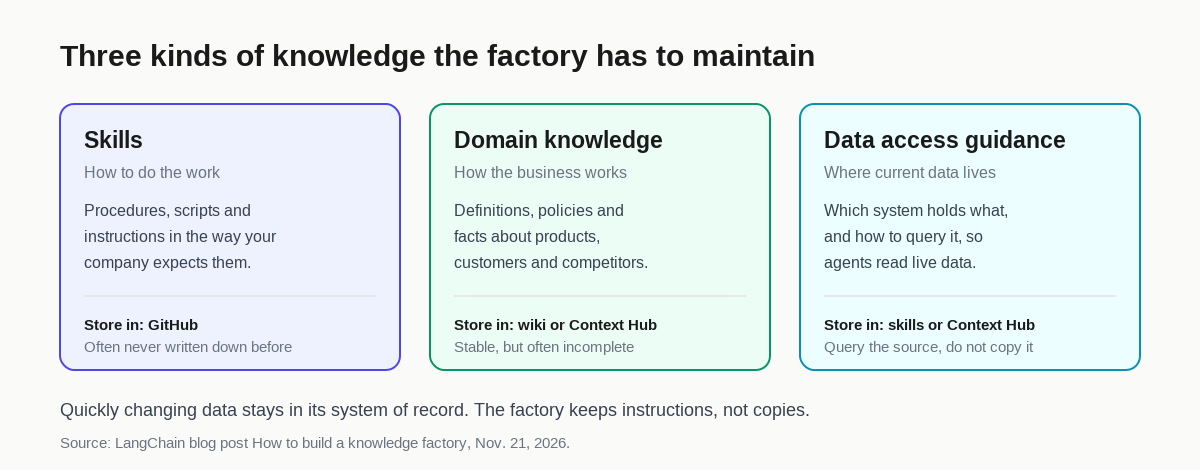
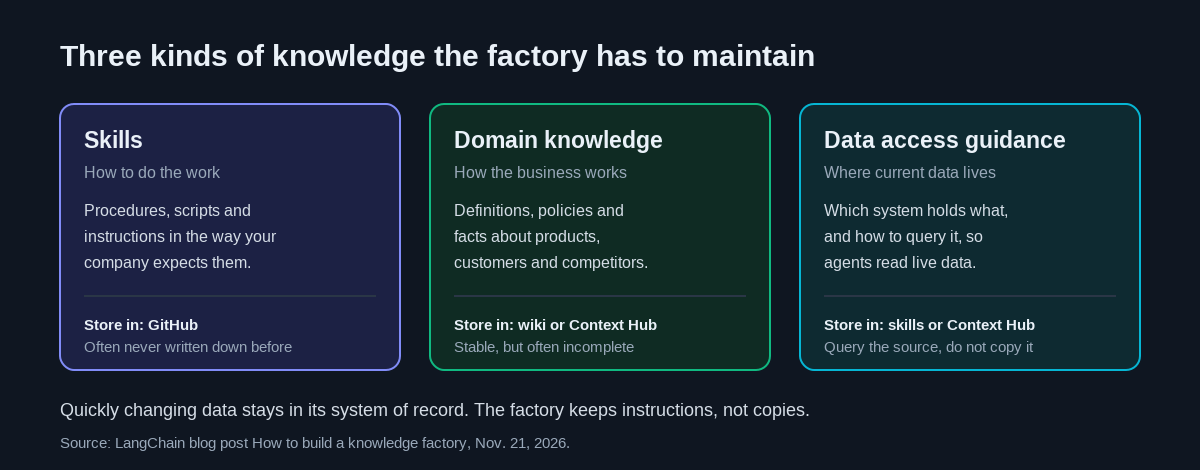
Skills. Procedures, instructions and scripts for doing a task the way the company expects. Much of it was handed coworker to coworker rather than written down.
Domain knowledge. Definitions, policies and facts about products, customers, competitors and organization. It changes rarely, so the written version is often incomplete or quietly wrong.
Data access guidance. Which systems hold what, and how to query them. If the source of truth is already current, keep the instructions rather than a copy.
The three parts of the factory
A flag tool. The working agent gets a tool whose minimum job is to report what it could not find or what it found to be wrong, optionally with a suggested correction.
A curator agent. A separate agent updates the knowledge on a background cadence, with read access to the raw sources where knowledge is scattered, plus agent traces and the flags the working agents left.
Storage. LangChain is least prescriptive here. Skills can live in GitHub, one file in Notion, OKF format in LangSmith Context Hub, or a knowledge graph in Neo4j. Procedural memory has converged on skills; semantic memory has no standard yet.
The curator is a separate role for a reason worth stealing. Agents that use the knowledge are chasing their own goals, and LangChain argues a crowd of self-maintainers leaves knowledge unruly and full of contradictions. Repairing knowledge means reading the underlying sources deeply, a different job from doing the work.
One report, one night
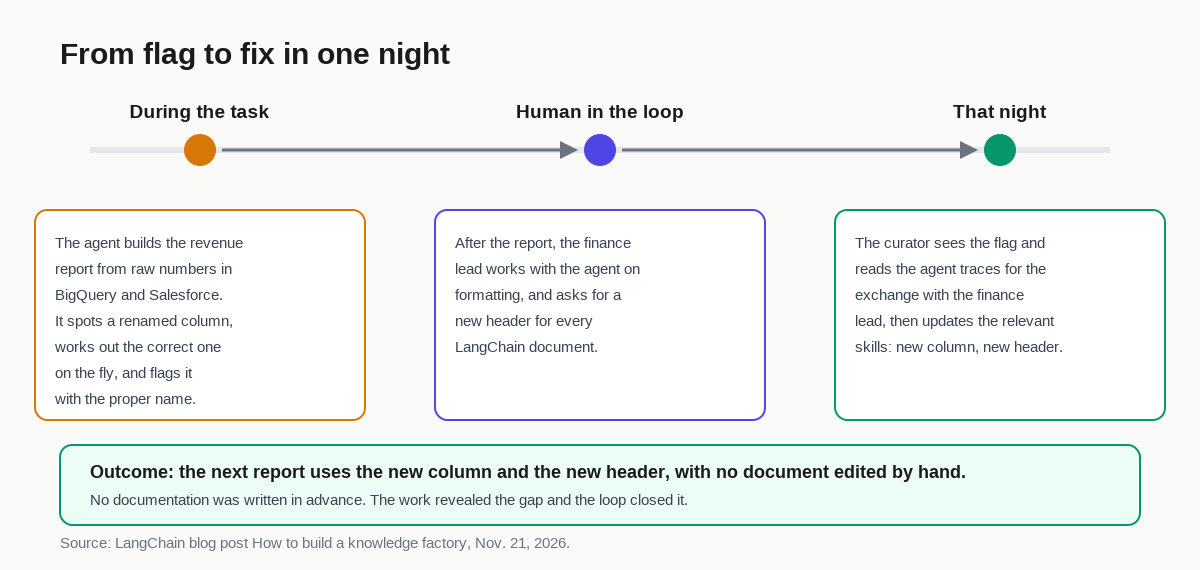
The worked example is an agent preparing a revenue report. Base context is raw revenue numbers in BigQuery and Salesforce. Knowledge is layered: reporting skills in GitHub, the way ARR is calculated in a company wiki, and the data-access instructions in Context Hub.
During the run the agent notices a renamed column, works out the correct one on the fly, and flags it. Afterward a finance lead works with the agent on formatting and asks for a new header on every LangChain document. That night the curator sees the flag, reads the traces of the exchange, and updates the relevant skills. The work reveals what is missing, and closing the gap makes later work better. Nobody documented the column rename in advance.
What you can do with this
For teams running Claude Code, Codex or another coding agent against internal documentation, four changes follow.
Give the agent a way to complain. A flag tool turns a silent wrong answer into an auditable item instead of a support ticket.
Separate the maintainer from the user. The curator runs on a schedule, not inside a user request, and answers to sources and traces rather than to the person waiting.
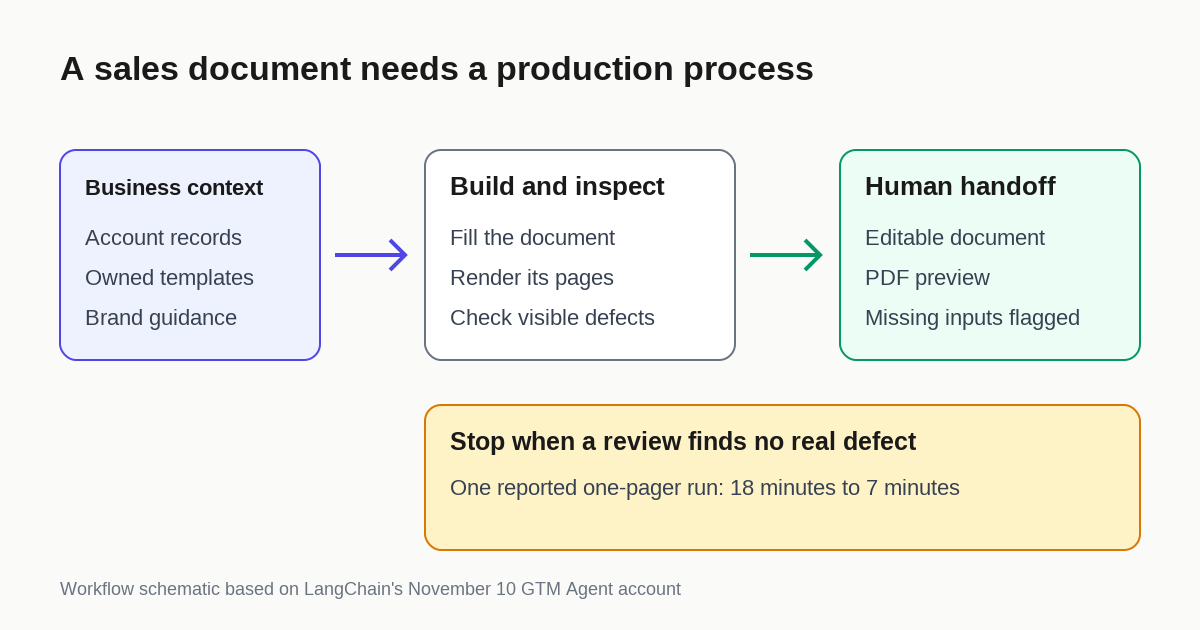
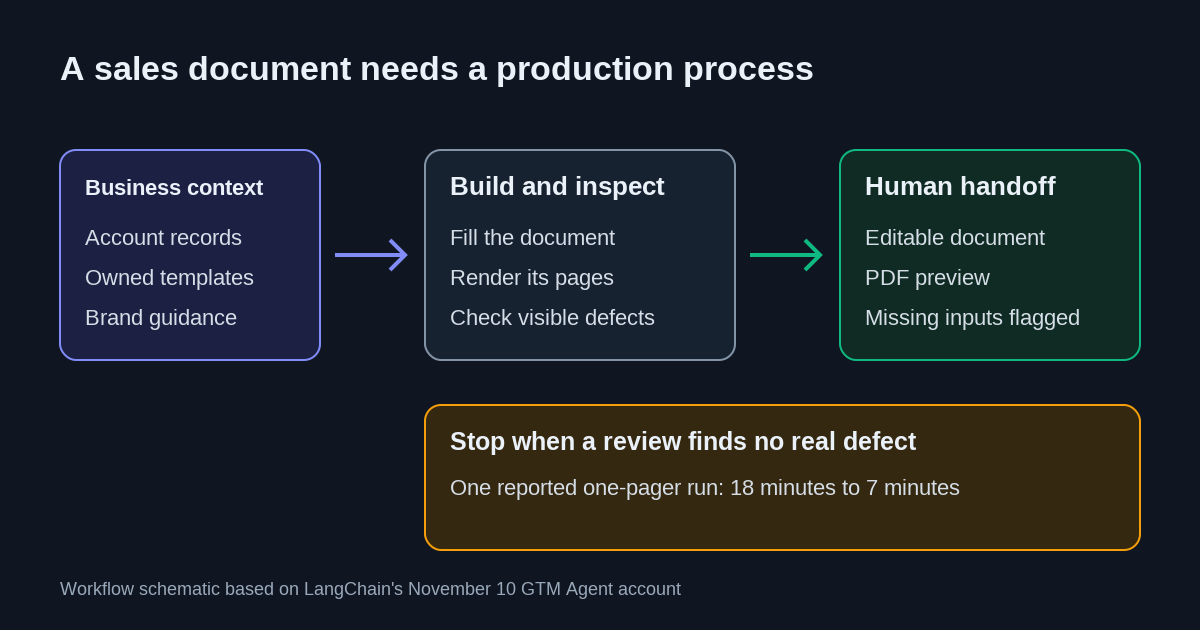
Feed traces to the maintainer. Traces are where tacit procedure becomes written skill. LangChain runs a factory behind its internal GTM and content-studio agents, and LangSmith Engine maintains one per agent it troubleshoots.
Store knowledge where it gets reviewed. Skills in GitHub where possible, so a knowledge change shows up in a diff like any other change.
Automater has covered the GTM agent, the Deep Agents guide to context engineering and the proactive-agent memory playbook. LangChain’s own advice: start with one recurring workflow, watch where the agent struggles, close that loop.
What the evidence shows
Two cautions. This is one vendor describing one vendor’s internal system, with no independent numbers for how often flags are right or how many curator edits survive review. And the design is openly unsettled: LangChain calls storage the least explored area and points at the Open Knowledge Format as a semantic memory standard that has not arrived.
The corroboration is adjacent but real. Stripe’s Kai, built on the Deep Agents harness, reached more than 1,000 skills contributed by over 100 teams, and Stripe found that frontier models degrade in quality when more than 150 skills load alongside the system prompt. That is the problem the curator aims at, with one difference: Stripe federated skill ownership to the teams that own them, while LangChain proposes a central agent writing back. Either way, the open question is who reviews a knowledge change, and the post does not say how that is gated.
The takeaway
The interesting part is not that agents can write documentation. It is the division of labor: the agent closest to the task reports what it could not do, and a second agent with more authority over sources and traces decides what to change. If your agents are confidently wrong from stale internal context today, the fix is not a longer prompt or a bigger window. It is a loop that turns every wrong answer into a queued repair.
Sources
- How to build a knowledge factory - LangChain, Nov. 21, 2026
- How Stripe Built Kai on Deep Agents - LangChain, Aug. 3, 2026
- LangChain blog index - the publisher listing that dates the post