LangChain's Five Harness Choices Before an Agent Owns a Goal
Harrison Chase's November 16 essay says handing an agent a goal changes who picks the work. LangChain's October harness—Slack, split identity, two memory tiers, a sandbox proxy, and schedules with a skip rule—is how three internal agents bound that shift.
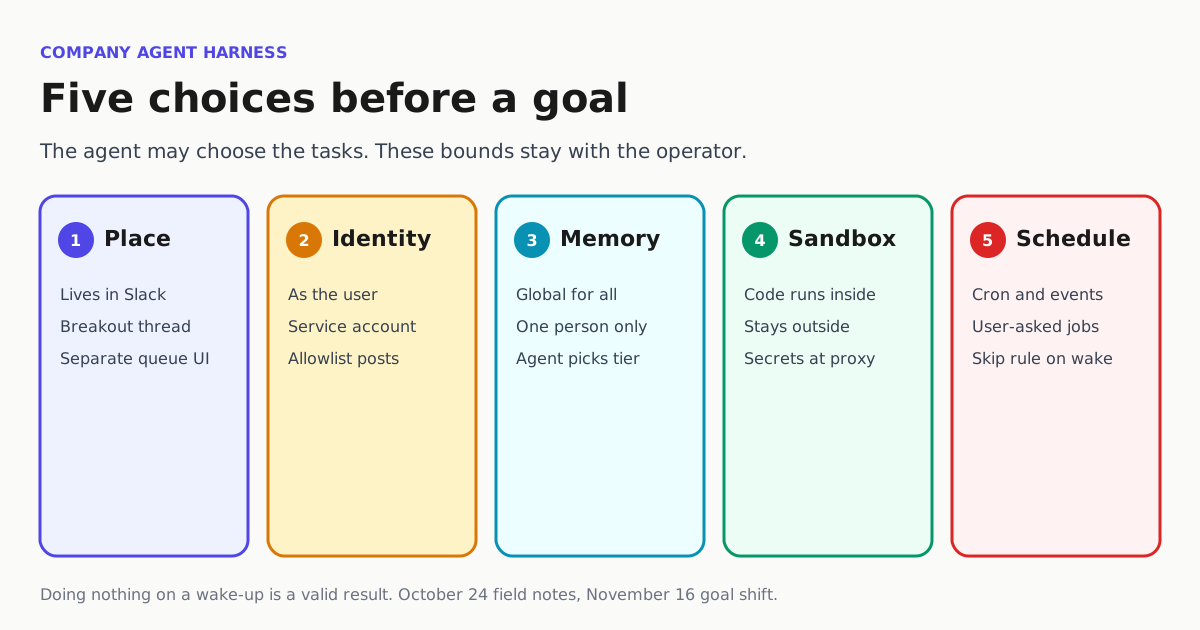
On November 16, 2026, Harrison Chase published From tasks to goals. A task names an action and stops: write this email, draft this blog, fix this bug. A goal names an outcome and keeps going: keep important commitments on track, maintain a blog, make a product successful. The agent then picks tasks, revises them, and sometimes waits. That reaches what the agent decides, what it needs, how it is built, and how people supervise it.
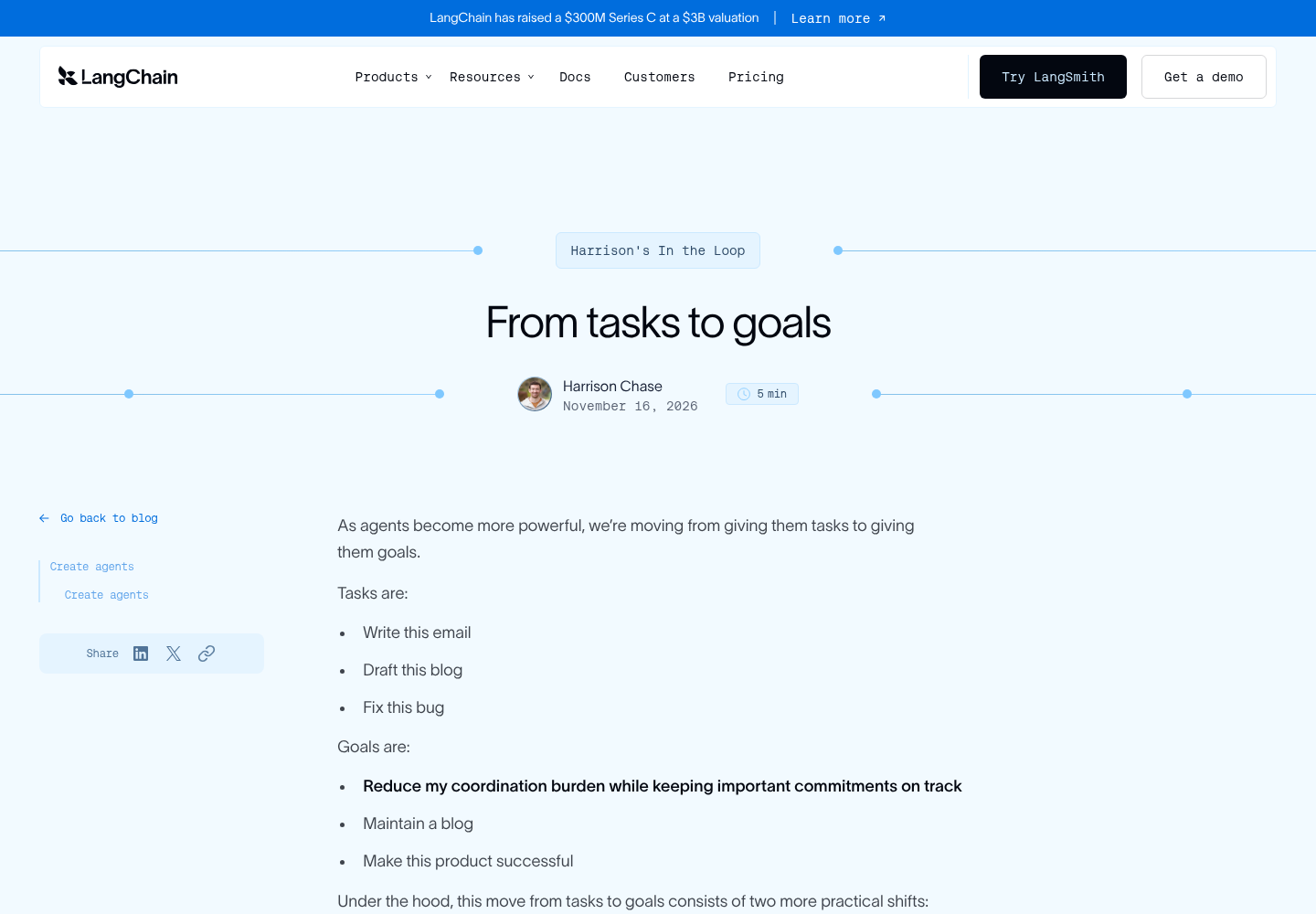
A harness has to carry work that outlasts a single reply. On October 24, Chase and Caspar Broekhuizen published The five components of building a “company harness”: the primitives their marketing, sales, and engineering agents converged on. On November 2, New context engineering challenges in late 2026 lists what always-on goal agents still leave unsolved. Read November 16 as the operating argument, October 24 as the field record, and November 2 as the limit.
What a goal forces you to add
Chase describes two moves: from an action to an outcome, and from a bounded assignment to an ongoing responsibility.
| Requirement | What you add |
|---|---|
| The agent picks the tasks | A visible to-do list, and prompts that vary the ideas |
| The next tool is unknown | Limits on which tools may run |
| The run is in the background | A way for the agent to ask a person |
| One metric can be gamed | Human feedback beside any number you track |
| Wake-ups continue | Heartbeats, cron, reminders, or events, plus a skip rule |
| Corrections must compound | Memory of decisions across runs |
Sending an email implies a mail tool. Keeping commitments on track leaves the next call open: mail, search, a browser, or a tool still unconnected. Chase’s response is stricter limits on which tools may run.
Wake-ups keep a goal alive when nobody is typing. Chase lists a heartbeat on a fixed interval, a recurring cron, a one-off reminder, and an event listener. OpenSWE’s builders review each new pull request from a listener they installed. A daily brief Chase requested from GTM Agent became a cron the agent created. Repeating one question every thirty minutes is a failed wake-up, and staying quiet can be the correct action. Attach a skip rule to the trigger.
For a single task the user can paste context again. For a standing goal, a rejected blog topic has to change later pitches. Scoping goals so feedback stays cheap is covered in LangChain’s Goal Engineering. The November 16 addition is storage: the next run must see that decision.
Five primitives, three internal agents
GTM Agent handles email, qualified leads, daily briefs, account questions, and outbound motions. OpenSWE drafts pull requests and reviews every one. Content Studio drafts blogs, images, decks, and videos in the company voice. Chase and Broekhuizen present these as one recipe. The posts offer an internal account, with no external tally of briefs kept, reviews merged, or posts blocked.
Place. Agents live in Slack, each with an app people DM or mention. Channel use is deliberate: colleagues can see the requests. A breakout shifts the agent to its own thread and leaves the human conversation intact. A large GTM email-approval backlog fit Slack poorly, so they built a separate queue UI.
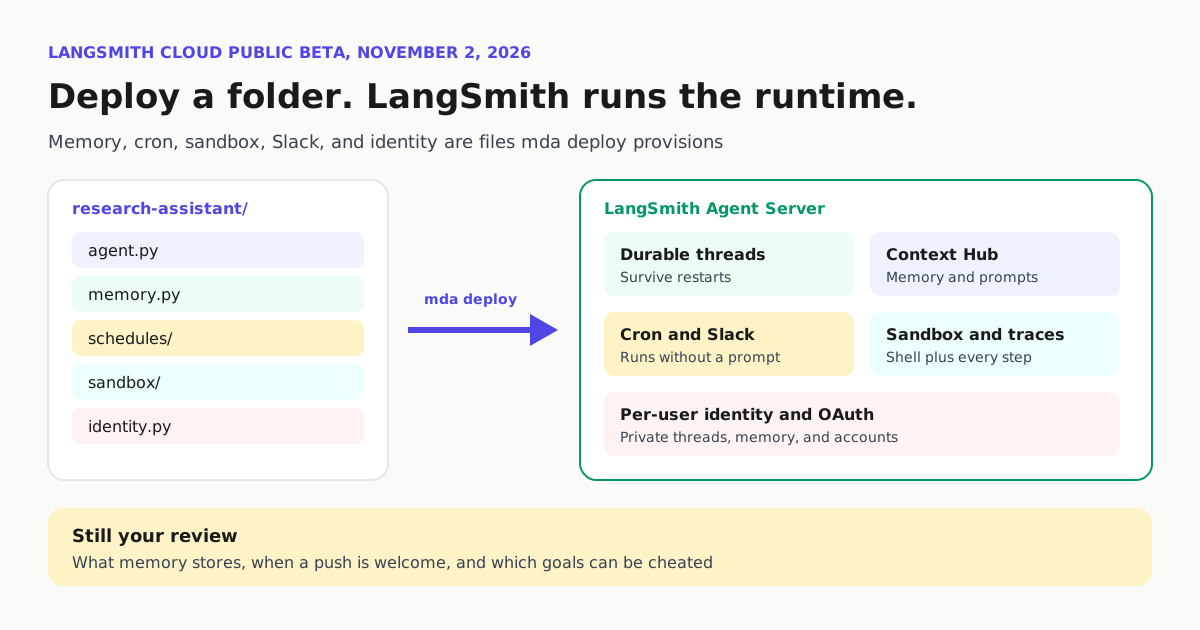
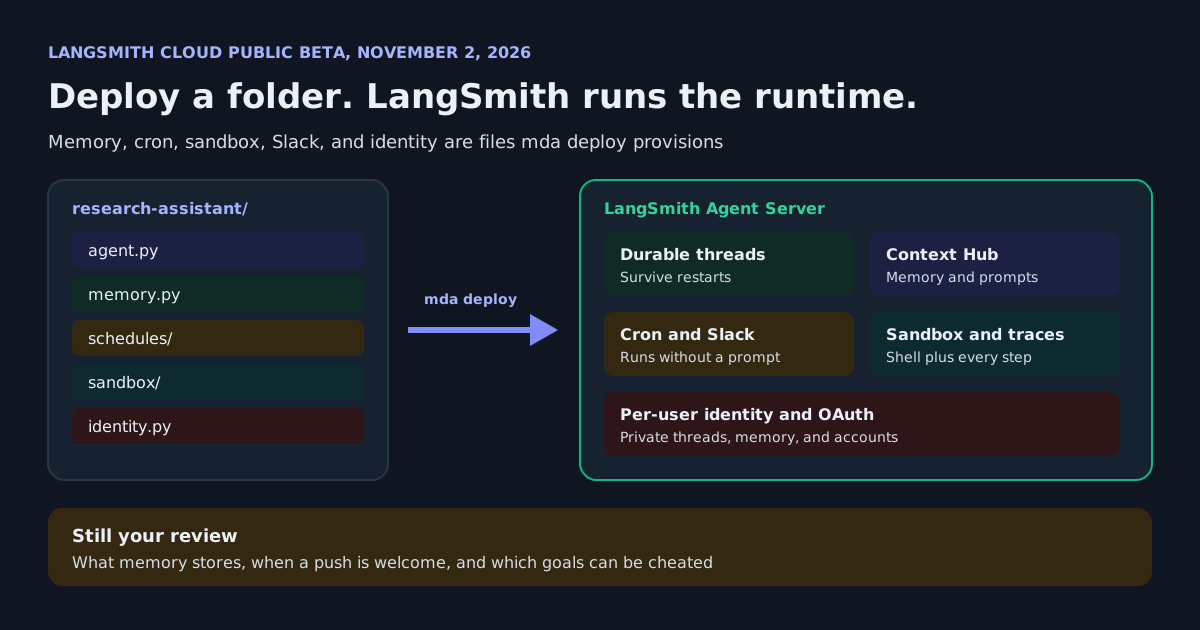
Identity. Chase calls identity the thorniest problem: whose authority an action uses. The two patterns are on-behalf-of the invoking user, and a fixed credential such as a service account.
| Agent | As the invoking user | On a fixed identity |
|---|---|---|
| OpenSWE | Pull requests you request use your GitHub handle | Background review uses its GitHub app |
| GTM Agent | Email sends as the invoker, and only in DMs | Salesforce access uses one shared login |
| Content Studio | Notion runs as the invoker | The company Twitter account is fixed; a whitelist may post |
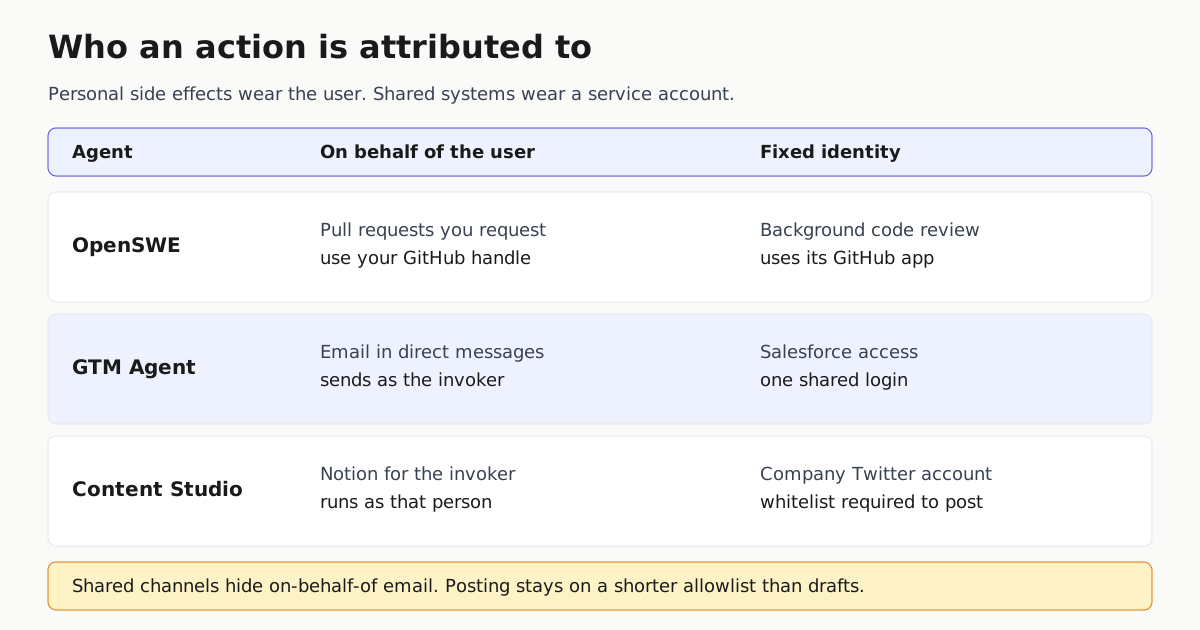
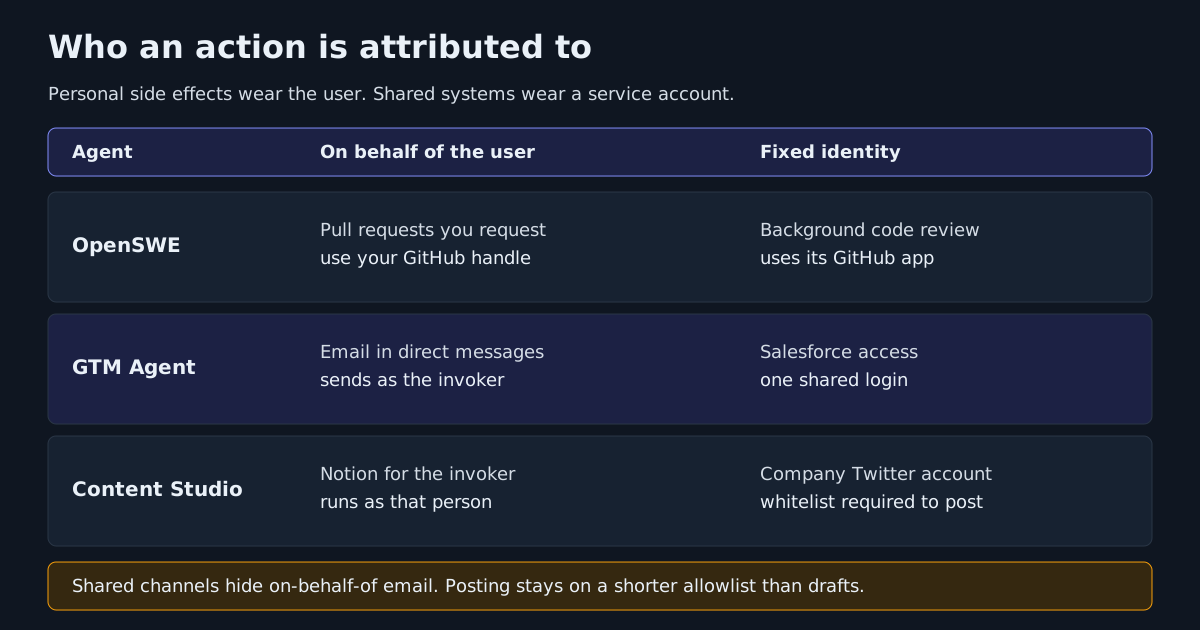
Copy the gates with the table. On-behalf-of GTM email exists only in DMs. Company Twitter posting is whitelisted separately from drafts. Requested OpenSWE pull requests use your handle; background review uses the GitHub app. User-scoped mail, docs, and commits stay on the invoker and out of shared rooms. CRM, the company account, and fleet-wide review stay on a service identity. Public actions get the shorter allowlist. See AWS on separating an agent’s permissions from the user’s authority.
Memory. Global memory applies to every user. User memory applies to one person. The agent chooses the tier for each fact. The authors call this the least explored piece, with substantial work left.
Sandbox. The agent stays outside, connects in, and executes inside a sandbox. Images differ across the agents, and OpenSWE selects one by channel or user. The LangSmith Sandboxes secret proxy lets that code call authenticated services without holding the secrets. The boundary to copy is code inside, credentials at the proxy, and a per-team image.
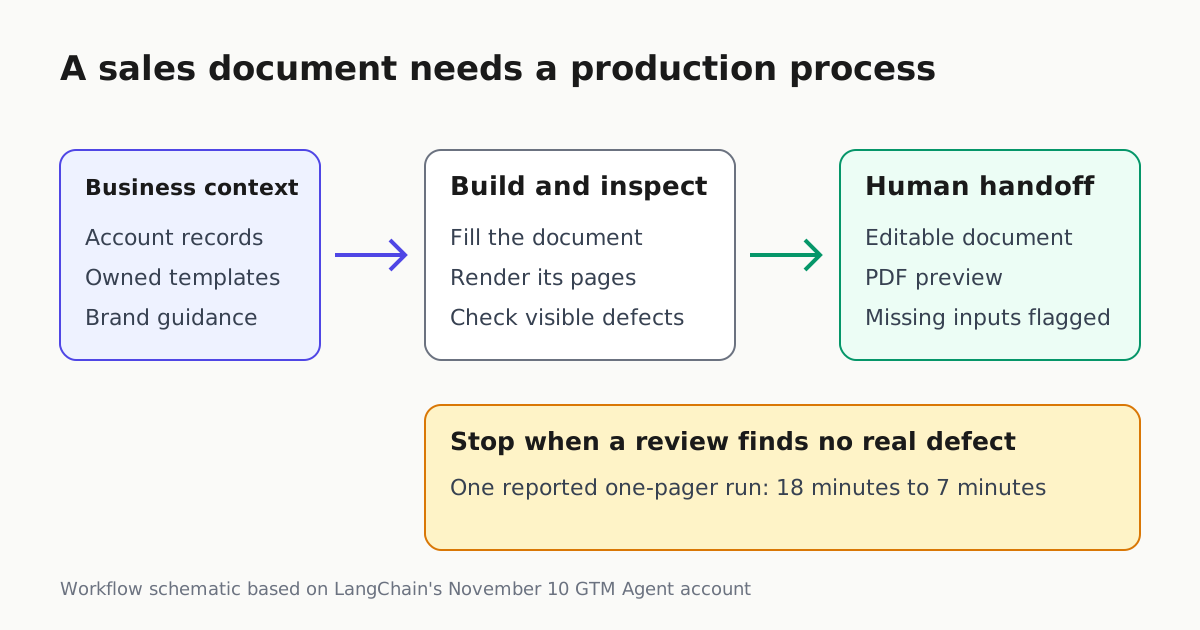
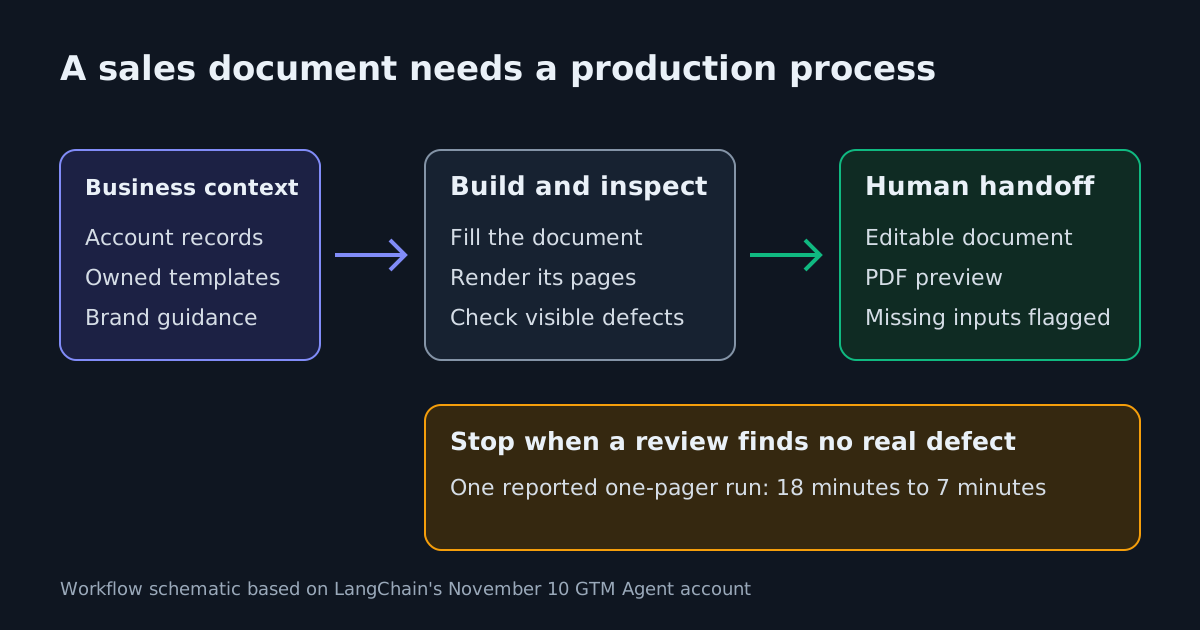
Schedule. Many runs are background: listeners developers attach, such as OpenSWE on each new pull request, and crons a user can request, such as the daily GTM brief. Pair each trigger with a skip rule. LangChain’s GTM Agent shows that stop on one sales workflow.
What the harness leaves open
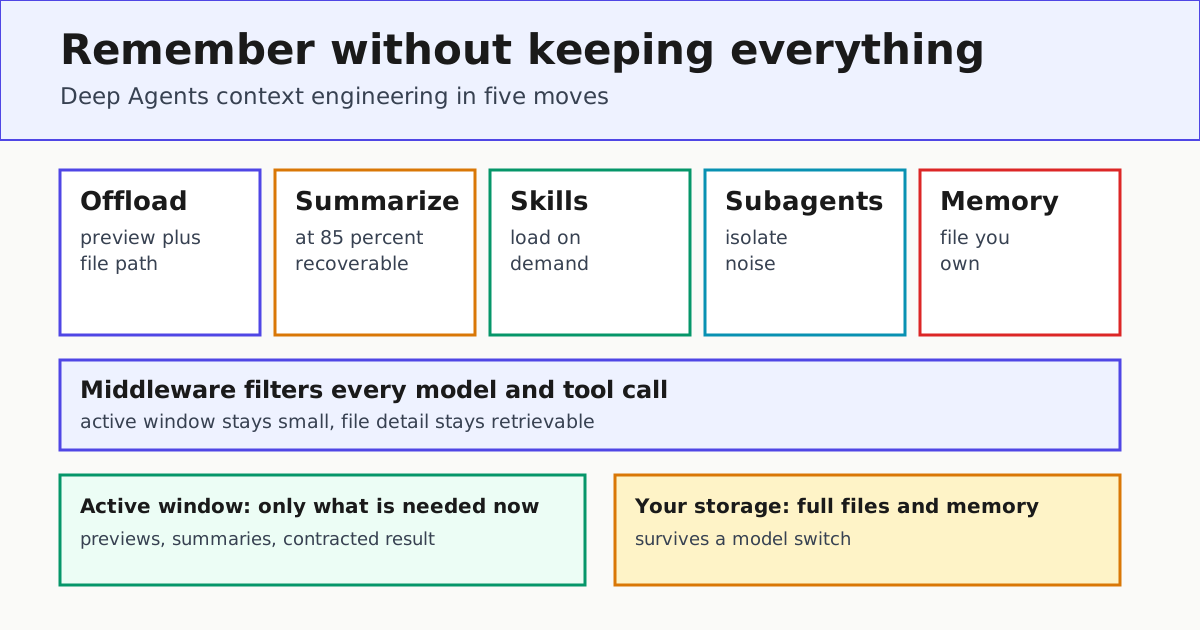
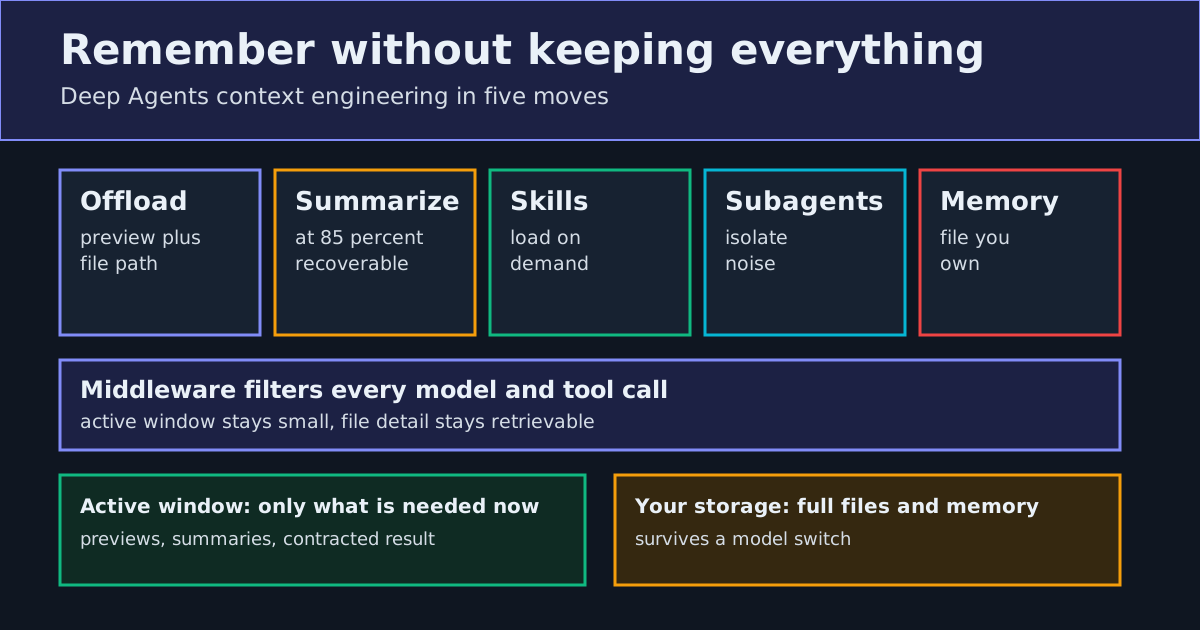
On November 2, Chase described a context stack many teams already share: summarize long threads, offload large tool results, phase skills in, search tools, isolate subagents, and treat the shell as a primary tool. Always-on goal agents, he writes, reopen problems without general solutions yet.
- Calibrate how often the agent interrupts.
- Decide what to remember. The store is often simple, the judgment is the open part, and both extremes fail.
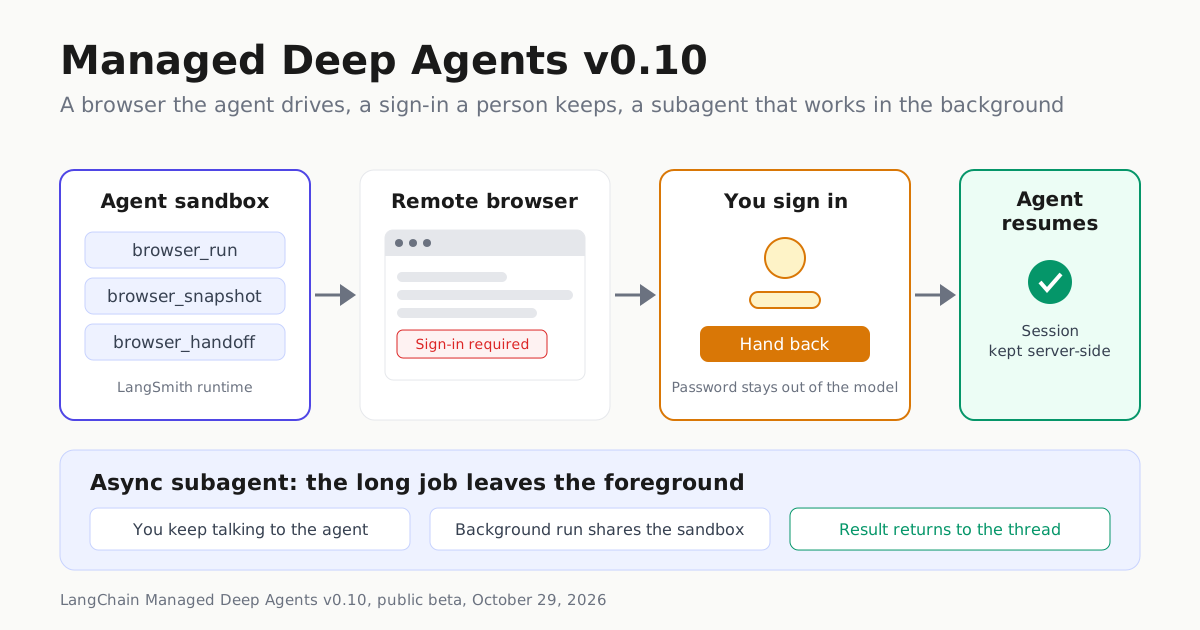
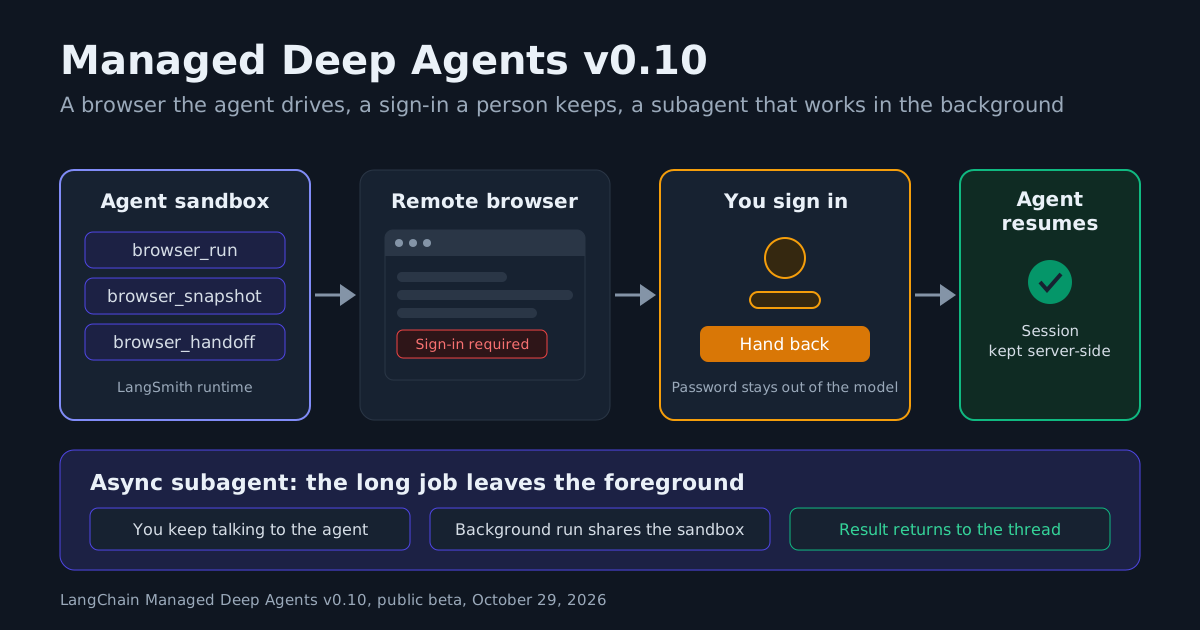
- Notify the foreground agent when async work ends, even mid-run or during an approval pause.
- Try new experiments across a long horizon.
- Block cheated goals, including a bug purge met by deleting the codebase.
- Treat the browser as a primary tool for broader agents, and budget context for images or the DOM.
Those items sit outside the five primitives. LangChain runs the agents on Managed Deep Agents over open-source Deep Agents. Memory, cron, and identity as project files are covered in Managed Deep Agents in Public Beta. Responsive supervisors are covered in Deep Agents async subagents.
Before you hand off a standing outcome, write the skip rule next to the goal. Classify each tool as the user’s identity or a service identity. Keep on-behalf-of actions out of shared channels. Put secrets on the proxy side of the sandbox. Store rejections where the next run will read them. Then audit the same gates on your own agents.