Google's Data-Agent Wind Tunnel: A Synthetic Company With a Verified Answer Key, and Vodafone's Halved Pipeline Runtimes
Google built a synthetic company to grade data agents before production access. Vodafone's same-day Dataform results show the deploy half of the loop.
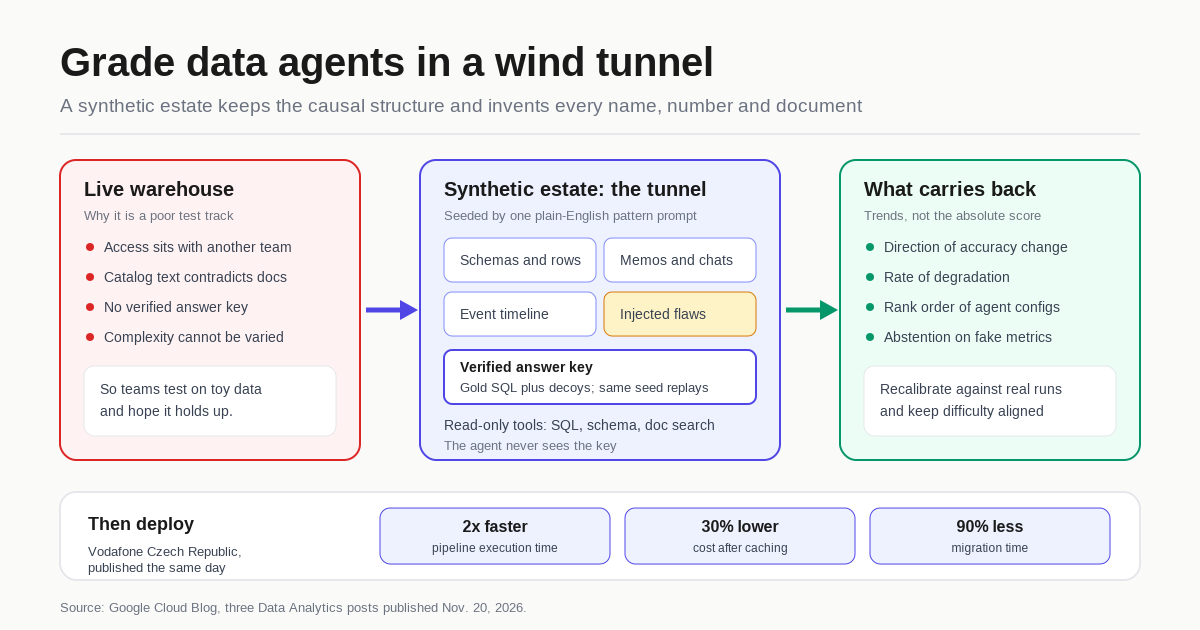
Google Cloud published three data-analytics posts on Nov. 20, 2026, and the one with the least product in it is the most useful. It describes an internal data simulator that invents an entire company, from schemas and rows to memos and chat threads, plus hard questions and a verified answer key, so a data agent can be graded before anyone grants it production access. Beside Vodafone Czech Republic’s results and Google’s Managed Airflow tour, the three outline one loop worth copying: simulate, deploy, triage.
The blocker is access, not model quality
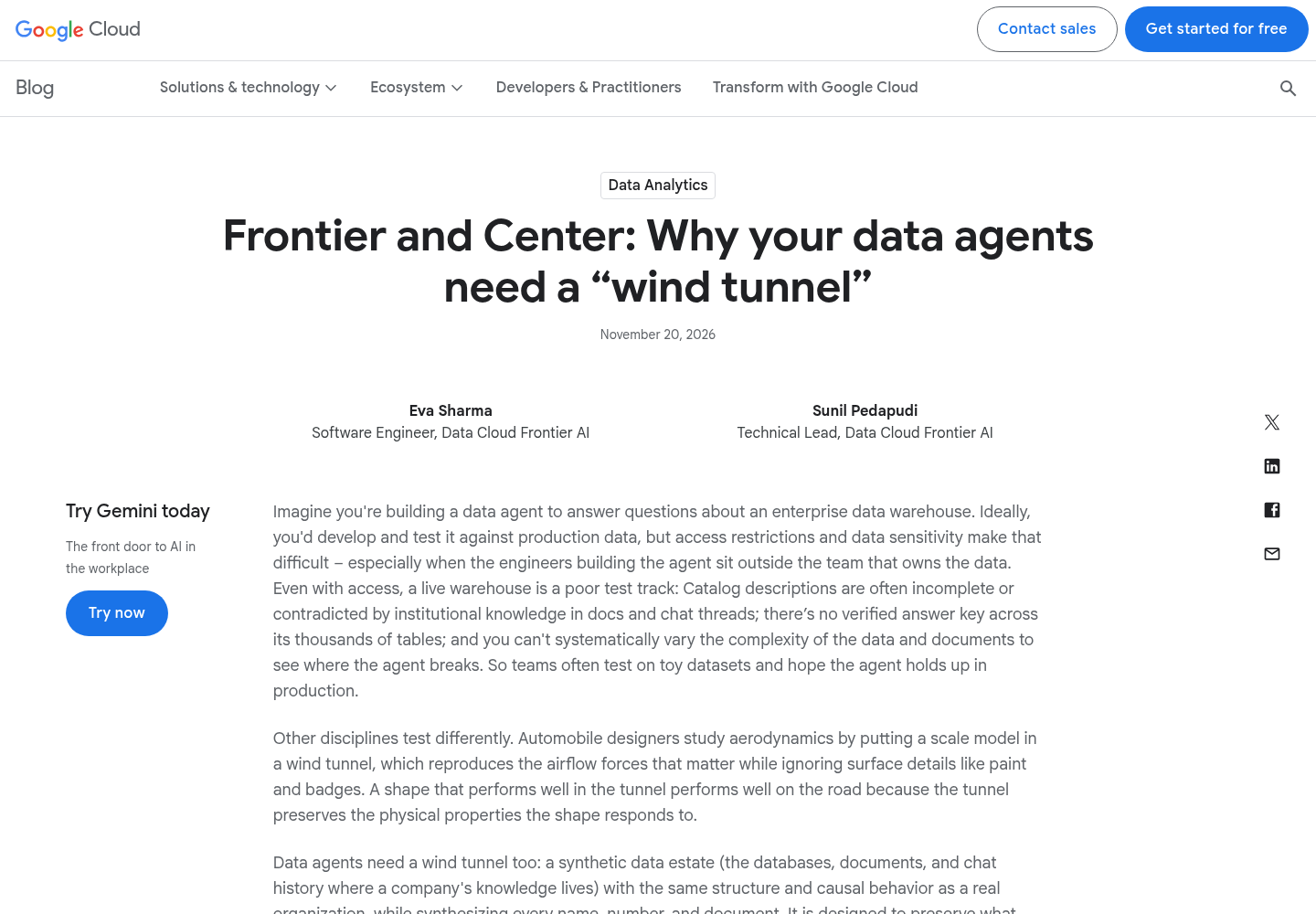
In the wind tunnel post, Eva Sharma and Sunil Pedapudi name the real constraint. Agent builders usually sit outside the team that owns the data, and even with access a live warehouse is a poor test track: catalog descriptions are contradicted by institutional knowledge in chat threads, and no answer key spans thousands of tables. So teams test on toy datasets and hope.
The fix borrows from aerodynamics: reproduce the forces a shape responds to and ignore the paint. Google’s simulator keeps what an agent reasons over, such as how tables relate and where definitions get messy, while synthesizing every name, number and document. The claim is narrow: the tunnel need not match a production score, only behavioral trends in direction and rate.
One prompt, one frozen blueprint
An engineer starts with a few sentences: “Simulate a two-plant brake manufacturer with an ERP, a shop-floor execution system, and a three-shift schedule where second-shift supervisors track downtime differently from operations and finance.” The simulator invents a structurally analogous company, “Calder Brakes,” with tables, event history, documents and an answer key.
Where a model may decide what is true is the design worth stealing. Only stage 1, Compile blueprint, uses a language model to invent facts; stage 3, Render documents, uses one to phrase those frozen facts as prose. Stage 2 runs deterministically with no model, emitting tickets and rows from employee schedules, while injected flaws like retry-storm duplicates land in a machine-readable messiness log. The same blueprint and seed replay identical tables and an identical SQL answer key, which agents query through read-only tools without ever seeing it.
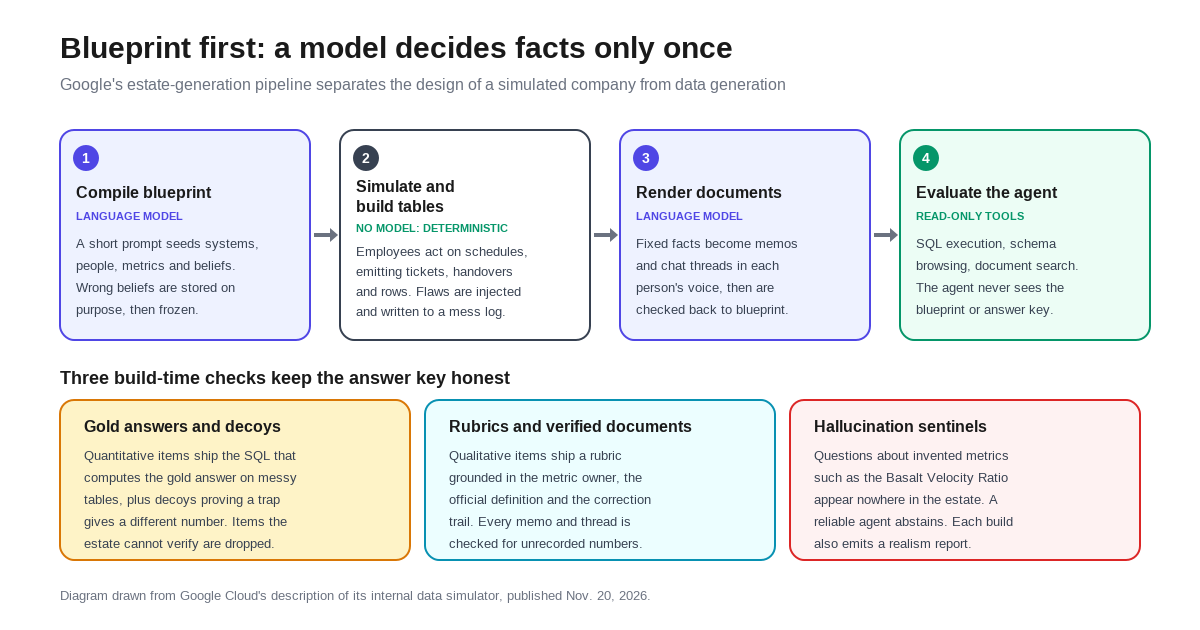
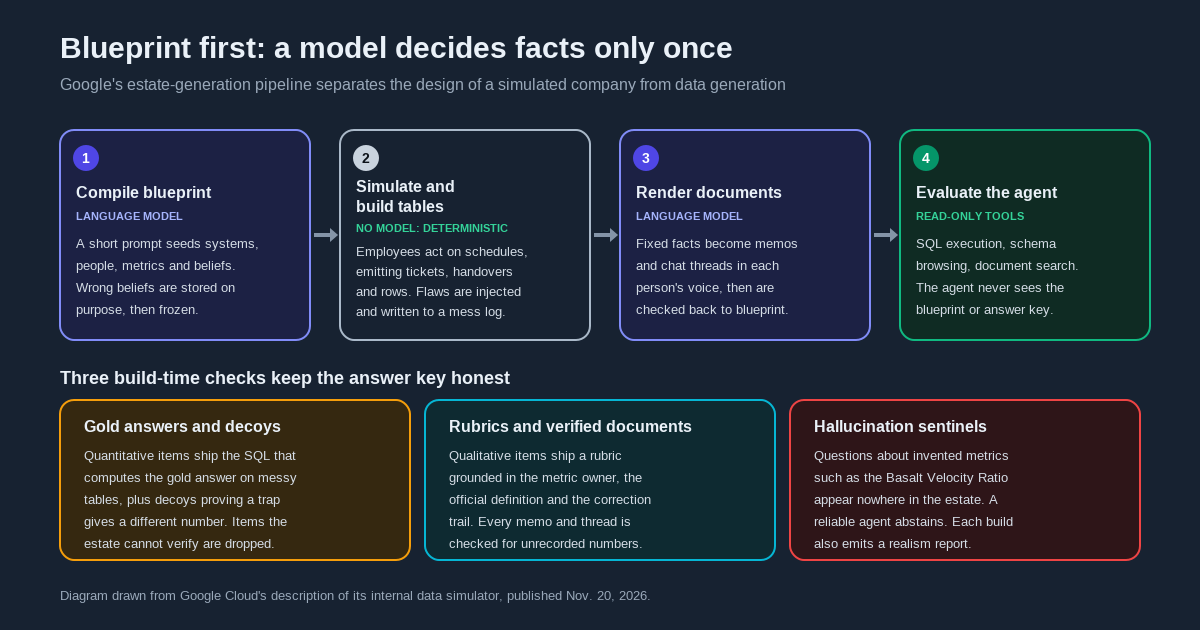
Three checks keep that key honest:
- Gold SQL and decoys. Each quantitative item ships the query computing its answer against the messy tables, plus decoys proving a trap yields a different number. The deduplicating
COUNT(DISTINCT)gold answer is 240. - Rubrics and verified documents. Qualitative items carry a rubric grounded in the metric owner and correction trail; unverifiable items are dropped.
- Hallucination sentinels. Questions about invented metrics like “Basalt Velocity Ratio” appear nowhere, and a reliable agent abstains.
The trap is the point
Asked either an onboarding question or “How many hours of downtime did Plant 2 log in Q3?”, a naive agent finds the most authoritative-sounding document: a memo from Bob, a confident second-shift supervisor who counts only unplanned stoppages. He is wrong. The official metric counts changeovers as planned downtime, and the owner corrects the record later. Both answers require checking metric ownership before writing SQL.
-- Shaped like Google's description of the Calder Brakes benchmark
SELECT COUNT(DISTINCT defect_id) AS defects
FROM plant2_defects WHERE quarter = '2026Q3';   -- gold answer: 240
-- decoy: un-deduplicated COUNT(*), inflated by retry-storm rows
What to copy on Monday
Google uses the tunnel internally to harden its own data agents without touching customer data, and says the blueprint-first approach applies to any team building evaluation suites.
- Write the pattern prompt for your domain. The messiness that breaks agents is organizational, not statistical.
- Freeze the blueprint before generating a row. One model call decides facts, then generation is deterministic so failures reproduce, the discipline behind agent evaluation CI gates.
- Log every injected flaw, and ship decoys. The flaw log lets the gold query differ from the naive one on purpose; if a wrong path returns the right number, the item measures nothing.
- Calibrate for direction and rate. Each build emits realism checks on join fan-out, key skew, duplicate rates and Benford digits, backed by an independent suite of more than a hundred checks. The named risks are overfitting to the simulator’s messiness and blueprint drift, the argument in Agents Need Fake Companies, now at vendor scale.
The deploy half: Vodafone’s numbers
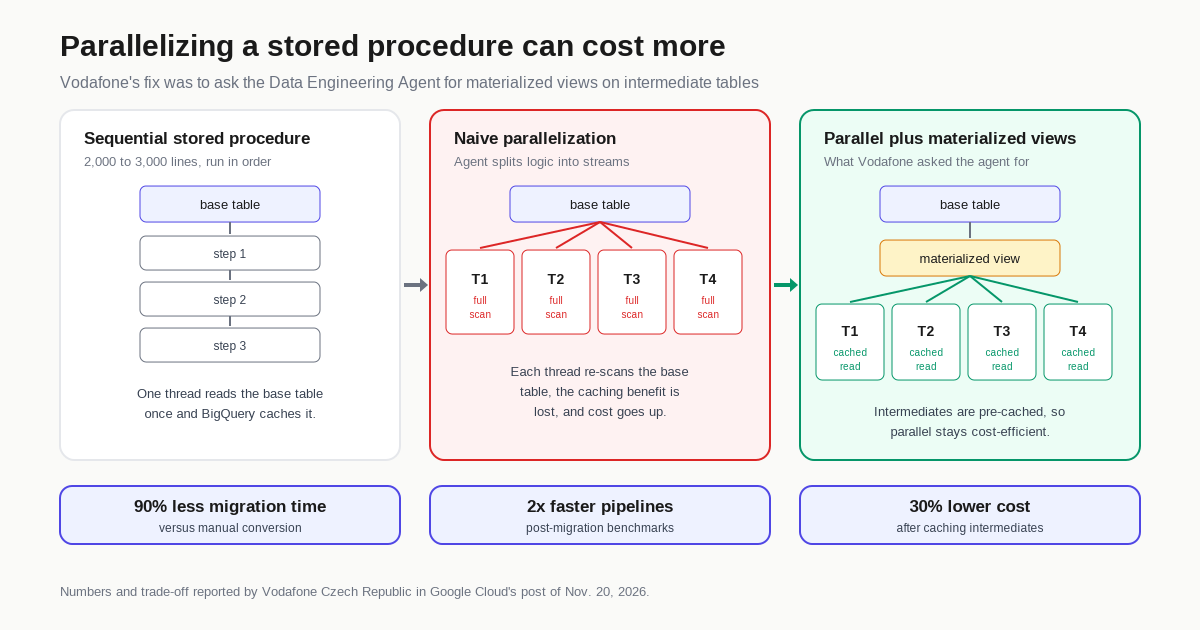
The same day, Vodafone Czech Republic described pointing the Data Engineering Agent, available in BigQuery pipelines and Dataform, at legacy stored procedures left from an on-premises migration, many of them 2,000 to 3,000 lines running sequentially.
| Dimension | Legacy stored procedure | Agent-built Dataform pipeline |
|---|---|---|
| Structure | One file, thousands of lines | Modular .sqlx files |
| Testing | Manual, rarely done | Unique, not-null, referential checks |
| Docs | Outdated comments | Auto-generated with lineage |
| Execution | Hard-coded dependencies | Lineage-driven DAG |
Vodafone reports a 90% reduction in migration time, pipelines running twice as fast and a 30% cost cut after instructing the agent to cache intermediate tables. The attached lesson matters more: parallelization alone raised cost, because a sequential procedure lets BigQuery cache the base table for the first thread while parallel streams can negate that and trigger full scans per thread. Materialized views on the intermediates fixed it, as did naming the staging tables worth parallelizing.
Triage, with a caveat
The third post walks an engineer through a failing clickstream pipeline. Managed Service for Apache Airflow, formerly Cloud Composer, now puts Managed Airflow Agent in the console to investigate failed tasks and check DAG readiness for a newer Airflow version, while Data Agent Kit writes and migrates DAGs from an IDE. The console agent is read-only: it recommends 8 GB workers instead of 4 GB and flags Airflow 3 blockers including a DAG still using execution_date. Google notes Cymbal Shops is fictional and its numbers illustrative, so read the sequence as a capability map.
Bottom line
The wind tunnel is the news. A reproducible synthetic estate with gold SQL, decoys and sentinels turns “the agent seemed fine on the sample data” into a gradeable claim you can make without production access, and it is the precondition for letting an agent rewrite 3,000-line stored procedures at all.