
Google Data Agent Kit Goes GA: Free MCP Tools Wire 15+ Data Cloud Services Into Claude Code, Codex and Cursor
Google made Data Agent Kit generally available on October 9, 2026: a free collection of MCP tools and Google-authored agent skills connecting more than 15 Google Data Cloud services to VS Code, Antigravity, Cursor, Claude Code and Codex for schema inspection, query authoring and end-to-end pipelines.
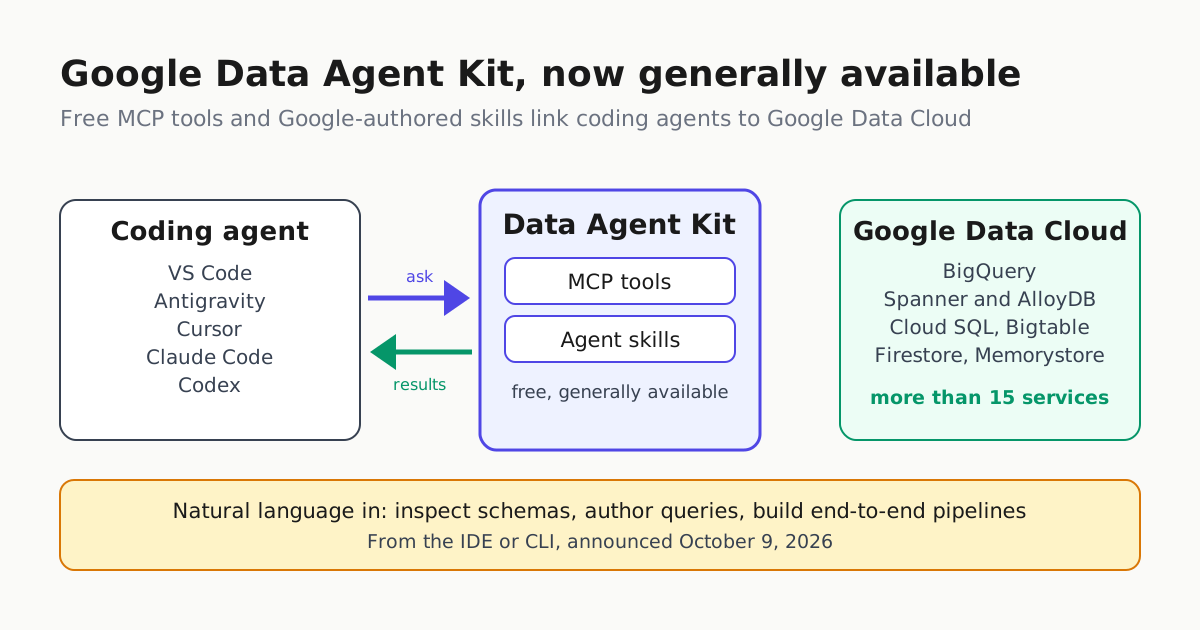
Google has taken Data Agent Kit to general availability. The kit is a free collection of Model Context Protocol (MCP) tools plus Google-authored agent skills that connect more than 15 Google Data Cloud services directly to the coding agent you already run: VS Code, Antigravity, Cursor, Claude Code and Codex. The GA notice is the first item in the October 5-9 roundup of Google’s weekly What’s new with Google Data Cloud digest, posted October 9 by the Google Cloud Data Analytics, BI, and Database teams, and the Google Cloud Blog index lists a dedicated launch post: “Data Agent Kit is now GA: Bring Google Data Cloud to any coding agent” by Arun Nair.
The header of Google Cloud’s weekly Data Cloud digest, posted October 9, 2026. The October 5-9 section that leads with the Data Agent Kit GA announcement sits further down the same page. Source: Google Cloud Blog.
Two artifacts, not one
The interesting part of the design is what Google paired. The MCP tools are plumbing: protocol-standard tool servers a harness can call the way it calls any other MCP tool, the interface pattern our MCP explainer covers. The agent skills are know-how: Google-authored procedures that teach an agent how to work a given Data Cloud surface instead of discovering it by trial and error.
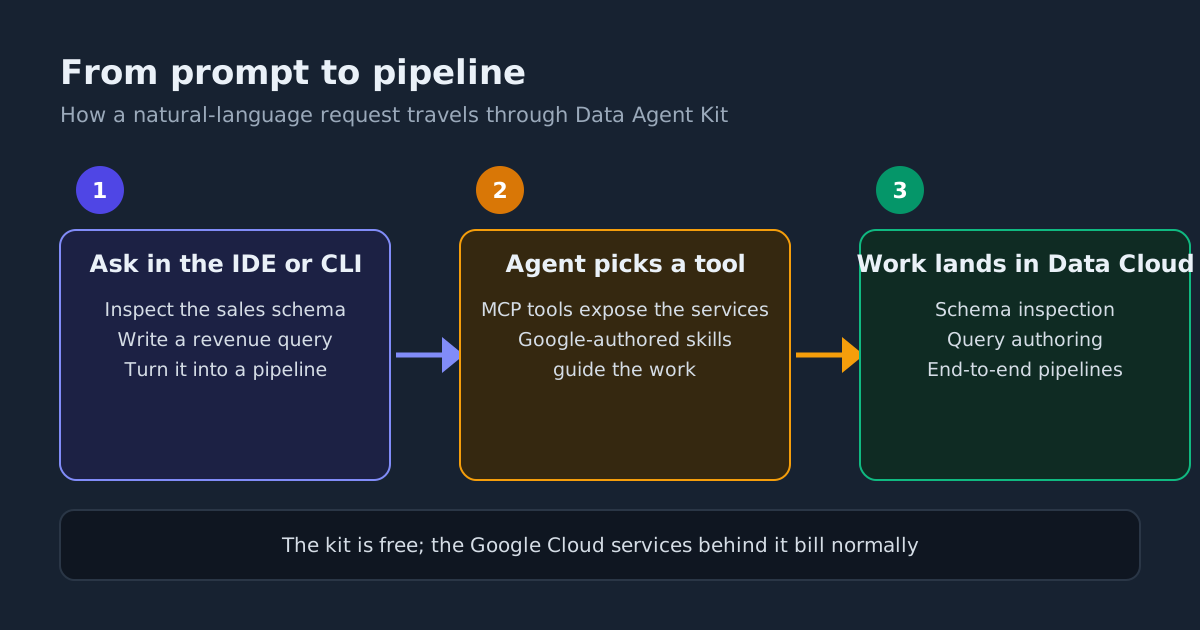
The digest describes the payoff in three verbs: inspect schemas, author queries, and build end-to-end data pipelines, in natural language, from the IDE or the CLI. That is the workflow of a data practitioner compressed into an agent turn.
Which agents it reaches
| Coding agent | Where it runs | What the kit adds |
|---|---|---|
| VS Code | IDE | MCP tools plus Google-authored data skills |
| Antigravity | Google’s agentic IDE | The same toolset inside Google’s own editor |
| Cursor | IDE | Data Cloud tools beside existing coding tools |
| Claude Code | Terminal-first, with IDE extensions | Schema and query work without leaving the loop |
| Codex | Terminal and IDE extensions | The same surface for OpenAI’s agent |
Five harnesses is the coverage the announcement claims, and the list is deliberately mixed: four of the five are not Google products, and two of those four — Claude Code and Codex — are rival AI labs’ agents, from Anthropic and OpenAI respectively. Only Antigravity is Google’s own editor. Nothing here forces a particular harness, which is the point of shipping over MCP rather than as an IDE plugin.
What a turn looks like
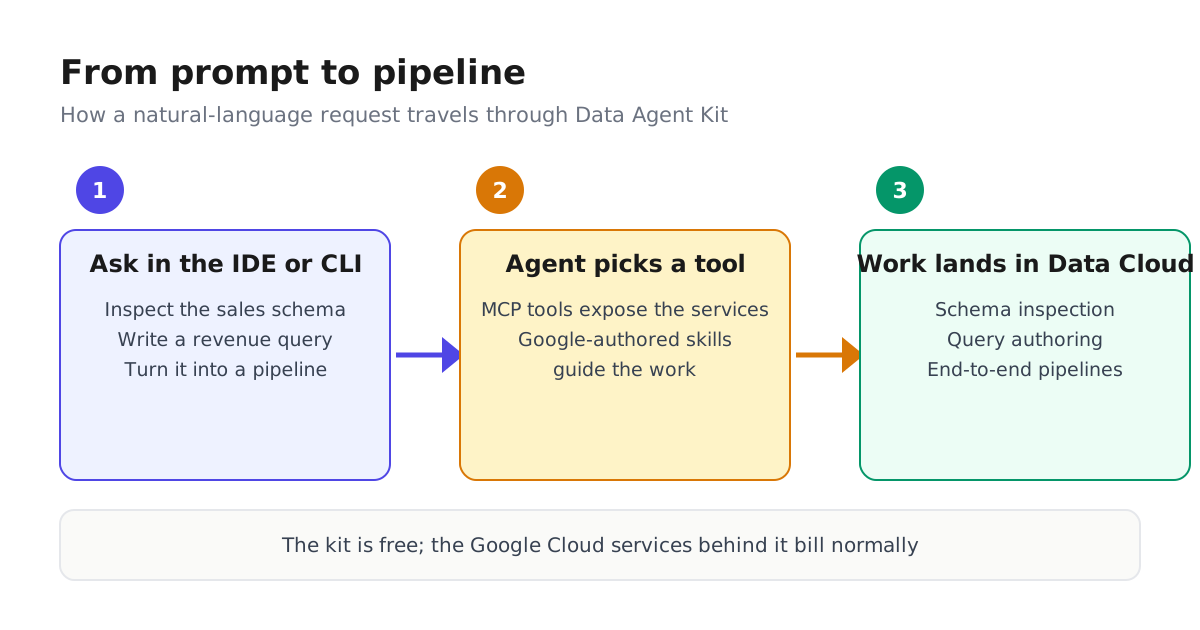
Here is an illustrative request in the shape the announcement describes. It is a prompt sketch, not a literal command from the kit:
Inspect the schema of the sales dataset, then write and run a query
for weekly revenue by region. If the numbers look right, turn it
into a scheduled pipeline.
One turn chains discovery, query authorship and pipeline assembly. The digest does not enumerate all 15-plus services the kit reaches, but the trajectory is visible in the same blog: in February, Google introduced managed and remote MCP support for Google Cloud databases including AlloyDB, Spanner, Cloud SQL, Bigtable and Firestore. Data Agent Kit is the developer-facing packaging of that reach, credentials and tooling bundled so the agent needs no bespoke glue per service.
Free kit, metered services
“Free” refers to the toolkit. The Google Cloud services behind the tools (queries executed, pipelines run, storage and compute consumed) bill normally. The zero-cost part removes the licensing excuse for a trial; it does not remove the meter. Teams handing an eager agent write access to a warehouse should budget for both.
Guardrails before the first production connection
None of the following is specific to Data Agent Kit. It is the standard price of admission when a coding agent gains a data plane, and it is cheaper to decide before the first connection than after:
- Scope credentials. Exploration lanes get read-only access; pipeline writing goes on a lane with a human approval gate before deployment.
- Treat vendor skills as arriving instructions. Google-authored skills direct what the agent does on a service. Review what they instruct before enabling them, the same discipline our hardening MCP in production guide applies to any tool server.
- Keep the audit trail out of the agent’s reach. Who ran which query, and what changed, should live somewhere the agent cannot rewrite.
The failure mode to plan for is not the kit. It is the ungoverned combination of an agent and a warehouse, the same shadow-MCP pattern that appears whenever tool servers spread faster than policy.
Not an isolated move
Read the whole digest and a strategy shows through. BigQuery gained augmented analytics table-valued functions that “integrate as skills for AI agents.” AlloyDB is positioned as “PostgreSQL for agents.” Memorystore for Valkey 9.1 is pitched at real-time AI agent state management. The Data Analytics section of the Google Cloud blog also surfaces a companion piece on empowering agents with the Google Cloud CLI remote MCP server, a second on-ramp for agents that live outside the editor. Google is converging Data Cloud into an agent runtime, and Data Agent Kit is the slice aimed squarely at coding agents. It sits alongside the sibling MCP Toolbox Java SDK v1.0, which approaches agentic database access from the application side.
For a team already running one of the five supported agents, the marginal cost of pointing it at the warehouse just dropped to roughly zero. The interesting question is no longer whether the agent can reach the data. It is who reviews what it did once it got there.