
MCP Toolbox Java SDK Hits v1.0: Spring Boot and Quarkus Agents Get Type-Safe Database Access
Google Cloud's MCP Toolbox for Databases Java SDK reached v1.0 on October 6, 2026, hardening the beta that followed the earlier MCP Toolbox server v1.0 milestone. Here's what changed and how to wire it into a Spring Boot or Quarkus agent today.
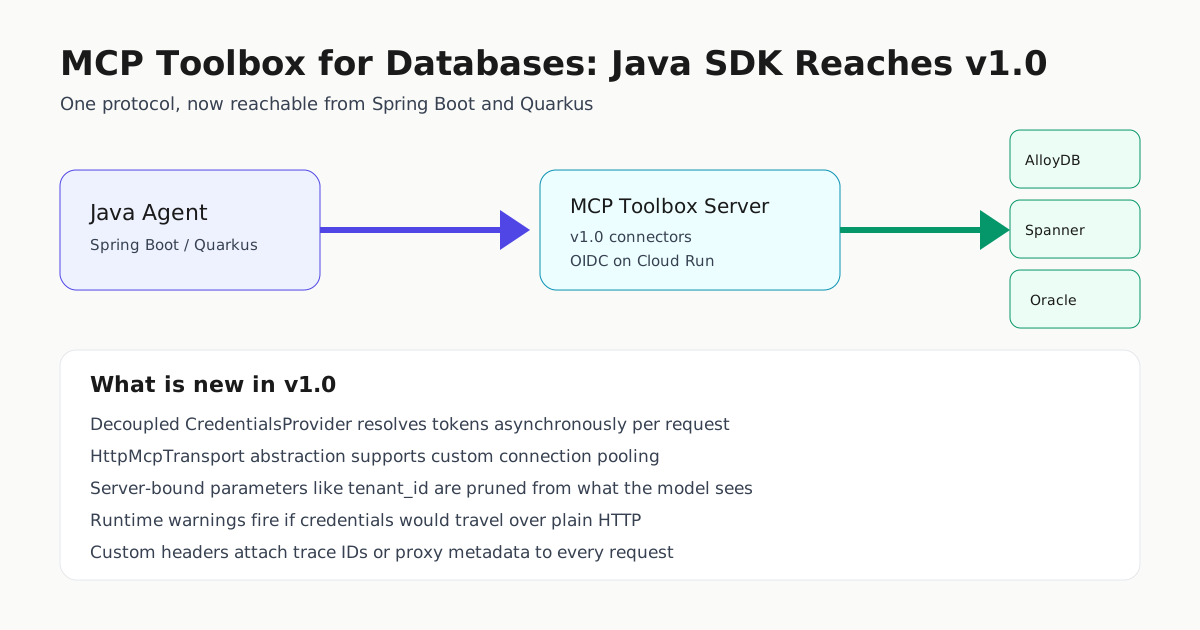
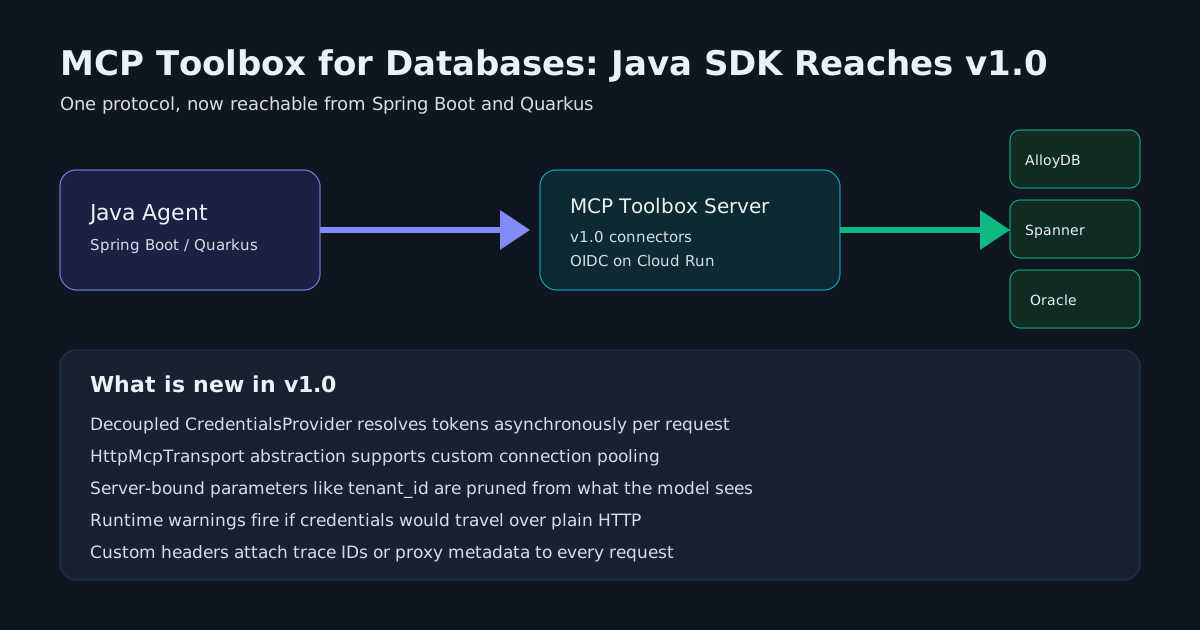
Google Cloud’s MCP Toolbox for Databases — the open-source Model Context Protocol server that lets AI agents talk to enterprise databases without hand-written integration code — previously reached a stable v1.0, and its dedicated Java SDK now has a matching v1.0 release of its own, shipped October 6, 2026. For teams running Spring Boot, Quarkus, or plain Jakarta EE services, this is the point where wiring an agent into AlloyDB, Spanner, Cloud SQL, Oracle, MongoDB, Snowflake, or open-source Postgres stops being a bespoke integration project and becomes a dependency you add to a pom.xml.
The problem MCP is solving
Google’s announcement post frames the issue as an N×M integration bottleneck: N agent frameworks times M data sources otherwise equals a fragile mesh of custom glue code, each connection its own security and maintenance liability. MCP standardizes that into one protocol — Toolbox exposes tools, the agent calls them, and neither side needs to know the other’s internals.
What actually hardened since the beta
According to the Google Cloud post, the Java SDK’s public beta — launched following the earlier, separately announced MCP Toolbox v1.0 milestone — has now been reworked into a “stable, backwards-compatible foundation suitable for enterprise workloads,” with several concrete changes since the v0.2 release:
- Transport layer abstraction, via a new
HttpMcpTransport, so teams can swap HTTP clients or customize connection pooling without touching protocol logic. - Decoupled client authentication through
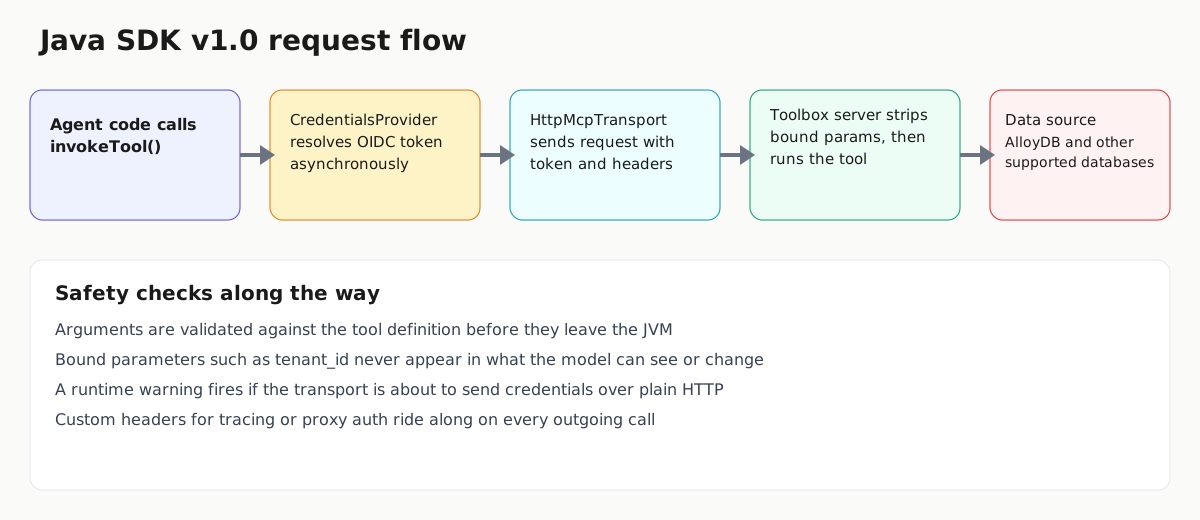
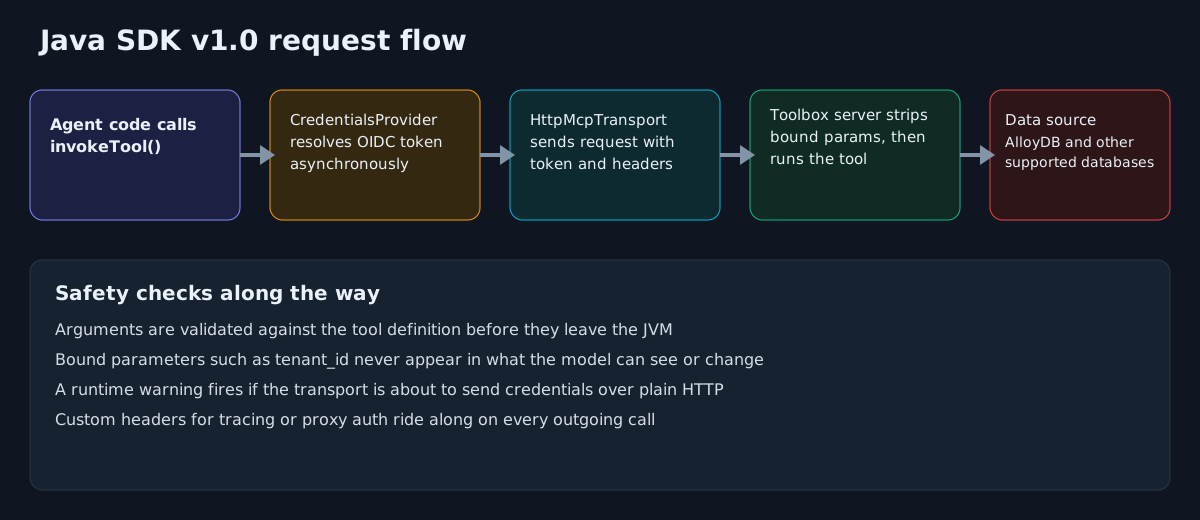
CredentialsProviderandAuthMethodsclasses — credentials resolve asynchronously on every request, so a team can refresh tokens dynamically or plug in a non-Google token source behind a one-method interface. - Default parameter values for tool arguments, which shrinks prompt payload size.
- Automatic pruning of server-bound parameters (the post uses
tenant_idas an example) from the tool definitions exposed to the model, so an LLM literally cannot see or manipulate values the server already fixed. - HTTP credential exposure warnings that fire at runtime if a call is about to send credentials over plaintext HTTP.
- A generic client-headers map for attaching corporate proxy headers, trace IDs, or correlation metadata to every outgoing request.
The post also walks through a reference implementation — a fictitious “Cymbal Transit” booking agent built on AlloyDB, Spring Boot, and LangChain4j — to show the SDK handling conversational state through an @MemoryId annotation while routing tool calls to the Toolbox server behind the scenes.
Where the Java SDK fits today
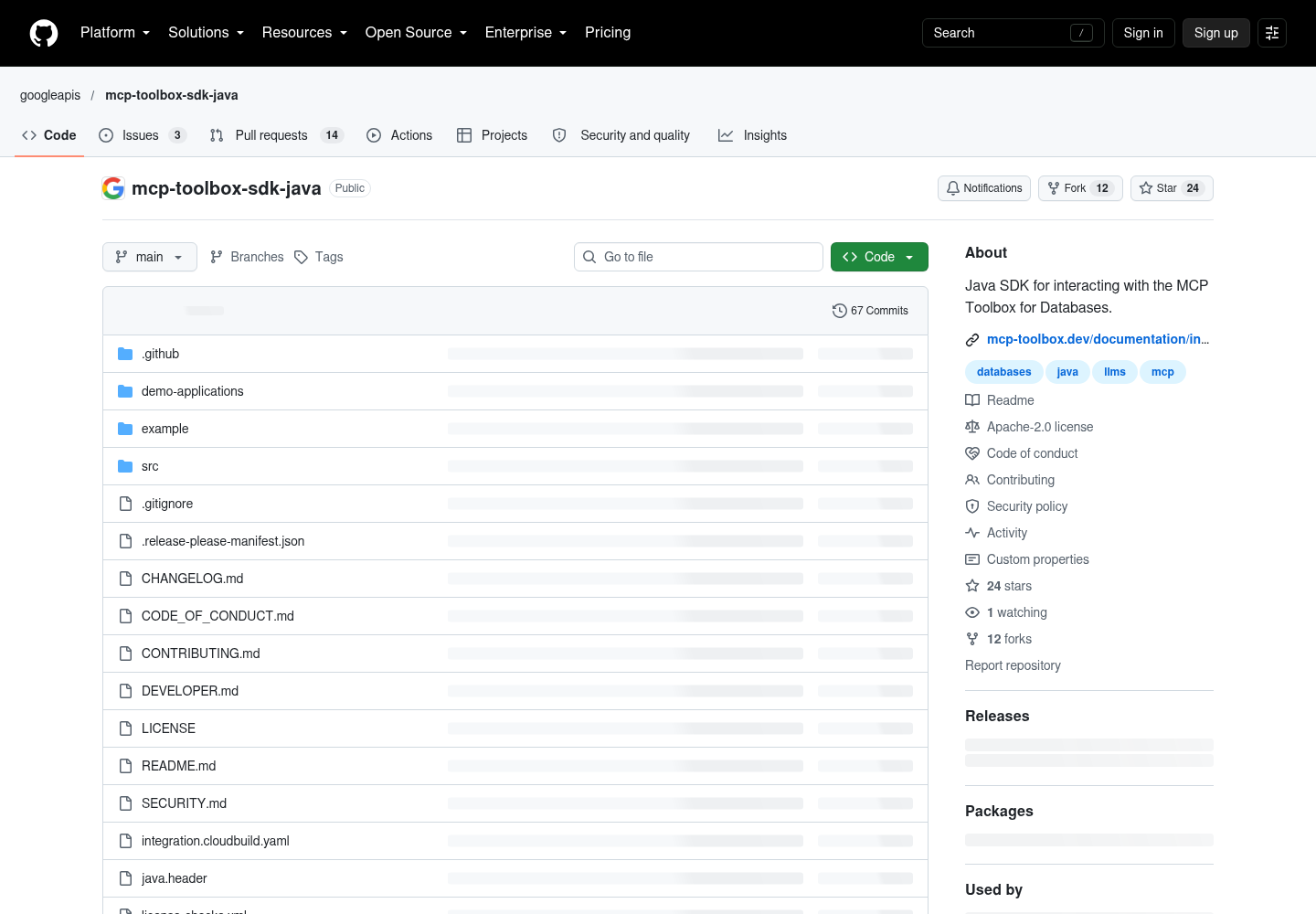
The SDK’s own GitHub repository still flags that Java feature parity with the Python, Go, and TypeScript SDKs is a work in progress, but it documents clear support across runtimes and cloud environments:
| Runtime / Framework | Supported | Notes |
|---|---|---|
| Java 17+ (LTS) | Yes | Base requirement; tested on OpenJDK, Corretto, Temurin |
| Java 21+ (LTS) | Yes | Fully compatible, including Virtual Threads |
| Spring Boot 3.x | Yes | Works as a standard library bean |
| Quarkus | Yes | Compatible in JVM mode |
| GraalVM Native Image | Experimental | Reflection config may be needed for Jackson |
| Deployment target | Supported | Notes |
|---|---|---|
| Google Cloud Run | Yes | Automatic OIDC auth via the attached service account |
| Google Cloud Functions | Yes | Gen 2 recommended |
| Local development | Yes | Via gcloud CLI credentials |
| On-Premise / Hybrid | Yes | Via GOOGLE_APPLICATION_CREDENTIALS |
| AWS / Azure | Yes | Via Workload Identity Federation or service account keys |
Getting a tool call off the ground
A minimal Maven dependency and client call, as published in the SDK’s README:
<dependency>
  <groupId>com.google.cloud.mcp</groupId>
  <artifactId>mcp-toolbox-sdk-java</artifactId>
  <version>1.0.0</version>
  <scope>compile</scope>
</dependency>
McpToolboxClient client = McpToolboxClient.builder()
    .baseUrl("https://my-toolbox-service.a.run.app/mcp")
    .build();

client.invokeTool("get-toy-price", Map.of("description", "plush dinosaur"))
    .thenAccept(result -> System.out.println(result.content().get(0).text()))
    .join();
The diagram below traces what happens between that invokeTool call and the database: the SDK resolves a credential asynchronously, attaches it through the new transport abstraction, and the server strips any bound parameters before running the query.
Skills: packaging a multi-step job once
The broader MCP Toolbox for Databases repository — recently renamed on GitHub from genai-toolbox to mcp-toolbox to reflect its MCP focus — also documents a skills-generate command that converts an existing toolset into a portable Agent Skill package, installable directly into Gemini CLI with gemini skills install. That’s a direct answer to a recurring practical problem: instead of re-prompting an agent through the same multi-step database-troubleshooting routine every time, a team can generate it once as a skill and reuse it across agents and sessions.
What this actually changes for readers
If your agent stack is Java-based, you can now give it parameter-bound, schema-validated access to dozens of managed and open-source databases — AlloyDB, Spanner, BigQuery, Cloud SQL, Oracle, MongoDB, Snowflake, and plain Postgres among them — without writing per-database client code. Arguments are validated against the tool definition before they leave the JVM, bound parameters like tenant IDs never reach the model, and Cloud Run deployments get OIDC authentication for free. The tradeoff to plan for: the Java SDK’s own maintainers flag it’s not at parity with the Python, Go, and TypeScript SDKs yet, so check the supported tool list for your specific database before committing a production integration.
For teams already running an MCP gateway or inventory process, this release is worth folding into your existing MCP server inventory and hardening checklist rather than treated as a one-off library upgrade — see our broader primer on how MCP works if you’re evaluating Toolbox against a hand-rolled integration.
Sources
- Announcing MCP Toolbox Java SDK v1.0: Agentic data access for the enterprise | Google Cloud Blog
- GitHub - googleapis/mcp-toolbox-sdk-java: Java SDK for interacting with the MCP Toolbox for Databases. · GitHub
- GitHub - googleapis/mcp-toolbox: MCP Toolbox for Databases is an open source MCP server for databases. · GitHub