Together AI's Prompt Leak Began With Its Own Coding Agent Committing a Credential
Together AI says an AI coding agent committed a credential that exposed stored serverless prompts from June and July 2026, and the intruder tested stolen secrets. What operators should do now.
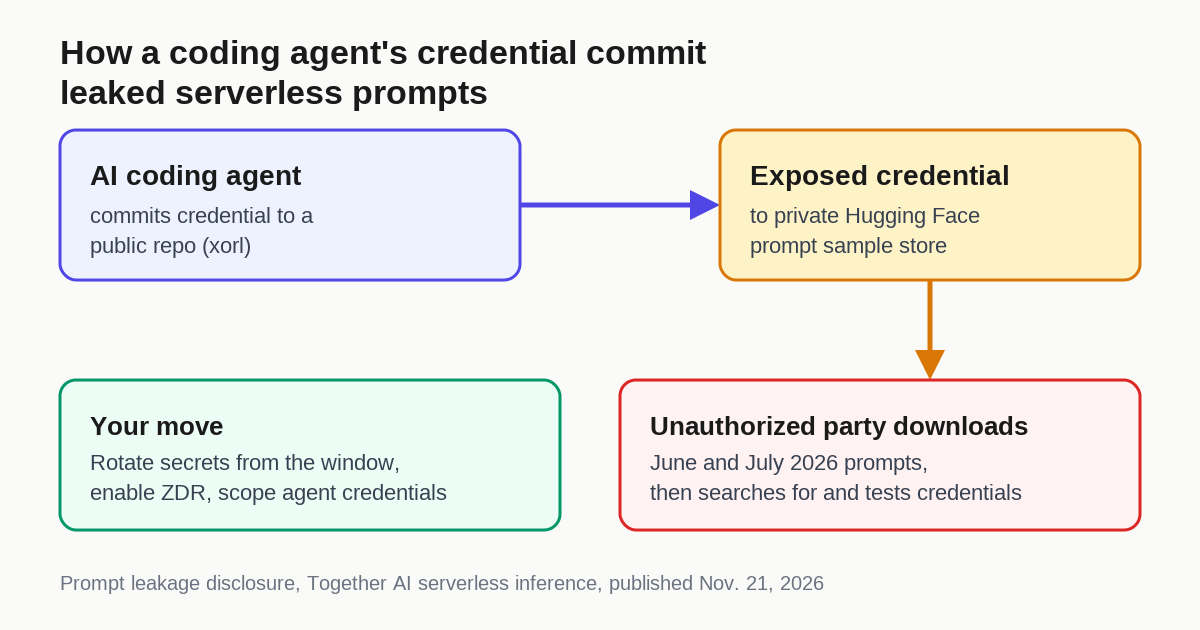
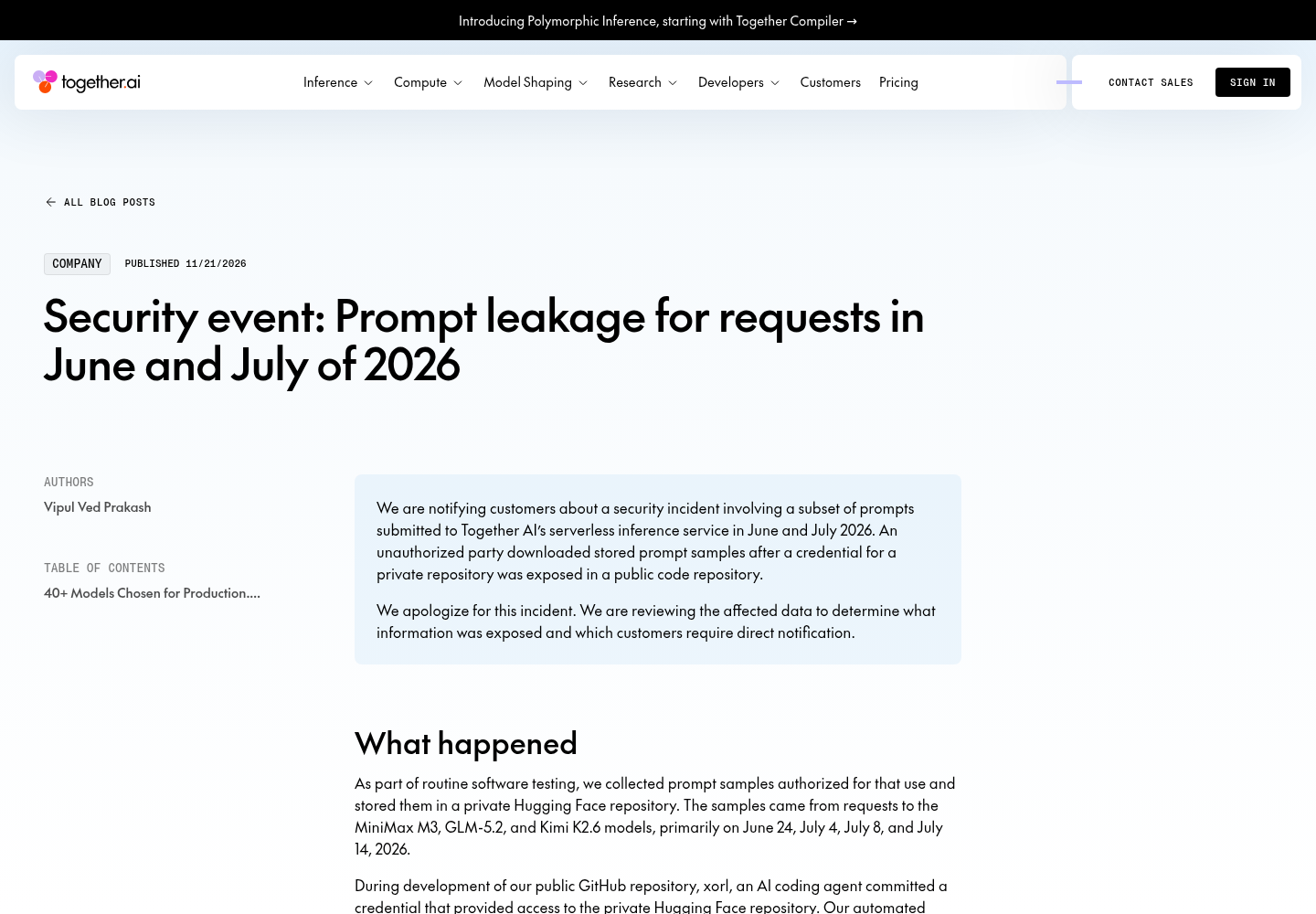
Together AI disclosed on Nov. 21, 2026 that an unauthorized party downloaded stored prompt samples from its serverless inference service, affecting a subset of requests submitted in June and July 2026. The chain of failure is unusually instructive for anyone running coding agents: the company’s own AI coding agent, working in a public GitHub repository named xorl, committed a credential that gave access to a private Hugging Face repository holding those prompts. Automated scanning caught the commit and the company reverted it — but during the exposure window, someone else had already obtained the credential and downloaded the stored samples (Together AI).
What was stored, and who came for it
The exposed samples were prompt samples collected for routine software testing and stored in the private Hugging Face repository. They came from requests to three specific models — MiniMax M3, GLM-5.2, and Kimi K2.6 — with activity concentrated on June 24, July 4, July 8, and July 14, 2026 (Together AI).
The more alarming detail is what the intruder did next. Together says the party searched the downloaded samples for credentials to other services and tested whether those credentials were valid. Five of the credentials tested were canary credentials belonging to a Dragos security experiment — meaning the Dragos researchers’ planted tripwires fired here too, on a breach Together AI did not yet know it had (Together AI). The company has engaged an external forensics firm and law enforcement, and says its review of the affected prompt contents is ongoing to determine whether sensitive personal information or other customer data was exposed. It has not identified evidence of additional prompt leakage beyond this incident, and will contact affected customers directly (Together AI).
Why this lands the same week as the canary research
The disclosure arrives amid a wider reckoning over prompt confidentiality. Dragos researchers planted roughly two million canary credentials, URLs and hostnames in inference requests across AI routers and providers, and saw privacy claims broken even under advertised zero-data-retention policies (Techmeme). OpenRouter separately began notifying customers that prompts sent to MiniMax models through several providers may have been read by a third party, and removed zero-retention labels from the affected endpoints while it investigates — affected users posted the notification emails publicly, noting there was no public page at first (Hacker News). Techmeme’s coverage now lists the Together disclosure alongside the Dragos research and the OpenRouter incident notices as one connected story about the AI inference supply chain (Techmeme).
The distinction matters for scoping: the Together incident is not a claim that model providers retained and leaked routed traffic. It is a credential-exposure incident against a sample store the company itself maintained for testing — collected, in Together’s words, “authorized for that use.” But the reader-facing consequence is the same either way: prompts you sent to a hosted endpoint in a given window were downloaded by an unauthorized party, and some of them contained live secrets. We covered the canary research and OpenRouter’s label removals in Two Million Prompt Canaries Caught the AI Supply Chain Leaking.
What Together changed, and what it means for operators
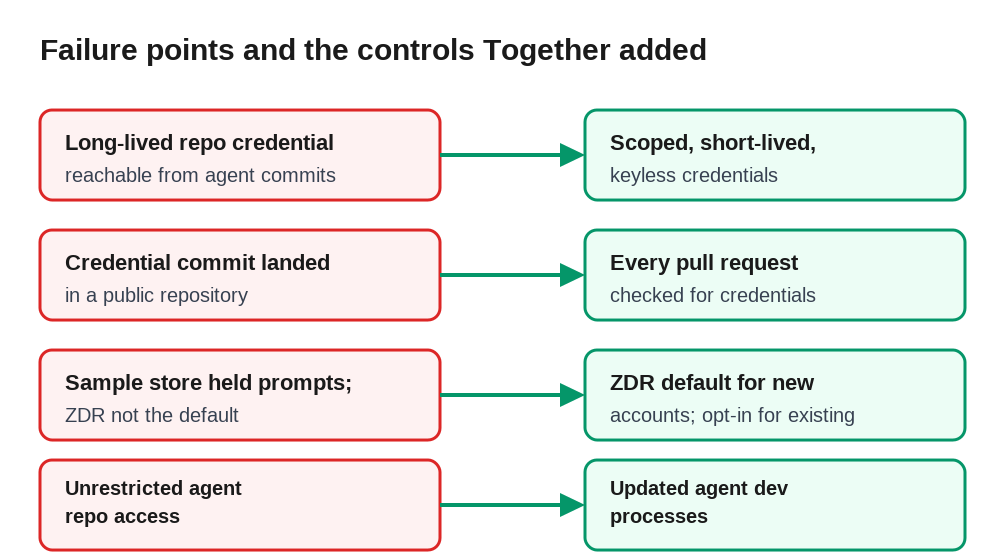
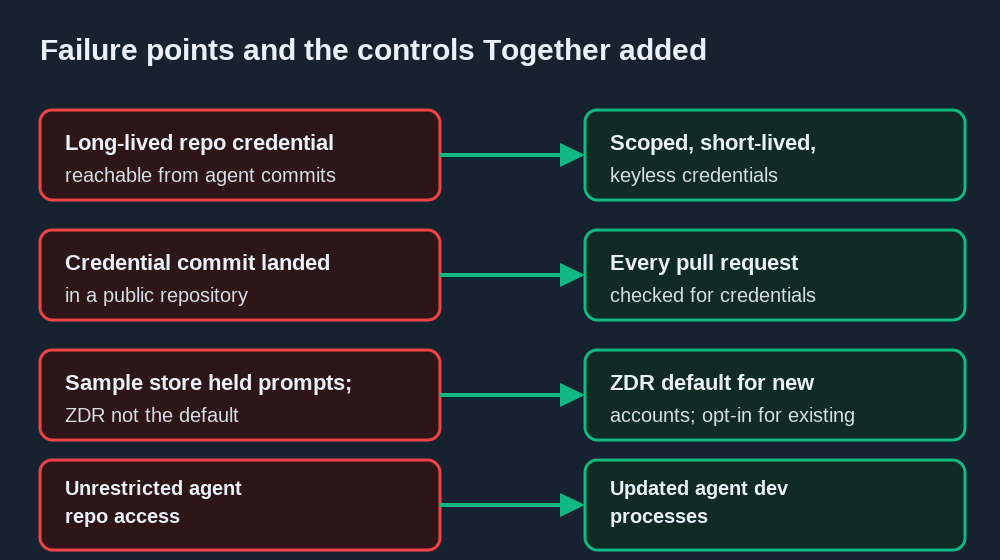
Together says it has strengthened controls around development workflows, credentials and customer data: scoped or short-lived credentials and keyless access where supported, credential checks on all pull requests, zero data retention as the default for new accounts, and updated development processes governing AI coding agents (Together AI). Existing customers handling sensitive prompt data are told to enable ZDR themselves in account settings.
| Control | Before the incident | After |
|---|---|---|
| Credential scope | Long-lived repo credential reachable from a coding agent’s commits | Scoped, short-lived, keyless where supported |
| PR review | Credential commit landed in a public repo | All pull requests checked for credentials |
| Retention | Sample store held prompts; ZDR not default | ZDR default for new accounts; opt-in for existing |
| Agent usage | AI coding agent committed to public repo unrestricted | Updated processes governing AI coding agent use |
The pattern — an AI coding agent with standing repo access committing a live credential — is the same failure class operators have been patching all year. Treat every agent as a privileged user with scoped, expiring credentials rather than a shared long-lived token, and gate what it can commit, as laid out in AI Agent Identity: Treat Every Agent as a Privileged User. Zero-retention labels also deserve skepticism; Zero Data Retention AI Agents explains where vendor forgetting stops and agent memory starts.
A concrete checklist for the affected window
If your workloads hit Together’s serverless endpoints around June 24, July 4, July 8, or July 14, 2026 — especially against MiniMax M3, GLM-5.2 or Kimi K2.6 — the practical steps are short:
- Check whether your organization received or should have received a direct notification; Together is contacting affected customers as its review of prompt contents completes.
- Rotate any secrets that plausibly passed through prompts in that window: cloud keys, tokens, SSH passwords, internal URLs. Together has confirmed the intruder actively searched for and tested credentials found in the samples.
- Enable ZDR in your Together account settings if you handle sensitive prompt data — for existing accounts it is not yet the default.
- Audit your own repos for credentials an agent may have committed; scanning caught Together’s leak only after the exposure window had already been used.
- Treat provider zero-retention labels as claims to verify, not guarantees — the same week’s canary research showed ZDR labels breaking on routed traffic, and OpenRouter pulled labels from affected endpoints rather than standing behind them.
Prompt canaries caught this breach from the outside; the inside failure was a credential an agent wrote into a public commit. Both halves are now standard operating assumptions for teams that route source code and proprietary context through third-party inference providers.
The company’s apology is direct, and the response — external forensics, law enforcement, ZDR by default, credential scanning in CI — is the right shape. The open question is one every operator should be asking about their own stack: which standing credentials can your coding agents reach, and what happens in the hours between an accidental commit and its revert?
Sources
- Security event: Prompt leakage for requests in June and July of 2026
- Techmeme: Researchers used canary credentials in requests to AI routers like OpenRouter and Vercel, even under “ZDR” policies, and saw “privacy” often broken, keys stolen (Dan Goodin/Ars Technica)
- Tell HN: OpenRouter prompts to Minimax may have been read | Hacker News