Two Million Prompt Canaries Caught the AI Supply Chain Leaking. OpenRouter Just Pulled MiniMax Zero-Retention Labels
Two million prompt canaries caught breached hosts, logging resellers and a lab scraping secret URLs. OpenRouter pulled MiniMax ZDR labels. What operators do now.
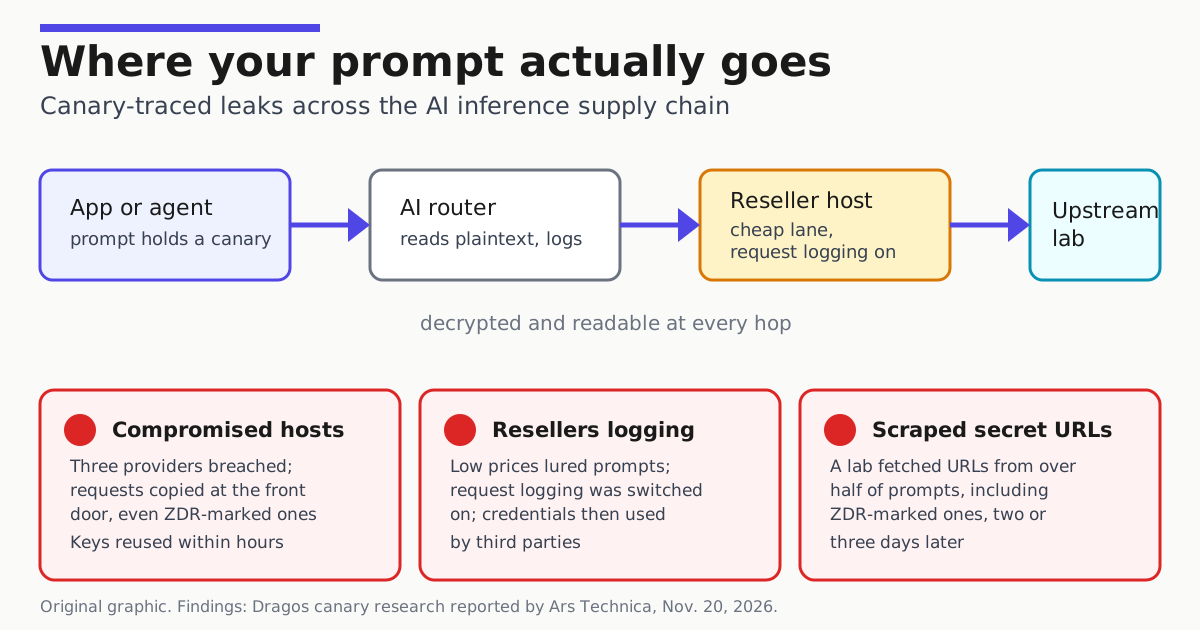
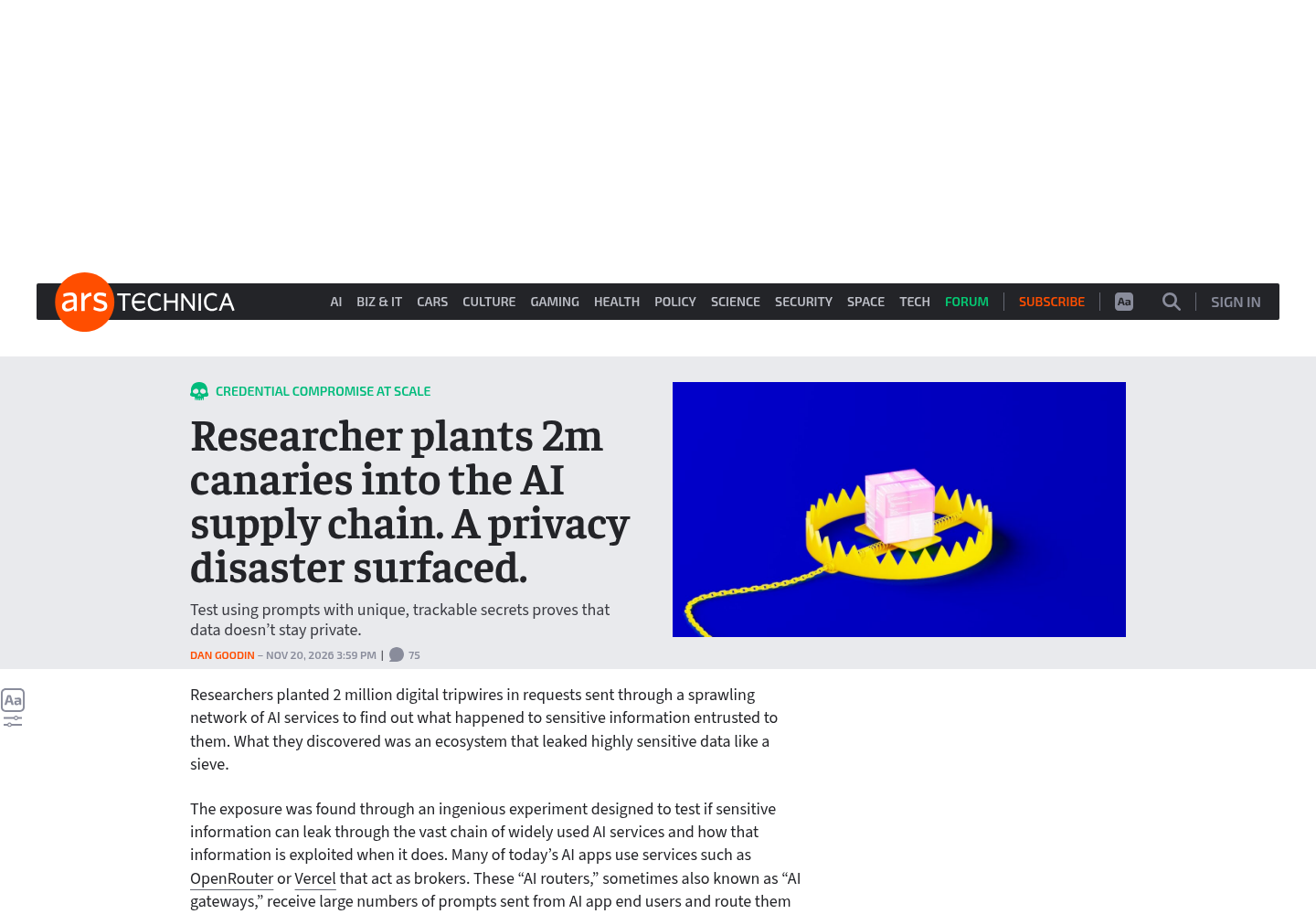
A security researcher seeded nearly two million AI prompts with unique, trackable secrets and watched where they surfaced. The answer, published Thursday by Dragos chief research officer HD Moore and reported by Ars Technica, is an indictment of the whole inference reseller chain: compromised hosting providers, resellers that log prompts and hand them on, and privacy flags that some providers simply ignore. This week, OpenRouter began telling users that prompts sent to MiniMax models may have been read by a third party, and stripped the Zero Data Retention (ZDR) label from the affected endpoints.
What the canaries caught
Moore’s canaries were never-before-used AWS keys tied to empty accounts, SSH passwords, unique URLs, DNS names and private git repository references, each seeded into exactly one prompt to one provider, with infrastructure he controlled receiving any use. Because each secret was unique, its first unauthorized use identified the exact link in the chain that leaked it.
The findings fall into three buckets, per Ars Technica’s report:
| Failure | What happened | Why it matters for agent fleets |
|---|---|---|
| Compromised hosts | At least three hosting providers were breached; attackers copied requests at the front door, including some marked ZDR | A privacy flag does not help when the attacker is already inside |
| Logging resellers | Resellers offered low prices, turned on request logging and passed prompts to people who used the credentials | The cheapest lane may be a harvesting operation |
| Ignored privacy settings | A Chinese AI lab’s systems fetched secret URLs from over half of prompts sent July-October, including roughly two-thirds marked “no data collection” | ZDR labels are claims, not guarantees |
The breached-provider attackers reused “a couple hundred” AWS keys — tens of thousands of API calls in total — exploring S3 buckets, secrets managers and parameter stores, enabling Bedrock models and adding their own IAM users. Some stolen keys came from requests the provider rejected before a model ever ran.
The MiniMax detail OpenRouter users got by email
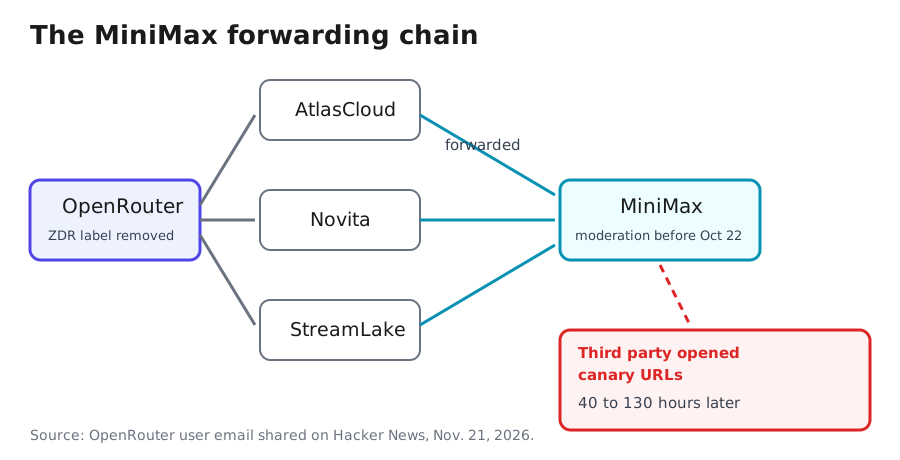
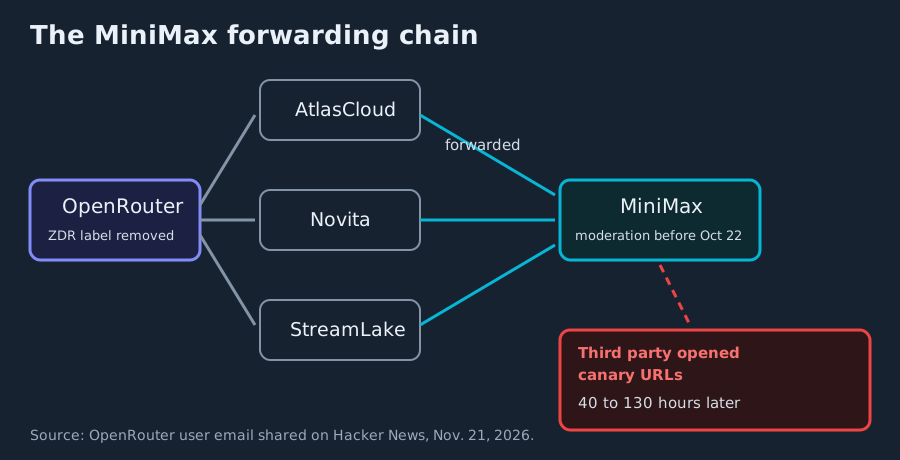
OpenRouter’s user warning, surfaced on Hacker News, fills in the specifics. A security researcher placed unique test URLs in prompts sent to MiniMax models from July to October 2026; a third party accessed those URLs 40 to 130 hours after the requests were sent, whether MiniMax served the request directly or another provider forwarded it. Tests on other models at the same providers were not accessed, and none of the AWS test keys were used.
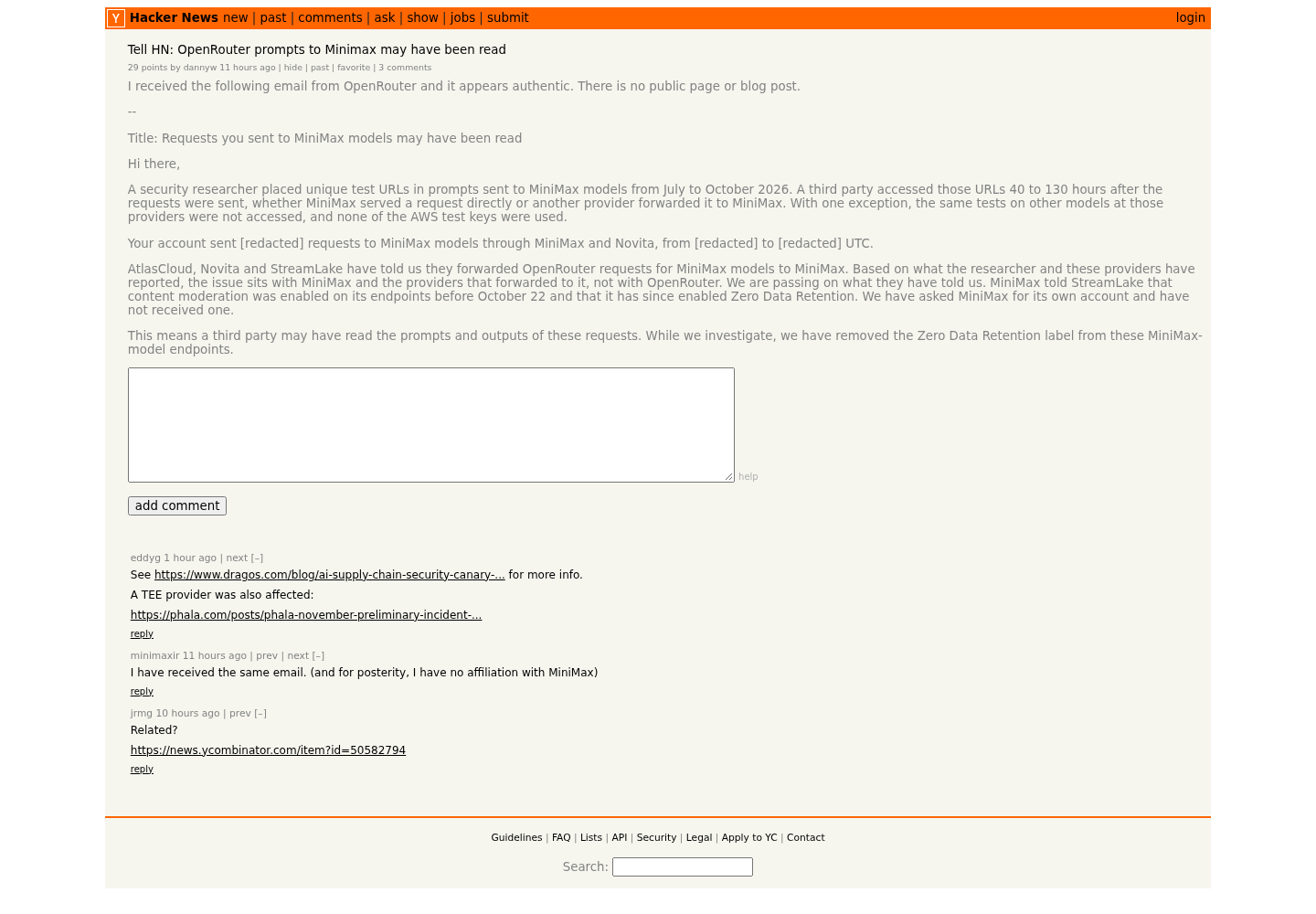
Three providers — AtlasCloud, Novita and StreamLake — told OpenRouter they forwarded MiniMax-model requests to MiniMax. That is the quietly damning part: a developer who picked a US hosting provider to keep traffic in the US was actually shipping prompts to MiniMax anyway. MiniMax told StreamLake that content moderation was enabled on its endpoints before October 22 and that ZDR has been enabled since; it had not given OpenRouter its own account. While investigating, OpenRouter removed the Zero Data Retention label from these MiniMax-model endpoints — an honest admission that the label no longer described reality.
Why coding-agent traffic is the worst case
Coding agents put source code, database URLs, cloud credentials and internal hostnames directly into prompts, and route them through the exact broker chains this research tested. If your Claude Code, Codex or Qwen Code lane runs through an aggregator or a bargain third-party provider, every secret that has ever appeared in a prompt on that lane should be treated as potentially exposed — the OpenRouter email’s implicit ask is secret rotation, and Moore’s data shows why: reused keys surfaced within hours, and one US provider crawled a secret URL more than two months after a single inference call.
A concrete triage list:
- Inventory your lanes. Which CLI, gateway or router actually serves each model? A reseller’s “US-hosted” badge may hide an upstream forward. Keep a vendor-lane last-hop register per lane.
- Rotate anything that has touched a prompt on an affected or unverified lane — API keys, database URLs, SSH credentials — and prefer short-lived credentials so an old prompt is not a live secret. The OpenCode breach rotation guidance covers the mechanics.
- Stop trusting ZDR as a control. Moore’s clearest example is a lab scraping roughly two-thirds of ZDR-marked requests. Treat retention labels as vendor claims to verify, not enforceable settings; see our zero-retention vs. agent memory analysis.
- Pick your upstream yourself. Moore’s recommended hierarchy: on-premises hosting first; failing that, a direct contract with a first-tier provider offering “one contract and a privacy policy to read”; never default provider or reseller pools.
- Re-check old traffic. In the MiniMax case, the third party opened canary URLs 40 to 130 hours after each request. And per Ars Technica, a different US hosting provider crawled a secret URL more than two months after a single inference call. The exposure window is not the request window.
The ecosystem is closing ranks
The timing is not coincidental. Semafor reported that OpenAI now requires review and approval of any gateway or router providing third-party access to its models — explicitly extending oversight beyond gray-market “transfer stations” to any service standing between it and end users, in response to distillation and reseller-chain concerns. Model labs are starting to treat the reseller chain as a security boundary, not just a sales channel.
For operators, the lesson from two million canaries is that “who actually served this request” is a security question with teeth. The cheapest lane on a router is also the least examined one, and the evidence now shows some of those lanes were copying, logging and scraping what passed through. Verify your last hop, rotate what leaked, and put your secrets somewhere other than the prompt.