Anthropic Researcher Claims AI-Assisted Riemann Hypothesis Proof in Lean 4 as Human Proof Surfaces
Anthropic mathematician Levent Alpöge has released a Lean 4 repository claiming a machine-verified proof of the Riemann Hypothesis developed with Claude, arriving alongside an independent human proof from Alessandro Masullo.
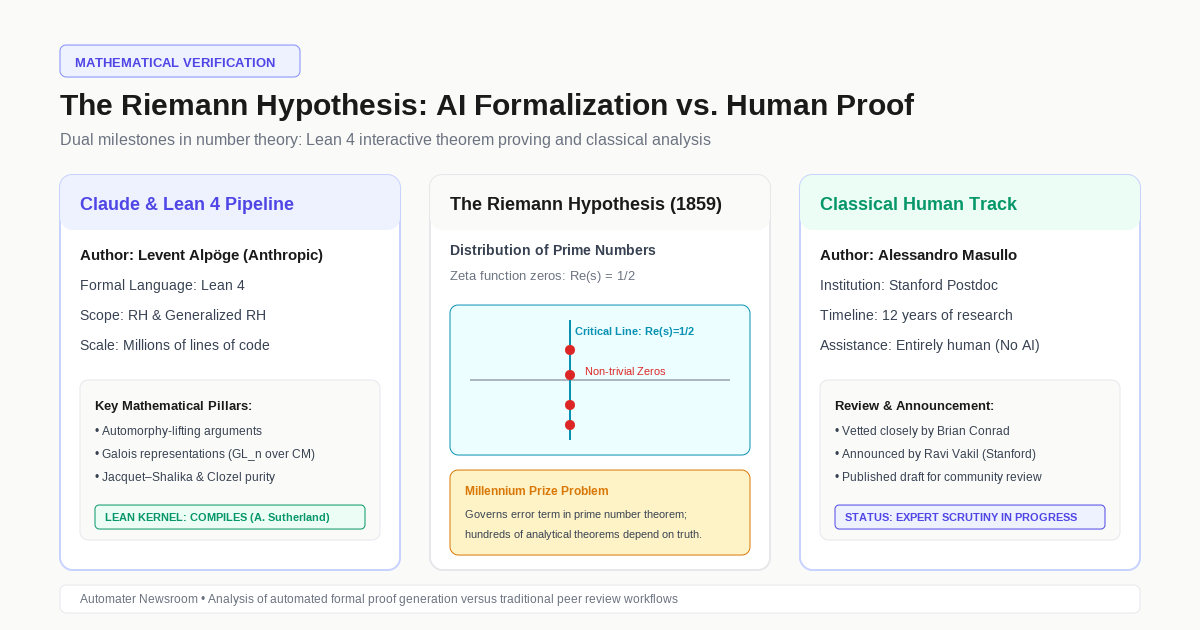
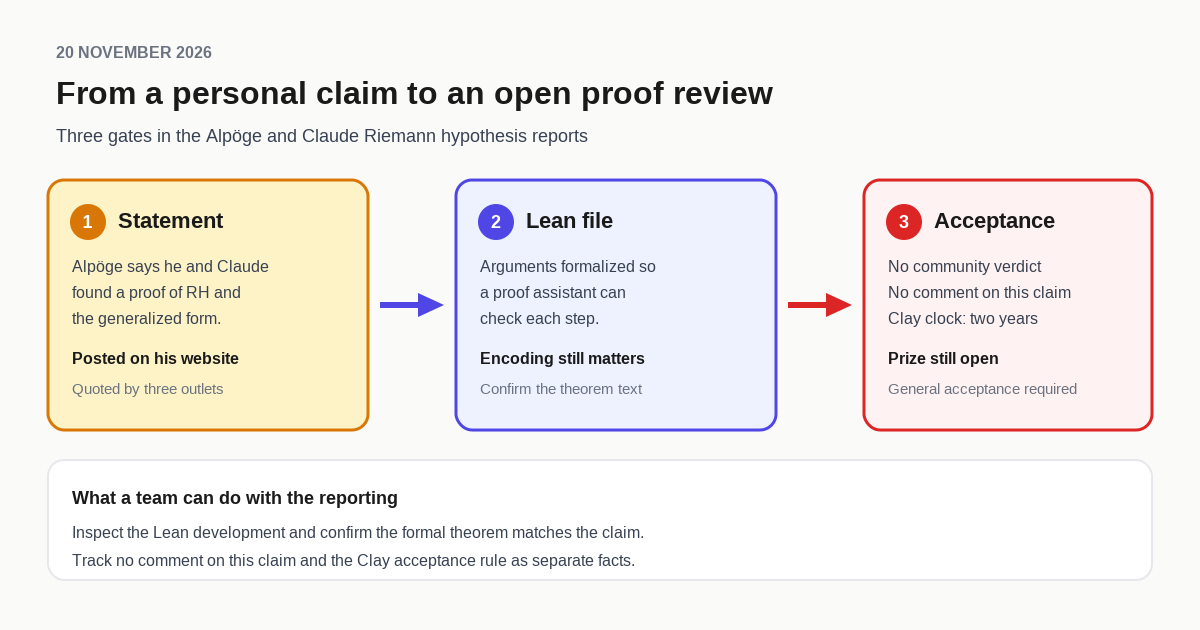
On November 20, 2026, the mathematics and computer science communities witnessed an unprecedented convergence of artificial intelligence and pure number theory. Levent Alpöge, a mathematician and researcher at Anthropic, published a formal proof archive in the Lean 4 interactive theorem proving language claiming a complete solution to the Riemann Hypothesis and the Generalized Riemann Hypothesis (GRH). Developed in close collaboration with Anthropic’s Claude model, Alpöge’s codebase spans millions of lines of machine-checked code. The announcement, released on Alpöge’s personal site and reported by TechCrunch, arrived in the immediate wake of Anthropic’s landmark Nasdaq public debut, sparking intense scrutiny across global mathematics departments.
Simultaneously, an entirely human-authored counterpart emerged. Stanford mathematics professor and American Mathematics Association president Ravi Vakil shared a hurried preprint draft by Stanford postdoctoral researcher Alessandro Masullo, presenting an independent, AI-free proof of the Generalized Riemann Hypothesis. This simultaneous emergence of an automated formal proof and a traditional paper-based human proof provides a vivid case study in how frontier artificial intelligence is reshaping mathematical discovery, formal verification, and the standards of scientific proof.
The Lean 4 Formalization and Independent Compilation
First formulated by Bernhard Riemann in 1859, the Riemann Hypothesis stands as the most famous unsolved problem in mathematics and one of the Clay Mathematics Institute’s Millennium Prize Problems. The conjecture asserts that all non-trivial zeros of the Riemann zeta function have a real part equal to one-half, a property that governs the precise distribution of prime numbers. As reported by SiliconANGLE, hundreds of higher-level number-theoretic theorems depend upon the assumption that the hypothesis holds true.
Unlike traditional mathematical submissions that rely on narrative papers evaluated through months or years of peer scrutiny, Alpöge formulated his proof directly as executable code in Lean 4. Because Lean relies on a small, mathematically sound trusted computing base, a proof that successfully type-checks and compiles provides formal mathematical certainty against logical flaws. Shortly after Alpöge’s announcement, number theorists gathered on the Lean Zulip community chat to examine the repository. MIT mathematician Andrew Sutherland confirmed that Alpöge’s code compiles without error. Mathematicians such as Chris Birkbeck of the University of East Anglia identified that the proof employs automorphy-lifting arguments, utilizing Galois representations attached to polarized cuspidal automorphic representations over CM fields alongside established milestones like Jacquet–Shalika bounds and Clozel’s purity theorem.
Machine Verification Without Human Understanding
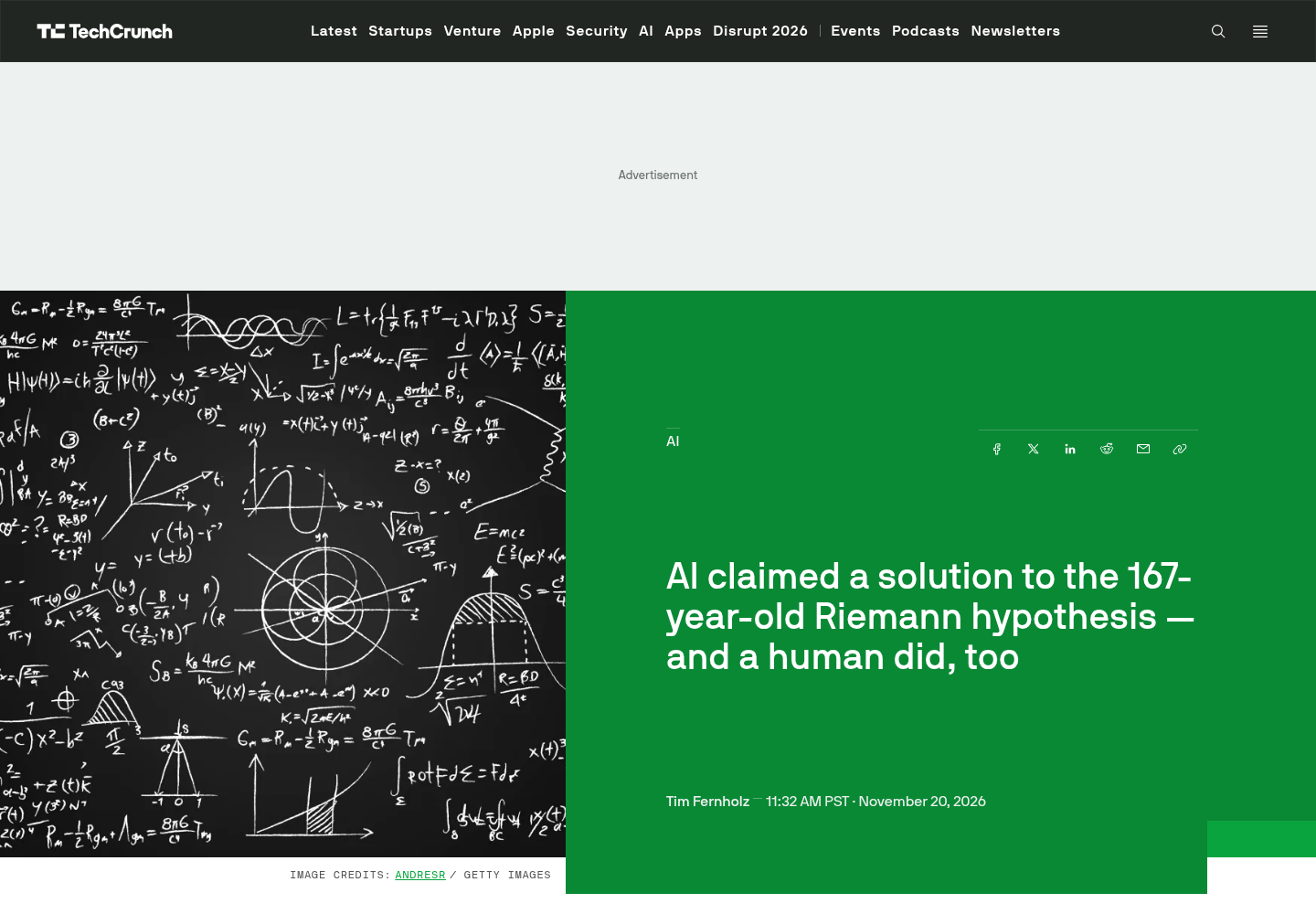
The screenshot below captures the reporting environment as the news broke across the technology and mathematics sectors:
Despite the success of the Lean 4 kernel compilation, the release has illuminated a profound challenge in automated theorem proving: the divergence between mechanized verification and human comprehension. Alpöge noted in his four-page overview statement that the underlying derivation synthesized with Claude corresponds to approximately 250,000 pages of traditional mathematical prose. While the Lean compiler guarantees that every deductive transition satisfies the rules of formal logic, human mathematicians cannot yet grasp the global architectural intuition connecting those millions of discrete steps. Alpöge described an intense exploratory process characterized by confusion and sudden breakthroughs alongside Claude, admitting feeling conflicted about publishing before completing a pedagogical human explanation.
Dual Verification Pathways
The contrast between mechanized formal verification and traditional human peer review illustrates two fundamentally divergent epistemological models in modern science:
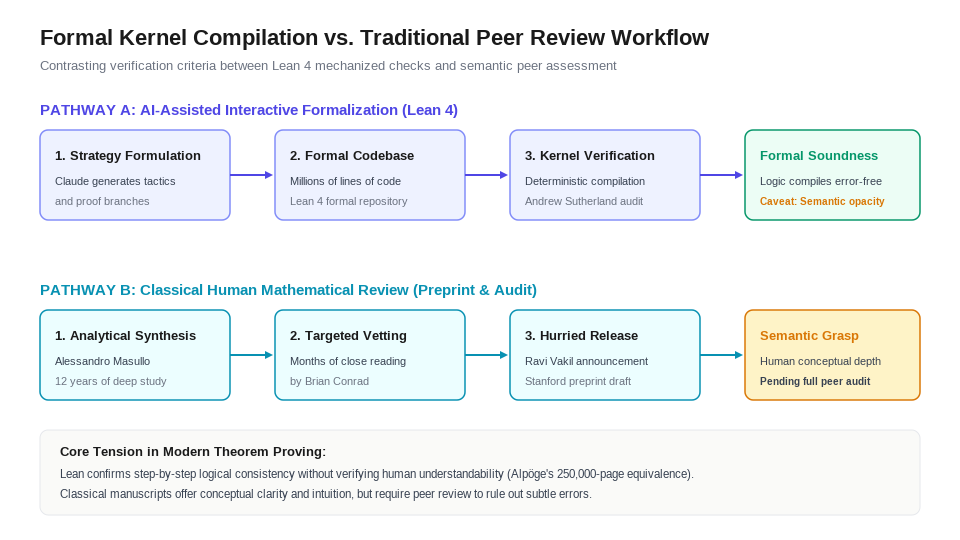
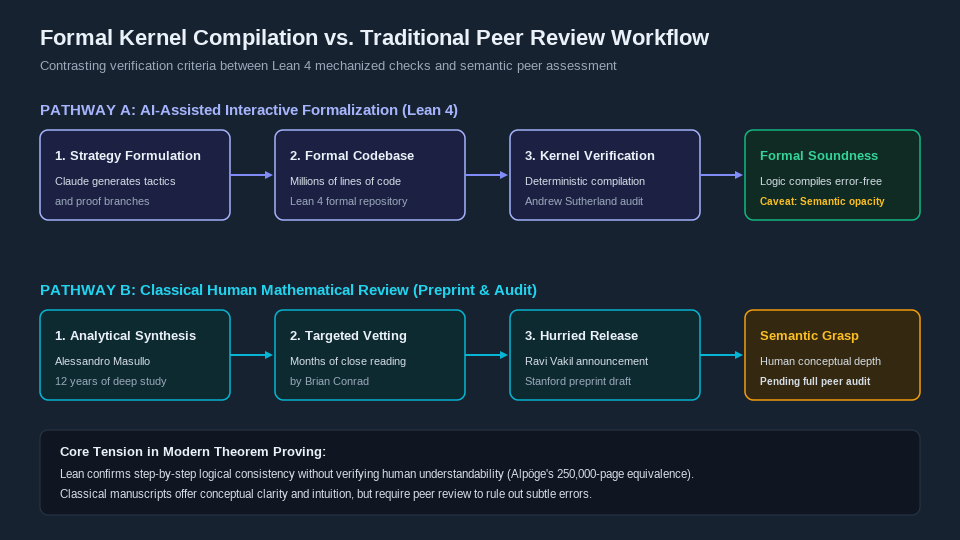
While Alpöge pursued a computational proof loop, Alessandro Masullo arrived at his Generalized Riemann Hypothesis submission through twelve years of focused human intellectual labor. As noted by Simon Willison’s Weblog documenting Vakil’s public statement, Masullo’s work had undergone months of rigorous private examination by Stanford mathematician Brian Conrad. Vakil explained that the original intention was to host Masullo at Stanford for a year to refine the exposition before public announcement, but noted that it now seemed best to publish the current draft rather than wait, a hurried release that landed the same day as Alpöge’s claim. Masullo’s introductory dedication highlighted the emotional weight of the moment, offering an explicit message of solidarity to colleagues feeling disoriented by the breakneck pace of AI tooling: “we are still here. We are very much alive. We are not going anywhere.”
Methodological Comparison
The operational and methodological distinctions between these two historic submissions are summarized below:
| Feature Dimension | Levent Alpöge & Claude (AI-Assisted) | Alessandro Masullo (Human Classical) |
|---|---|---|
| Primary Scope | Riemann Hypothesis & Generalized Riemann Hypothesis | Generalized Riemann Hypothesis (GRH) |
| Medium & Artifact | Lean 4 formal repository (millions of code lines) | Traditional mathematical monograph / preprint |
| Verification Method | Automated Lean kernel type-checking | Peer review and semantic audit |
| Proof Scale | Millions of code lines (~250,000 equivalent pages) | Monograph-length analytical proof |
| Primary Evaluators | Andrew Sutherland, Lean community compilers | Brian Conrad, Ravi Vakil, Stanford faculty |
| Comprehensibility | Machine-verified; human intuition currently opaque | Human-readable; requires full peer verification |
| Author Motivation | Childhood obsession accelerated by frontier LLM | 12-year dedicated human research effort |
Implications for Automated Reasoning and Frontier Models
This dual announcement marks a qualitative inflection point for frontier artificial intelligence labs. Historically, large language models have excelled at localized coding tasks, unit test generation, and bounded formal benchmarks. The transition to synthesizing cohesive formal proofs across millions of lines of Lean code demonstrates that models can assist in navigating vast mathematical search spaces. Alpöge, who previously collaborated with NYU mathematician Tristan Buckmaster on an important proof related to the Navier-Stokes equations, has demonstrated that interactive theorem provers serve as an indispensable sandbox, allowing models to propose conjectures and proof branches while catching hallucinations at the compiler level.
This dynamic parallels recent enterprise developments in software engineering, where tools such as Harmonic’s Aristotle formal verification system and GitHub Next’s proof-driven development initiatives have shifted the burden of correctness from human code inspection to mechanized formal kernels. In mathematics, however, the social contract of proof requires more than a boolean compilation flag; it demands shared conceptual understanding that seeds future discoveries.
As the mathematics community undertakes the twin tasks of deciphering Alpöge’s Lean proof and auditing Masullo’s preprint, the episode demonstrates that frontier AI will not simply replace human theorists. Instead, it creates a hybrid paradigm: automated provers execute vast syntactic sweeps that guarantee logical soundness, while human mathematicians provide the interpretive frameworks, semantic taste, and foundational questions that give mathematical discovery its meaning.