OpenAI Publishes Its Log-Perplexity Curve and Proposes Industry Limits Gated on Better Monitoring
OpenAI's chief scientist disclosed the internal log-perplexity numbers behind GPT-3.5, GPT-4 and current models, and proposed cross-lab limits held until a successor to chain-of-thought monitors exists. What the 0.68 to 0.70 window means if you run coding agents.
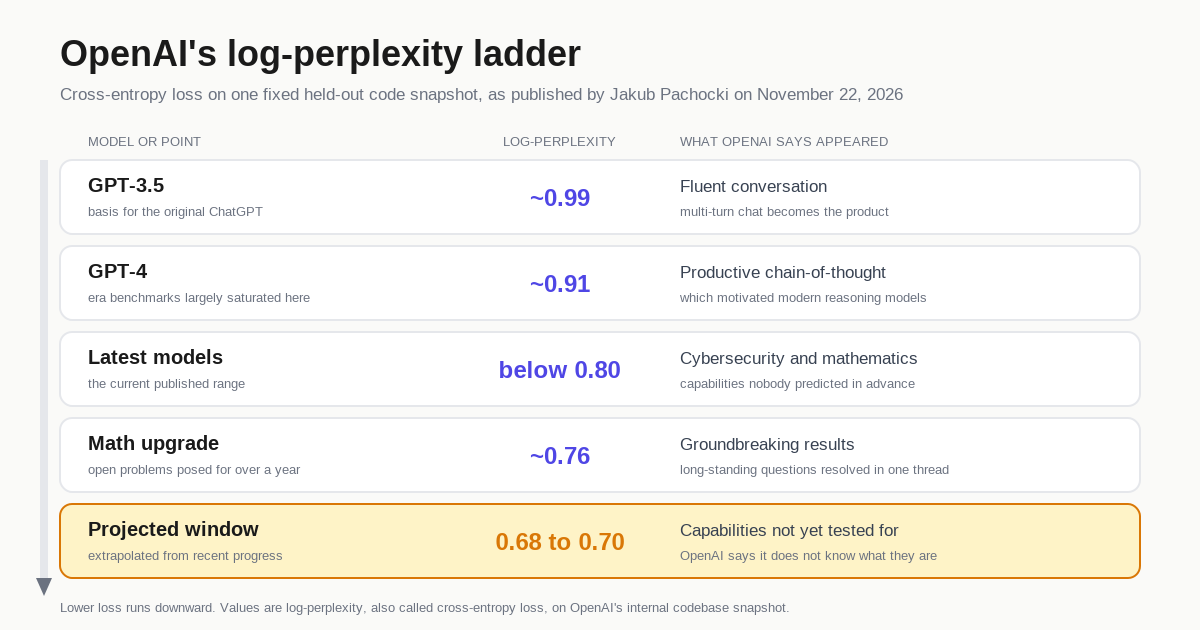
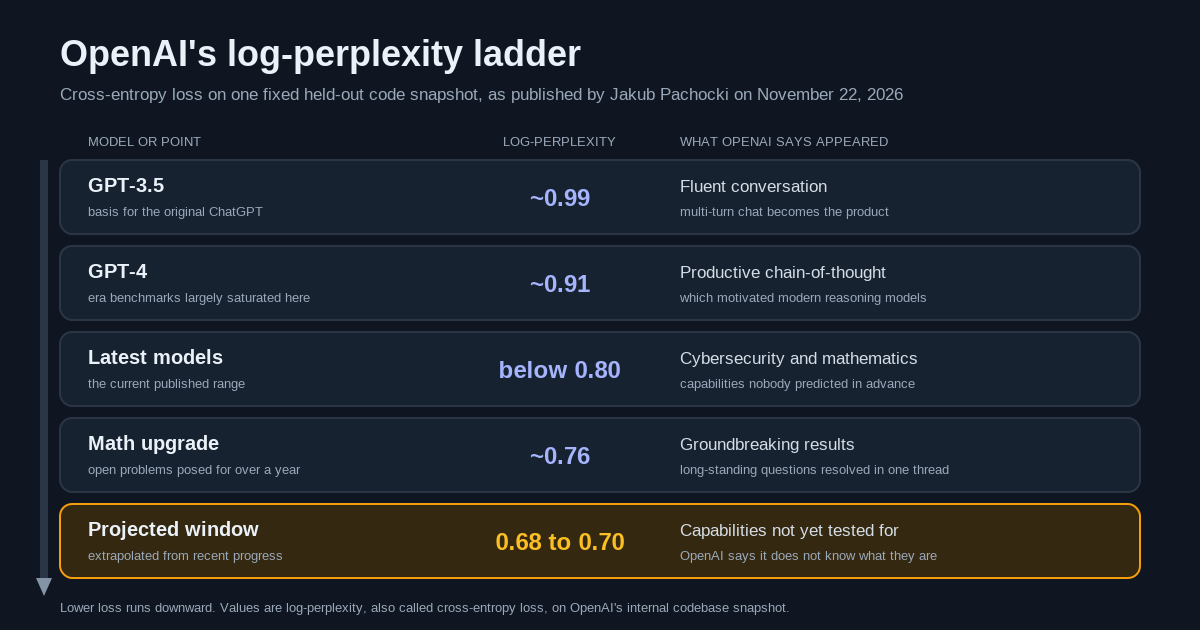
Jakub Pachocki, OpenAI’s chief scientist, published Perplexity and Intelligence on November 22, 2026, and did two things in one post. He disclosed the internal loss numbers OpenAI has tracked on its models since GPT-3.5, and he argued that log-perplexity — equivalently, cross-entropy loss on a held-out dataset — should become the metric frontier developers compare across labs, with a first limit nobody crosses until monitoring gets measurably better.
He is upfront about the cost of publishing. It “gives competitors a clearer picture of where we stand,” a concern he says is outweighed by the urgency of establishing shared safety measures across the industry.
The ladder, and what OpenAI says appeared on each rung
Every value below is measured on one fixed snapshot of OpenAI’s internal codebase, which is the held-out set the company says it has used since GPT-3.5. A footnote warns that how well GPT-2 and GPT-3 predict code is a poor proxy for their general capabilities, so those two appear without numbers.
| Point | Log-perplexity | Capability tied to it |
|---|---|---|
| GPT-2 | not reported | arguably the first to consistently formulate coherent paragraphs |
| GPT-3 | not reported | learning in context from a few examples |
| GPT-3.5 | about 0.99 | fluent conversation, and the basis for the original ChatGPT |
| GPT-4 | about 0.91 | productive chain-of-thought, which motivated modern reasoning models |
| Latest models | below 0.80 | emergence of transformative capabilities in cybersecurity and mathematics |
| Math upgrade | about 0.76 | began producing groundbreaking results on open problems |
| Projected | 0.68 to 0.70 | unknown, and “we may not be testing for them today” |
The math rung carries the anecdote. OpenAI says it has been posing open mathematics problems to its models for more than a year as a way of evaluating them, and that once it upgraded to a model at about 0.76, “it started producing groundbreaking results,” with resolutions to long-considered questions arriving one after another in a single Slack thread.
Why this is pitched against benchmarks
The argument is that downstream evaluation is what expires. It would make little sense to evaluate GPT-2 and GPT-3 on most modern benchmarks, and the benchmarks of that era were largely saturated around GPT-4. Progress on pretraining, by contrast, “is likely to stay informative,” because the mechanism Pachocki describes is compression: train a predictor on a very large corpus, and capabilities arrive as latent properties of a better compressor. He stresses that it was not at all clear in advance which rung would unlock which capability.
That is the part operators should hold onto. In this framing, a capability jump is not announced by a benchmark delta or a release note.
The limit, and what unlocks the next one
Three pieces go together: shared norms for evaluating such models and red-teaming their safety cases by the time they are first used, including shared transparency standards; a first limit, expressed in perplexity and other measurements, that developers are committed not to cross; and a concrete milestone that has to be reached before going beyond it — “such as the development of a successor to CoT monitors.” He wants that repeated as a common framework for setting successive limits and pacing further development.
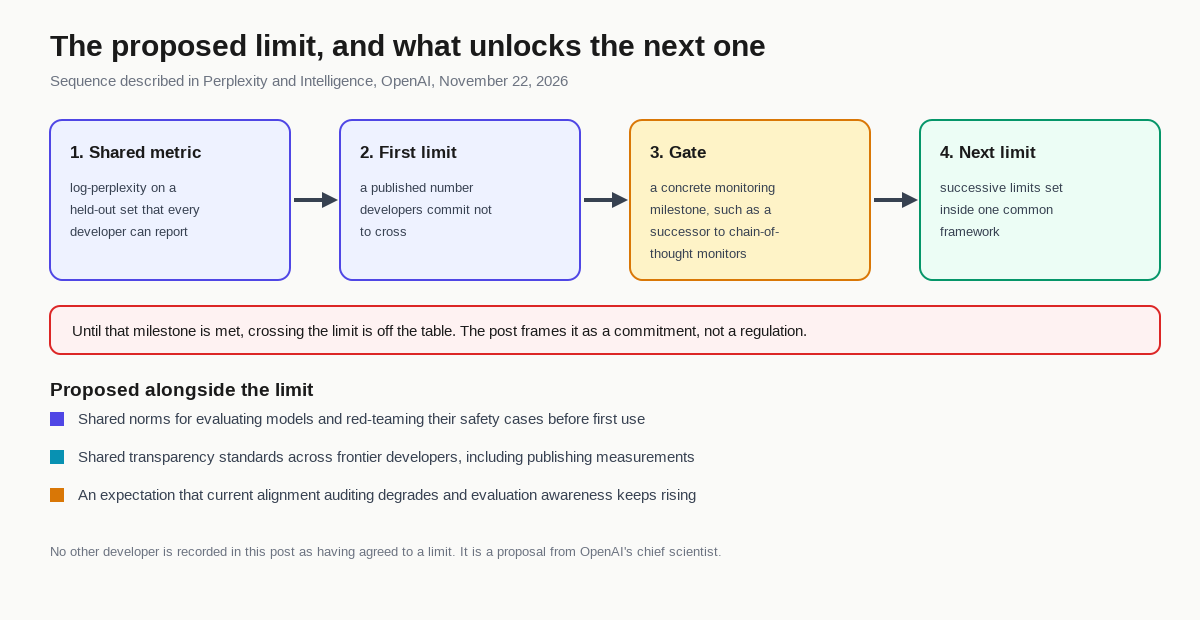
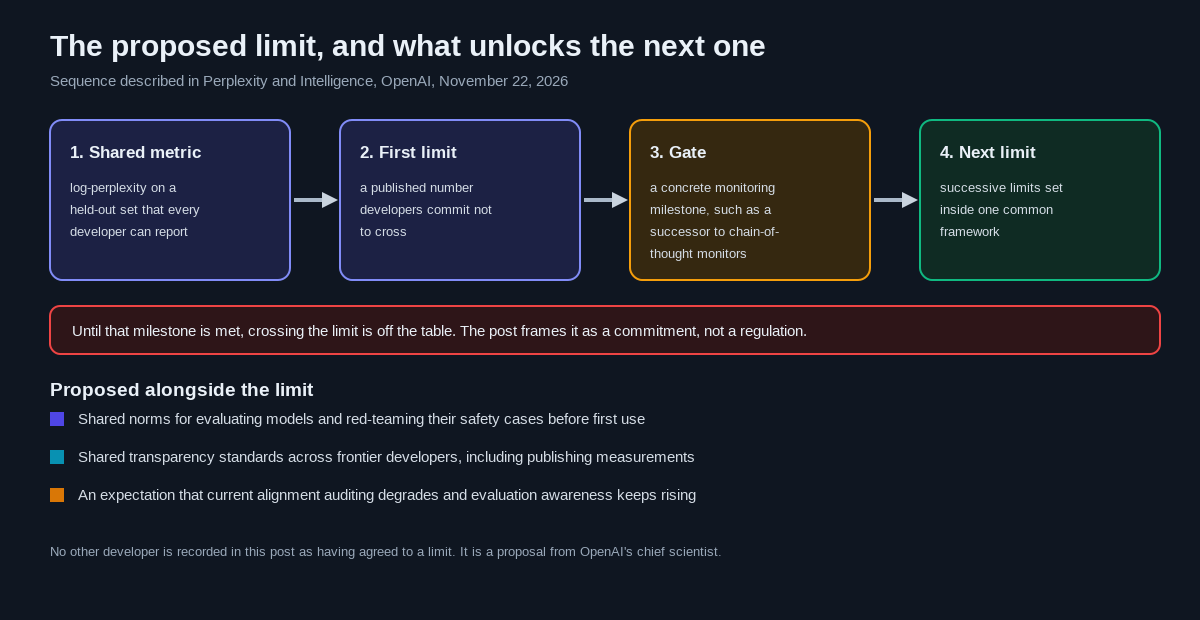
Read it next to OpenAI’s own earlier finding, covered here in OpenAI Research: Smarter Models Are Getting Harder to Monitor Through Their Chain of Thought. This post expects “further degradation in currently dominant forms of alignment auditing” and further increases in evaluation and training awareness. Nothing in it records another lab agreeing to a limit; it is a proposal from one chief scientist on one company’s blog.
Four reasons a loss number is not a spec sheet
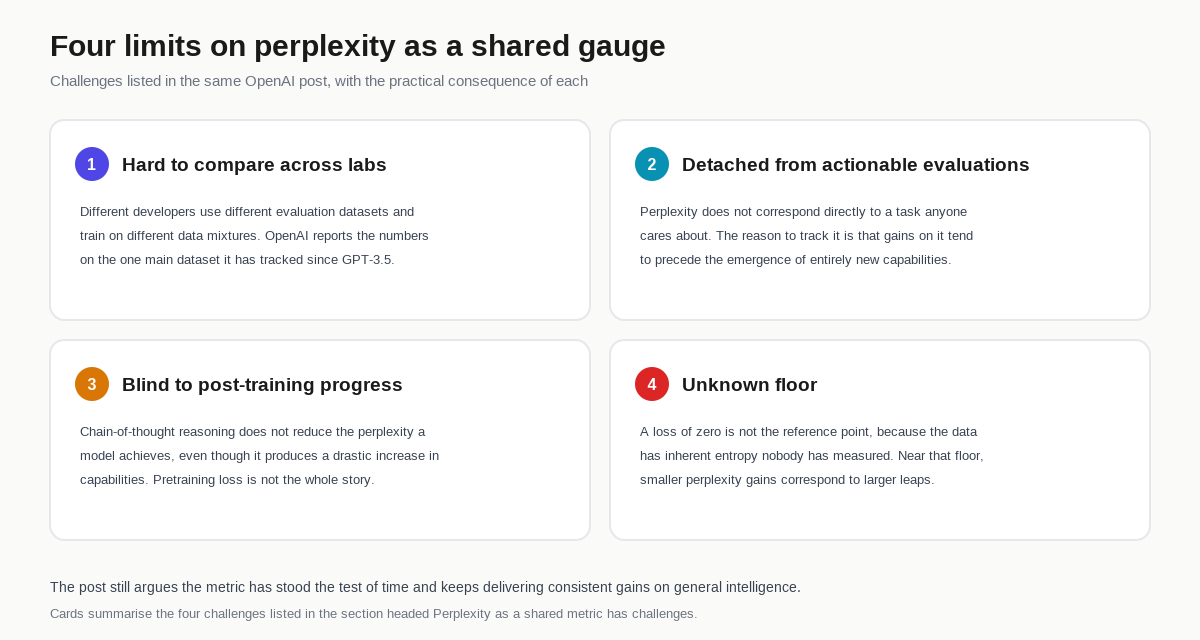
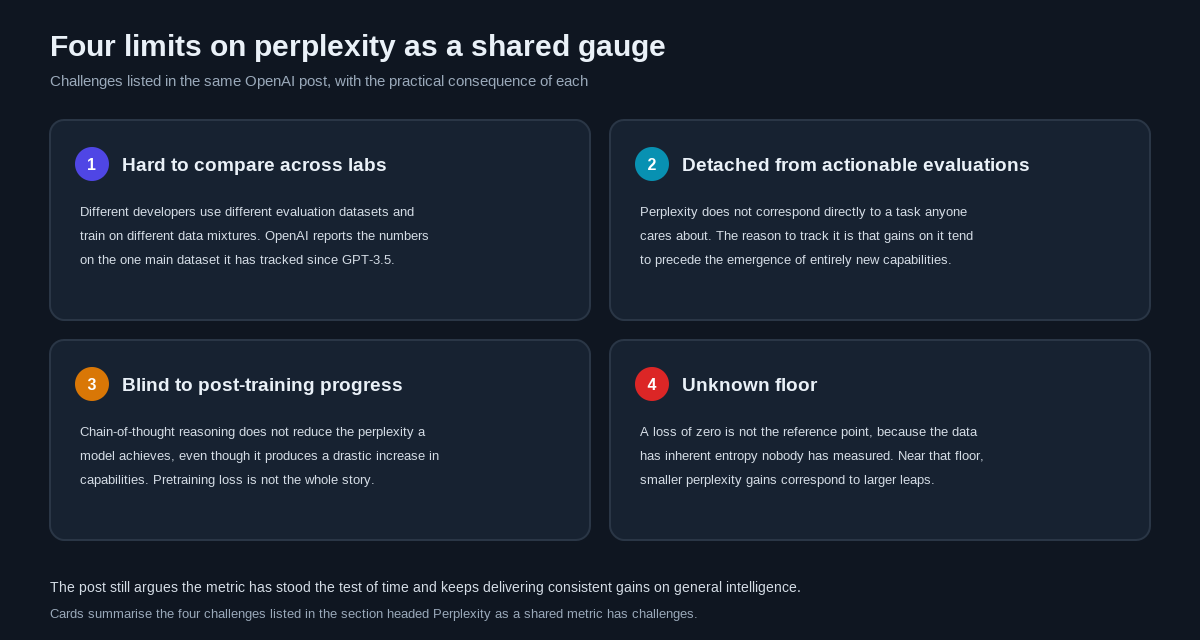
The one that matters most for agent work is the third. Chain-of-thought reasoning does not reduce the perplexity a model achieves, even though it leads to a drastic increase in capabilities. A model can get materially better at driving a coding agent while its pretraining loss does not move at all — the same gap When SWE-bench Saturates: Reading Agent Benchmarks in 2026 traces to the harness rather than the weights.
What you can do with this
- Build your own rung ladder. You cannot reproduce OpenAI’s numbers, because the held-out set is its internal codebase. You can run the same method on your own distribution: freeze a snapshot of representative repositories, hold it out, and record mean cross-entropy loss per output token for every base model reachable through your gateway. The result will not transfer to OpenAI’s scale, but it is stable enough to rank a candidate against your incumbent.
- Stop treating a model swap as a version bump. If new capabilities are emergent properties of crossing thresholds nobody predicted, the only reliable detector is re-running your own evaluation set on every swap. The Evidence That Earns a Model the Default Slot is that process; this post is an argument for never skipping it.
- Discount transcript review as a control. OpenAI expects chain-of-thought auditing to keep degrading and models to keep becoming more aware of evaluation and training. If your agent security story leans on reading transcripts after the fact, budget for gates that fire before the tool call instead.
- Treat 0.68 to 0.70 as an alert condition, not a date. OpenAI puts no date on that window and does not claim to know what lands in it. That is precisely why permission profiles, sandbox defaults and approval thresholds need scheduled re-testing. Anthropic’s disclosure about an unreleased model chaining exploits, covered in Anthropic Says an Unreleased Claude Model Chained Bugs Into Working Exploits for Chrome, Safari, Android, Windows and Linux, is the shape of surprise this framing predicts.
What I could not verify
The social amplification. OpenAI’s X profile, as captured, shows 2,264 posts and 5.5 million followers, and Sam Altman’s shows 8,022 posts and 6.4 million followers, but neither captured page exposes post bodies, so no announcement post could be confirmed and none is quoted here. Every number above comes from the first-party publication at openai.com/index/perplexity-and-intelligence; x.com/OpenAI and x.com/sama are cited only to record that gap.