Qwen Code v0.28.4 Adds Built-In Gemini 4 Reasoning and a Workspace Artifact Library
Qwen Code v0.28.4 adds built-in Gemini 4 reasoning defaults and a workspace artifact library with progressive scanning, while tightening local runtime directory permissions.
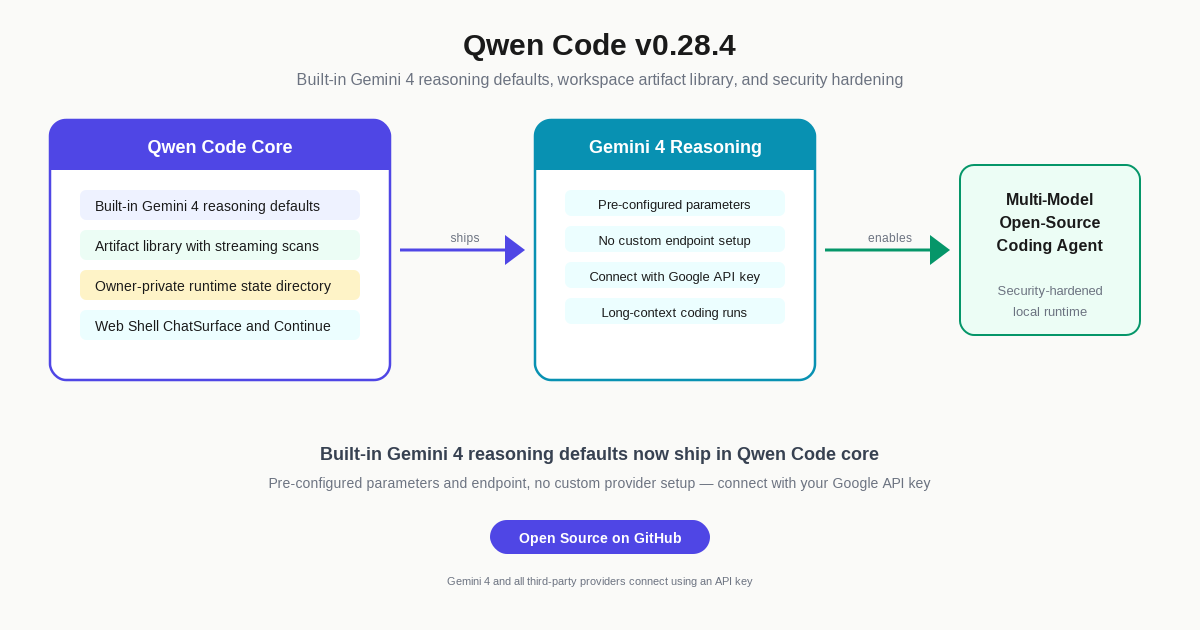
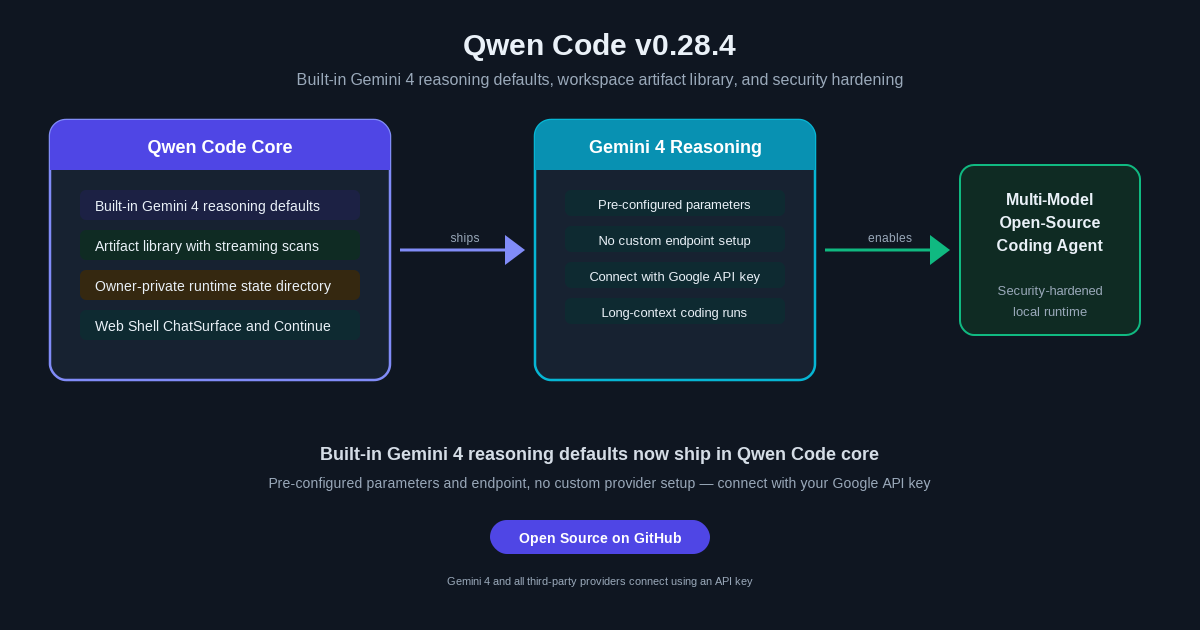
Qwen Code v0.28.4 shipped today with built-in Gemini 4 reasoning defaults, adding Google’s frontier model as a pre-configured option inside the open-source coding agent. The release also delivers a workspace artifact library page with progressive scanning and streaming updates, and hardens the local runtime by creating its state directory with owner-private permissions at process spawn.
Gemini 4 Arrives as a Built-In Default
The headline change is pull request #18039, which adds Gemini 4 reasoning model defaults directly into Qwen Code’s core. Users can now select Gemini 4 as a first-class option alongside Qwen’s own models — the built-in defaults preconfigure reasoning parameters and the provider endpoint, so no custom provider setup is needed. Users still supply their Google API key, as they would for any third-party provider.
As documented in the Qwen Code overview, the tool already supports QwenCloud, Alibaba ModelStudio, DeepSeek, MiniMax, OpenRouter, and custom providers through its settings file. Adding Gemini 4 extends that roster with Google’s frontier reasoning model.
For Qwen Code operators, the practical effect is straightforward: teams that prefer Gemini 4 for specific workloads — long-context reasoning, cybersecurity analysis, or cost-sensitive batch runs — can now reach for it without maintaining custom provider endpoint configuration across machines.
Workspace Artifact Library
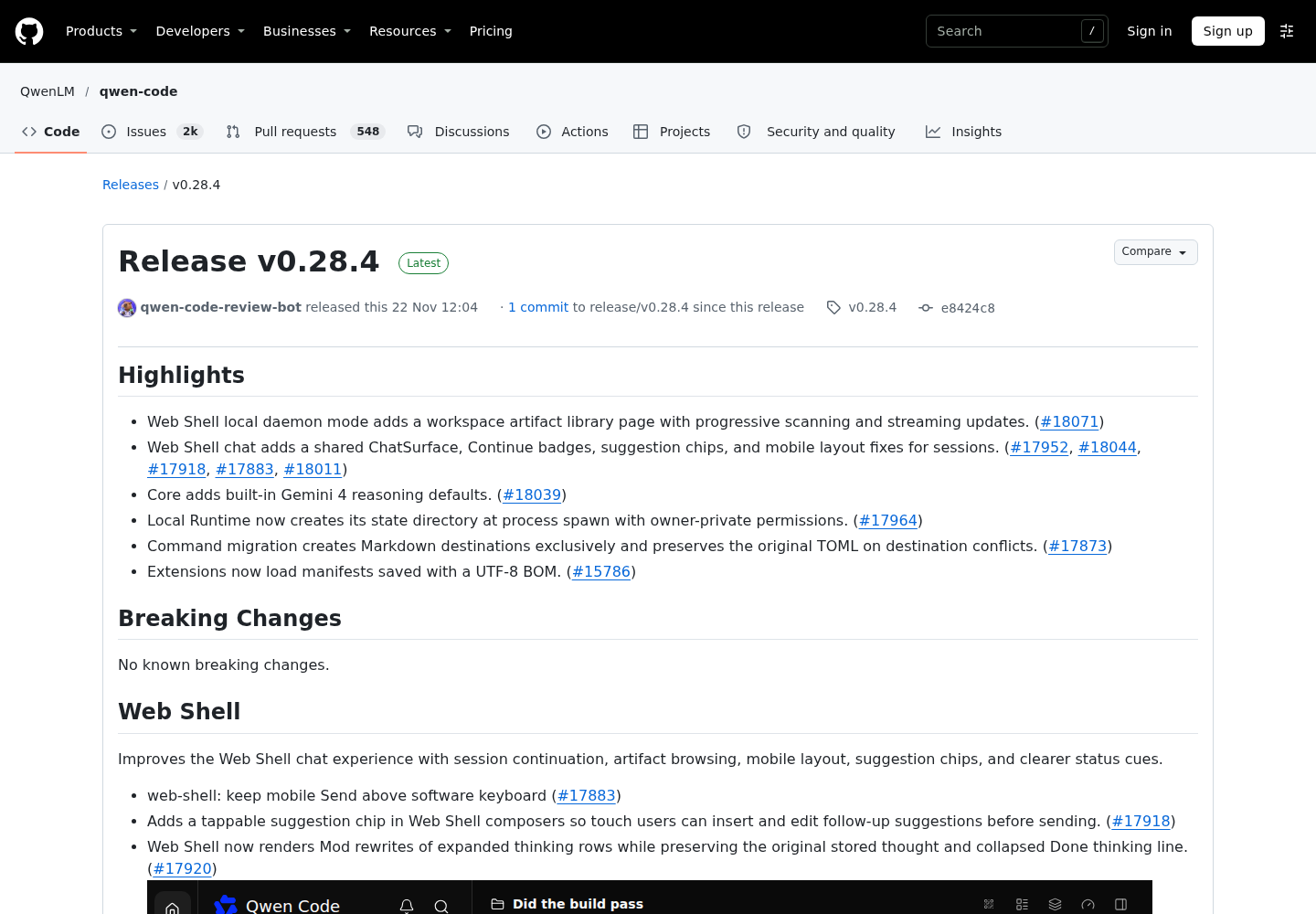
Pull request #18071 adds a workspace artifact library page to the Web Shell’s local daemon mode. The page scans a session’s workspace progressively and streams discovered artifacts as they are found, rather than waiting for a complete scan to finish.
This matters for long-running agent sessions where artifacts accumulate over time. Instead of scrolling through a transcript or searching the filesystem, operators get a live updating inventory of what the agent produced. The feature was designed in #18036 and marked as accepted in #18063, then implemented in this release.
Security Hardening: Owner-Private Runtime State
The local runtime now creates its state directory at process spawn with owner-private permissions (#17964). Previously the directory was created during provider initialization, later in the startup sequence. Moving creation to spawn time and enforcing restricted permissions closes a window where the state directory could exist with broader access than intended — particularly relevant on shared systems or CI runners where multiple processes share a filesystem.
Web Shell and Session Experience
The Web Shell gains several quality-of-life improvements in this release. A shared ChatSurface component (#17952) renders transcripts, approvals, questions, and the composer from session state, replacing fragmented per-component rendering. The sidebar now shows a Continue badge for sessions whose last turn was interrupted and needs resumption (#18044). Touch users get tappable suggestion chips that insert follow-up prompts into the composer before sending (#17918).
On the mobile side, the Send button now stays above the software keyboard (#17883), and session titles get more space on both mobile and desktop by moving optional actions into a More menu (#18011).
Other Notable Changes
Command migration now creates Markdown destinations exclusively and preserves the original TOML file when a destination conflict exists (#17873). Extensions can now load manifests saved with a UTF-8 byte order mark (#15786), fixing a longstanding edge case for extension authors on Windows.
The Managed Agent and Hosted Harness subsystems received fixes for session races, preflight configuration handling, telemetry channel attribution, and storage identifier readability. ACP channels now tolerate busy agents during liveness checks instead of treating them as unhealthy (#18028).
What It Means
Qwen Code v0.28.4 continues the trajectory set by v0.28.3, which put managed agents in GitHub and Teams channels with private PR wakes and idle session suspension. Where v0.28.3 expanded where agents can live, v0.28.4 expands what models they can use and what operators can see them produce — all while tightening the security posture of the local runtime.
The desktop release, Qwen Code Desktop v0.28.4, ships the same core changes alongside desktop-specific fixes including RHEL 10 build root re-pinning and macOS end-to-end test fixes, published at 12:52 UTC.