Vercel Adds Independent Audits to AI Gateway Zero-Data-Retention Claims After OpenRouter Prompt-Theft Findings
Vercel adds independent security audits to AI Gateway zero-data-retention claims, moving provider privacy from self-attested contracts to verified reports by Dec 8.
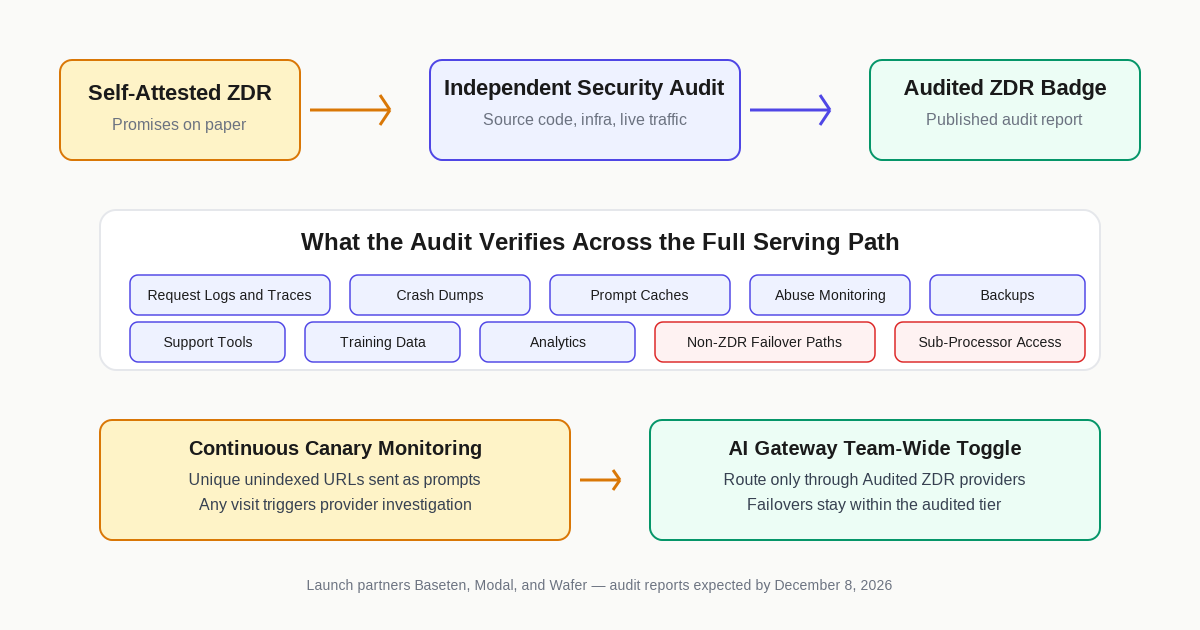
Vercel is introducing independently audited zero-data-retention verification on AI Gateway, adding a layer of third-party proof to what has, until now, been a self-attested promise from inference providers. Launch partners Baseten, Modal, and Wafer have begun audits, with reports expected by December 8, 2026.
The move arrives days after OpenRouter off-boarded three inference providers and stripped zero-data-retention eligibility from 125 endpoints, following security research that used prompt canaries to catch providers retaining data they had pledged to discard. The Dragos report found that certain providers were not upholding their stated data policies. OpenRouter removed providers flagged by researchers based on its investigation findings, and pulled additional ZDR labels as a precautionary measure.
That sequence — a public finding, followed by gateway-level enforcement — exposed a structural gap: ZDR guarantees have been backed by contracts and self-attestation, not verification. A provider agrees not to retain prompts or completions, and customers take that commitment on faith. For teams sending proprietary code, customer records, or regulated data through models, that faith has been the only assurance available.
How Audited ZDR Works
Under the new program, an inference provider engages an independent security firm — chosen from among respected third-party auditors — to test its zero-data-retention policy across the full serving path. The audit must cover every model, endpoint, feature, and tool that handles AI Gateway traffic.
The scope is broad. Auditors confirm that customer data — prompts, completions, system prompts, embeddings, files, images, audio, tool-call payloads, and any derived data — is never written or retained on durable storage. Coverage spans request logs, traces, metrics, crash dumps, prompt caches, abuse monitoring, analytics, backups, support tools, and training datasets.
Auditors review the provider’s serving-path source code and infrastructure configuration, then run live tests: they send marked prompts through AI Gateway and search the provider’s logging, caching, and storage systems for any trace of them. The audit also confirms that a request marked ZDR never fails over to a non-ZDR endpoint, that no human or automated process accesses customer data outside handling the request itself, and that no training on customer data occurs.
Each passing provider publishes the report under the auditor’s name. It covers scope, methodology, dates, findings, and fix status, with exceptions disclosed and redactions limited to exploit detail. AI Gateway links directly to the report.
Between Audits: Canary Monitoring
Vercel is layering continuous canary checks on top of the point-in-time independent audits. Each run sends prompts containing unique, unindexed URLs mapped privately to a provider, model, and run. A ZDR provider should never retain, inspect, or crawl prompt content, so any request to a canary URL triggers an investigation.
Canary checks cannot detect prompts written to disk and never read, which is why they complement rather than replace independent code and infrastructure audits. Together, the two mechanisms give teams both a verified baseline and an ongoing detection layer.
What Teams Can Do Now
AI Gateway is adding an independently Audited ZDR provider tier and a team-wide policy toggle. When enabled, AI Gateway routes and failovers your team’s requests only across providers with published audits that meet the bar. Launch partners enter the tier as soon as their reports are published.
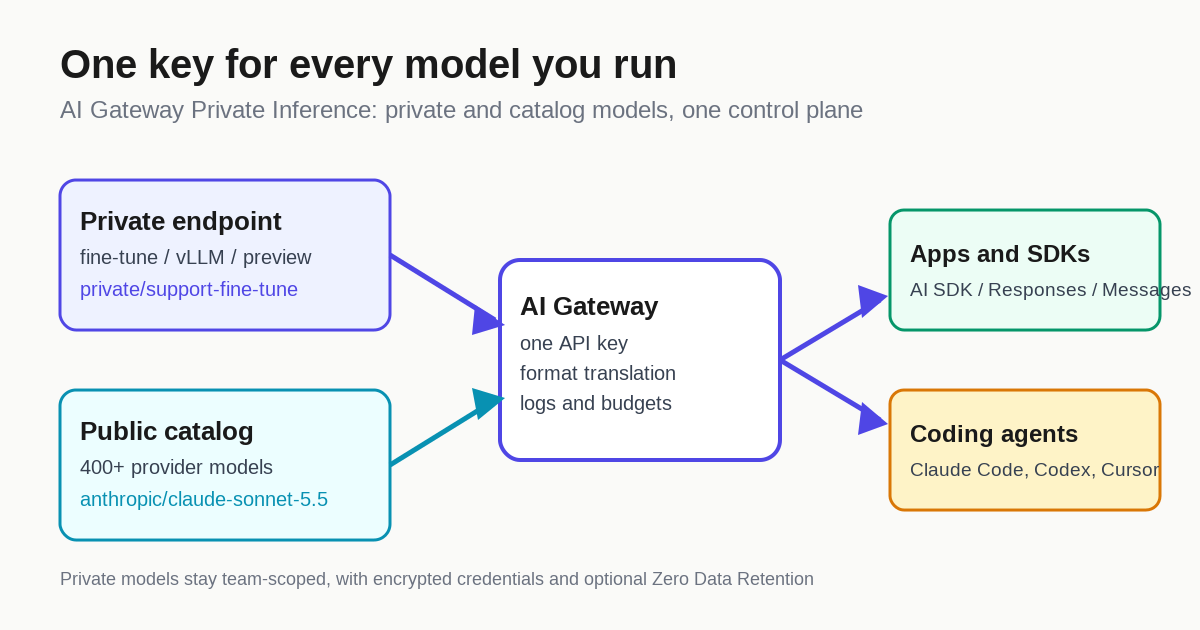
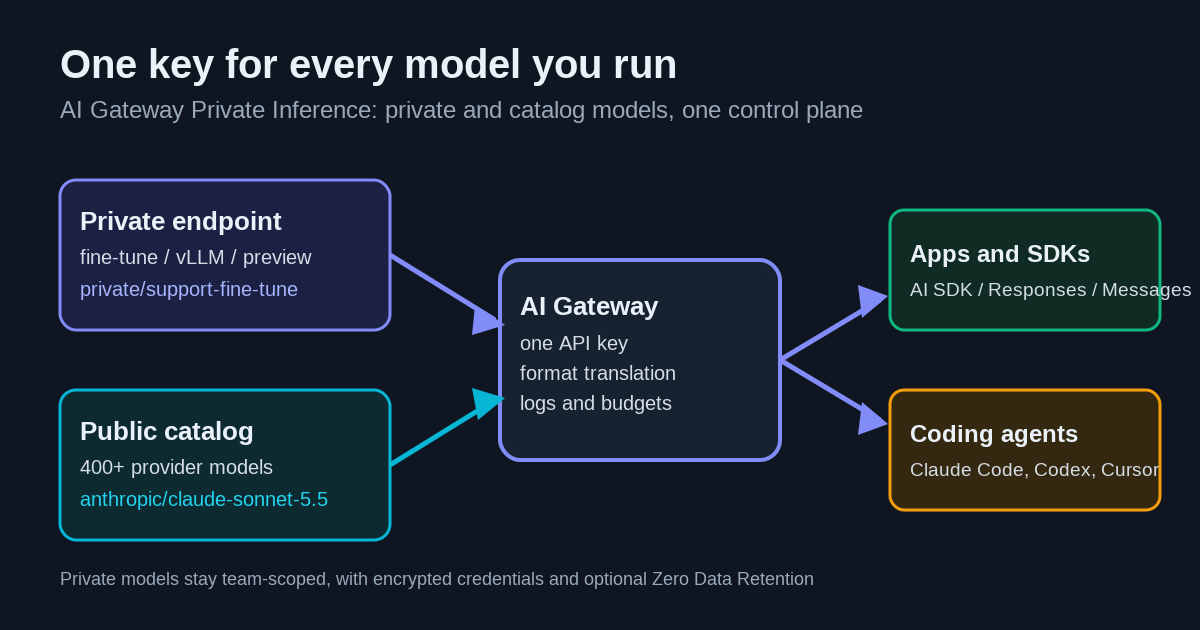
The audited tier works alongside AI Gateway’s existing compliance controls: regional inference pins, provider-headquarters filters, and private inference for self-hosted or fine-tuned model endpoints. Teams can already enforce team-wide ZDR-only routing; the audited tier adds verification to that enforcement.
The timing is significant. Together AI recently disclosed a security event where prompts leaked for requests in June and July of 2026, which began when its own coding agent committed a credential. The broader prompt-canary investigation caught multiple providers retaining data they had committed to discard. Independent audits address the root problem — a missing verification step between a provider’s privacy claim and the code that actually handles your prompts.
For teams routing coding agents through AI Gateway, the practical step is straightforward: once launch-partner reports are published, enable the Audited ZDR toggle in gateway policy settings. Before then, review which providers currently handle your team’s ZDR-labeled traffic and compare against OpenRouter’s published list of provider security announcements. Vercel’s AI Gateway documentation covers the full configuration path for ZDR enforcement, regional constraints, and provider filtering.