Congress's Second Nvidia Inquiry Meets a Chip-Tracking Admission: What It Means for GPU Fleets
Nvidia privately told a lawmaker chip tracking is feasible while Democrats open a second inquiry into China sales. What it means for GPU fleet operators.
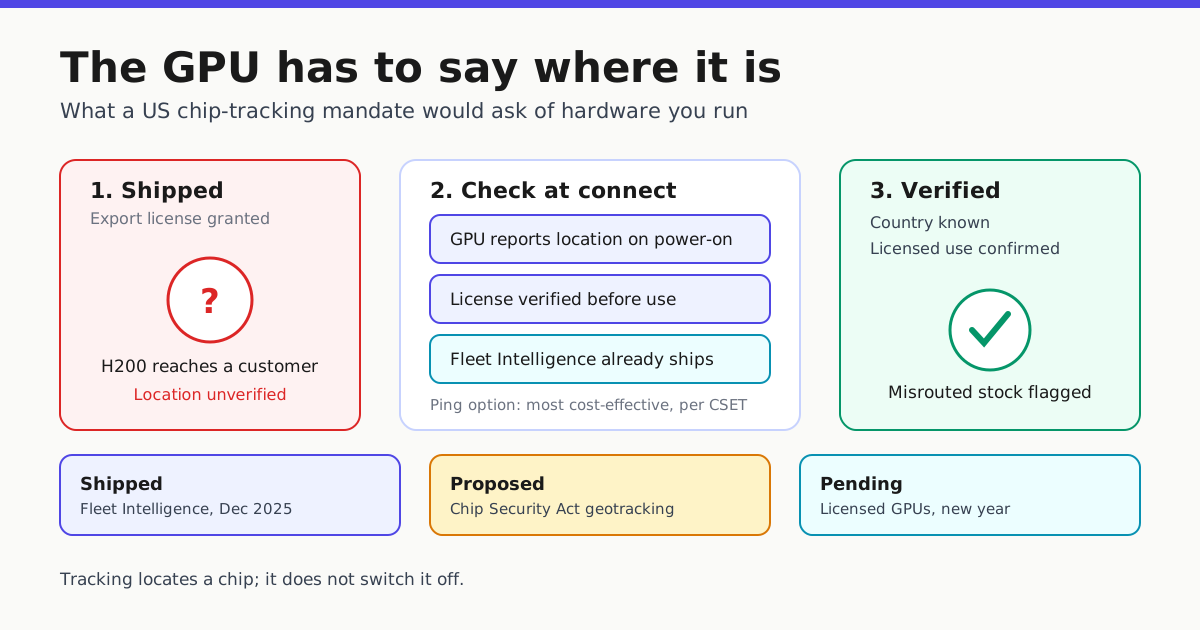
MIT Technology Review reported on November 12 that Nvidia representatives privately told Rep. Bill Foster that implementing the Chip Security Act’s anti-smuggling measures was technically possible, measures that would verify the location of advanced AI chips. The same day, TechCrunch reported that Rep. Richard Neal and Sen. Ron Wyden opened a second congressional inquiry into Nvidia’s China chip sales.
Two stories, one piece of hardware. For anyone running GPUs on rented or owned capacity, the tracking question decides what a future law asks of the machines.
A mandate the industry called infeasible
MIT Technology Review’s report is the load-bearing evidence. Foster, a Democrat on the House Science Committee who cosponsors the act, said Nvidia representatives told him the measures were technically possible, even as the Semiconductor Industry Association, whose members include Nvidia, wrote in March 2026 that chip tracking was “new, untested, and potentially infeasible.”
Two caveats travel with the admission: Foster said the representatives “never put anything in writing,” and Nvidia did not respond to requests for comment.
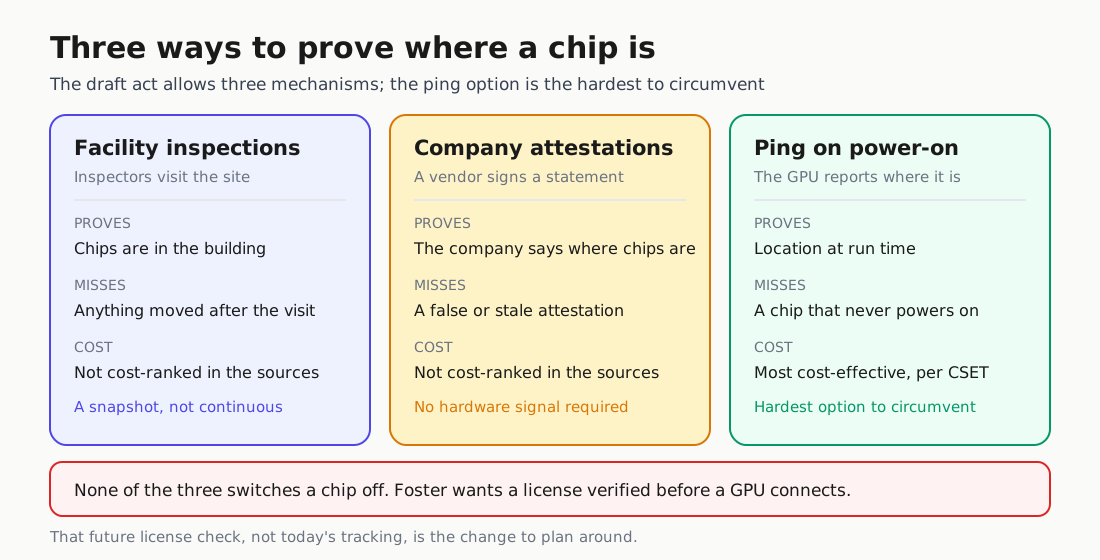
As drafted, the act would require a mechanism to track chip locations: facility inspections, company attestations, or a ping in which the GPU signals its location on power-on. The Center for Security and Emerging Technology found in September that the ping option would be the most cost-effective. It is one of three chip-security bills in play for the Senate’s defense authorization act.
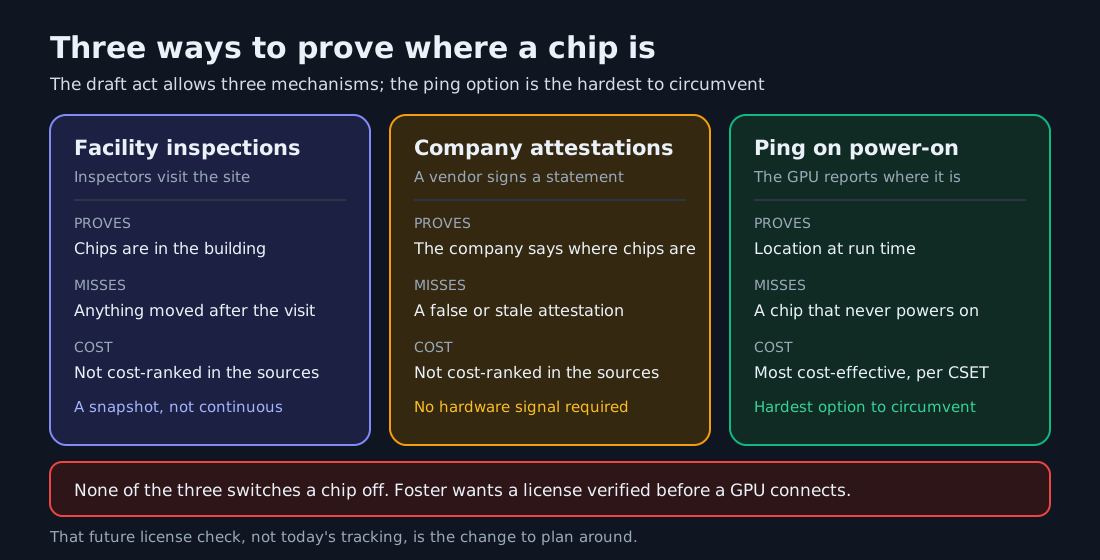
A capability argument is still not a rule. But the direction is set: a mandate contested as infeasible in March is, on a lawmaker’s account, an engineering problem.
What ships, and what it cannot do
Nvidia has already built part of this: in December 2025 it announced Fleet Intelligence, a tool to monitor advanced chips across data center locations. Nvidia confirmed to Reuters that it can indicate which country chips are in, while declining to say whether it could prevent smuggling.
What matters more is what a location check is not: Foster said the mechanisms would tell investigators where chips are, not disconnect them if they turn out to have been smuggled. He plans stricter legislation in the new year requiring licenses to operate advanced GPUs, verified before a GPU could connect - a gate at the point of use, not telemetry.
The second inquiry and its hard limit
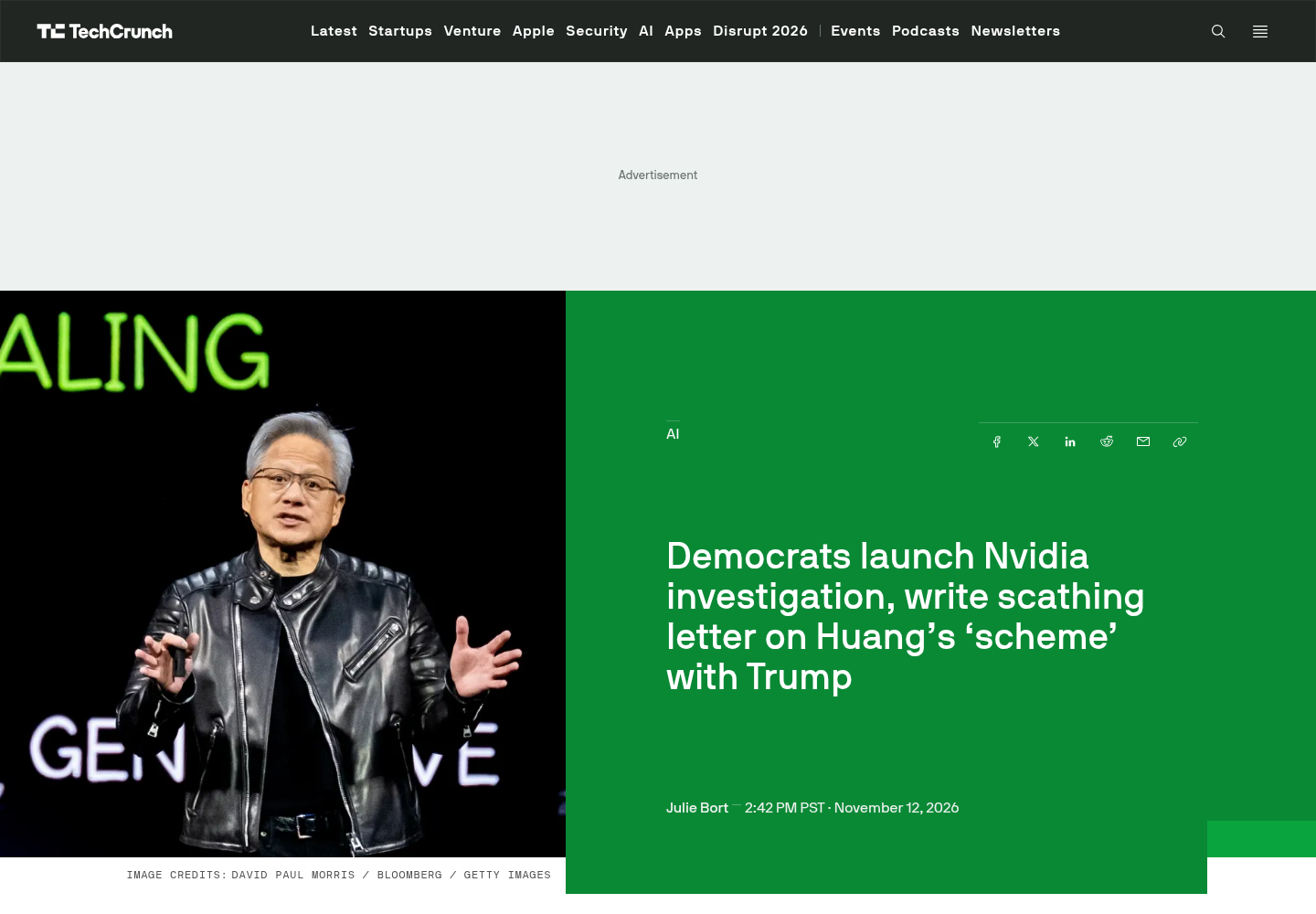
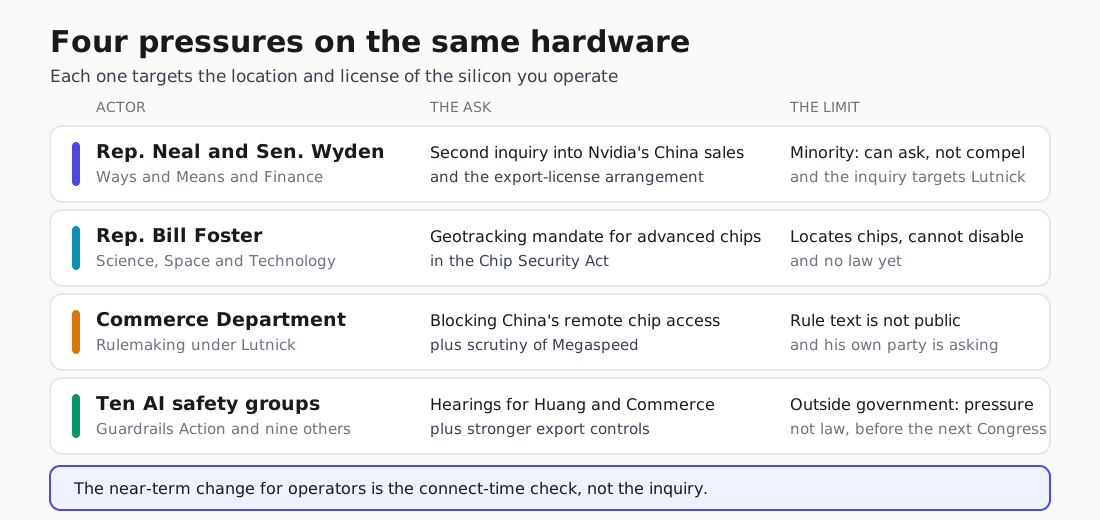
TechCrunch reported that the inquiry comes from Rep. Richard Neal, the top Democrat on the House Ways and Means Committee, and Sen. Ron Wyden, the top Democrat on the Senate Finance Committee, and that their letter to Commerce Secretary Howard Lutnick asks his department to preserve records.
The letter’s account: Trump agreed to sales of Nvidia’s H200 chips to China as long as the chips, manufactured in Taiwan, were first shipped to the United States, then added a tariff the letter calls “what appears to be an unconstitutional export tax system.” Separately and publicly, Nvidia and AMD had agreed in August 2025 to share 15 percent of China chip revenue with the U.S. government as part of a deal to secure export licenses.
The letter also asks why Commerce kept allowing Megaspeed, the Singapore-based firm at the center of the smuggling allegations, to buy chips, and why other Asian buyers were approved with “no physical presence at their listed addresses.” It is the second congressional investigation; the first, Republican-led, has secured Jensen Huang’s agreement to testify. We covered the board’s move to oust him in our earlier report.
The limit is structural: as the minority, they can ask questions but cannot compel answers. The inquiry points at the administration as much as at Nvidia.
Four pressures, one dependency
Semafor reported on November 13 that Guardrails Action and nine other AI safety groups wrote to Senate Minority Leader Chuck Schumer and House Minority Leader Jeffries, demanding hearings with Huang and Commerce officials; a separate letter from the Alliance for Secure AI and the Tech Oversight Project went to Lutnick demanding stronger export controls.
The administration’s own side is unsettled. Semafor reported the previous evening that a growing Republican contingent is pointing at Lutnick for not cracking down on Megaspeed and for Commerce’s failure to restrict AI chip exports to China; that Rep. John Moolenaar, the House China committee’s top Republican, says Trump directed three times that Megaspeed be blacklisted; and that Lutnick will testify before the Senate Commerce Committee. Commerce is also finalizing a rule to block China’s remote access to AI chips.
What changes if you operate GPUs
-
A new outbound signal. Under a ping mandate the accelerator reports its location when it comes online, and no source says a missing ping would disable the hardware. How a future rule treats a chip that never signals is an open question to plan for.
-
A license check at connect. Foster’s proposed version verifies a license before a GPU connects. That gate lands first on capacity you rent rather than own: a serverless GPU runtime allocates hardware per job while the hardware sits with the provider, so a check at allocation time is the natural place to enforce it. We covered serverless NVIDIA GPU capacity and the provider boundary it introduces.
-
Attestation becomes a provenance record. If attestations are the compliance path, your record of where hardware came from - serial numbers, order documents, the integrator-to-rack chain - becomes evidence a customer or auditor can ask for.
-
Price and allocation risk. The H200 tariff and the export-license arrangement are the targets of the inquiry, and Commerce is finalizing a remote-access rule. Either can move the terms on China-bound H200-class parts, feeding allocation and pricing for everyone else. We last flagged this thread when China weighed its own AI export controls.
What is not yet true
Nothing above is law. The Chip Security Act has not passed, Foster’s stricter bill does not exist yet, the Commerce remote-access rule is not public, the inquiry cannot compel testimony, and Nvidia has neither confirmed nor denied Foster’s account. The company is also under strain: WIRED reported that “between bubble talk and Huang rumors, Nvidia shares in recent days have sunk to their lowest point in more than a year,” and quoted an AI company chief executive saying a new professional CEO would not keep backing AI startups, meaning “systemic risk for the AI trade and AI bubble increases substantially.” That is market context, not a rule.
Plan against the license-gated version, expect a location signal, and keep provenance records for the hardware you own.
Sources
- Democrats launch Nvidia investigation, write scathing letter on Huang's 'scheme' with Trump | TechCrunch
- Democrats encouraged to scrutinize Trump and AI | Semafor
- Nvidia privately confirmed it could track chips to fight smuggling, even as industry publicly questioned feasibility | MIT Technology Review
- Nvidia fallout fuels questions about Lutnick’s staying power | Semafor
- Silicon Valley Is Still Defending Jensen Huang | WIRED