
China Weighs AI Export Controls as the Open-Weight Commons Nears an Estimated $1B in Shared Training Compute
Beijing is weighing export licensing for AI models and chips just as the shared open-weight commons nears an estimated $1B in donated training compute.
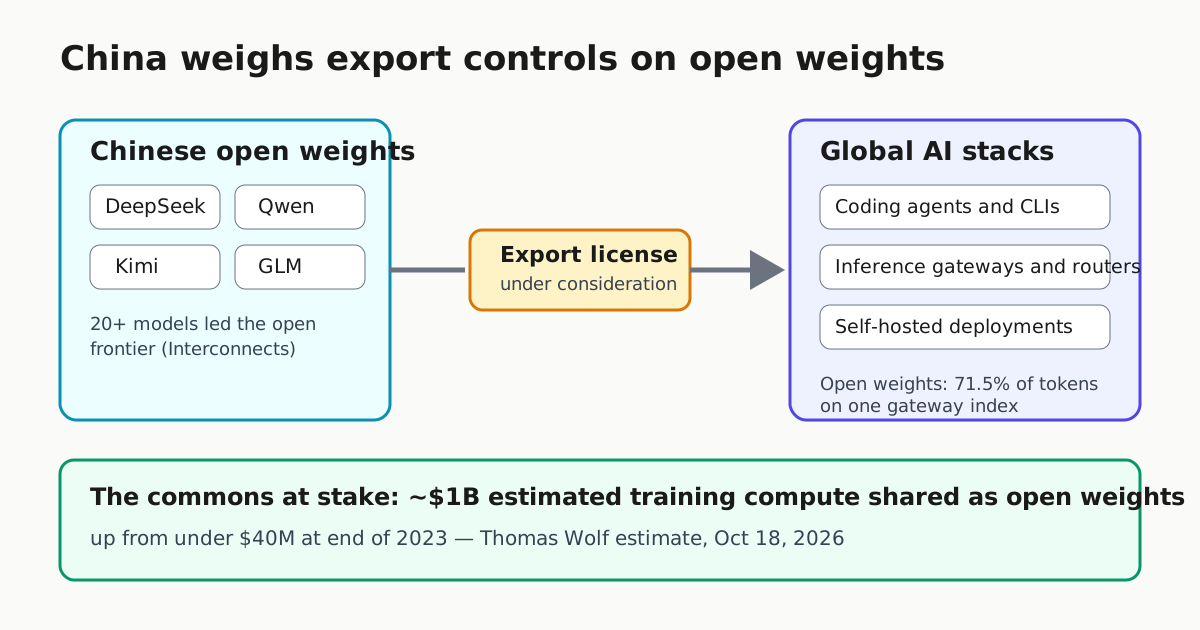
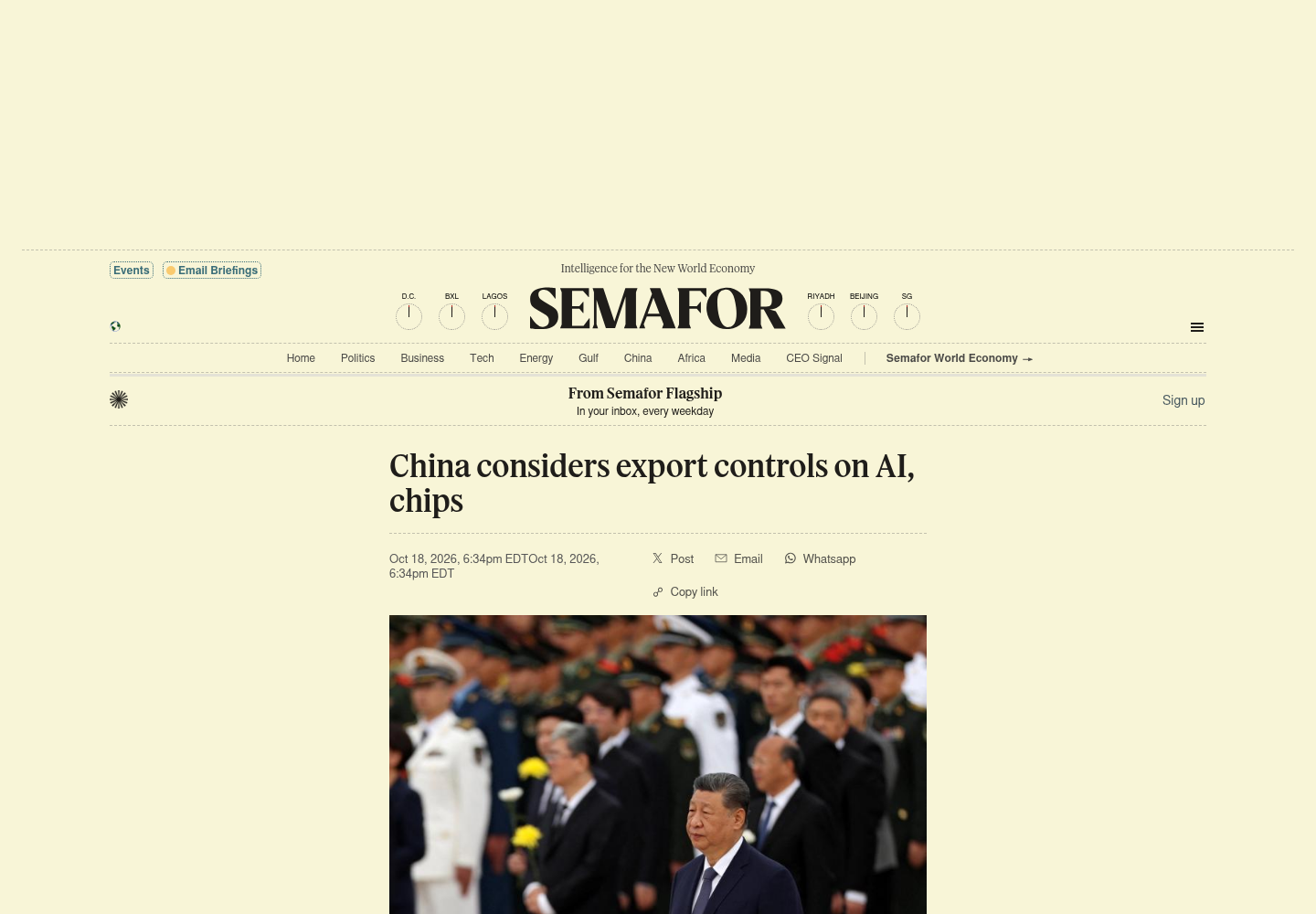
China is considering export controls that could check the global spread of its AI models and chips, as Beijing increases oversight of its tech sector, Semafor reported on Oct 18. The report is thin on mechanics — it says rules are under consideration, quotes a former Biden administration adviser saying they “could shape the evolution of the Chinese AI ecosystem,” and notes open questions about compliance and whether they would give Beijing leverage without actually slowing global adoption. But the timing matters, because the assets these rules would touch have never been larger or more embedded in operator infrastructure.
What is at stake, quantified
The same week, Hugging Face co-founder Thomas Wolf published what he self-describes as “fun and crazy napkin math”: Meta, NVIDIA, Alibaba, DeepSeek, Moonshot, Mistral and roughly 30 other labs have shared close to $1 billion worth of training compute as freely downloadable open weights on the Hugging Face Hub — up from under $40 million at the end of 2023 (Wolf’s post on X). He frames it as a new commons: “Wikipedia was written in volunteer hours. This AI age commons is written in GPU-hours and data.” Wolf explicitly calls the figure a floor — about half comes from official compute disclosures, the rest is estimation, and it excludes roughly 900,000 community fine-tunes.
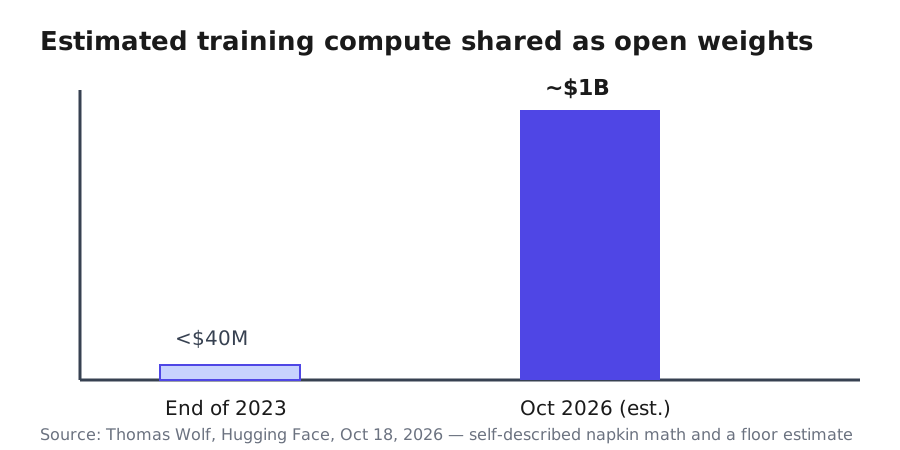
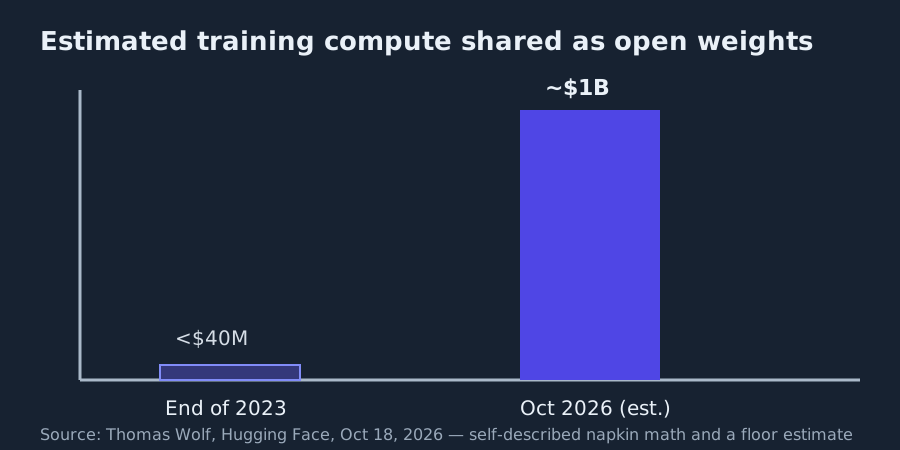
That estimated 25x growth since end of 2023 — in just under three years — is the economic backdrop for any export-licensing regime. If licensing attaches to the largest Chinese model weights, a material fraction of that commons becomes subject to a permit.
Why the Chinese share is disproportionate
The competitive context comes from Nathan Lambert’s Oct 17 Interconnects analysis of Meta’s Muse Spark Open release. His key datapoint: without Meta’s Muse Spark Open and Reflection’s Beam, there would be 20+ open-weight models from Chinese companies better than the best Western open models. With them, the gap between the best American and Chinese open models has been cut roughly in half — from “largely irrelevant” to “behind but relevant.”
In other words: China’s labs currently supply the majority of the top tier of that ~$1B commons. DeepSeek, Qwen (Alibaba), Kimi (Moonshot) and GLM (Zhipu) releases have paced the open-weight frontier for much of the past year, which is why cost-conscious routing tiers in coding agents and gateways lean on them heavily — a pattern we’ve covered in Chinese AI Models for Agent Work and the open-weight scorecard. Aggregate demand points the same direction: our coverage of one major gateway’s October index recorded open-weight models crossing 71.5% of routed tokens on that index.
| Question | Status |
|---|---|
| Are China’s export controls enacted? | No — reportedly under consideration (Semafor) |
| Which models would be affected? | Unspecified; reporting refers to China’s AI models and chips |
| Value of shared open weights (est.) | ~$1B training compute, up from <$40M end-2023 (Wolf estimate) |
| Top-tier open-weight supply | 20+ Chinese models ahead of best Western ones before this week (Interconnects) |
The operator lens
Three practical reads for anyone routing agent traffic through open-weight models:
-
Announcement vs. availability. Nothing has changed yet. Existing downloaded weights, mirrors and hosted endpoints are unaffected until rules are actually drafted and enforced — and Semafor’s own sourcing flags compliance as an open question.
-
Concentration risk is the real story. Whether the trigger is Chinese licensing, US reciprocal controls (Semafor reports the conservative group Humans First is pushing an “America First AI Policy” including US export controls), or a license dispute, fleets that default to one or two Chinese open-weight models carry a single-jurisdiction dependency. The provider-cutoff rehearsal is the right drill: know which lanes would break, and which Western or hosted alternatives could take the traffic.
-
Licenses already constrain openness. As Interconnects details with Muse Spark Open, today’s leading open weights carry revenue-gating clauses, acceptable-use policies and attribution requirements whose legal force is untested. Export licensing would add a state-enforced layer on top of an already-fragmented contractual landscape — one more attribute to track per model in a routing table.
Bottom line
A considered-but-not-enacted Chinese export-control regime meets an open-weight commons that an industry insider estimates at nearly $1B in donated compute, with Chinese labs supplying much of its top tier. Nothing is restricted today. But the episode is a useful prompt to measure how much of your agent stack depends on weights whose availability now has a clear political dependency chain — and to price the Western alternatives, which only this week became genuinely competitive again.
Sources
- China considers export controls on AI, chips | Semafor
- Thomas Wolf on X: "Fun and crazy napkin math: Meta, NVIDIA, Alibaba, DeepSeek, Moonshot, Mistral and ~30 other labs have shared close to $1B worth of training compute on the Hugging Face Hub Free to download End of 2023 it was under $40M Wikipedia was written in volunteer hours. This AI age comm…
- Meta shakes up the frontiers, open and closed