Mirendil Raises $1B Series A to Turn Model R&D Into an Agent Fleet Job
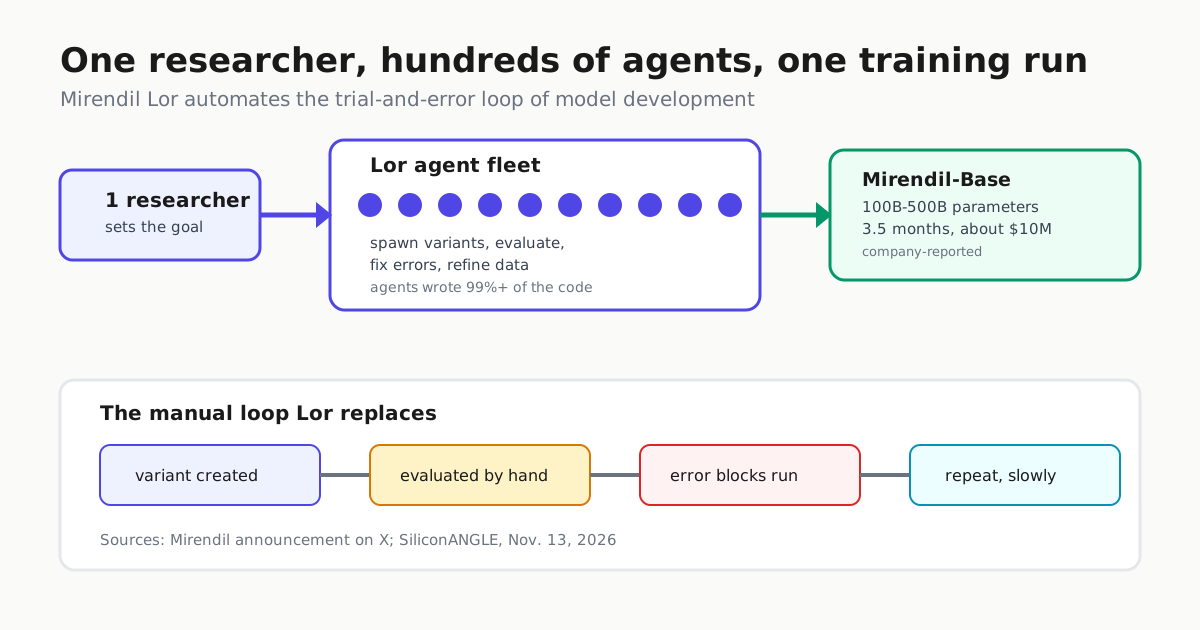
Mirendil raised a $1B Series A to scale Lor, a platform where hundreds of AI agents run the trial-and-error loop of model development. A single researcher already used it to pretrain a 100B+ parameter model in 3.5 months for $10M.
Mirendil, a startup building software that automates AI model development with fleets of agents, has raised a $1 billion Series A led by Kleiner Perkins and Clearlake Capital, with Google and more than half a dozen other investors joining. The company announced the round on X, and Crunchbase News ranked it the largest U.S. funding round of the week of Nov. 7-13, 2026 — ahead of Mercor’s $750M Series D. For teams that already run coding agents, the round is a signal about where agent workloads are heading: from writing application code toward running the R&D loop itself.
What Lor actually does
Mirendil’s first product, Lor, automates the most labor-intensive part of building a model: the trial-and-error loop. As SiliconANGLE reports, LLM development requires researchers to create many variants of a training setup that differ in small ways, evaluate them, and keep the winners. Lor splits that work among hundreds of AI agents. When an error appears during evaluation, the platform fixes it automatically rather than paging a human.
That description will sound familiar to anyone operating an autonomous fix loop in CI — the same pattern Qwen Code shipped with its three-pushes-then-a-human budget, and the same failure mode (agents thrashing on an unfixable error) that our agent evaluation guides cover. Lor is that loop, pointed at pretraining experiments instead of pull requests.
The claimed proof point
The company’s central claim is that its automation shrinks the team size needed for frontier-scale work. Earlier this year, Mirendil says it asked one researcher to build a coding model competitive with leading open-source LLMs — work normally done by a team of specialists. The result, Mirendil-Base, was completed in about 3.5 months for roughly $10 million. The company’s agents wrote more than 99% of the model’s code, set up infrastructure, selected a training algorithm, collected training data from the web, and refined both the dataset and the architecture.
Mirendil-Base sits between 100 billion and 500 billion parameters, and it underpins Fern, the specialized coding model Mirendil unveiled in October that the company says processes 10 million input tokens per prompt — about 500,000 lines of code in one request. Late last month Mirendil previewed upgraded base models in the 500-billion to 10-trillion-parameter range. These figures are company-reported; there is no independent verification of the cost or the 99% figure.
Why the money matters more than the model
A $1B Series A is a bet that “agent-assisted R&D” becomes a product category. The investors are effectively pricing the scenario in which a small team plus an agent platform can produce competitive models at a fraction of lab budgets — which would reshape compute purchasing, hiring plans, and tooling expectations across the AI ecosystem. It also deepens the bench of well-funded companies building on top of frontier-model APIs, the same layer where operators already juggle multi-provider cost and failover tradeoffs.
Mirendil was founded in 2025 by CEO Behnam Neyshabur and CTO Harsh Mehta, both formerly of Google DeepMind and Anthropic. Neyshabur is a co-inventor of SAM, a well-known algorithm for improving model generalization beyond its training distribution; Mehta worked on pretraining at both labs.
What to watch
For operators, two questions determine whether this matters to you. First, does the single-researcher result replicate outside the company’s own stack? Mirendil-Base’s claims are the vendor’s own, and the open-weight leaderboard already has crowded competition, as our open-weight scorecard tracks. Second, does Lor become available as a product teams can point at their own training runs — the announcement describes the platform but the round is about scaling the company, not a launch.
If agentic R&D does get cheaper and smaller, the practical consequences reach beyond AI labs: the same trial-and-error automation pattern applies to any expensive evaluation loop — hyperparameter search, regression triage, infrastructure tuning. The $1B is the market saying it expects that pattern to generalize.
Facts: the $1B round, lead investors, founding team, Lor’s agent-based automation, and the Mirendil-Base project details (3.5 months, ~$10M, 99%+ agent-written code, 100B-500B parameters) all come from Mirendil’s announcement and SiliconANGLE’s Nov. 13, 2026 reporting; the weekly ranking is from Crunchbase News.
Sources
- Mirendil on X: "Today we're announcing our $1B Series A, led by @kleinerperkins and @clearlake. We believe making frontier AI R&D more accessible is the most direct path to AI that solves humanity's most pressing problems across science and technology." / X
- Mirendil raises $1B in funding to speed up AI model development - SiliconANGLE
- The Week’s 10 Biggest Funding Rounds: Agentic AI And Infrastructure Are Still On A Roll