 Automater
From Dashboard Theater to Pre-Action Gates: Where AI Agent Security Gates Belong
AI agent security gates should act before each tool call: approve, prune, broker, revoke, and record. Use the matrix, vendor questions, and Tuesday drill.

Go deeper. Build your own.
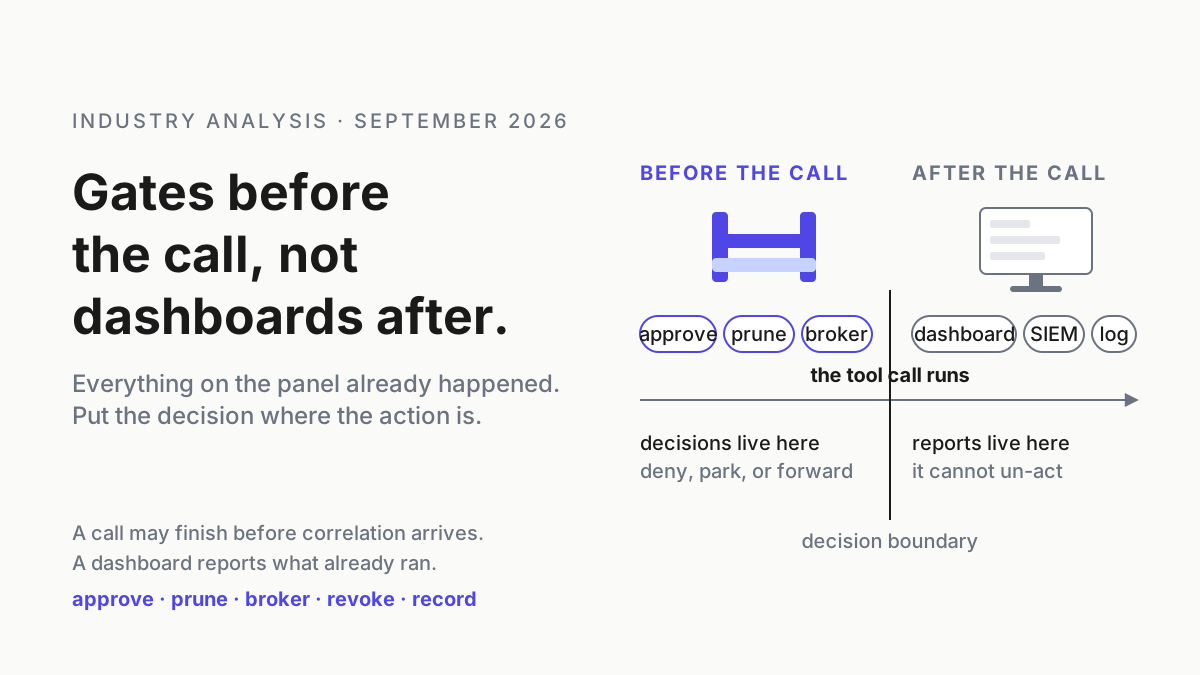
Everything on a security dashboard has already happened. The tool call ran, the branch exists, the file left the laptop; the panel is a well-lit photograph of the moment you lost. For chatbots that was fine, because the worst thing on the panel was a paragraph. For agents it is the incident itself, which is why the AI agent security gates worth paying for act before the call: approve it, prune the tool, broker the credential, or deny it with a reason. The dashboard reads the evidence afterward. It does not get a vote.
This is a stance piece with a runbook inside it. The stance: demand pre-action gates from every layer you buy or build, and grade SIEM and observability as consumers of the gate’s evidence, never as the control. The runbook: five gates and the artifact that proves each, a matrix of where each can live, six questions that expose a dashboard in a gate costume, and a Tuesday drill that converts one panel into one gate.
A control that fires before the action can change the outcome. One that pages afterward can only change the response.
The line worth keeping from an August 3 vendor post
On August 3, 2026, Nightfall published “Best AI Agent Security & MCP Security Platforms for MCP Access Control in 2026” (nightfall.ai/blog/mcp-access-control), a vendor comparison that ranks Nightfall first. Its useful line is “visibility without control is just a dashboard.” The surrounding section distinguishes observing data movement from runtime actions such as blocking, coaching, overriding, and routing a call through an approval workflow.
 Screenshot: Nightfall blog, “Best AI Agent Security & MCP Security Platforms for MCP Access Control in 2026” (Aug 3, 2026), captured Sep 13, 2026.
The same post says its endpoint coverage uses IDE hooks for Cursor, Claude Code, and VS Code on macOS and Windows, including local stdio servers and files an agent touches. Its product page describes a separate proxy path that evaluates, logs, and forwards approved MCP calls (nightfall.ai/products/mcp-security). Whether to buy that proxy or build the checks is its own decision. This piece takes the sentence and builds the stance it implies.
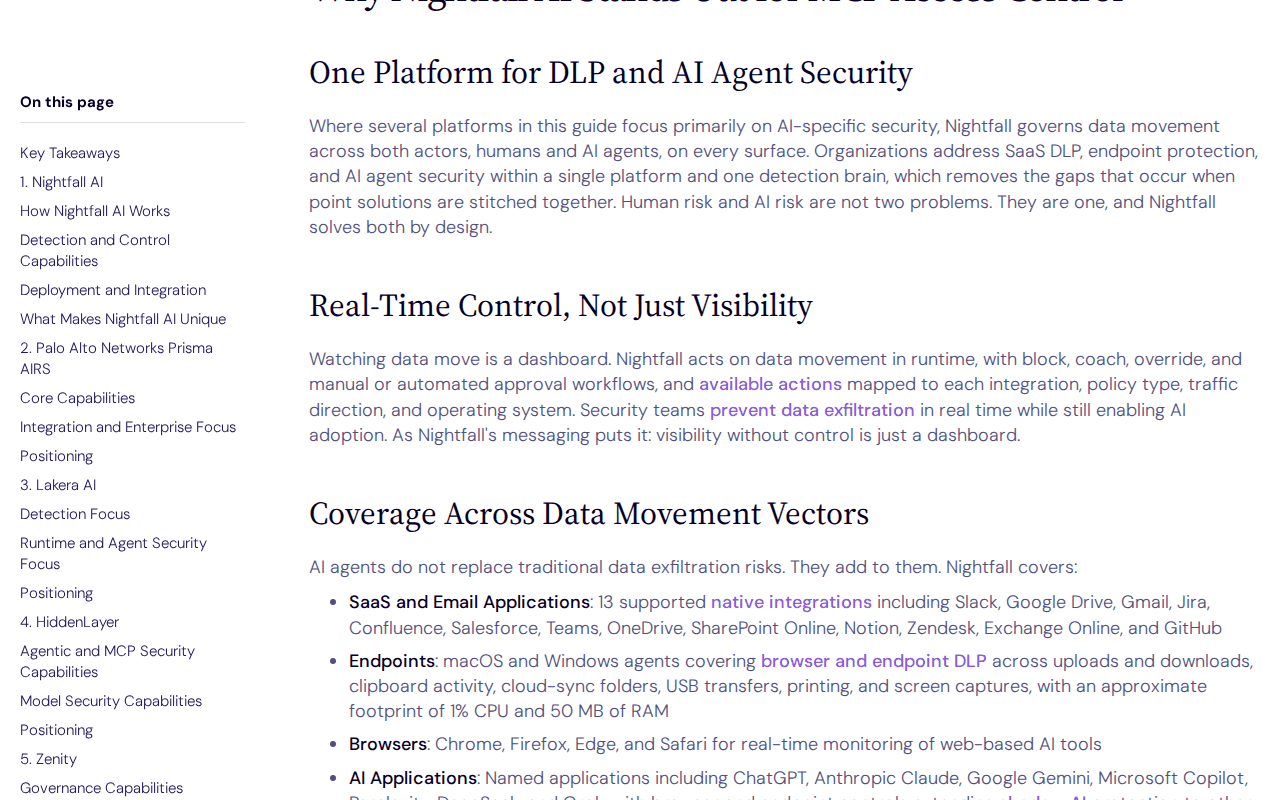 Screenshot: Nightfall blog, “Real-Time Control, Not Just Visibility” passage (Aug 3, 2026), captured Sep 13, 2026.
Three months earlier the same company had announced the visibility half.
Why “after” became the wrong tense for agent security
TeamCopilot’s July explainer put the category shift in six words: “A chatbot can suggest. An agent can act.” (teamcopilot.ai). A call can complete before after-the-fact correlation reaches a human, and a weekly review lands later still. Every control that lives to the right of the call is measured on the response timeline rather than the decision timeline.
This summer supplied the exhibits. Pillar Security’s Deadbugz investigation found an MCP server that behaved normally for three tools/call requests, then returned altered metadata on later tools/list and prompts/get requests that directed an agent toward sensitive files and credentials (Pillar Security). A dashboard records the changed behavior after it reaches the client; the runtime controls that could stop the next action are the subject of the approve-once piece.
At Black Hat on August 5–6, Novee showed a Gemini CLI chain rated CVSS 10.0 in which a child process read the parent’s secrets out of /proc/$PPID/environ (Novee); Gemini CLI itself was discontinued on June 18, 2026, and the pattern is what survives. A sandbox badge, it turns out, is also a dashboard: a green light about a boundary that was not there, and the sandbox piece draws the operator conclusions. On September 1, Manifold Security’s GitSpawn showed seven coding agents running attacker-named programs from a repo’s .git/config before any trust prompt fired (Manifold Security). That one is the sharpest: a gate that fires at the tool call is still too late if the harness acts at folder open.
So “before the call” has to include the harness’s own startup actions. Keep that in mind when a vendor draws the gate around the network.
The five AI agent security gates to demand, with the artifact that proves each
The six gateway checks and their pass lines live in the control-plane runbook; which layers to buy and which to keep portable lives in open gateway vs vendor suite. This section is narrower: for each gate, what “pre-action” has to mean, and the artifact you ask for.
Gate 1: approve per call, with a named approver and an expiry
Approval is a decision per call for writes and hard-to-undo actions, taken by a named human, valid for one call inside a time window. A trust flag ticked at install is not a gate; a consent dialog that says “always allow” is a dashboard about your past self.
# gates.yaml — illustrative; evaluated on every tools/call by whatever sits in the path
- match: github-mcp/create_pull_request
  class: write
  require:
    approvals: 1
    approver_group: repo-owners
    ttl_minutes: 30
    pending_response: 'parked; approval pending' # a state the agent can see, not a timeout
- match: '*/delete_*'
  class: hard_to_undo
  deny_outside_window: change-window
Artifact: one parked or denied call, as a log line, with the policy that decided it.
Gate 2: prune the tool list before the model sees it
A model cannot call a tool it was never shown. Pruning removes tools from the list at the boundary: allow the server, drop the dangerous verbs. Nightfall’s page gives the example “allow GitHub but block create_branch.” Claude Code documents deny rules that use a tool’s canonical name in settings.json; copy the exact MCP tool name from /permissions before writing the rule (code.claude.com).
{ "permissions": { "deny": ["mcp__github__create_branch"] } }Illustrative shape. Artifact: the tools/list the model received, diffed against the server’s, with the removed entries named.
Gate 3: broker the credential at call time
In this proposed gateway pattern, the agent presents a short-lived identity token to the gate. At call time the gate fetches a credential scoped to that tool and injects it on the outbound request; the agent does not receive the credential. This is an architecture requirement to test, not a capability attributed to any vendor cited here, so ask for a demonstration in those words.
Artifact: a tool call that succeeded while the agent’s environment held no secret for that tool.
Gate 4: revoke in seconds, at the gate, not at the laptop
Revoke is a drill with a stopwatch: pull one identity and time the first denied call. If revocation means reaching every laptop, it is a project, not a gate. Artifact: a number in seconds, on a calendar, re-measured monthly.
Gate 5: evidence written by the gate, readable without the console
The dashboard’s proper job is reading this. The gate writes one line per decision, denials included, and the line carries the identity, the policy version, the decision, and the approver. An illustrative evidence shape:
{
  "ts": "2026-09-08T09:41:07Z",
  "agent": "spiffe://corp/agents/release-bot",
  "tool": "github-mcp/create_branch",
  "decision": "deny",
  "policy_ref": "gates@v12",
  "reason": "pruned",
  "upstream": "github-mcp",
  "latency_ms": 3
}
Artifact: that line as a file on your disk. The desk-side twin, a session you can replay from your own transcript, is what tells you what the agent was doing when the gate said no.
Where each gate can live, and where a dashboard cannot
Five gates, five places a control can live. The matrix is an operator model, labeled illustrative, and it is built to be argued with.
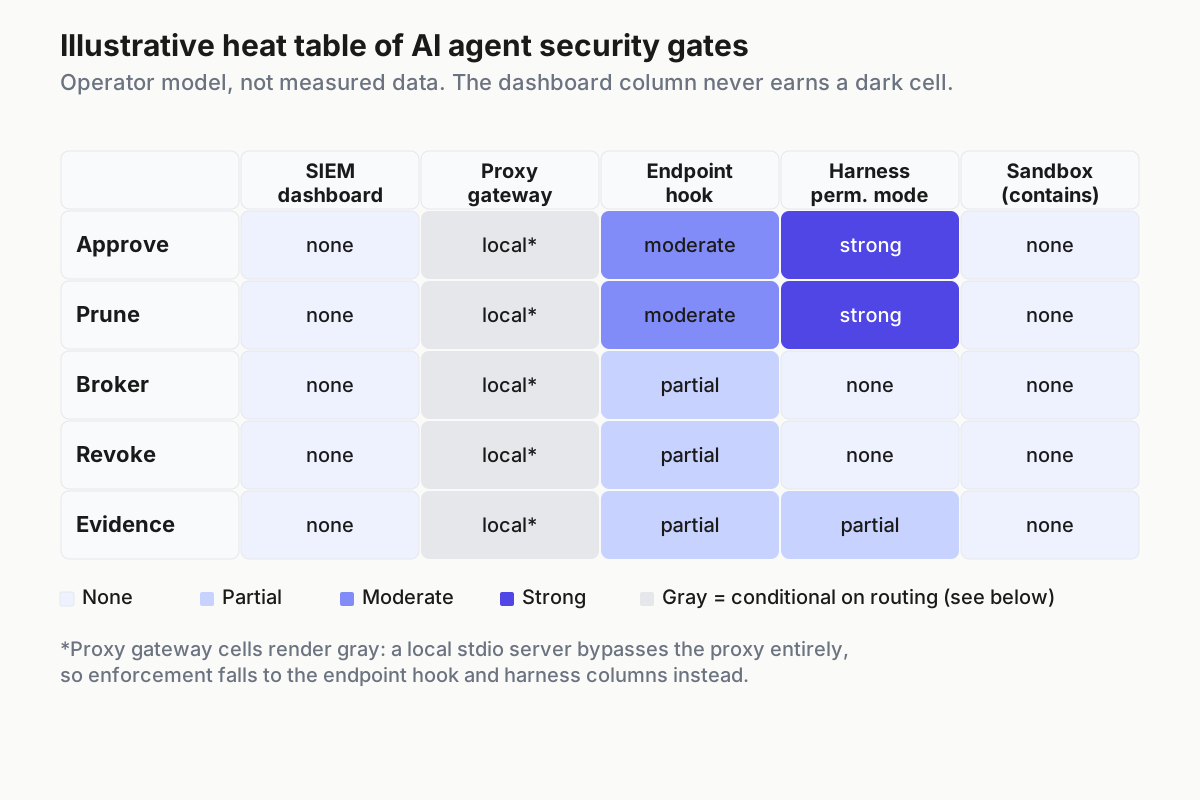 Illustrative. The dashboard column never earns a dark cell; the proxy column goes gray the moment the server is local.
Three readings. The SIEM column is uniformly after-the-fact, and that is the column’s job rather than a flaw. The proxy column is the strongest, and it applies only to traffic routed through it: a stdio server, which the client spawns as a child process under the protocol’s stdio transport (modelcontextprotocol.io), drops to the endpoint and harness columns, which is why shadow MCP is an inventory problem before it is a gateway problem. The sandbox column is containment: it limits what an allowed call can reach, and it decides nothing.
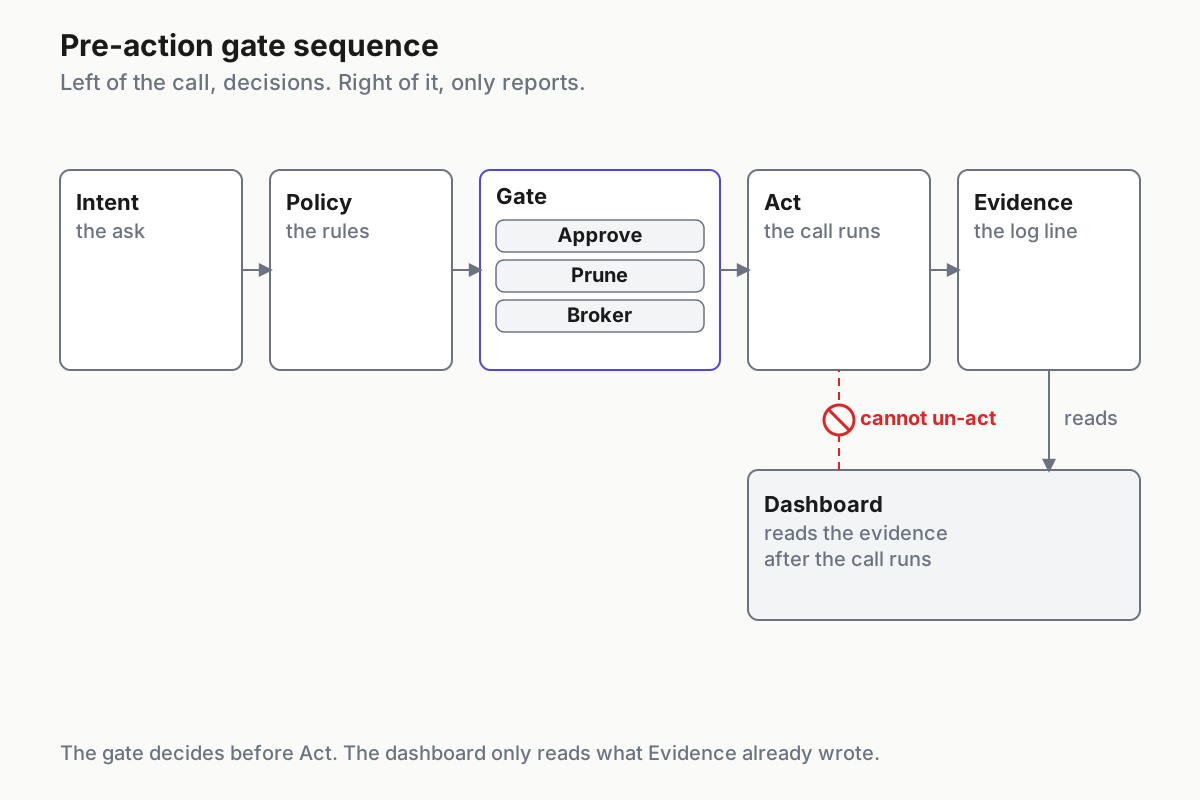 The sequence every purchase should be able to draw. If the vendor’s picture starts at “evidence,” you are buying a dashboard.
Six questions that separate AI agent security gates from dashboards in costume
Ask them in this order, of every vendor and of your own platform team.
- “Show me a call that was stopped before it ran. Not the alert; the denial, with the policy that decided it.”
- “Which tools can you remove from the list the model sees, per server, per role, before the session starts?”
- “Where is the credential at call time, and can the agent print it?”
- “Time from revoke to first denied call, measured in your product, not estimated.”
- “Give me the evidence line for one decision as a file on my disk, and name the fields that exist only in your console.”
- “What does your product do about a stdio server the client spawned five minutes ago, and about a git hook that ran at folder open?”
Question one sorts the room. A product built around a gate answers with a log line. A product built around a dashboard answers with a screenshot.
The Tuesday drill: convert one panel into one gate
Pick the dashboard panel you look at most and replace it with the gate that makes it boring. The table is the conversion; the drill is one row a week.
| Dashboard panel today | The gate that replaces it | The signal that it worked |
|---|---|---|
| Tool calls by server | default-deny list with tool-level prune | an unknown server shows as a 403 with a policy_ref, not as a new bar |
| New MCP servers discovered | quarantine hold until signed, fed by the weekly inventory | discovery keeps counting; calls from unsigned servers stay at zero |
| Secrets found in transcripts | broker plus redaction before the model sees the text | the DLP hit rate falls because there is nothing left to find |
| Failed tool calls | a pending_approval state with an approver |
“pending” appears as a state, not as an error the agent retries |
| Alerts per day | the revoke drill | a number in seconds, on a calendar |
The drill itself, for row one:
- Export yesterday’s “tool calls by server” panel as a table.
- For the top write-class tool on it, write the gate 1 rule and load it into whatever sits in the path.
- Send a canary call from a read-only identity.
- Watch the panel. Pass: the call appears as a denial with a policy reference. Fail: it appears as a completed call, or not at all, in which case the path around your gate is the thing you found.
Ten weeks of that and the dashboard is a record of denials, which is the only kind of dashboard worth keeping.
What breaks, and how you’ll know
Approval fatigue turns the gate back into a dashboard. A gate a human rubber-stamps in two seconds is an after-the-fact record with extra steps. Signals: median approve latency under three seconds; approvals granted outside working hours by the same person; an approve-without-read rate you have never measured. The fix is tiering, batching, and expiry, the subject of human-in-the-loop queues that do not become rubber stamps.
The gate becomes the bottleneck, and the bypass becomes the incident. Signals: exception requests older than a day; developers holding direct provider keys; command entries multiplying in MCP configs because remote servers are gated and local ones are not. When the gate is slow, the fleet builds a path around it, and the path never had a gate.
The gate covers the network and the incident happened on disk. GitSpawn’s whole lesson: the first action was a git operation at folder open, before any policy saw a tool call. Signal: your evidence for an incident starts after the incident’s first action. Fix: intake controls before the harness touches a repo, and endpoint hooks where a proxy cannot reach.
Dashboard theater returns in new clothes. “AI observability” that scores each call after it ran, “agent posture” that grades configs weekly, “runtime detection” that pages a human. Each is useful as a consumer of evidence. Ask question one, and if the answer is a screenshot, budget it as reporting.
Classifier-backed gates ship an error rate. Any gate that decides with a model has false positives and false negatives. Ask for measurements on a representative policy set. False positives teach developers to route around the gate; false negatives are what the dashboard will show you later.
The operating-layer frame: gates are infrastructure, not a smarter prompt
A pre-action gate is operating-layer infrastructure. No system prompt produces a denial with a policy reference, a tool list the model never saw, a credential the agent never held, or a revoke that lands in sixty seconds. Those are properties of the path between the agent and the world, and the organization owns that path whether it buys a proxy, installs an endpoint hook, or writes harness rules by hand.
The desk is the other half. The gate’s line says what the agent asked and what the policy answered; the operator’s own record says what the session was doing at the time, which one stalled, and which local server it launched. Keep both, in formats you can read without a login, and the dashboard becomes what it should have been all along: the place you read evidence that a gate already produced.
FAQ: pre-action gates for AI agents
What is a pre-action gate for AI agents?
A pre-action gate is a control that decides on an agent’s tool call before it executes: it approves the call through a named human, prunes the tool from the list the model sees, brokers a scoped credential at call time, or denies with a reason. It writes evidence of the decision rather than merely observing.
Is a SIEM enough for AI agent security?
No. A SIEM correlates events after they happen, while a tool call may complete before that evidence reaches a human. It belongs in the stack as the reader of gate evidence: denials, approvals, and policy versions. On its own it produces a record of incidents rather than a decision on the pending action.
What does “visibility without control is just a dashboard” mean for MCP?
It means an MCP inventory, a traffic panel, or a risk score changes nothing about what an agent can call next. Control means an allowlist enforced per call, tool-level pruning, per-call approval, and revocation at the boundary. Visibility feeds those controls; it does not replace them.
Sources
- Nightfall — Best AI Agent Security & MCP Security Platforms for MCP Access Control in 2026 (August 3, 2026)
- Nightfall — MCP Security product page
- Nightfall AI — MCP Observability early-preview post (May 2026)
- TeamCopilot — What is an agent gateway (July 8, 2026)
- Pillar Security — Deadbugz: the currently active MCP supply-chain campaign
- Novee — Critical flaws in Anthropic, Google, and OpenAI’s coding agents (Black Hat 2026, August 5–6)
- Manifold Security — AI coding agents git hijack, GitSpawn (September 1, 2026)
- Claude Code docs — Configure permissions
- Model Context Protocol — specification and transports