Datasette's Local-Model Agent Path: Streaming Renderers, SQL-Capable Apps and an Access-Control Fix on the 0.65 Line
Datasette's November 2026 releases add OpenAI-compatible local-model support, a sandboxed SQL app layer, streaming renderers, and an access-control fix for the 0.65 line: what operators can actually do with them.
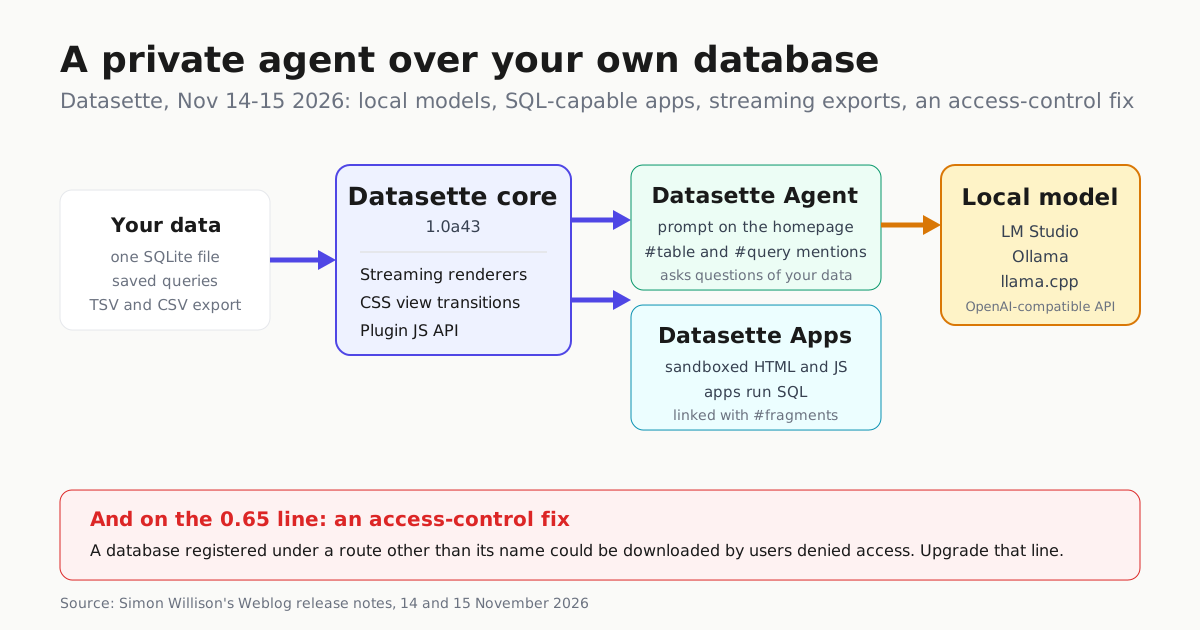
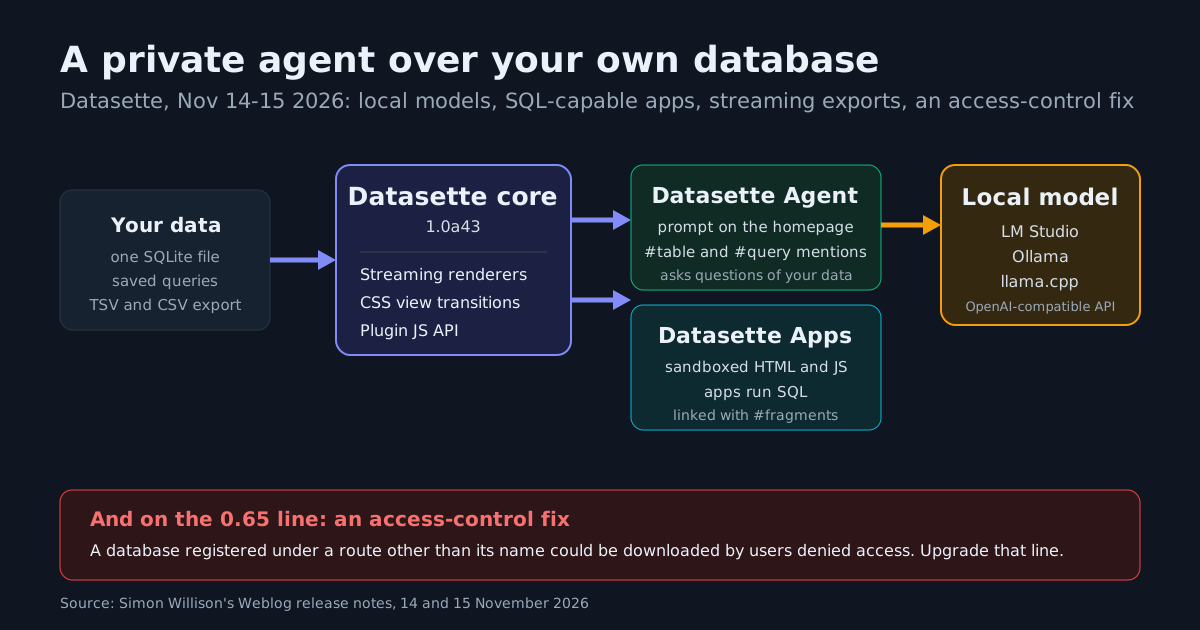
Datasette, Simon Willison’s open-source tool for exploring and publishing SQLite data, shipped seven releases across two days in mid-November 2026. Read one at a time they look like a changelog: a renderer API, a homepage prompt, a sandbox for apps, a geospatial plugin, a compatibility bump. Read together they add up to one thing operators have wanted for a while: a question-answering agent over your own database that can run on a local model, next to apps that query that database with SQL, and one access-control fix that needs attention now.
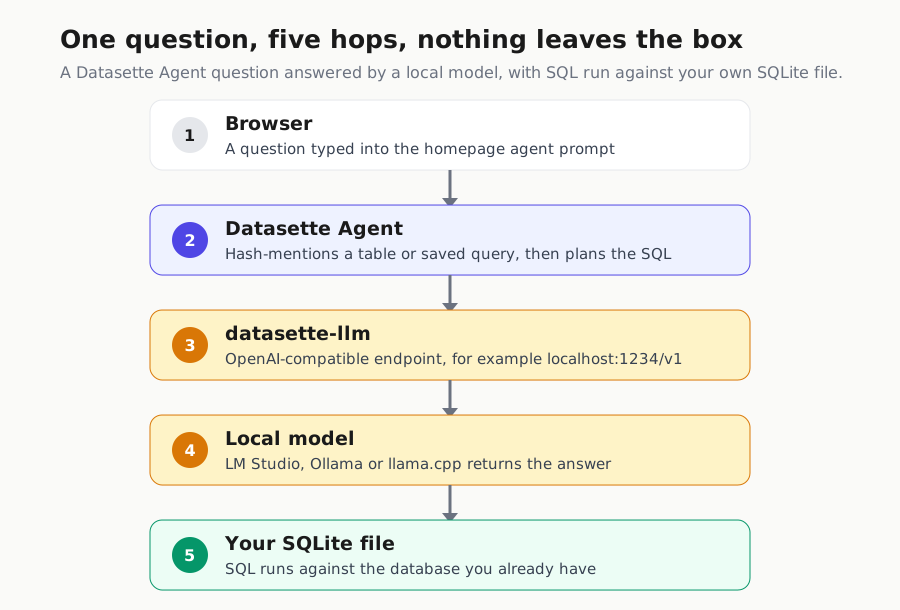
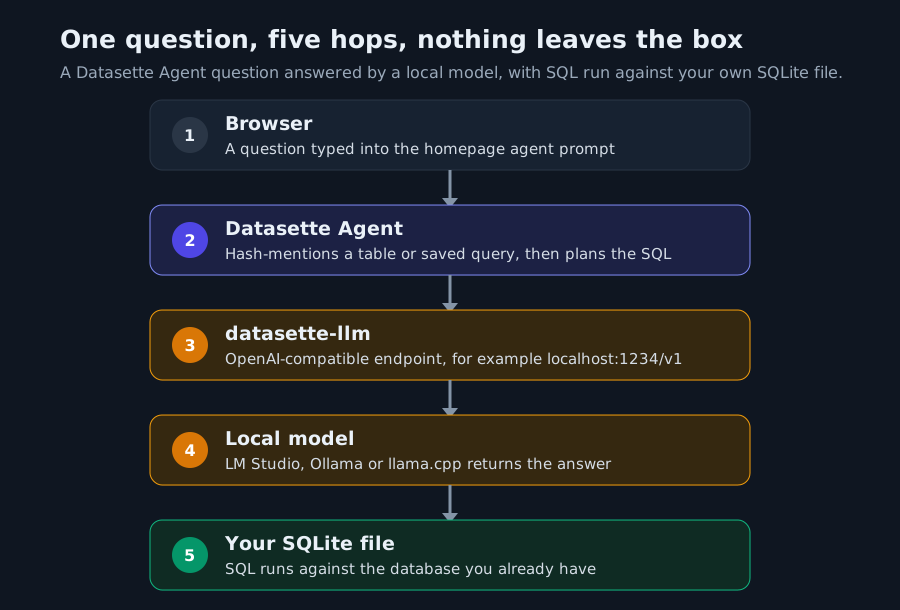
The local-model path is the real headline
The piece that changes the deployment story is datasette-llm 0.1a11. datasette-llm is the intermediate plugin other Datasette plugins use to reach a model, and this release adds support for OpenAI-compatible endpoints, so the model can be hosted anywhere that speaks that pseudo-standard protocol. The maintainer’s worked example points a Datasette Agent instance at a local model server:
wget https://datasette.io/content.db

uvx --with datasette-agent datasette \
  --root --secret 1 \
  -s plugins.datasette-llm.default_model '{
    "model": "lmstudio-qwen",
    "model_name": "qwen/qwen3.8-27b",
    "api_base": "http://localhost:1234/v1"
  }' content.db
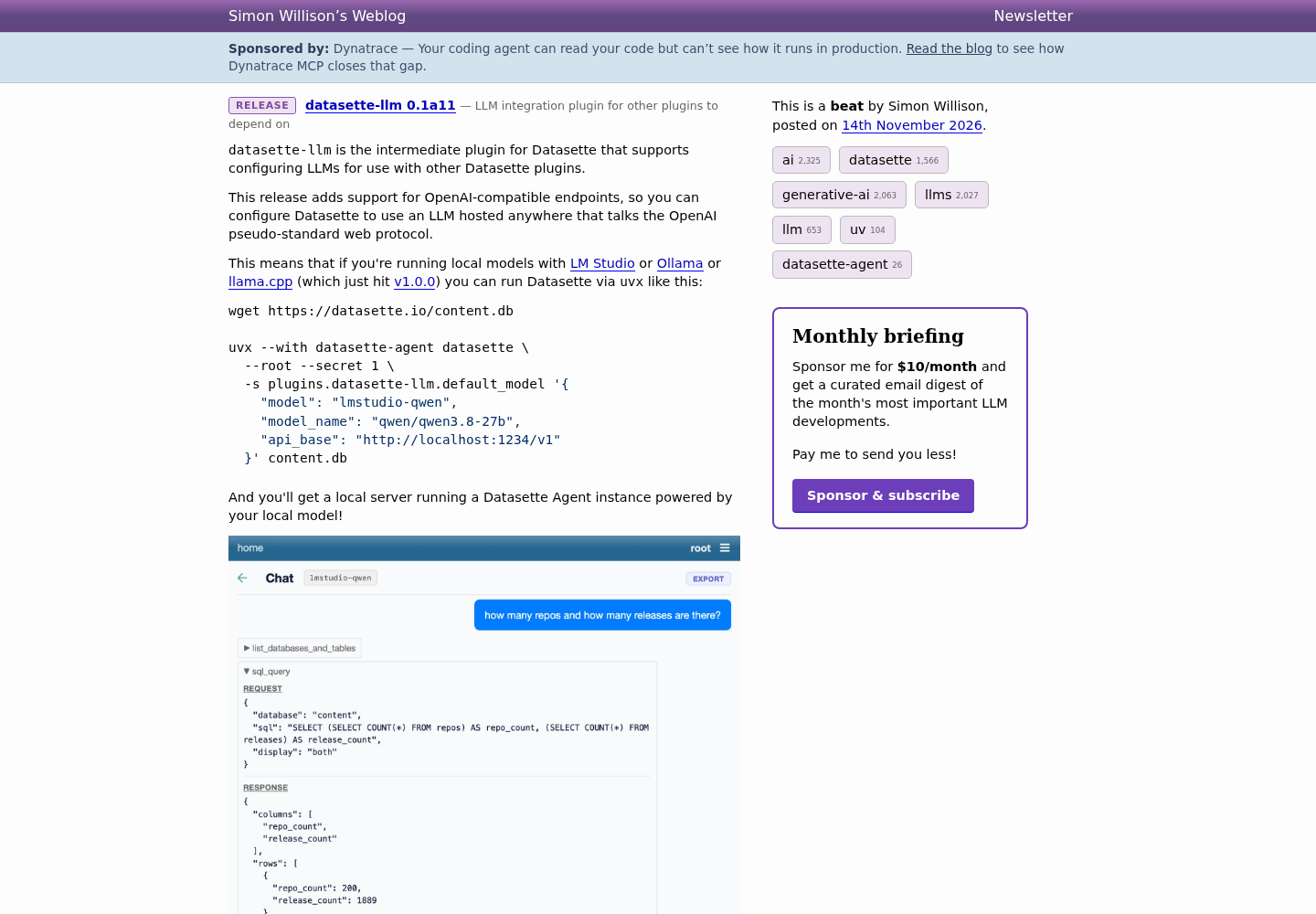
Lower on the same page, an embedded Datasette Agent chat demo answers “how many repos and how many releases are there?” with a sql_query against the database.
Run that and you have a private agent over a local database: rows never leave the machine, prompts never leave the machine, and the model can be LM Studio, Ollama or llama.cpp, which just hit v1.0.0. That is the practical consequence worth naming: the agent over a private dataset no longer needs a vendor key, an account or an egress rule. For teams already running local models, the LM Studio setup guide and the Ollama local-only lane turn the Datasette agent into a local reader instead of a network call.
Two sharp edges in that snippet are yours to fix. --root switches off the per-user permission model entirely, and --secret 1 is a guessable password. Use them on a scratch database, not on the instance holding anything you care about. The plugin adds no access control of its own; it only changes which endpoint answers.
The agent surface and the app layer
datasette-agent 0.6a0 is, by the maintainer’s description, mostly accumulated small fixes. The one that changes a session: Datasette Agent now puts its prompt directly on the Datasette homepage, with support for hash-mentions of tables and queries. You point the agent at the specific table or saved query you mean instead of describing it, which removes a round of “which table did you mean” from every question.
datasette-apps 0.4a0 is the more interesting half of the pair. Datasette Apps are sandboxed HTML and JavaScript applications that live inside Datasette; the maintainer’s comparison is to Claude Artifacts, except these can run SQL queries against your data. Version 0.4a0 adds linking: an app can be linked to with #fragments in the URL and can read those fragments, and the supported URL schemes are reported back to Datasette Agent.
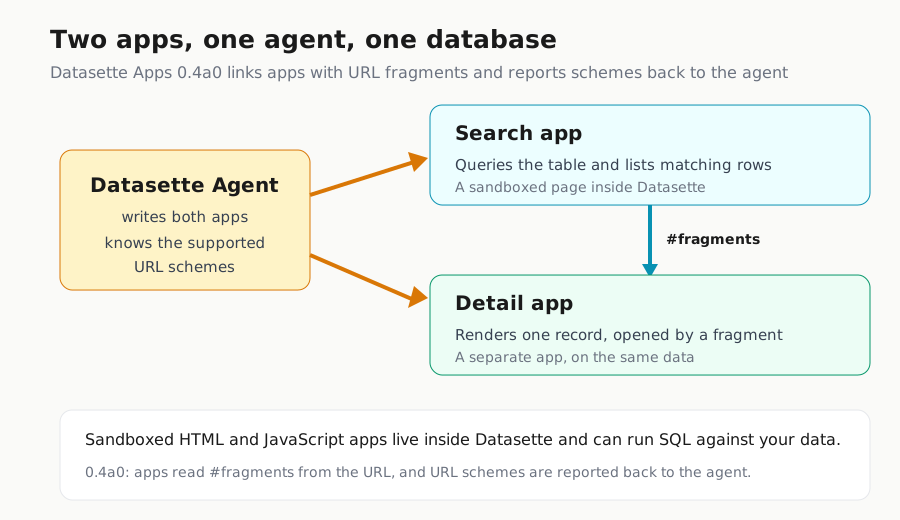
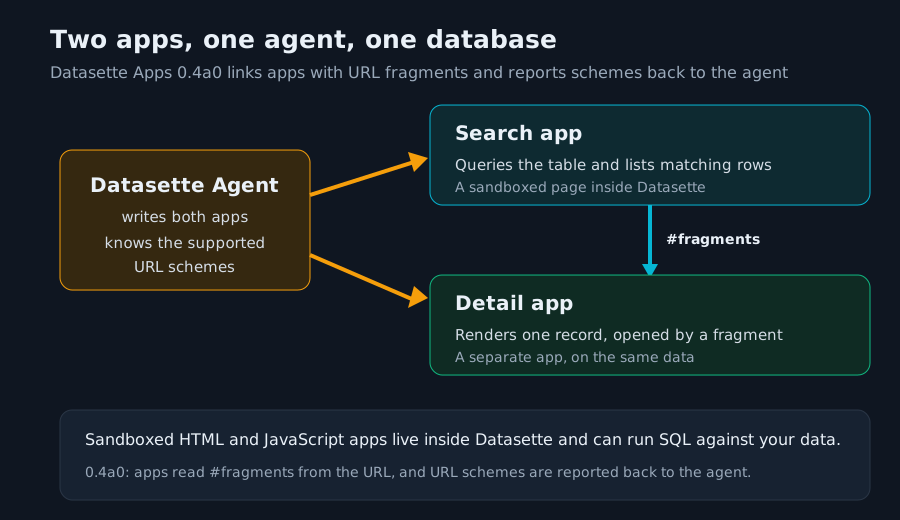
Read that as one capability: a search app can hand a row to a detail app, and the agent knows which URL schemes it may use because Datasette tells it. Apps become a composable layer over the same SQLite file instead of one-off embeds.
The core release: streaming renderers and two security fixes
datasette 1.0a43 carries the biggest 1.0 item so far: streaming support for output renderers. The built-in TSV and CSV export mechanisms now use it, and plugins can register themselves as capable of streaming every row of a table in one go through the new Response.stream() method. For operators exporting large tables, that is a memory-profile change, not a cosmetic one.
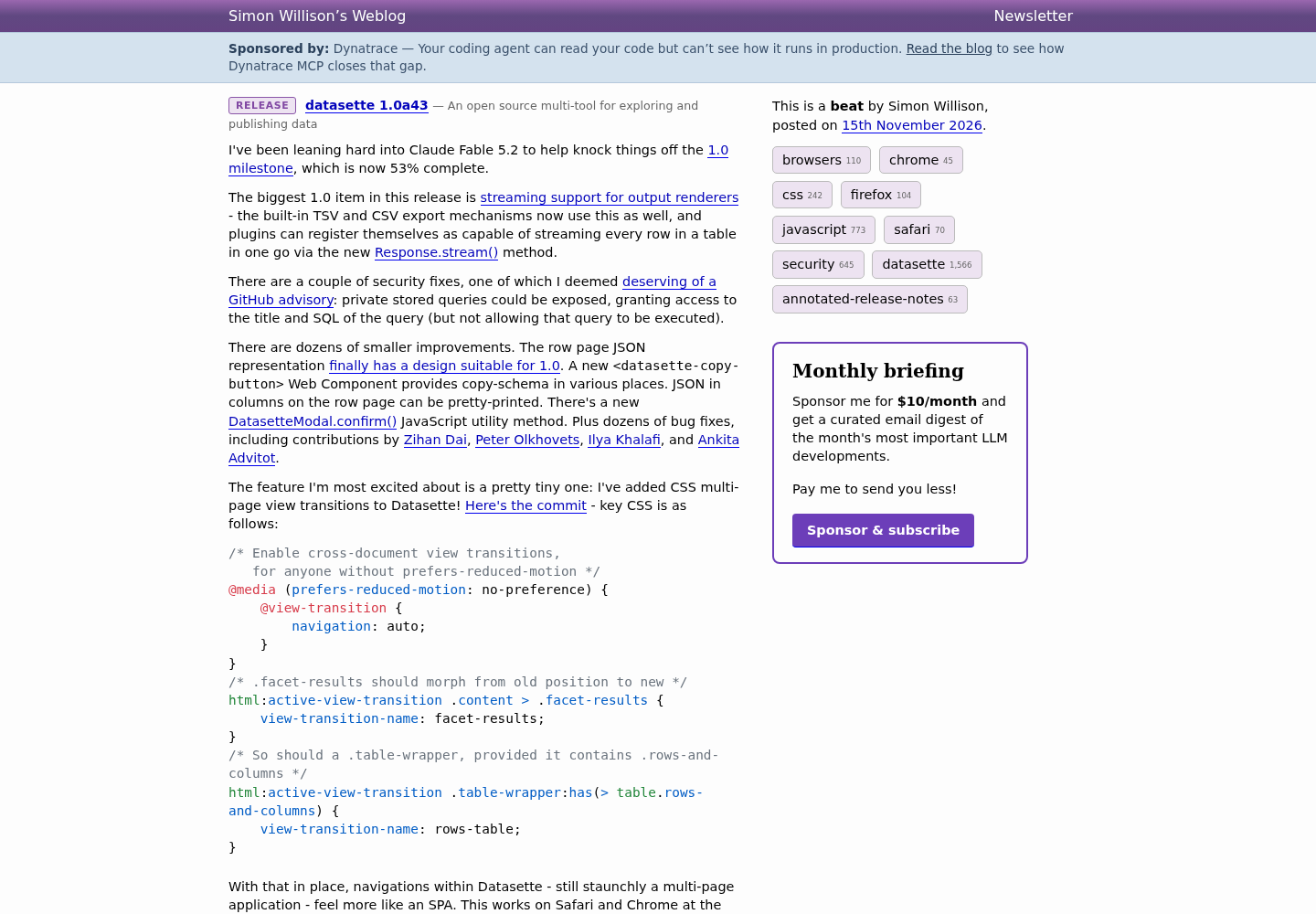
The release also has two security fixes, one of which the maintainer says deserved a GitHub advisory: private stored queries could be exposed, granting access to the title and SQL of the query, though not allowing that query to be executed. The title and SQL of a saved query can still be the sensitive part of a dataset, so treat it as a disclosure issue.
The 0.65 stable line got the backport that matters most for existing deployments. datasette 0.65.6 fixes a case where a database registered with add_database(db, name=..., route=...), using a route that differs from its name, could be downloaded from /<route>.db by users denied access to it. If you register databases under custom routes, a common way to hide internal names behind friendly ones, that is your configuration. Upgrade the 0.65 line.
The ecosystem signal
datasette-maplibre 0.1a0 is the first new Datasette geospatial plugin in years, combining MapLibre GL with the free OpenFreeMap vector server. The maintainer says he built most of it from a single prompt to Claude Fable 5.2, and that asking the model to “be creative and think outside the box” produced his favorite feature: SVG previews of GeoJSON shapes that load a WebGL preview only when they scroll into view. It also runs in Datasette Lite through Pyodide and WebAssembly.
datasette-vega 0.7 is the quieter release with a related theme: a plugin last touched in July 2018, finally compatible with the current alphas and with Datasette Lite, which can now run JavaScript plugins.
What to do on Monday
| Release | What changed | Practical consequence |
|---|---|---|
| datasette-llm 0.1a11 | OpenAI-compatible endpoint support | Run the agent on LM Studio, Ollama or llama.cpp with no vendor key |
| datasette-agent 0.6a0 | Prompt on the homepage, table and query mentions | Fewer clarification round trips, question grounded in one mention |
| datasette-apps 0.4a0 | Fragment linking, URL schemes reported to the agent | Apps that link to each other over the same SQLite file |
| datasette 1.0a43 | Streaming renderers and streaming TSV and CSV export | Lower memory on large exports, plus a plugin streaming API |
| datasette 0.65.6 | Access-control fix for databases under a custom route | Upgrade if you pass a route to add_database() |
So: try the local-model path on a copy of a database, with a real secret and without --root; upgrade the 0.65 line if you register databases under custom routes; treat the agent as a reader you point at a specific table rather than a component to hand a production endpoint.
None of this is finished. The 1.0 milestone is 53% complete, these are alphas, and datasette-agent 0.6a0 is a fix release rather than a redesign. Pin your versions, read the release notes before upgrading an instance other people depend on, and treat the app sandbox as a sandbox. The notable part is not the version numbers. It is that the agent, the apps and the data can now live on one machine, in one process, with the model inside your perimeter.