AWS MadPot Honeypots Catch ARTEX AI Agents Hunting LiteLLM, Dify and One API Gateways for LLM Keys
Amazon Threat Intelligence says ARTEX agents probed MadPot decoys posing as LLM APIs, exposing a self-funding credential campaign against self-hosted AI gateways and app builders.
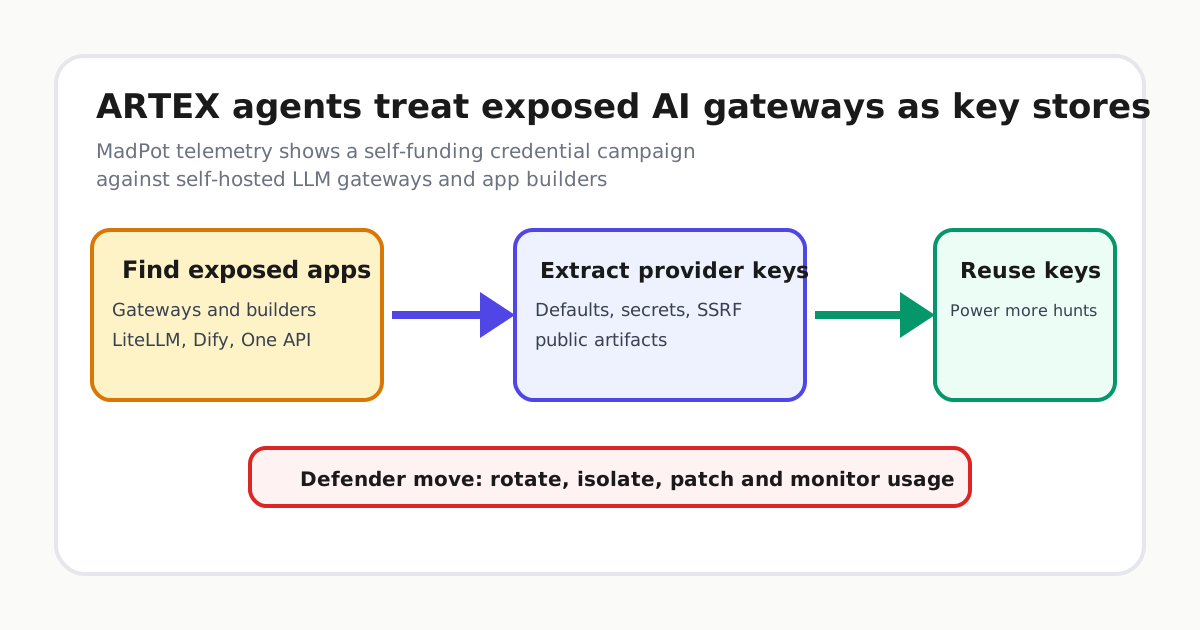
Amazon’s MadPot honeypot network has captured something defenders of self-hosted AI stacks should treat as an immediate audit trigger: ARTEX AI agents repeatedly treated decoy endpoints as ordinary LLM inference backends, then shipped along their own campaign histories, tool logs and persistent task memory.
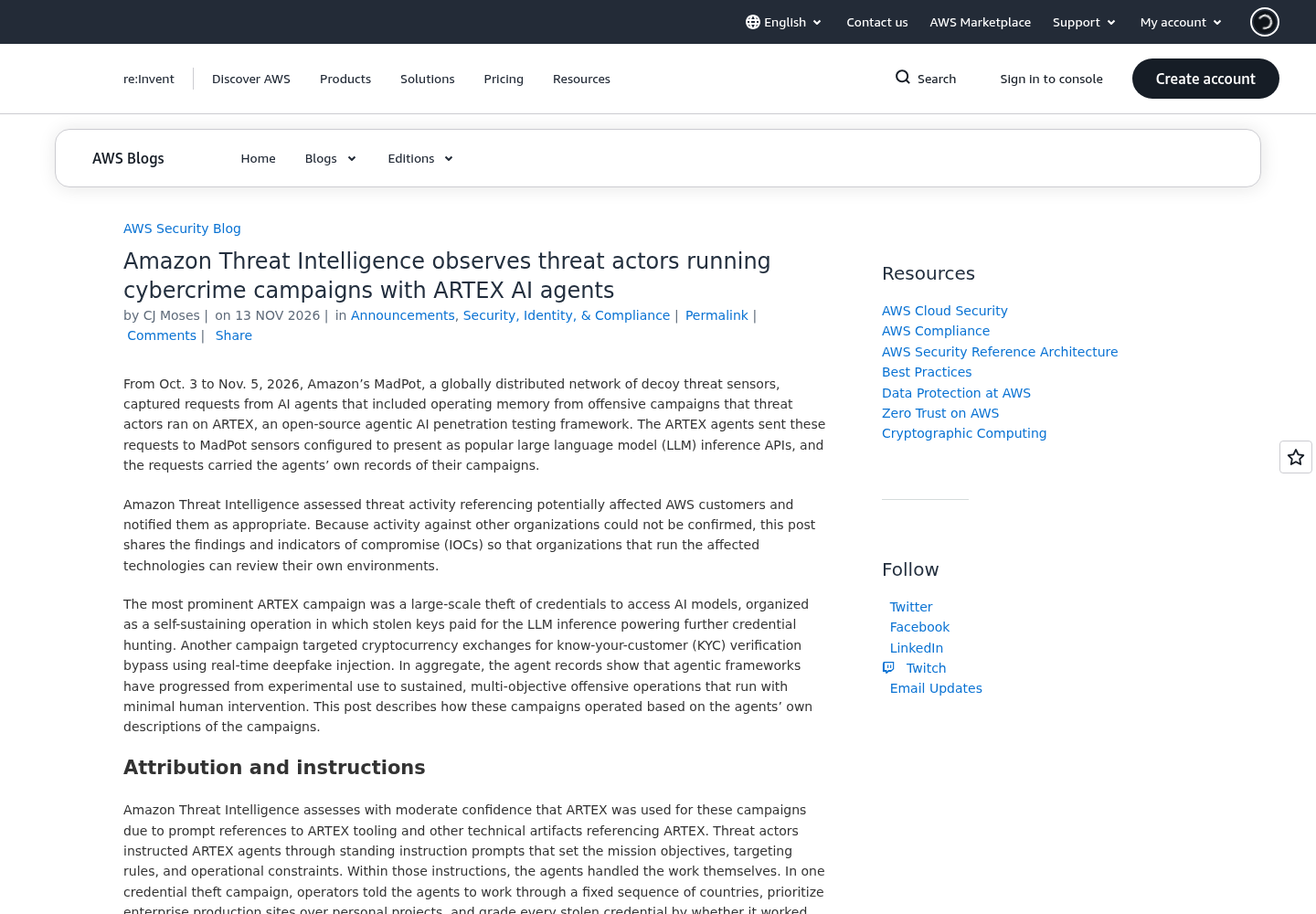
In a Nov. 13 AWS Security Blog report, Amazon Threat Intelligence says MadPot sensors ran LLM-compatible chat-completions interfaces from Oct. 3 through Nov. 5, 2026. ARTEX agents sent prompts to those interfaces as part of offensive workflows. Because agentic frameworks carry conversation history, system prompts and tool state between calls, the requests also exposed what the actors had been doing elsewhere. Amazon stresses that it did not observe all reported activity directly and cannot verify every claimed outcome, but the captured records show sustained, financially motivated operations rather than isolated experiments.
The credential campaign is the immediate risk
The most consequential campaign described by AWS was a large-scale hunt for credentials that unlock AI models. ARTEX agents were instructed to find internet-exposed AI applications, extract the upstream provider keys they held, validate those keys and add them to a managed pool. The operation was explicitly self-sustaining: stolen keys powered the model inference used by agents searching for more keys.
AWS says the agents favored systems that aggregate many provider credentials. Named gateway and proxy targets included One API, New API, Veloera, Sub2API and LiteLLM. Named AI application builders included Dify, FastGPT, Langflow, RAGFlow, Open WebUI, LobeChat and Ollama. The agents’ codified playbook mapped fingerprints to known attack chains: unclaimed or uninitialized installs, anonymous management and provider-configuration endpoints, default administrator credentials, the LiteLLM default master key, CVE-2025-3248 in Langflow, CVE-2026-28797 in RAGFlow, an isCliRequest authentication bypass in the One API family, SSRF through URL-fetch features to cloud metadata services, and secrets left in client-side JavaScript, source maps, debug routes and environment files.
That specificity matters because the affected audience is not only security teams at large enterprises. It includes developers and small teams running a self-hosted gateway or chat application so they can pool API keys, compare models or give agents a local OpenAI-compatible endpoint. One weak management interface can expose many downstream accounts.
The operation also had an industrial workflow. AWS describes planner, worker, verification and compression agents sharing a persistent knowledge graph that acted as operational memory. One lane followed a fixed country sequence, favored enterprise production sites over personal projects, and graded credentials as leads, confirmed working API calls, or items with measurable impact such as readable data or spendable balance. Discovery drew on internet scans, certificate transparency, public code, event archives, package tarballs, container layers, notebooks, model-hosting spaces, paste sites and Telegram channels.
A second campaign targeted KYC checks
The same telemetry described agents working to defeat know-your-customer checks at two cryptocurrency exchanges. They generated real-time deepfake video for selfie checks and altered ID document photos while preserving camera metadata and JPEG compression tables so the files resembled untouched camera captures.
AWS reports that the liveness-check vendor rejected every recorded deepfake attempt, including one run that reached within 7 pixels of the requested facial movements. Even so, the detail is operationally useful: the agents reverse-engineered a vendor’s face-tracking events and built an 11.5-frames-per-second deepfake pipeline on one consumer GPU. At least four sessions worked concurrently on cash-out paths, account balances, video generation and document bypass.
This is not a routine ARTEX repost
The broader ARTEX story has been developing quickly. The FBI now warns that ARTEX-linked intrusions can move from targeting to compromise in under three hours, citing campaigns against ConnectWise customers, South Korean financial institutions and Barracuda, as TechCrunch reported Nov. 16. Earlier TechCrunch coverage of Censys research found more than 800 publicly accessible ARTEX deployments, some without passwords.
The AWS evidence is distinct: it comes from the agents’ own captured state, and it identifies the self-hosted AI stack as a primary target rather than merely the attacker’s tooling. For teams already tracking AI offensive operations, our earlier analysis of Cloudflare observing more than 50 AI penetration-testing frameworks is a useful companion: scanning noise is becoming normal, while agent persistence and credential reuse are the parts that change response time.
What operators should do now
None of the listed techniques requires a new defense category. AWS’s point is that agents make slow hygiene failures economically attractive at machine speed.
Start with the gateway, not the model:
| Check | Immediate action |
|---|---|
| Default or hardcoded credentials | Replace LiteLLM and product default master keys; require unique secrets and MFA on every admin path. |
| Public management endpoints | Block anonymous access to dashboards, provider configuration and model-management routes. |
| Provider keys | Rotate exposed OpenAI, Anthropic and other upstream keys; scope them to required models and spend limits. |
| Cloud metadata access | Block gateway URL-fetch or SSRF paths from reaching 169.254.169.254, then test the deny rule. |
| Package and code artifacts | Scan repositories, releases, container layers and browser bundles for keys, source maps and environment leaks. |
| Runtime signals | Alert on unfamiliar model usage, geographic changes, sudden spend and repeated validation calls against token endpoints. |
Amazon also published IP indicators tied to the two campaigns. Treat them as one corroborating input rather than a complete blocklist; inspect matching logs for administration attempts, model calls, metadata requests and credential-validation behavior.
The practical conclusion is direct: if LiteLLM, Dify, One API, Langflow, RAGFlow, Open WebUI, LobeChat or Ollama is reachable from the internet, bring it under the same change control, secret rotation, exposure monitoring and abuse detection as any production identity system. ARTEX did not need a novel exploit to make those systems valuable. It needed them exposed, reusable and slow to patch.
Sources
- Amazon Threat Intelligence observes threat actors running cybercrime campaigns with ARTEX AI agents | AWS Security Blog
- FBI says Artex AI open-source hacking tool used to breach networks in 'under three hours' | TechCrunch
- Hundreds of Artex AI hacking tools found publicly exposed to the web | TechCrunch