Superset Rebrands to Paradev, Raises $11.5M to Scale Parallel Coding-Agent Fleets
Superset is now Paradev after an $11.5M seed led by Union Square Ventures. See what the parallel-agent IDE does, and the worktree-isolation caveat to know.
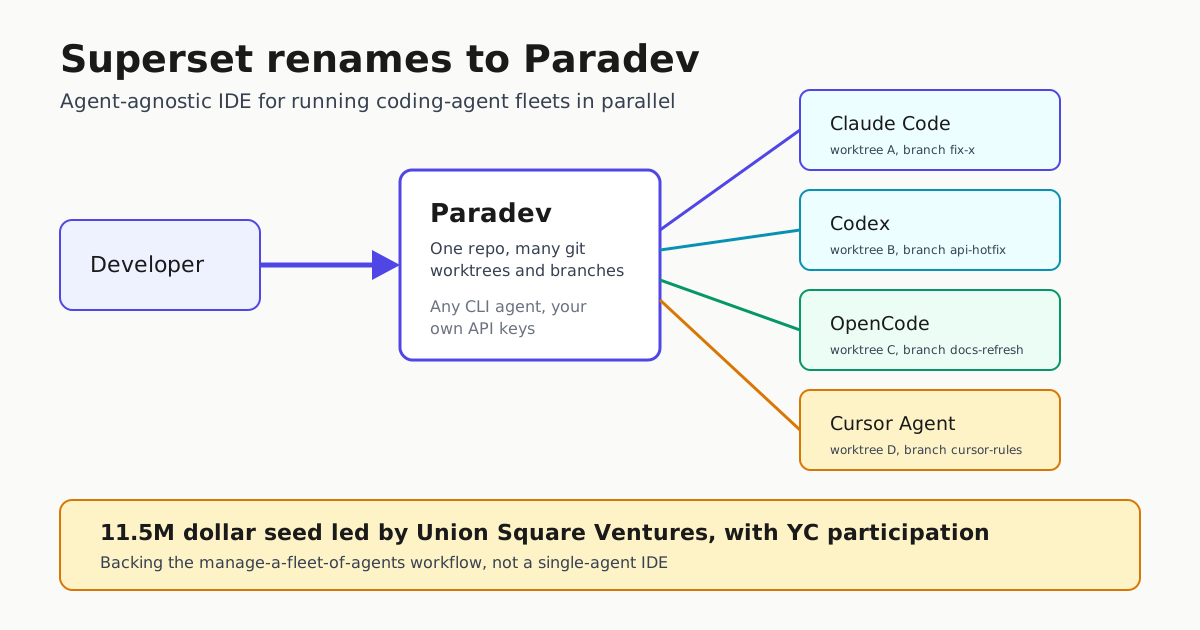
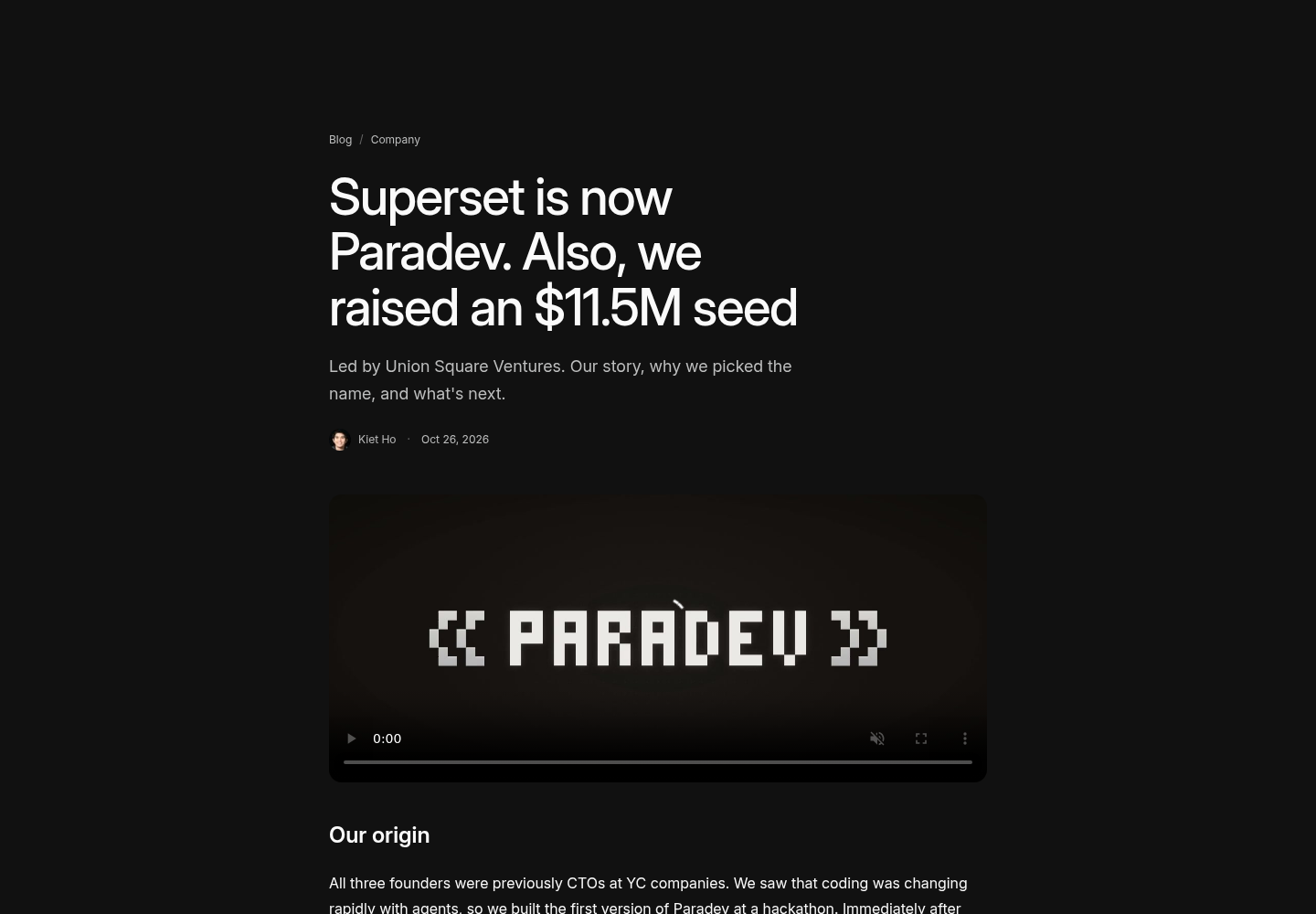
Superset, the terminal-first IDE built for running many AI coding agents at once, renamed itself Paradev on October 26, 2026, and disclosed an $11.5 million seed round led by Union Square Ventures with Y Combinator participation. The news came through the company’s own blog post and X account.
For teams already running single-agent sessions in Claude Code, Codex or OpenCode, the more useful question than the new name is what the underlying product, now carrying fresh investor backing, actually lets you do once you move from one agent to a dozen.
What the product does
According to Paradev’s own homepage, the desktop app launches any CLI-based coding agent — Claude Code, Codex, OpenCode, Cursor Agent, Gemini CLI and others — inside its own isolated git worktree and branch. Each task gets a separate working directory, so one agent fixing a bug and another refactoring auth code do not step on each other’s uncommitted files. A single workspace view shows which agents are running, which are blocked, and which are ready for review, and scheduled “automations” can kick off agents on a cron or on events like an incoming PR review request.
Three details matter for anyone evaluating it against a single-agent IDE. First, Paradev does not proxy model calls: you bring your own Claude, OpenAI or other API keys and subscriptions, so switching the orchestration layer does not lock you to one model provider. Second, the code is source-available on GitHub under the Elastic License 2.0, not OSI-approved open source, but inspectable and self-hostable under that license’s terms. Third, there is a free tier, alongside a CLI, a TypeScript SDK and an MCP server for scripting workspaces from CI or from another agent.
The worktree-isolation caveat
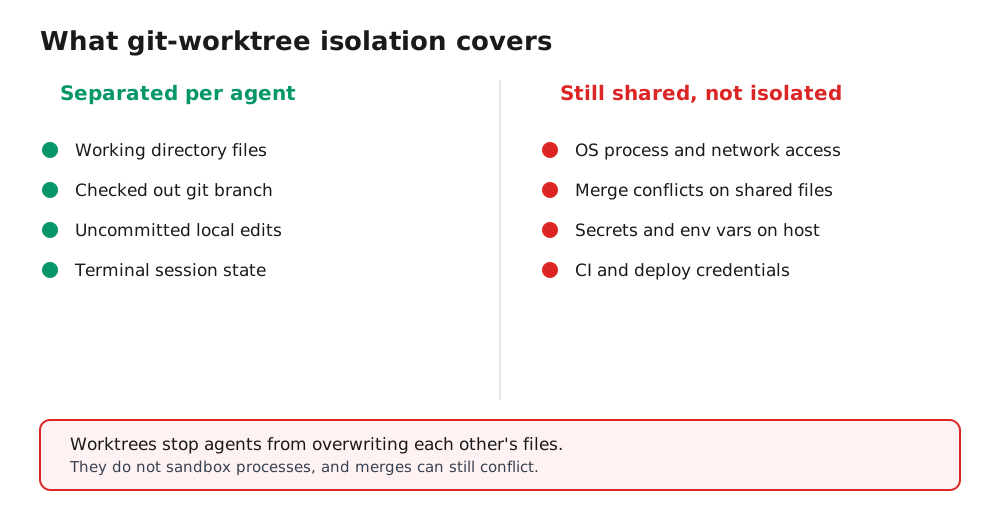
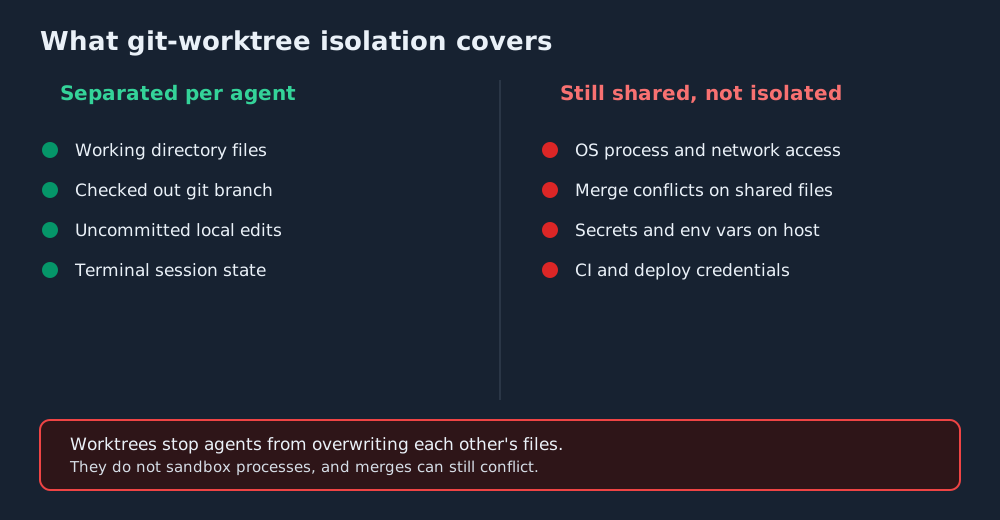
Per Paradev’s own FAQ on its homepage, each agent’s working files are separated by git worktree, but “changes can still conflict when merged.” That isolation is scoped to the file system: in practice, worktrees do not sandbox processes, network access or host credentials, so a compromised or misbehaving agent still shares the host machine’s process and network access with every other workspace. Running ten agents in parallel means ten branches that still have to merge cleanly into the same codebase. Platform support is also uneven right now: the desktop app runs on macOS with an experimental Linux AppImage, and the FAQ states plainly that “Windows is not yet available.”
What else shipped this week
A changelog Paradev published the day before the rebrand, Plugins for Everyone, turned on plugin support for every account rather than a subset. Installing a plugin once now gives every CLI agent running inside a workspace — the changelog names Claude Code, Codex and Cursor specifically — that plugin’s skills on every machine tied to the account, and Claude Code and Codex additionally get the plugin’s tools. That is a direct, practical change for teams standardizing shared context (internal API docs, house coding conventions, deployment runbooks) across a mixed fleet of agents instead of configuring each CLI separately.
Why the funding is the bigger signal
According to Y Combinator’s company page, Paradev (formerly Superset) is a four-person team from YC’s Spring 2026 batch. Its original Superset launch drew more than 11,000 GitHub stars and over 75 contributors within five months, and the company says it is used daily inside engineering teams at Wix, DoorDash and Netflix, among open-source projects including Homebrew, Mastra and Browser Use. An $11.5 million seed behind that traction, led by a firm like Union Square Ventures with Y Combinator’s Paul Graham and Nicolas Dessaigne among the named backers, is a concrete bet that “manage a team of agents from one workspace” is a durable category, not just a feature inside an existing IDE.
What does not change
According to the blog post’s own FAQ, existing Superset accounts, workspaces, settings, billing and contracts carry over automatically, the superset CLI command keeps working with paradev added as an alias, Homebrew installs are unaffected, and old superset.sh and GitHub links redirect. If you already run Superset, there is nothing to migrate; if you are weighing whether to add an orchestration layer on top of Claude Code or Codex, the free tier and source-available license make it a low-cost thing to pilot, as long as you plan for merge review and keep the sandboxing of each agent’s blast radius as a separate problem from worktree isolation.
For teams already thinking about how to run several agents without losing track of who touched what, this sits alongside existing patterns for multi-agent command centers and for deciding who owns a given worktree when more than one tool can create one.
Sources
- Superset is now Paradev. Also, we raised an $11.5M seed | Paradev
- Paradev (formerly Superset) - Run an army of coding agents
- Paradev (formerly Superset): Building self-improving software | Y Combinator
- Paradev (formerly Superset) on X: "Superset is now Paradev: The code editor that helps engineers run armies of coding agents. We just raised an $11.5M Seed round led by @usv with @ycombinator to redefine how software is written." / X
- Plugins for Everyone and Automations Sorted by Last Run | Paradev