GPT-6.1 Terra Lands on Amazon Bedrock and GitHub Copilot at Half Price
OpenAI's GPT-6.1 Terra arrives simultaneously on Amazon Bedrock and GitHub Copilot, offering a 1M-token context window, 3x faster task execution, and 50% lower token pricing for daily agentic workflows.
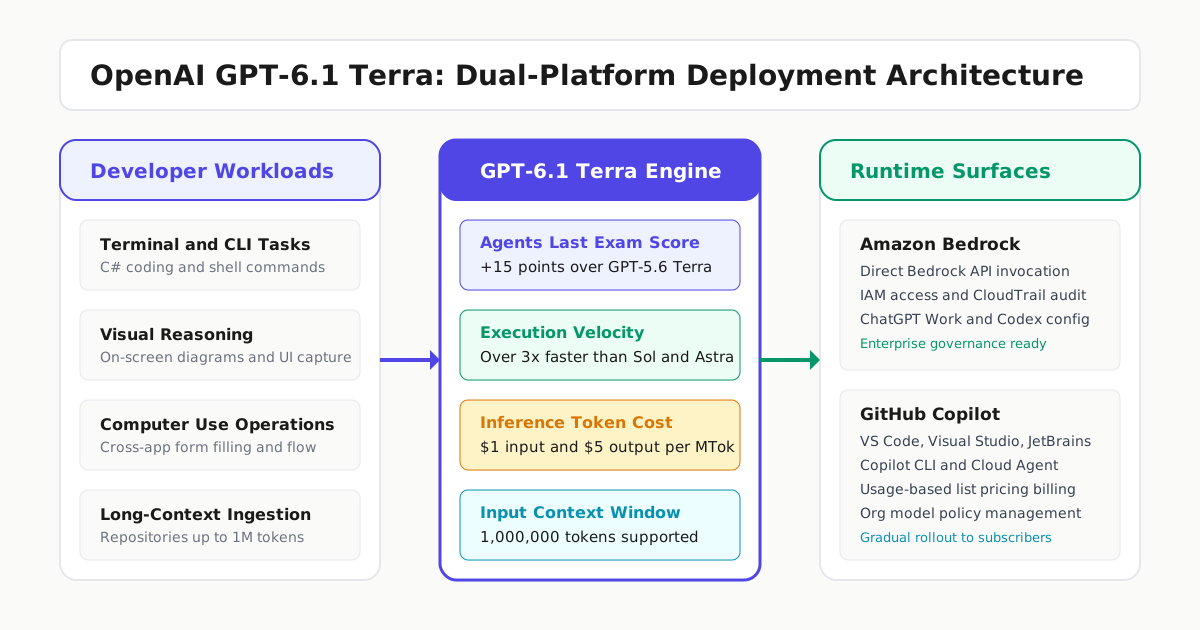
While Automater previously analyzed the initial enterprise Bedrock announcement, today’s general availability of GPT-6.1 Terra inside GitHub Copilot alongside Amazon Bedrock establishes a broader multi-environment rollout for engineering organizations. By pairing centralized cloud API endpoints with native desktop IDE access across Visual Studio Code, JetBrains, and terminal CLIs, the release shifts developer workflow economics. This analysis evaluates the new GitHub Copilot integration, practical model positioning against Sol and Astra, and where the 1-million-token input window and 3x execution speedup deliver measurable advantages for day-to-day coding.
As confirmed by OpenAI’s official announcement, GPT-6.1 Terra succeeds GPT-5.6 Terra as the primary workhorse tier in OpenAI’s lineup. It targets repetitive computer-based operations, technical writing, and automated terminal debugging that require dependable multi-step execution rather than high-latency frontier reasoning.
Benchmark Gains and Execution Velocity
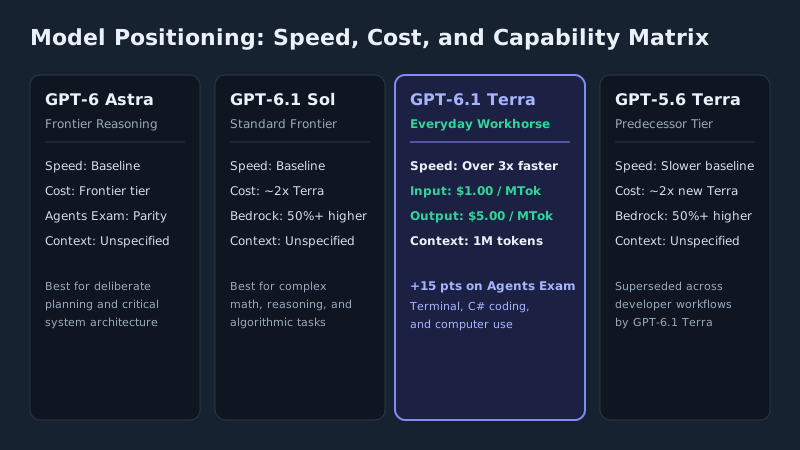
In benchmark evaluations conducted on OpenAI’s Agents’ Last Exam suite, GPT-6.1 Terra achieved a score 15 percentage points higher than GPT-5.6 Terra. Crucially for automated software engineering and multi-agent coordination, it completed evaluation tasks more than three times faster than both GPT-6 Astra and GPT-6.1 Sol while performing on par with GPT-6 Astra overall.
Independent analyst Simon Willison noted in his architectural breakdown that Terra occupies a market position analogous to Anthropic’s Sonnet tier: a fast, cost-conscious model engineered for volume automation. Citing commentary from OpenAI staff member Ted Sanders, Willison highlighted that Terra outperforms Astra and Sol in technical communication, delivers parity in visual comprehension and computer use, and executes at substantially reduced latency.
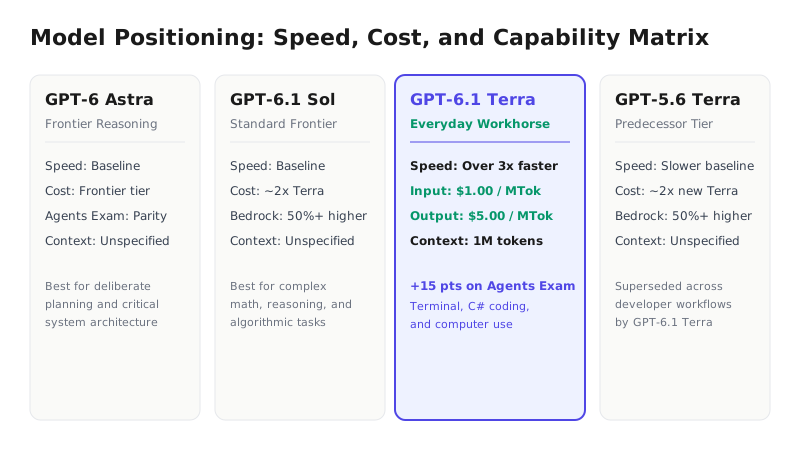
| Model Tier | Context Window | Verified Pricing Profile | Speed vs. Terra | Primary Workload Focus |
|---|---|---|---|---|
| GPT-6.1 Terra | Up to 1,000,000 input tokens | $1.00 input / $5.00 output per MTok | Over 3x faster than Sol and Astra | Terminal tasks, computer use, and everyday coding |
| GPT-6.1 Sol | Unspecified in announcement | Higher tier (~2x Terra; Bedrock 50%+ higher) | Baseline (Terra is >3x faster) | Deep reasoning and mathematical analysis |
| GPT-6 Astra | Unspecified in announcement | Frontier reasoning tier | Baseline (Terra is >3x faster) | Deliberate reasoning and complex planning |
| GPT-5.6 Terra | Unspecified in announcement | Predecessor tier (~2x Terra; Bedrock 50%+ higher) | Slower execution | Legacy agentic workflows (now superseded) |
GitHub Copilot Integration and Developer Tooling
On GitHub Copilot, GPT-6.1 Terra is generally available across Pro, Pro+, Max, Business, and Enterprise plans. Developers can select the model directly from the model picker across all major editing environments, including Visual Studio Code, Visual Studio, JetBrains IDEs, Xcode, Eclipse, the GitHub Copilot cloud agent, and GitHub Mobile.
According to GitHub’s changelog, early developer testing demonstrated marked improvements over GPT-5.6 Terra when resolving terminal issues, executing shell commands, and authoring C# applications. Rather than drifting across exploratory paths, Terra operates in consolidated, focused execution steps on well-scoped programming tasks.
Enterprise administrators manage rollout through Copilot model policies, which are enabled automatically under default governance settings. As teams navigate recent Copilot model deprecations and policy updates, GPT-6.1 Terra offers a drop-in option billed under standard usage-based provider list rates.
Enterprise Bedrock Architecture and Computer Use
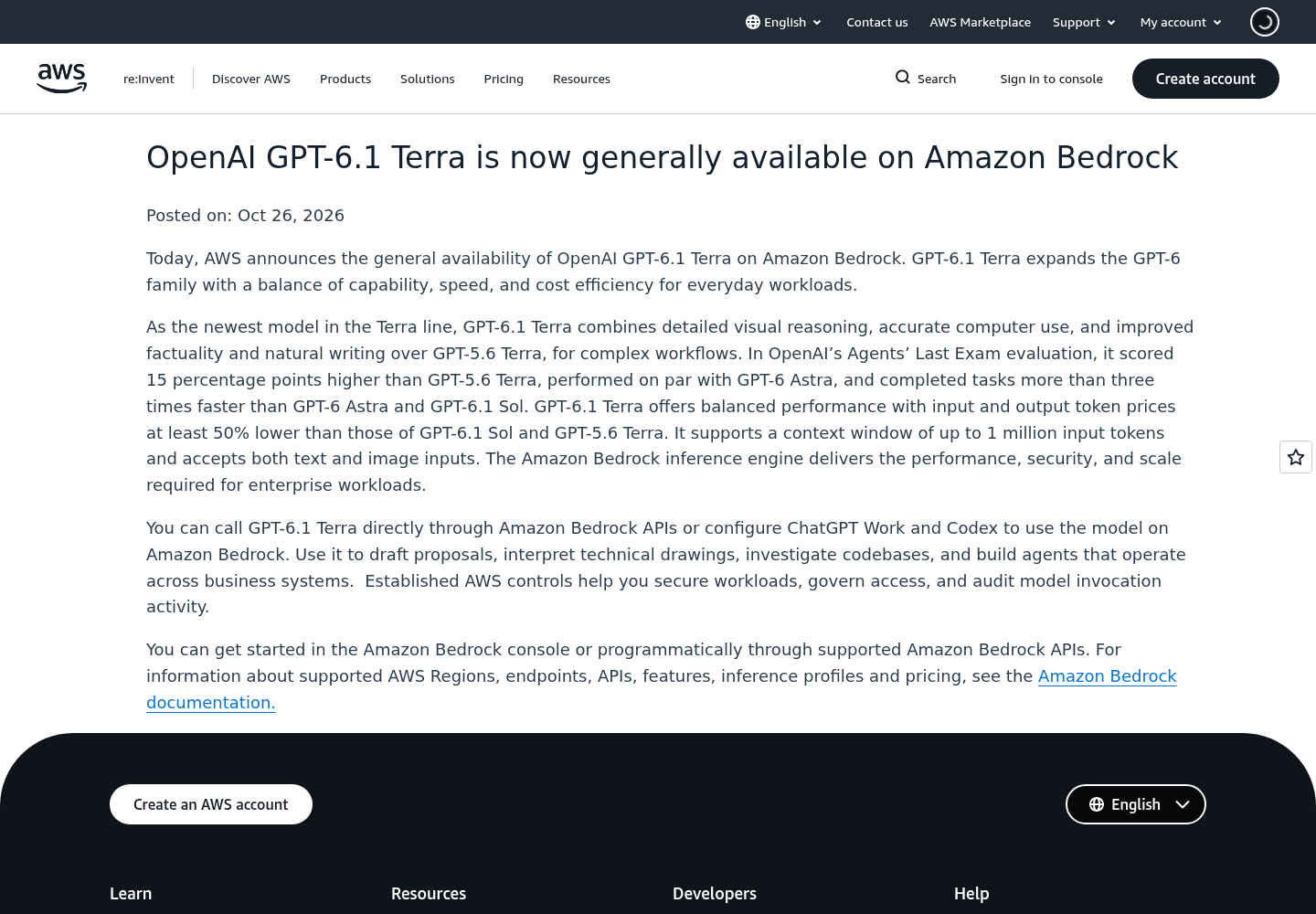
On Amazon Bedrock, GPT-6.1 Terra supports an input context window of up to 1 million tokens, accommodating complete multi-repository architectures, architectural documentation, and dense visual captures. Teams can invoke the model directly through standard AWS SDKs or configure ChatGPT Work and Codex to route invocations through Bedrock.
Because AWS notes that specific endpoints, inference profiles, and model identifiers are documented in the Amazon Bedrock documentation, engineering teams should verify the exact model identifier and request payload schema before deploying invocation scripts to production. The illustrative programmatic pattern through the AWS Python SDK demonstrates how teams structure Bedrock invocations for automated tasks:
import boto3
import json

# Illustrative template: verify modelId and request schema against Amazon Bedrock documentation
bedrock = boto3.client(
    service_name="bedrock-runtime",
    region_name="us-east-1"
)

# Request payload: consult Bedrock documentation for exact inference parameters
request_body = {
    "prompt": "Inspect the failure logs from the integration test run and draft a unified diff.",
    "max_tokens": 4096,
    "temperature": 0.1,
}

# Note: replace '<BEDROCK_MODEL_ID>' with the official model ARN/ID listed in Bedrock documentation
response = bedrock.invoke_model(
    modelId="<BEDROCK_MODEL_ID>",
    contentType="application/json",
    accept="application/json",
    body=json.dumps(request_body),
)

result = json.loads(response["body"].read().decode("utf-8"))
print(result)
Running GPT-6.1 Terra on Amazon Bedrock allows organizations to rely on established AWS controls to secure workloads, govern access, and audit model invocation activity—such as utilizing standard AWS IAM access policies and CloudTrail audit logging. This governance framework is particularly relevant for computer-use agents, where autonomous software clicks interface elements, submits forms, and extracts unstructured data across proprietary applications. Teams building autonomous desktop workflows can review our analysis on computer use desk-job inventories to structure execution permissions effectively.
Economic Impact and Workload Shaping
Inference pricing plays a central role in the viability of long-running coding agents. GPT-6.1 Terra is listed at $1.00 per million input tokens and $5.00 per million output tokens on OpenAI’s standard API lanes, while AWS notes that Bedrock token pricing is at least 50 percent lower than that of GPT-6.1 Sol and GPT-5.6 Terra, with specific regional rates detailed in Amazon Bedrock documentation. This represents an approximately 50 percent reduction compared to GPT-5.6 Terra and GPT-6.1 Sol—around ten times the cost of the lightweight GPT-6 Luna model, while sitting at roughly half the rate of Sol.
As discussed in our study on pricing the workload shape rather than list rates, long-running agentic loops often consume hundreds of thousands of context tokens while executing lightweight tool calls. When an agent reads repository context repeatedly across dozens of iterations, an input rate of $1.00 per million tokens makes continuous background test remediation economically feasible.
Practical Recommendations for Engineering Teams
- Audit Terminal and Build Workflows: Deploy GPT-6.1 Terra in the Copilot CLI and VS Code for daily refactoring and test-fix loops. Verify whether your repositories benefit from Terra’s consolidated execution steps.
- Review Bedrock IAM Policies: If your organization operates private AWS workloads, enable GPT-6.1 Terra through Amazon Bedrock inference profiles and tie invocations to existing CloudTrail audit logs.
- Calibrate Context Consumption: Take advantage of the 1-million-token window to ingest complete source trees during complex debugging sessions, while monitoring output token budgets on long-running loops.
- Govern Enterprise Rollout: Enterprise administrators should verify model policies in GitHub Copilot settings to ensure appropriate team access and track usage-based billing against department allocations.
Sources
- OpenAI GPT-6.1 Terra is now generally available on Amazon Bedrock - AWS
- GPT-6.1 Terra in GitHub Copilot - GitHub Changelog
- GPT-6.1 Terra
- OpenAI on X: "GPT-6.1 Terra: delivering fast and capable computer use at a lower price. GPT-6.1 Terra understands what’s on screen, takes action across apps, writes naturally, and is a more capable model for your whole workday with the efficiency to take on more of it." / X