
Cursor Adds Meta's Muse Wonder Model, Scoring Up to 50.4% on CursorBench at $4/$20 per Million Tokens
Cursor shipped Meta Superintelligence Labs' Muse Wonder into its model picker on Oct. 15, 2026, giving users a fourth major-lab frontier option. CursorBench 4.0 scores span 34.2% to 50.4% across effort levels, at $4/M input and $20/M output.
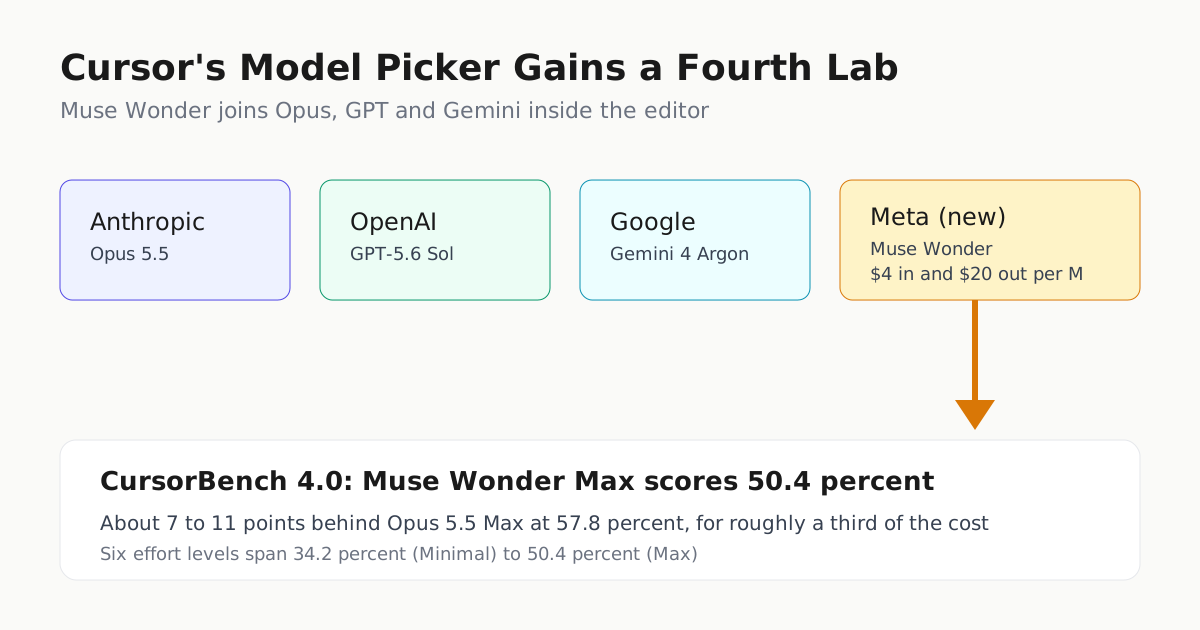
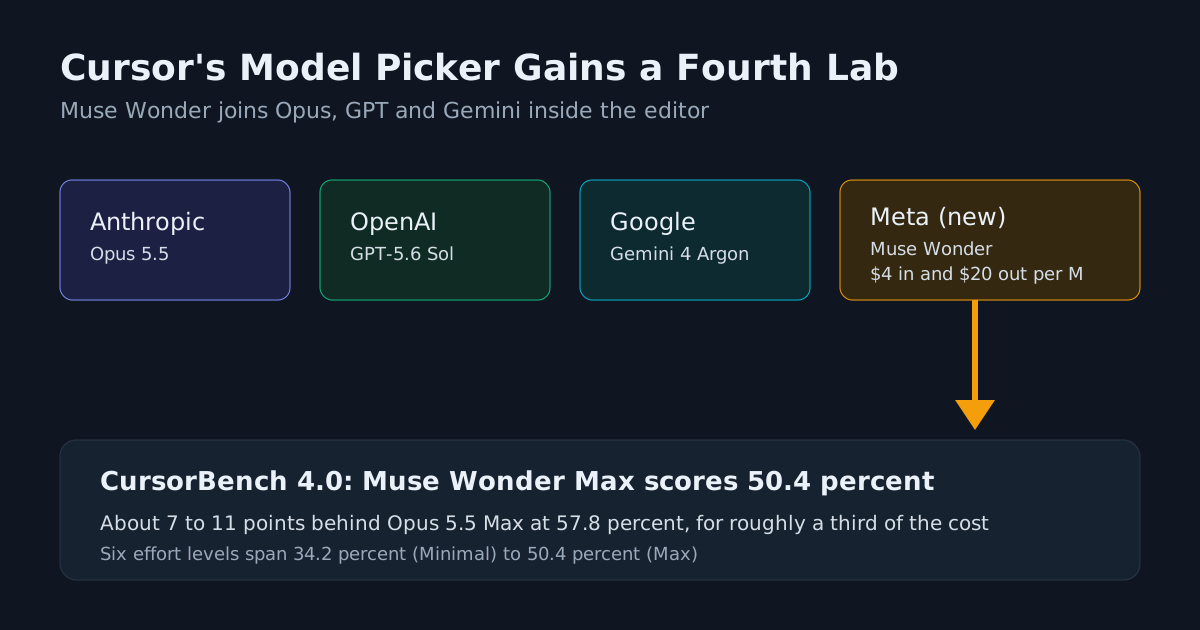
Cursor has added Meta Superintelligence Labs’ Muse Wonder to its in-editor model picker, giving developers a fourth major-lab frontier option — alongside Anthropic’s Opus, OpenAI’s GPT family, and Google’s Gemini — without leaving the IDE.
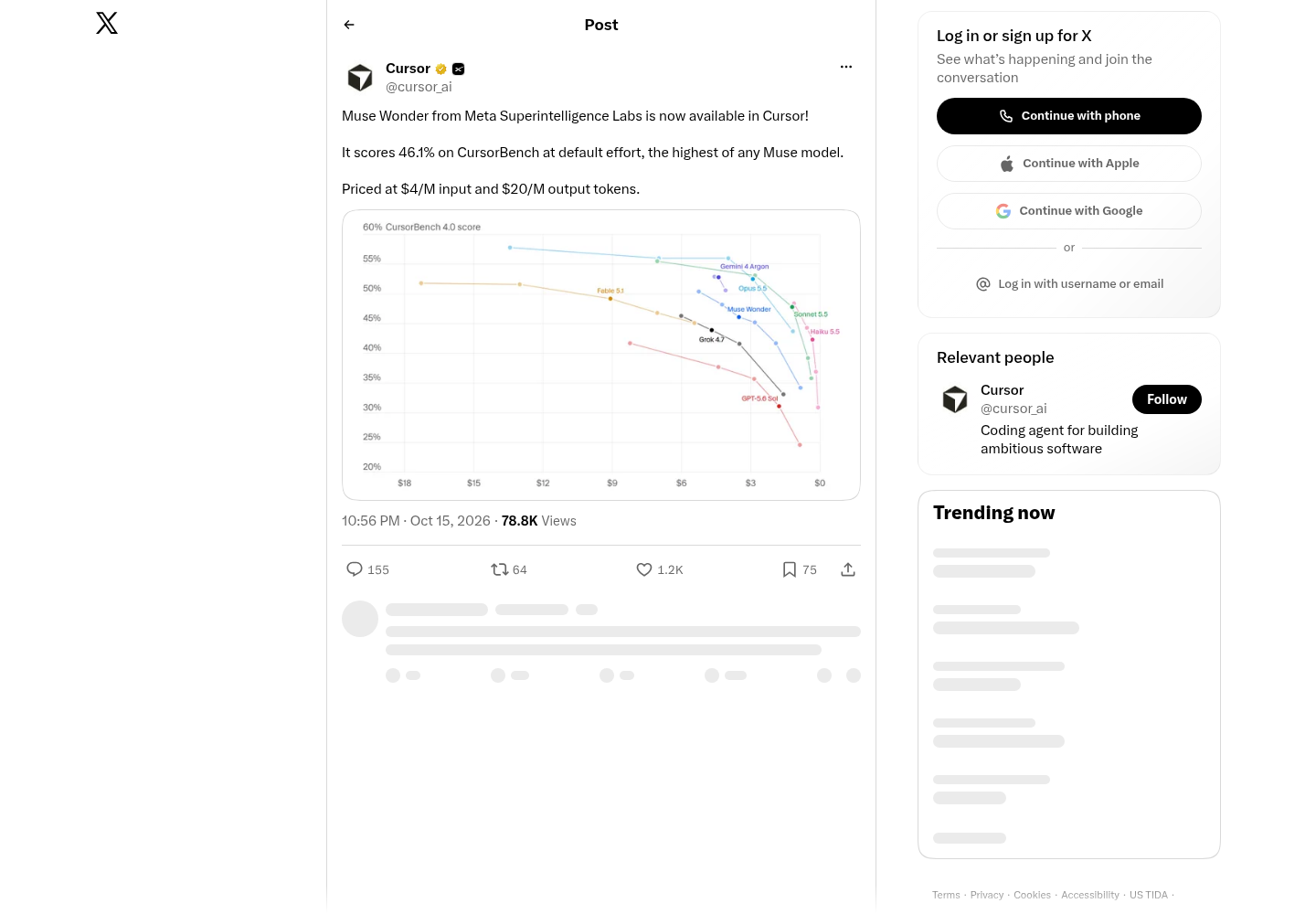
Cursor announced the rollout on its official X account at 10:56 PM UTC on October 15, 2026: “Muse Wonder from Meta Superintelligence Labs is now available in Cursor! It scores 46.1% on CursorBench at default effort, the highest of any Muse model. Priced at $4/M input and $20/M output tokens.” (source)
What CursorBench shows across effort levels
Cursor’s own benchmark page, CursorBench 4.0, independently confirms the integration with a full breakdown across Muse Wonder’s six effort levels — minimal, low, medium, high (the default), extra high, and max:
| Muse Wonder effort | CursorBench 4.0 score | Avg. cost / task |
|---|---|---|
| Minimal | 34.2% | $0.84 |
| Low | 41.7% | $1.91 |
| Medium | 45.2% | $2.82 |
| High (default) | 46.1% | $3.51 |
| Extra High | 48.2% | $4.24 |
| Max | 50.4% | $5.25 |
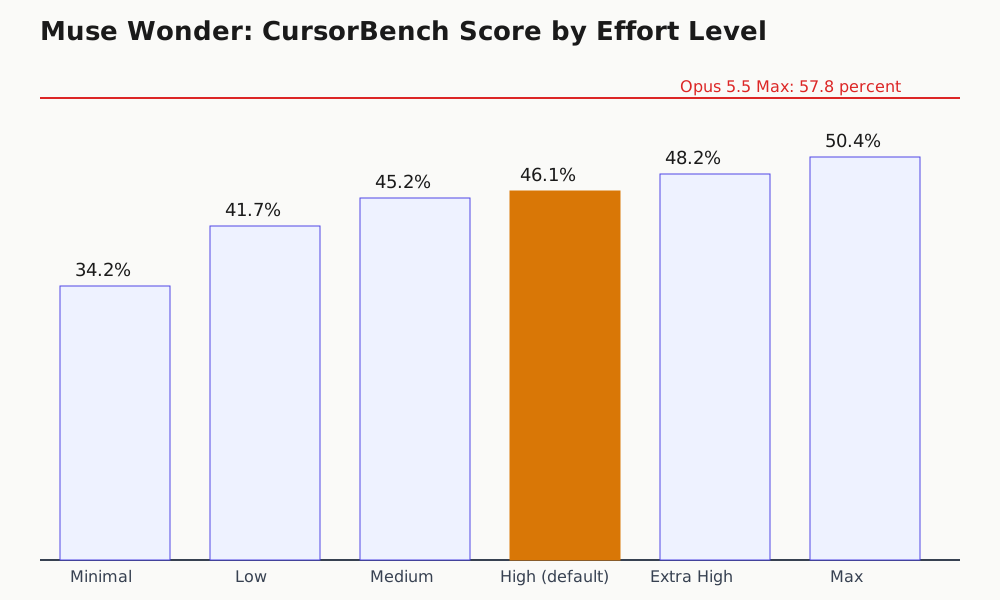
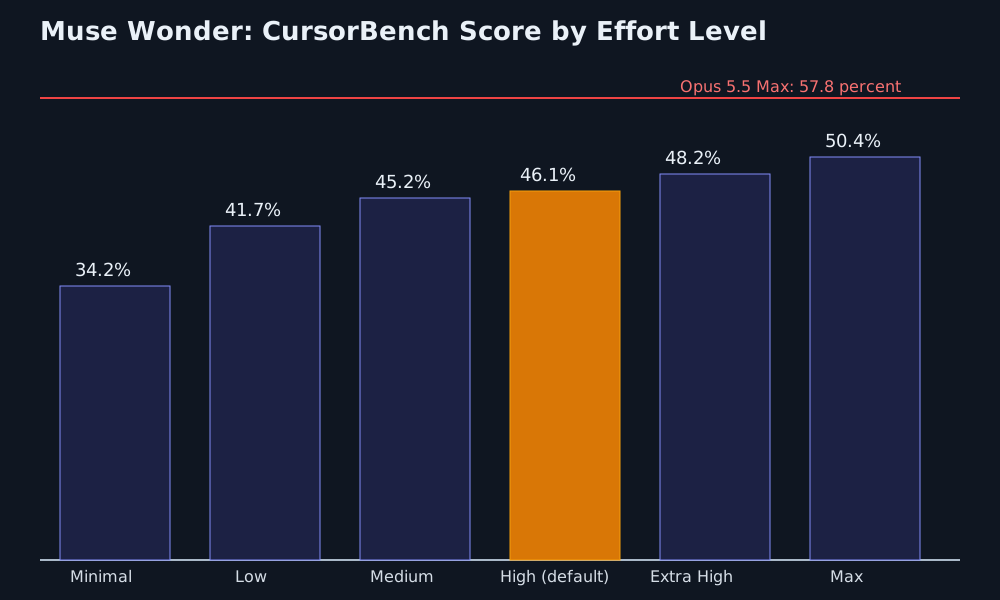
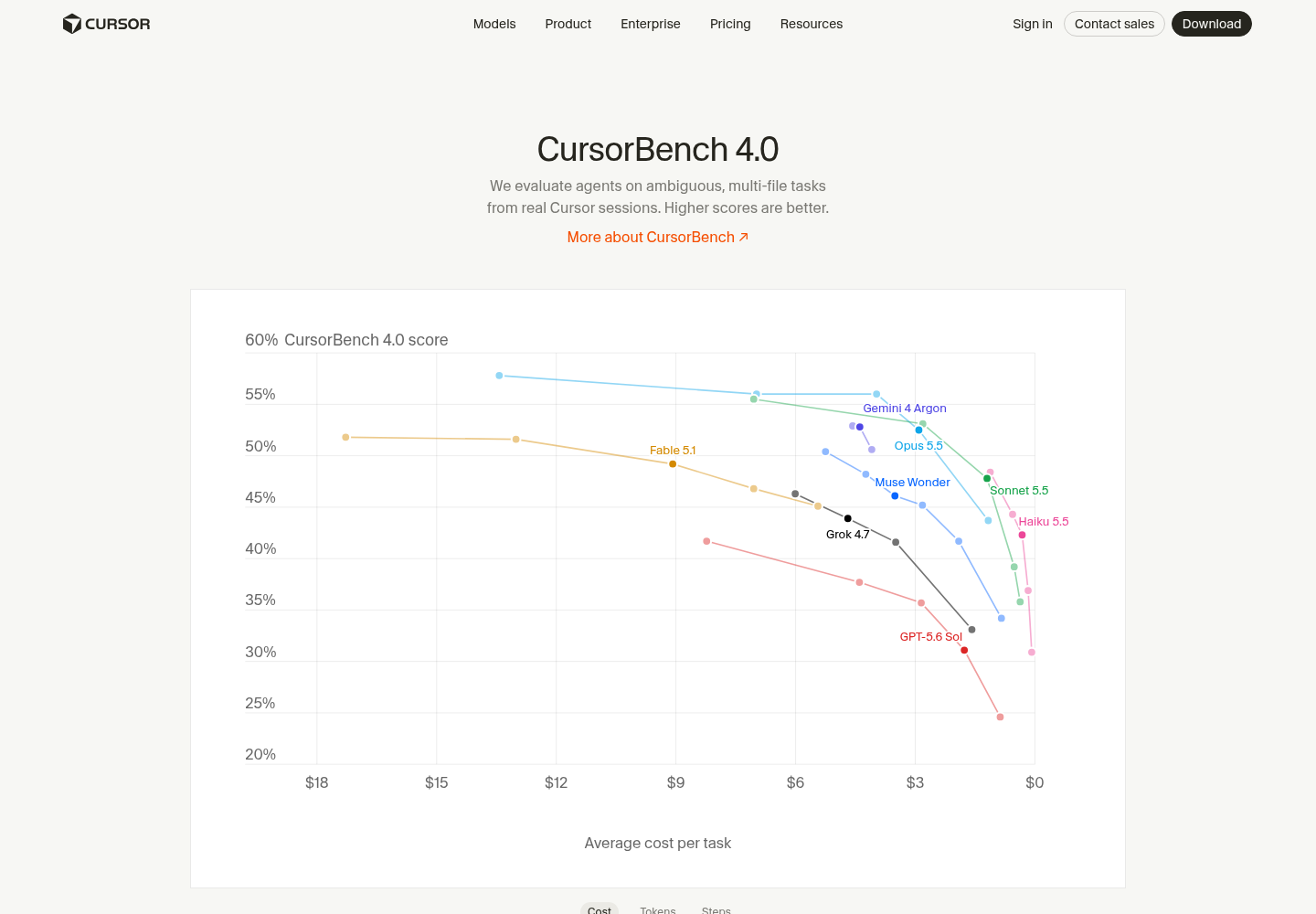
For context, the same leaderboard puts the current top scorer, Opus 5.5 Max, at 57.8% for $13.43 per task, and Opus 5.5 High at 56.0% for $3.97 per task. Gemini 4 Argon Low scores 50.6% for $4.09 per task — essentially matching Muse Wonder Max’s score at a similar cost. That places Muse Wonder mid-pack: roughly 7 to 11 points behind the leading Opus 5.5 configurations, but priced in the same tier as Opus 5.5 and, according to TechCrunch’s coverage of Meta’s October 12 launch, “roughly equivalent in cost to GPT-6 Sol or Opus 5.5.”
Cursor’s own methodology note is worth keeping in mind before switching default models on this data alone: “Results are subject to variance; small differences in scores may not be statistically meaningful.”
The second Meta model in Cursor, not the first
Muse Wonder isn’t Meta’s debut in Cursor — that distinction belongs to Muse Spark 1.3, which Cursor’s docs describe as “Meta’s previous flagship model and the first Meta model available in Cursor.” Muse Spark 1.3 is cheaper ($1.25/M input, $4.25/M output) but now carries an explicit recommendation to upgrade: “We recommend using Muse Wonder. It’s Meta’s latest flagship model.” (source)
That same documentation flags an administrative step that matters for larger teams: “Teams and Enterprise admins who configured model access before Meta was available need to enable the Meta provider before Muse Spark 1.3 appears for their members” — the same gate applies to seeing Muse Wonder in the picker.
What Meta shipped three days earlier
Cursor’s integration is a distribution follow-on to Meta’s own release. According to TechCrunch, Meta’s Superintelligence Lab shipped Muse Wonder and a larger Muse Wonder Full on October 12, 2026, calling them the company’s “first attempt at a frontier model” and claiming benchmark parity with Fable 5.1 and GPT-6 Astra. Meta emphasized “active memory” — the models’ ability to retain information across sessions — as a differentiator on its internal MemoryBench evaluation. Critically for Cursor users: Muse Wonder Full “will only be available to Muse Code subscribers and will not be served through the API,” so the version now in Cursor’s picker is the smaller Wonder, not Meta’s largest model.
What this means for picking a default
For teams already spending on Opus 5.5 or GPT-6 Sol at the $4/$20-ish tier, Muse Wonder is now a direct, same-price alternative to try inside the same picker, with CursorBench giving a rough quality baseline before committing: expect roughly 10 points lower accuracy than Opus 5.5’s top configurations, similar to or slightly better than Opus 5.5’s lowest effort setting. Teams on tighter budgets can drop Muse Wonder to Low or Minimal effort for sub-$2 and sub-$1 per-task costs respectively, trading another several points of score. Either way, switching costs nothing but a model-picker click, and Teams/Enterprise admins should check that the Meta provider toggle is enabled before assuming the option is missing.
This follows a pattern the editor has repeated throughout 2026: landing each new frontier-lab model on CursorBench as soon as it ships, as happened with Gemini 4 Argon’s arrival in Cursor and with Meta’s original Muse Wonder launch. Readers evaluating whether to add a fourth lab to their default rotation now have concrete, same-benchmark cost-versus-quality numbers rather than marketing claims to work from.
Sources
- Cursor on X: "Muse Wonder from Meta Superintelligence Labs is now available in Cursor! It scores 46.1% on CursorBench at default effort, the highest of any Muse model. Priced at $4/M input and $20/M output tokens." / X
- Cursor · CursorBench
- Muse Spark 1.3 | Cursor Docs
- Meta releases its first frontier model, Muse Wonder | TechCrunch