Beyond the Terminal: Cowork Tools and Autonomous AI Agent Workspaces
What an AI agent workspace really delivers in 2026 — Manus, Genspark, Devin, ChatGPT agent, and Claude Cowork compared on task fit, pricing, and trust.

Go deeper. Build your own.
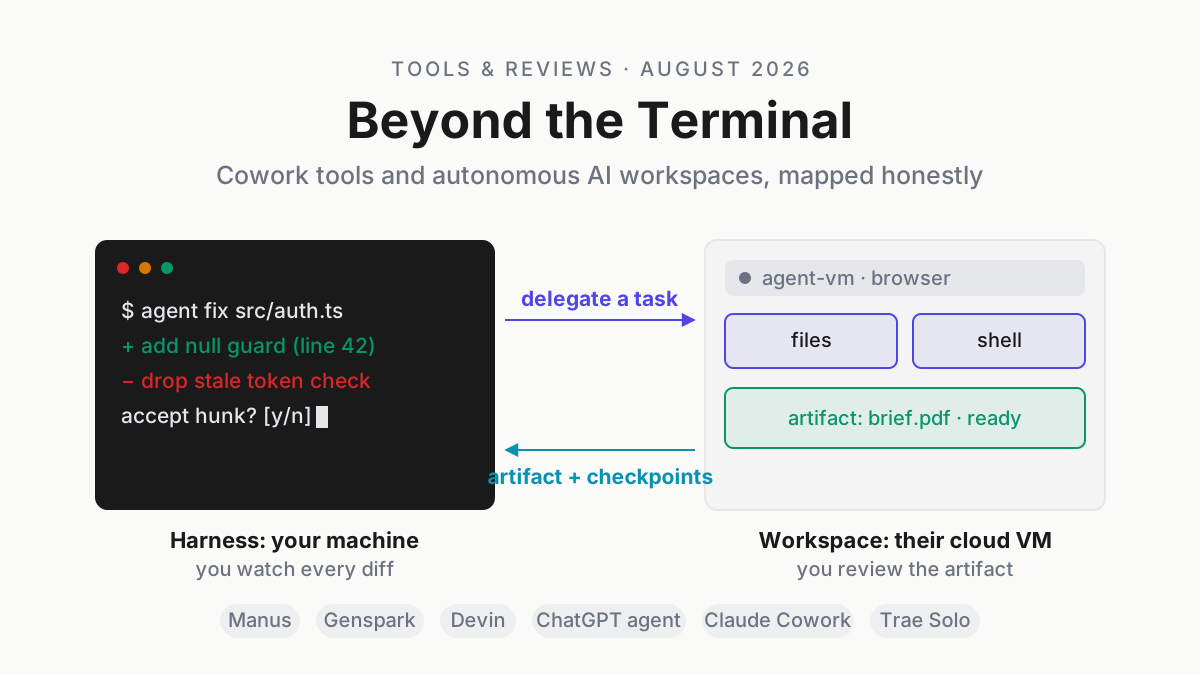
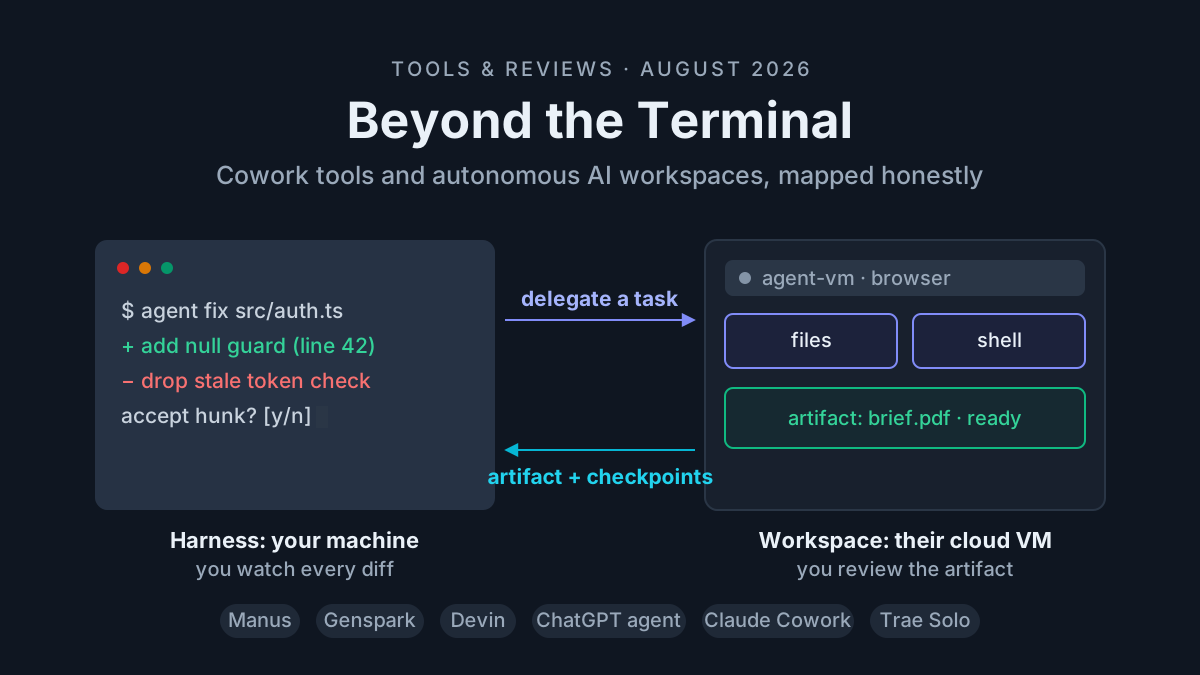
You know exactly what supervised agent work feels like: a harness in your terminal, an agent proposing diffs, you approving them one hunk at a time. The products in this piece run on a different contract. You hand over a whole task — “scan these forty vendors and give me a comparison brief” — and an agent works in a cloud machine you never see, returning an artifact you inspect when it is done. That is the AI agent workspace, and as of August 2026 it is the fastest-moving, worst-named category in agentic software.
Nobody agrees on what to call it. “Cowork tools,” “general agents,” “autonomous AI agents,” and “cloud agents” all circulate, attached to products as different as Manus, Genspark, Devin, ChatGPT’s agent mode, Anthropic’s Cowork, and ByteDance’s Trae Solo lane. The naming mess hides a practical question this article answers: what do these products do differently from the harnesses you already run, what do they cost in their strange credit-and-ACU currencies, and which — if any — deserve a lane in a setup that already has too many agents in it.
The honest read up front: these tools genuinely earn their keep on a specific set of task shapes, and they still carry a demo gap wide enough that we name its failure modes individually below. Product facts were checked on August 27, 2026; this category churns monthly, so treat every price as perishable.
What defines an AI agent workspace (and what separates it from a harness)
An AI agent workspace is a cloud environment — virtual machine, browser, filesystem, and shell — that the agent owns and operates. You delegate whole tasks instead of supervising turns, and you review finished artifacts (reports, decks, sites, pull requests) at checkpoints rather than watching every diff scroll past.
Four properties define the category. The agent owns the computer, not you. Delegation is measured in tasks per session, not conversational turns. The output is artifact-shaped — something you can open, read, and judge. And supervision happens through chat and checkpoints, not line-by-line review.
A coding harness inverts every one of those properties: it runs the agent in your environment, on your files, under your eyes, with your git history as the audit log. A workspace runs your task in the agent’s environment on its schedule. The boundary already leaks — Codex cloud tasks and Copilot’s coding agent are harness-world products with delegate-and-return behavior — and we treat that convergence properly below rather than pretending the line is clean. The core of each pole is stable, though: interactive terminal work on your own repo is harness territory no matter which vendor ships it, and a browser-equipped VM producing artifacts on its own clock is a workspace no matter what the marketing calls it.
| Harness | AI agent workspace | |
|---|---|---|
| Where it runs | Your machine, your repo | Vendor cloud VM (browser, files, shell) |
| Unit of delegation | Turns and diffs | Whole tasks |
| Output | Commits you review | Artifacts: reports, decks, sites, PRs |
| Supervision | Diff-by-diff, interactive | Checkpoints and chat, asynchronous |
| Typical meter | Tokens or a flat plan | Credits or ACUs |
| Where failure surfaces | Mid-run, in the diff | Afterward, in the artifact |
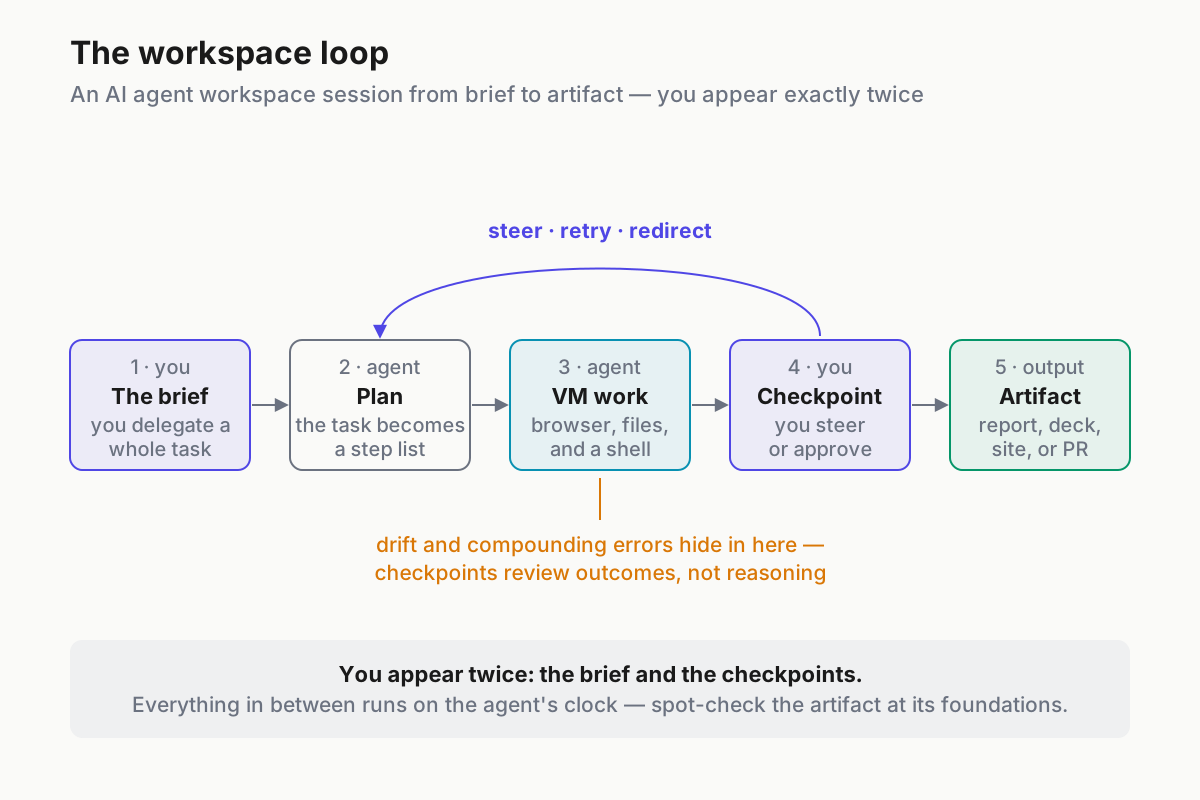
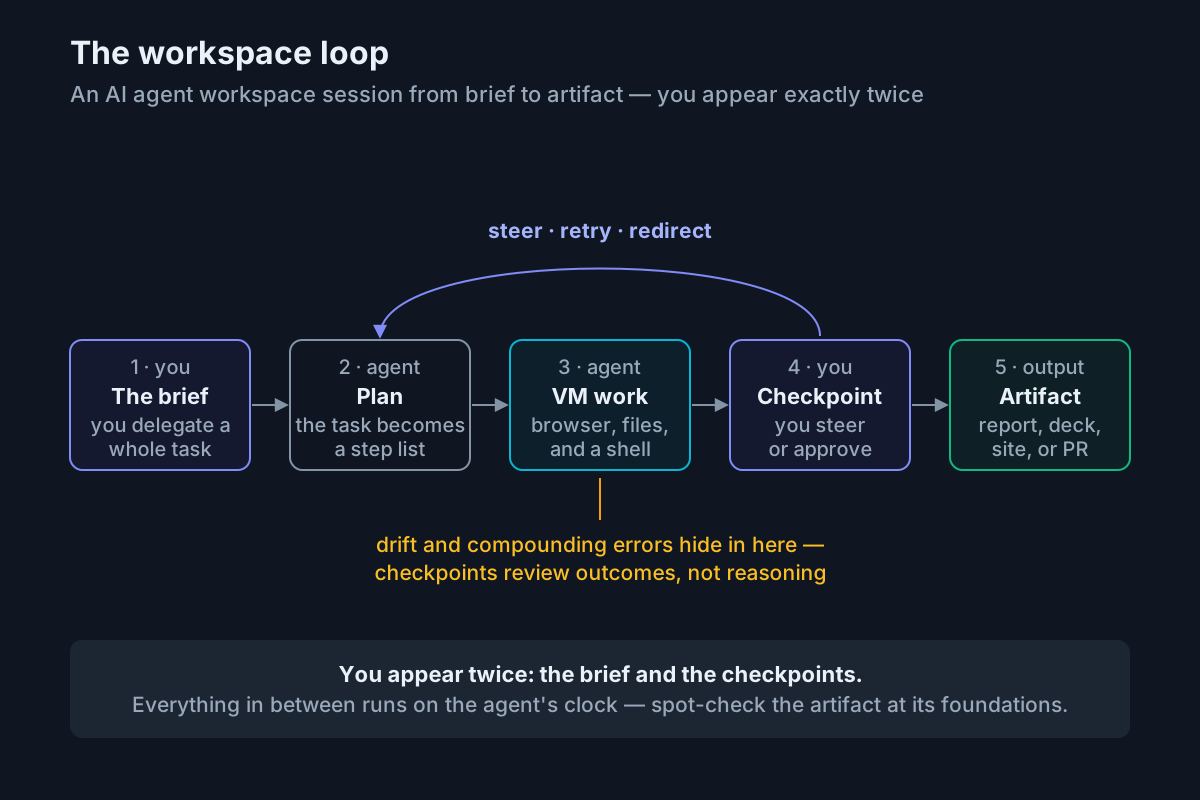 The workspace loop: you appear at exactly two points — the brief and the checkpoints.
Manus: the one that defined the category’s moment
Manus made the category legible. Its March 2025 launch — a general agent driving a cloud VM with a visible browser, invite codes scarce enough to be resold — turned the autonomous AI agent from research demo into product genre. Give it a prompt and it plans, browses, writes files, and hands back a research report, a working site, or a deck, with a replayable session log showing how it got there.
Pricing is credit-based: a free tier with a daily credit drip, and paid tiers running from roughly $19 to $199 a month, each a credit bundle that complex tasks drain faster than simple ones.
The corporate facts, stated once: Manus was built by Butterfly Effect, a Chinese-founded company that relocated its headquarters to Singapore in 2025, took US venture investment in a Benchmark-led round, and wound down its mainland-China operations. Those are jurisdiction inputs for the trust section below, nothing more.
Honest read: strong on research-to-deliverable work and browser grinding, where the replay log doubles as an audit trail. The canonical Manus win is the delegated scan — market research, candidate screening from a resume stack, a travel plan assembled from live listings — where the deliverable is judgeable at a glance. Reliability on long multi-step runs varies with task shape, and community consensus says the variance is real — the same prompt can produce a keeper on Monday and a plausible-but-hollow artifact on Wednesday.
Genspark: search-to-deliverable
Genspark came at the category from agentic search and grew into a general agent whose differentiator is built-in deliverable formats: slides, sheets, docs, and outbound phone calls, each a first-class output rather than a file the agent improvises. Team context in one line: founded by former Baidu search executives, with a funding pace that doubles as the health signal in a category where funding is the runway.
Pricing follows the category pattern: a free daily credit allowance, with paid tiers lifting the cap for heavier and parallel use.
Honest read: the fastest route in the category from question to presentable artifact — shallow-to-medium research at genuinely low effort, in formats you can forward without reformatting. The deliverable-format bet is the right one for its audience: an analyst wants a deck, not a directory of markdown files, and Genspark ships the deck. Depth and sourcing rigor are the ceiling; treat its outputs as strong first drafts with citations to spot-check, not finished analysis — and expect the gap to show most on topics where the good sources sit behind paywalls its browser cannot cross.
Devin: the autonomous engineer, priced in ACUs
Devin — “Devin AI” in a year of 2024 headlines — is Cognition’s autonomous software engineer: the demo that started the “can you delegate a ticket” argument, now a team product with parallel sessions and deep repo integration. You assign scoped work — a migration, test coverage, a well-specified ticket — and it returns a pull request.
The pricing unit deserves its own paragraph, because it is the category’s most explicit meter. An ACU — Agent Compute Unit — is Cognition’s normalized unit of Devin’s work, bundling the compute and tokens behind roughly a session-slice of active effort. Devin launched at $500 a month; per mid-2026 reporting it now starts around $20 a month plus usage metered in ACUs, which moved it from enterprise curiosity to something an individual can trial.
Then there is the acquisition that became a rebrand. Cognition acquired Windsurf in July 2025, after a whipsaw month in which a rumored OpenAI deal collapsed and Google hired away Windsurf’s founders. In mid-2026 the IDE re-shipped as Devin Desktop (formerly Windsurf) — an autonomous-agent company folding a whole IDE into its agent brand. That is the convergence thesis executed in one transaction: the delegated engineer and the supervised editor becoming one product line.
Honest read: production-credible for scoped tickets, migrations, and test debt at teams that invest in specifying work. It drifts on underspecified tasks — the scoping burden moves to the delegator, and teams that hand Devin a written brief do far better than teams that hand it a wish.
The platform lanes: ChatGPT agent, Claude Cowork, and Trae Solo
The startups defined the category; the platforms are bundling it.
ChatGPT’s agent mode gives the world’s largest chat product a virtual computer — the merged lineage of the Operator browser agent and deep research, running in a sandboxed VM with browser and terminal, with usage caps that scale by subscription tier. Its sweet spot is the same research-and-browse shape as Manus, with less deliverable polish and far more distribution. For anyone already paying OpenAI, the marginal cost of trying the category is zero, which is precisely the point.
Claude Cowork is Anthropic’s entry: agentic work beyond the terminal, with Claude operating on folders and files in a workspace of its own — the same delegate-and-checkpoint contract as the rest of the category, aimed at file-heavy knowledge work rather than repos. Supervision follows the category pattern: you set the brief, Claude plans and executes against the folder, and you steer at checkpoints rather than approving each operation. Availability and plan gating have shifted since its research-preview debut, so check the current docs before planning around it. It gets the identical rubric as everything else here: useful for closed-ended file work, the same demo-gap caveats, the same trust questions as any vendor cloud.
Trae Solo is ByteDance’s lane: the Trae IDE’s autonomous builder mode, which plans and executes multi-file work with supervision dialed down. The jurisdiction line, stated once as with Manus: Trae is ByteDance-owned, operated through its international entities.
The structural read: platforms bundle workspace capability into subscriptions people already pay for, which undercuts the startups’ credit pricing without a price war. Distribution is the moat — hence Devin’s price drop, and hence Manus and Genspark racing toward deliverable formats the platforms don’t ship yet.
Where autonomous AI agents genuinely earn their keep
Match the tool to the task shape and the category stops being a demo. Three shapes pay reliably.
Research-to-deliverable runs. A forty-source competitive scan returned as a cited comparison brief while you did other work is the category’s flagship case. The artifact is inspectable, wrong sources are visible, and a seventy-percent-right draft still saves the afternoon.
Parallel grunt work. N scoped tasks in N sessions: data cleanup, doc drafting, lead-list assembly running simultaneously. The value is wall-clock compression, not intelligence — five ordinary agents finishing five chores beats one brilliant agent finishing one. Concretely: normalizing six exported CSVs into one schema is an afternoon serially and twenty supervised minutes when six sessions run at once and you only review the merge.
Browser-dependent tasks. Logged-in navigation, form filling, portal workflows — the lane terminal harnesses structurally cannot reach, because the work lives behind a rendered UI rather than an API. This is the one shape with no harness substitute.
The common thread: closed-ended tasks, verifiable by inspecting the artifact, tolerant of retry. When a task fits all three clauses, delegation works. When it misses one — open-ended, unverifiable, or expensive to redo — you are back in supervision territory, and a harness does it better.
The demo gap
Launch reels select winners. Daily use meets the failure modes, and they are specific enough to name.
Long-horizon drift. Across a multi-hour session, goals decay: the agent optimizes for finishing an artifact that looks like what you asked for. The deliverable arrives polished, plausible, and subtly off-target — a failure that surfaces only on close inspection, which is exactly the inspection delegation was supposed to save you.
Compounding errors. One wrong assumption at step three poisons steps four through forty. Checkpoint supervision reviews outcomes, not reasoning, so the poison stays hidden until the end — unlike a harness session, where a bad diff gets caught the moment it is proposed.
The babysitting paradox. An “autonomous” session that needs checking every twenty minutes costs more attention than doing the work supervised. This is the category’s quiet tax and the reason most disappointed trials disappoint: the task was open-ended enough that checkpoints multiplied until autonomy became slow-motion pair work.
There is a working defense, and it is cheap: spot-check the artifact at its foundations, not its surface. Pick three load-bearing claims or numbers, trace each back through the session replay to its source, and judge the run on those three. Drift and poisoned assumptions fail that test immediately; polish passes every test you don’t run.
Calibrate against evidence rather than reels: where independent task-list evaluations of these products exist, per-run completion rates tell a much humbler story than the marketing, and vendor-reported wins are best read as ceiling, not average. None of this makes the category useless. It makes the previous section’s task-shape filter the difference between a tool and a toy.
Credits and ACUs: how AI agent workspaces price the work
Every meter in this category is an abstraction over compute plus tokens, and the abstractions are not equally honest.
| Meter | Who uses it | What it measures | Can you predict a task’s cost? |
|---|---|---|---|
| Tokens | APIs, harnesses | Model I/O, priced per million | Roughly — the meter is public and comparable |
| Credits | Manus, Genspark | Bundled compute + tokens per step | Poorly — burn varies with task complexity |
| ACUs | Devin | Normalized units of agent effort | Poorly — but at least the unit is defined |
The opacity is not an accident; it transfers complexity risk to the buyer. Token pricing is inspectable and comparable across vendors — the whole token-plan economy is built on that legibility. Credit pricing means the same “simple” ask can cost three times on Tuesday what it cost on Monday, because the agent took a longer path, retried a stuck browser step, or re-planned midway. The reported blowout patterns are consistent: retry loops silently draining a balance, one stuck login burning a session’s budget, complexity misestimates on tasks that looked trivial.
Buyer heuristics, in order:
- Benchmark cost on your own recurring task shape during the trial window — vendor examples are selected.
- Attribute spend per deliverable, not per month; a $39 plan that produces six keepers is cheap, one that produces one is not.
- Treat any task you cannot cost-estimate after three runs as trial-only.
- Re-check burn after every major product update; meters get retuned.
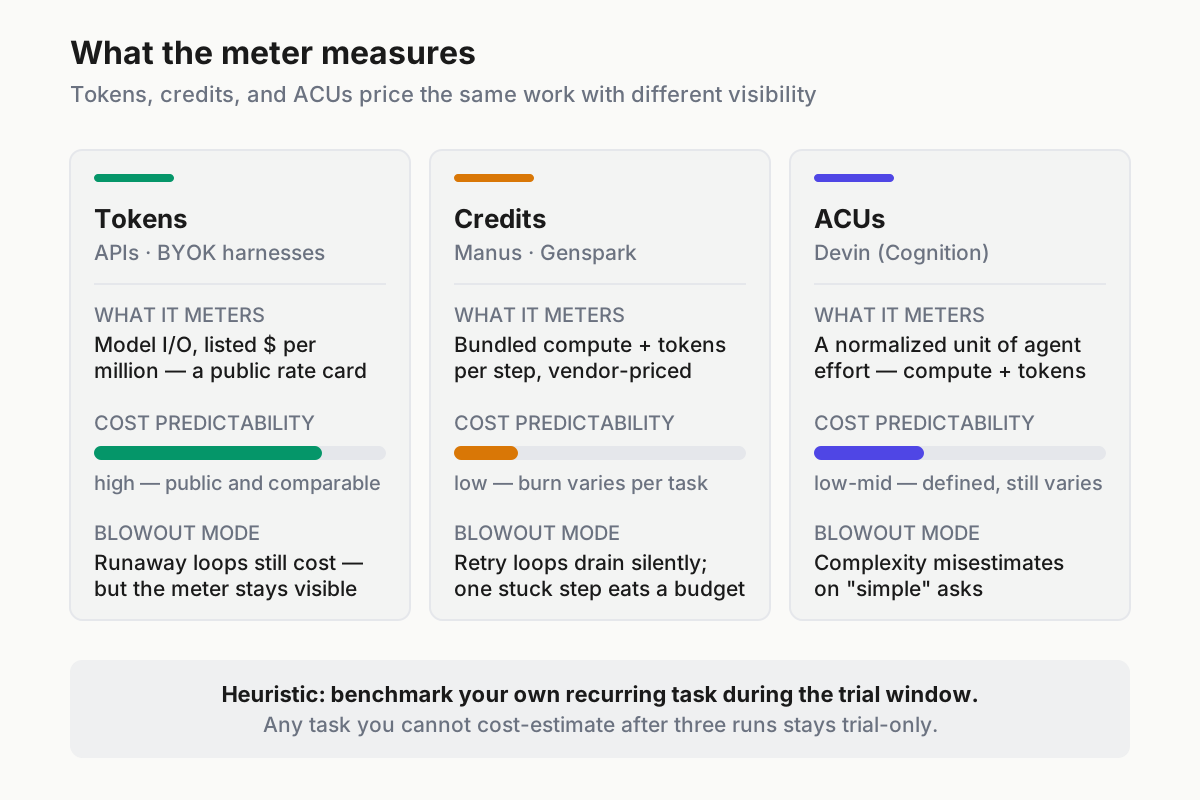
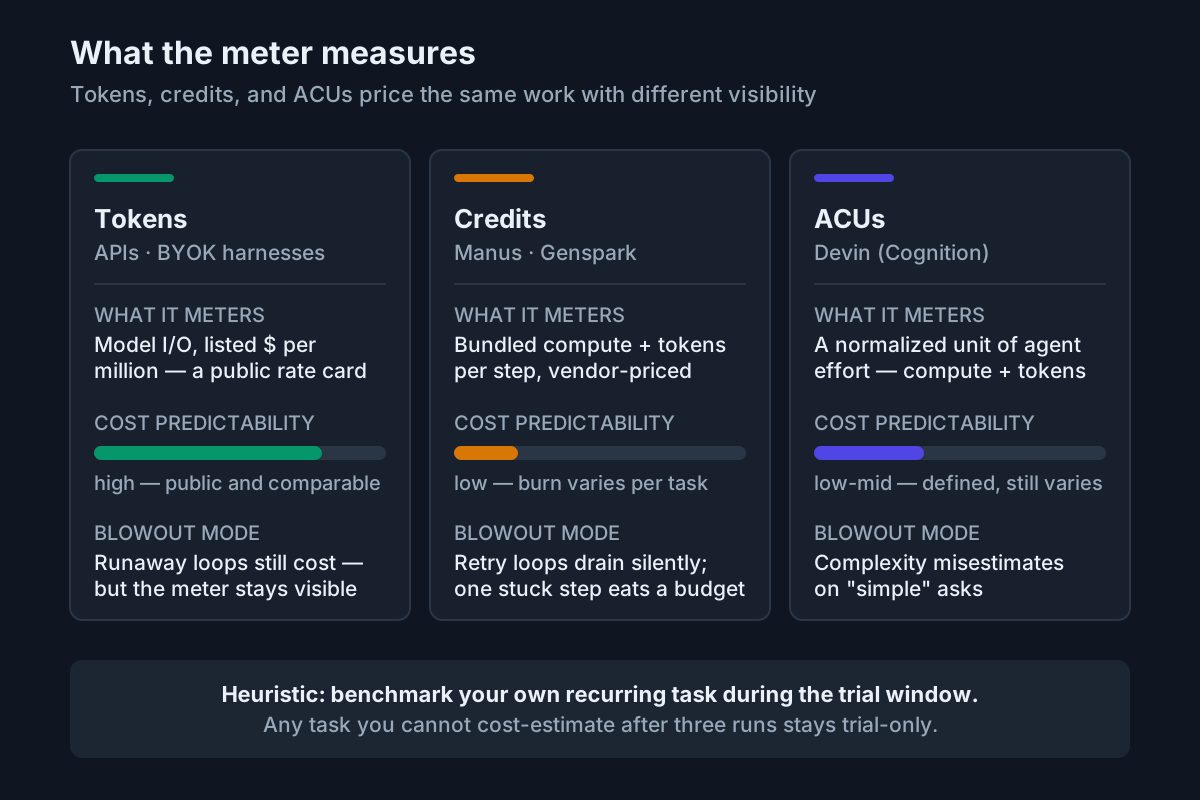 Three meters, one question: can you see what the work will cost before you commit to it?
The trust surface: your logins, repos, and docs in their cloud
Inventory the grant honestly. A workspace browser holds live logins. A connected repo carries tokens. An uploaded folder carries documents. That is a wider grant than any terminal CLI asks for: a harness keeps code and credentials on your machine, while a workspace moves both into vendor infrastructure. It is a real trade for real convenience — decided per data class, not by ideology.
One risk sits on top of standard SaaS trust: agents that browse the open web with your live sessions are exposed to prompt injection, which OpenAI’s own head of preparedness says may never be fully solved for browser agents. Plan as if a hostile page can reach whatever the workspace can reach.
Checklist logic, not vibes:
- Read data terms per vendor: retention, training-on-inputs defaults, session isolation, governing law. The jurisdiction facts above (Manus: Singapore-headquartered; Trae: ByteDance-owned) are inputs here — once, without adjectives.
- Scope every token: read-only where possible, per-repo rather than org-wide.
- Use dedicated accounts for browsing tasks; production credentials never enter a workspace browser.
- Decide per data class: public-web research is an easy yes; customer data and unreleased code are separate conversations with your own compliance owner.
- Plan the exit before the entry: know how to revoke the tokens, delete the uploads, and close the account — offboarding a workspace is part of adopting one.
- Apply the same operational guardrails you run on any agent fleet, and the least-privilege posture you apply to any software that acts with your permissions.
Convergence: the boundary is dissolving
Watched from mid-2026, the two categories are walking toward each other.
- Harnesses grew workspace features: Codex cloud tasks, Copilot’s coding agent that turns an assigned issue into a pull request, and the async lanes of Google’s Antigravity era all deliver delegate-and-return inside coding tools.
- Workspaces grew harness depth: Cognition folded an IDE into Devin Desktop, and Manus and Genspark keep adding repo and integration surface.
- The category question therefore dissolves into a fleet question — where does the work run: your machine, vendor cloud, or both — and the durable differentiator becomes supervision UX: how you review, steer, and interrupt work in flight.
- The falsifiable watch signals: checkpoint and diff quality, interruption latency, artifact provenance. Products that win on those win the merged category.
Picking a lane by persona and task shape
| You are | First pick | Runner-up |
|---|---|---|
| Researcher or analyst | A deliverable-focused workspace (Manus or Genspark class) | ChatGPT agent on the tier you already pay for |
| Engineer with a ticket backlog | Devin | Your harness’s cloud mode (Codex cloud, Copilot coding agent) |
| Harness power user | One workspace lane for browser-bound and parallel grunt work | A platform lane bundled with an existing subscription |
| Deliberate abstainer | Harness async modes, which now cover most of the category’s value | Revisit quarterly |
Two clarifications. For the harness power user — the reader this piece assumes — the move is additive: keep judgment-heavy work in the terminal where supervision is cheap, and delegate only what the task-shape filter clears; our tested tools roundup covers the vendor-harness side of that split. And the abstainer’s case is legitimate: if cost opacity or the trust surface disqualifies the category, you lose less than the marketing implies.
The fleet just got bigger
Adopting a workspace retires nothing. You now have terminal panes, cloud tasks, and workspace runs — more agent sessions in more places, each with its own history, artifacts, and spend. The operational questions multiply on contact: what ran where, what did it produce, what did it cost, and which session holds the decision you will need to find again next quarter.
That is the command-center problem, now spanning local and cloud. The pattern that works is reconciliation: one local layer where every session is findable, searchable, and metered regardless of which surface ran it — you own the record even when the work ran in someone else’s cloud.
Product note: Cloud workspaces multiply where your agent work lives. Automater Lite is the local operating layer that reconciles it — archive and full-text search across 10+ CLIs, live fleet health, and per-provider token metering, all on your machine. Free on automater.ai.
FAQ: AI agent workspaces
What is an AI agent workspace?
An AI agent workspace is a cloud environment — VM, browser, filesystem, shell — that an agent owns and operates. You delegate whole tasks rather than supervising turns, then review finished artifacts (reports, decks, sites, PRs) at checkpoints. Manus, Genspark, Devin, ChatGPT agent, and Claude Cowork define the category in 2026.
What is Manus AI?
Manus AI is a general autonomous agent from Butterfly Effect, now headquartered in Singapore, that runs tasks in a cloud VM with its own browser and returns artifacts — reports, sites, decks — plus a replayable session log. Pricing is credit-based: a free daily allowance with paid tiers above.
How much does Devin cost?
Per mid-2026 reporting, Devin starts around $20 a month plus usage metered in ACUs — Agent Compute Units, Cognition’s normalized bundle of the compute and tokens behind a slice of active agent work. Complex tasks burn more ACUs, so per-task cost varies with scope.
Is Genspark free?
Genspark offers a free daily credit allowance that covers light use, with paid tiers lifting the cap for heavier or parallel work. As with every credit system in this category, per-task burn varies with complexity, so benchmark a recurring task of your own before paying.
Are autonomous AI agents actually useful?
Yes, for a specific shape: closed-ended, artifact-producing, browser-dependent, retry-tolerant tasks — research briefs, form-heavy workflows, parallel grunt work. On long-horizon open-ended work they still drift, compound early mistakes, and demand enough checking that supervised harness work is often cheaper in attention.
What is the difference between Devin and Claude Code?
Devin is a workspace: it runs your ticket in its own cloud environment and returns a pull request you review at checkpoints. Claude Code is a harness: it works in your terminal, on your files, under diff-by-diff supervision. Same goal, opposite supervision contracts.