GitHub Brings Coding Work Into Slack and Teams, With Shared Review in Teams Canvas
@GitHub is generally available in Slack and Teams. Teams Canvas adds shared implementation plans, code changes and previews, while the announcement leaves pricing and permission details unspecified.
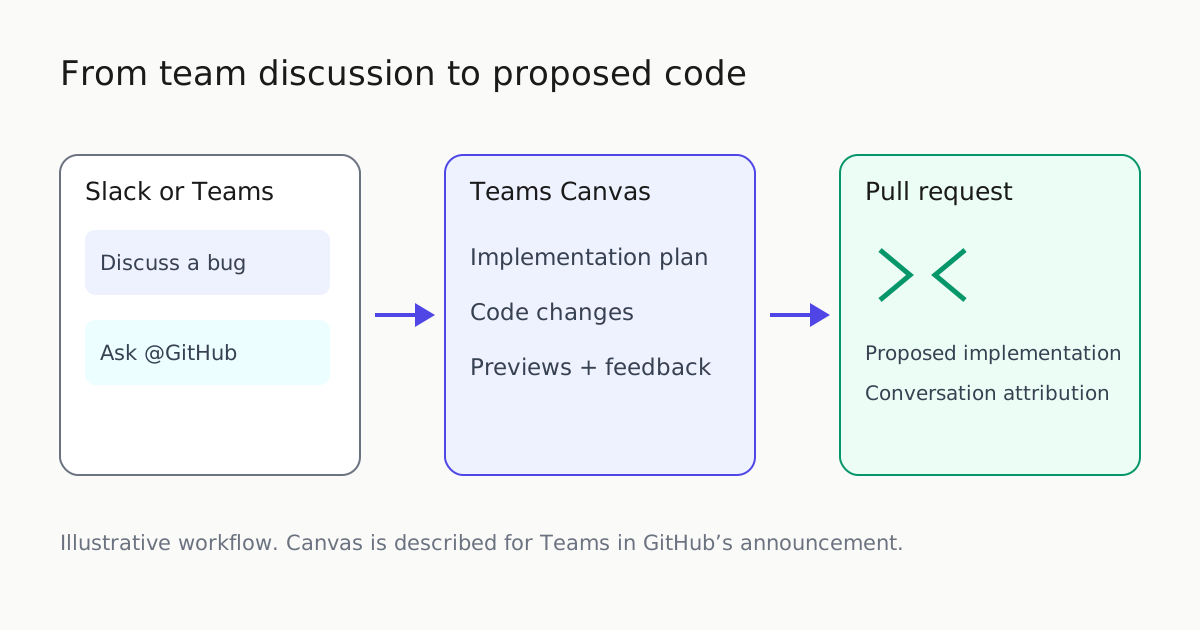
GitHub has made @GitHub in Slack and Teams generally available, bringing bug investigation, issue creation, implementation and pull-request creation into workplace conversations. The consequential addition is Teams Canvas: teammates can review implementation plans, code changes and previews alongside their discussion, according to GitHub’s announcement.
For engineering teams that already discuss bugs and proposed changes in those channels, this puts a coding workflow closer to the place where work gets defined. The practical change is a shared surface for discussing an implementation while it develops. GitHub’s announcement establishes those capabilities; it does not establish faster delivery, better code or reduced review effort.
What teams can do inside the conversation
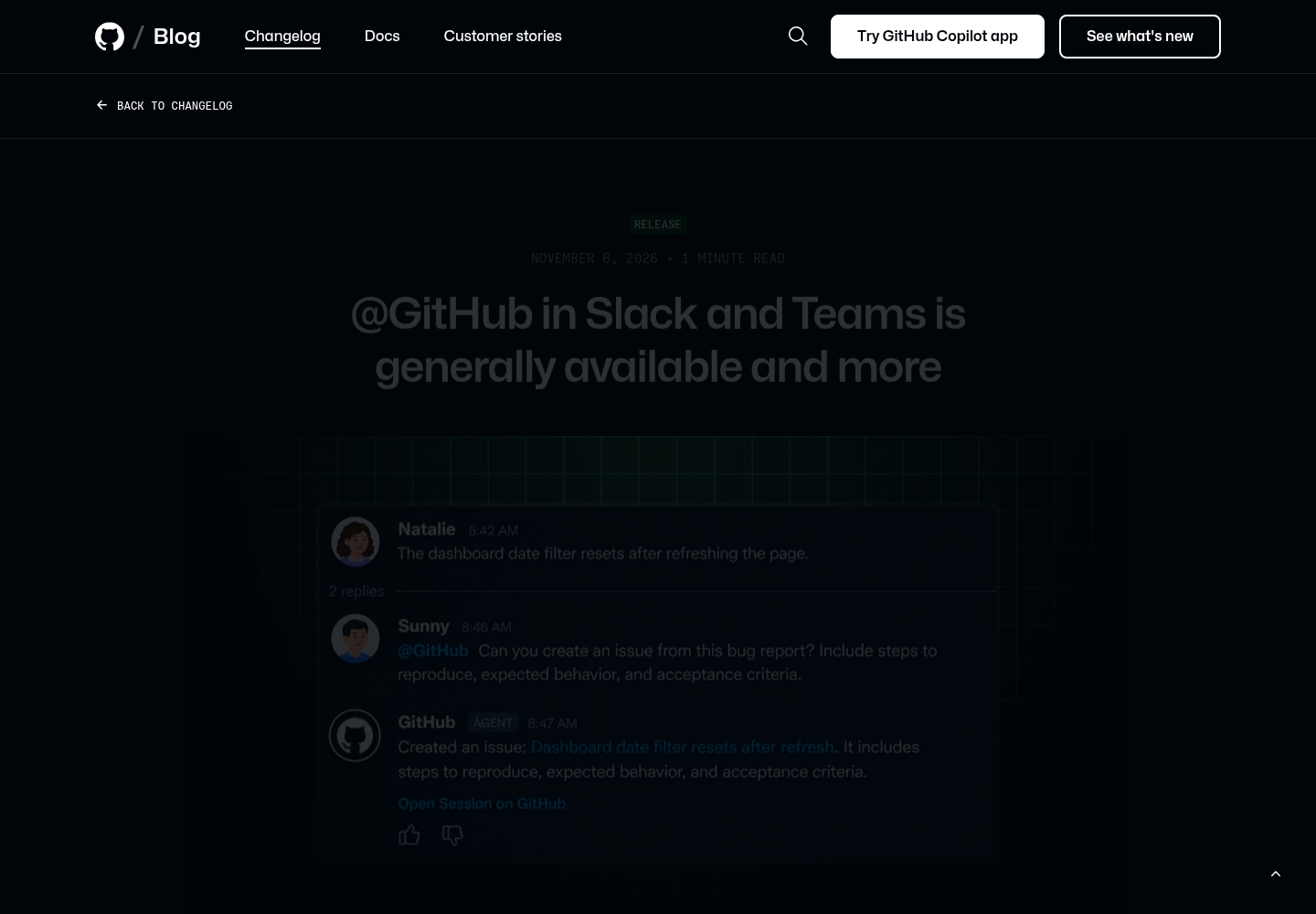
GitHub says users can investigate bugs, create issues, implement changes and open pull requests without leaving their conversation. Canvas adds a more specific collaboration capability in Teams: participants can inspect a plan, review code changes, see previews and give feedback while continuing the discussion. The announcement describes Canvas for Teams; it does not establish an equivalent Canvas surface in Slack.
Consider a team discussing a reproducible interface bug. The announced workflow would let participants ask @GitHub to investigate, examine an implementation plan in Teams, discuss the proposed change and move toward a pull request. That example illustrates the supported workflow rather than a tested result. The source does not document which application previews work, how long sessions take or how reliably the agent resolves a particular class of bug.
The release also reduces friction at the start of a coding session. GitHub says @GitHub can identify the repository from a message and launch the session without asking users to select that repository again. It describes improvements for users who are not signed in, lack a default repository, want to switch repositories or need app access. These are supporting improvements to an existing workflow, rather than evidence that repository access checks have disappeared.
GitHub also reports a fix for an issue that could prevent responses to follow-up messages. Issues and pull requests created through the integration now include the attribution “Created from a Slack/Teams conversation with @username” in their descriptions. That gives a resulting work item an explicit connection to its conversational origin, although a description alone does not establish a complete audit trail.
A shared workspace, with distinct availability boundaries
The general-availability announcement matters because it extends coding work into a team communication surface. Its significance is clearest for developers and technical leads who need to discuss an agent’s plan and implementation together, rather than pass summaries between a private coding session and a group thread.
It also fits a wider expansion of Copilot’s working surfaces. GitHub’s weekly release roundup describes Copilot in JetBrains Air, plus integration with Xcode’s built-in coding assistant. Those have separate availability conditions: the roundup calls the Xcode integration a public preview starting with Xcode 27.3 beta. General availability for the Slack and Teams integration should not be read as general availability for every Copilot feature mentioned that week.
The supplied Slack and Teams announcement does not specify pricing, subscription eligibility or the full permission model. It therefore supports reporting the release and its named capabilities, but not a claim that every Slack or Teams user can immediately run coding sessions against any repository.
The infrastructure context is still a preview
GitHub is also preparing its underlying repository infrastructure for heavier agent activity. In a separate engineering account of its new Git storage architecture, published November 5, the company reports internal testing with 5,000 concurrent agents on a repository and 7,200 pushes per second. Those are company-reported infrastructure tests, not performance measurements for the Slack or Teams integration.
The architecture is in limited private preview, with a broader rollout planned for early next year. Its status must remain separate from the generally available conversation integration. Together, the documents show GitHub addressing both where people initiate agent work and how repositories might handle much more of it; they do not prove that the new storage architecture powers this release.
For teams evaluating the integration, the useful question is whether shared plans, changes and previews make an actual task easier to assess. Our standing-brief analysis distinguishes a channel agent that reports findings from one that proposes code changes. @GitHub’s announced workflow reaches into the latter category. Teams Canvas provides another place to inspect that work, while the pull request remains a concrete artifact to evaluate before accepting the implementation.