GitHub Copilot Code Review Adds Adaptive Effort, Secret Detection and Cross-Repo Context
GitHub's Nov 17 changelog lets Copilot pick Lite, Balanced or Max review depth per pull request, flags 500+ secret types plus unformatted credentials in review comments, reads related public repos for context, and takes Azure DevOps support and Repository Insights to general availability.
GitHub shipped five changes to Copilot code review on November 17, 2026: three public previews and two features that just reached general availability. Together they change who decides how hard Copilot looks at a pull request, add a credential scanner inside the review itself, and finally give Azure DevOps teams a supported, billed, audited reviewer. The three preview features — Adaptive, cross-repository context and secret detection — are available on Copilot Pro, Pro+, Max, Business and Enterprise plans; Azure Repos GA is billed separately through the linked Azure subscription, according to GitHub’s changelog.
Adaptive: Copilot picks Lite, Balanced or Max
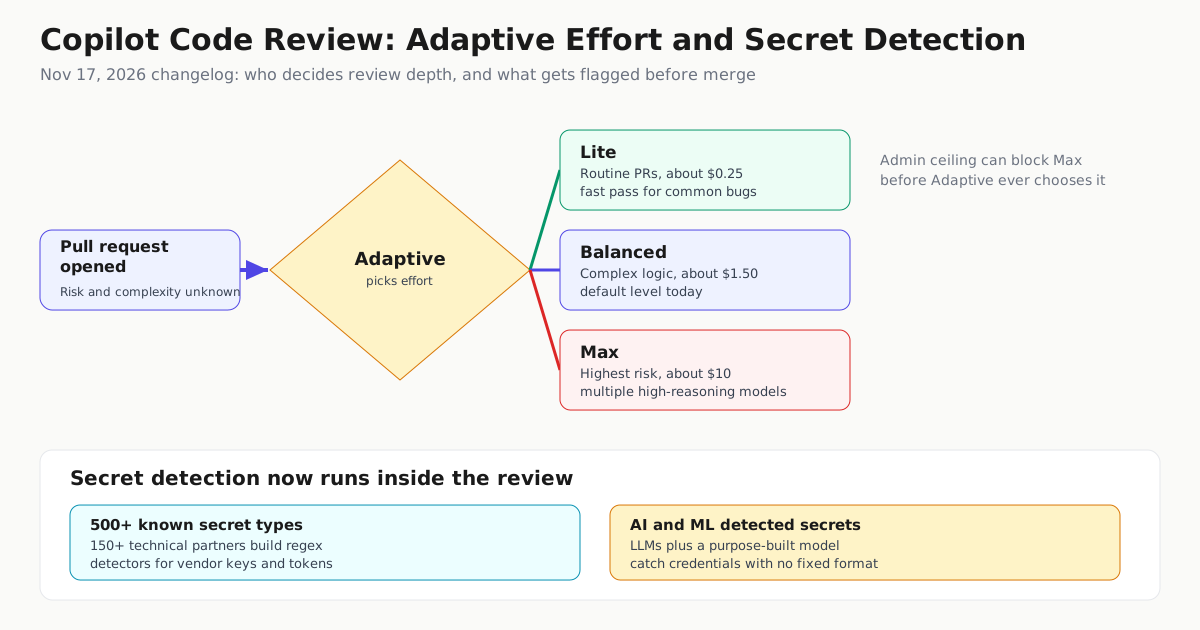
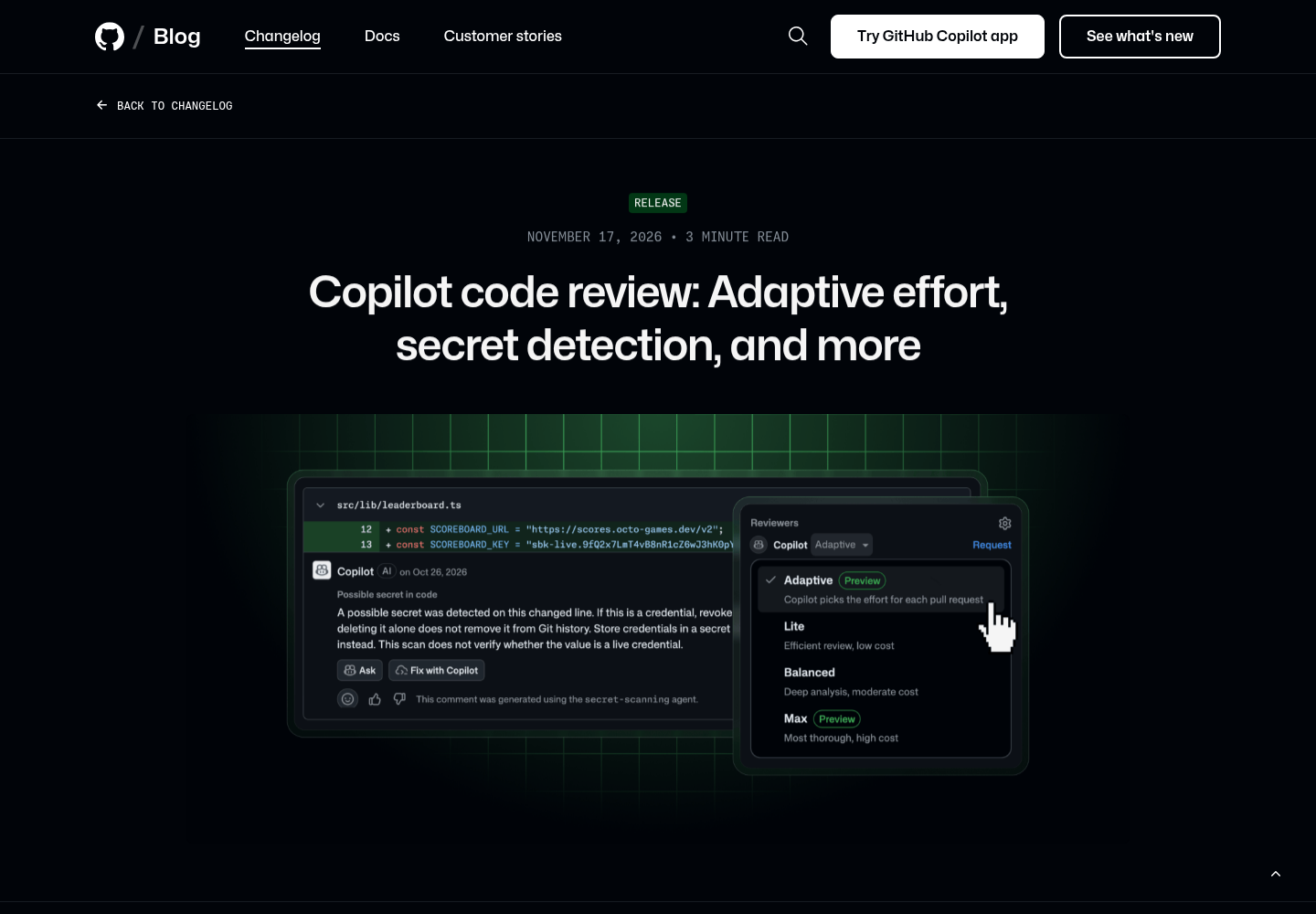
Until now, a human had to choose a review effort level in settings or when requesting a review. Adaptive, now in public preview, has Copilot weigh each pull request’s complexity and risk and pick Lite, Balanced or Max itself, labeling which level it used on the review. A documentation fix might get a Lite pass; a change to authentication logic can trigger Max, which runs multiple high-reasoning models on the same diff.
The guardrail that matters for budget owners: Adaptive never selects a level above the maximum review effort configured at the enterprise, organization or repository level, and Balanced stays the default until a team turns Adaptive on from the pull request’s Reviewers menu or in settings. AlphaSignal and Windows Forum both flag the cost spread behind that choice: GitHub’s own published ranges put a typical Lite review around $0.05-$1, Balanced around $0.25-$5, and Max around $1.50-$25 in GitHub AI credits, so a small share of pull requests escalated to Max can outweigh savings from routine reviews running cheaper at Lite. DataStudios models this out: a 400-PR-per-month team could pay roughly $600 a month if every review ran Balanced, versus roughly $350 if Adaptive split work evenly between Lite and Balanced under a Balanced-capped ceiling, or roughly $740 if Adaptive sent 10% of that volume to Max. GitHub has not published how Adaptive scores risk, so the safe rollout is to watch which levels it picks on a handful of repositories under an explicit cap before setting it as an org-wide default.
Secret detection enters the review itself
Copilot code review can now flag exposed credentials directly in review comments, in public preview. It combines two layers: deterministic regex-based detectors covering more than 500 secret types, built through GitHub’s secret scanning partnership program with 150+ technology partners, and an AI/ML layer using large language models plus a GitHub purpose-built secret detection model for credentials with no recognizable format, such as internal API keys or database passwords. Turn it on under repository or organization settings, then Copilot, then Code review.
This sits alongside, not instead of, GitHub’s existing secret scanning and push protection. The announcement makes no claim about detection accuracy for the model-based layer, which both Windows Forum and DataStudios flag as an open question worth testing with a limited rollout before trusting it broadly. A confirmed credential found in a pull request still needs to be rotated even if the PR never merges, since it already sits in commit history.
Cross-repository context, public repos only
A second preview, cross-repository context, lets Copilot read related public repositories while reviewing a pull request, so it can catch callers elsewhere that depend on a changed function, or pull in documentation and custom instructions stored in a separate repo. GitHub’s own example shows Copilot catching a caller in another repository still passing positional arguments after a function’s signature changed to accept an object. The preview is scoped to public repositories only, so private multi-repo codebases cannot use it yet, and repository administrators can turn off the underlying “search public repositories” setting if they don’t want it.
Repository Insights and Azure DevOps reach GA
Two changes left preview entirely. Repository Insights now shows, for any repository you can read, how Copilot’s review feedback gets addressed and used, under the repository’s Insights tab. And Copilot code review for Azure Repos is now generally available after a public preview, letting Azure DevOps teams enable it at the organization, project or repository level, request reviews automatically through branch policy, and bill usage in GitHub AI credits through the linked Azure subscription with Azure Cost Management tracking. Azure DevOps reviews currently default to Lite or Balanced only; GitHub’s changelog does not list Adaptive or Max there.
What changed, at a glance
| Feature | Status | Scope |
|---|---|---|
| Adaptive review effort | Public preview | Picks Lite, Balanced or Max within an admin-set ceiling |
| Secret detection in reviews | Public preview | 500+ known formats plus AI/ML detection for unformatted credentials |
| Cross-repository context | Public preview | Reads related public repositories only |
| Repository Insights | Generally available | Per-repository Copilot review outcome tracking |
| Azure DevOps support | Generally available | Billed through linked Azure subscription |
What to check this week
The practical move for teams already running Copilot code review at scale: find the maximum review effort set at your enterprise, organization and repository level before turning Adaptive on anywhere, since that ceiling is the only thing stopping it from routing a routine-looking diff to a $10-average Max review. Pilot Adaptive on two or three repositories first and compare the levels it picks against your current Balanced-only spend. Turn on secret detection in a single test repository and track false positives before enabling it org-wide, since the AI/ML layer is explicitly probabilistic. If you don’t want Copilot reading your public dependencies or docs during review, know that the cross-repository “Search public repositories” setting is on by default, and repository administrators can turn it off under Copilot code review settings. None of this makes Copilot a substitute for human review; GitHub doesn’t claim it does, and Azure Repos reviews still only leave Comment-level feedback that never blocks a merge on its own.
This is a different change from GitHub’s recent extension of secret scanning to Actions workflow logs, which catches secrets printed during CI rather than ones sitting in a diff, and it builds on the configuration surface covered in our walkthrough of Copilot code review’s GraphQL settings API. Both are worth a look if you’re tightening review policy alongside this rollout.
Sources
- Copilot code review: Adaptive effort, secret detection, and more - GitHub Changelog
- GitHub's Copilot Now Judges Its Own Code Review Effort Automatically | AlphaSignal
- GitHub Copilot Code Review Adds Adaptive Effort and Secret Detection; Azure Repos Reaches GA
- GitHub Copilot code review adds Adaptive effort and 500+ secret type detection