OpenCode 2.2.3 Adds a Claude Agent Provider: Use Your Claude Code Login and Models Inside OpenCode
OpenCode 2.2.3 adds a Claude Agent provider: install Claude Code, log in once, and run Claude models inside the open-source harness on your existing subscription.
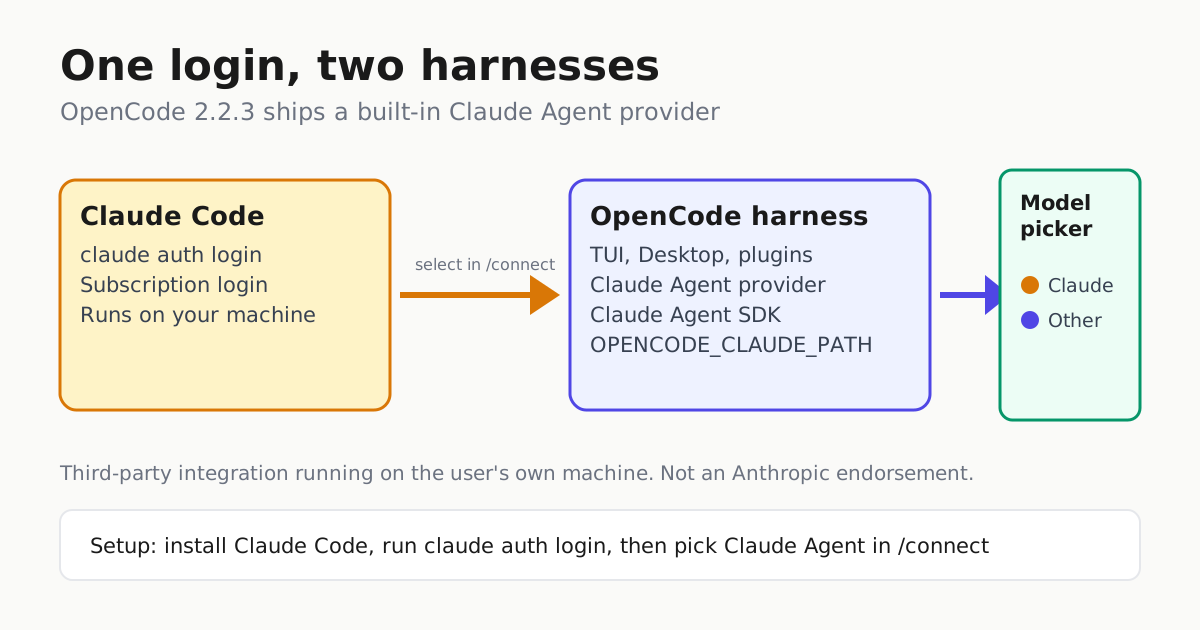
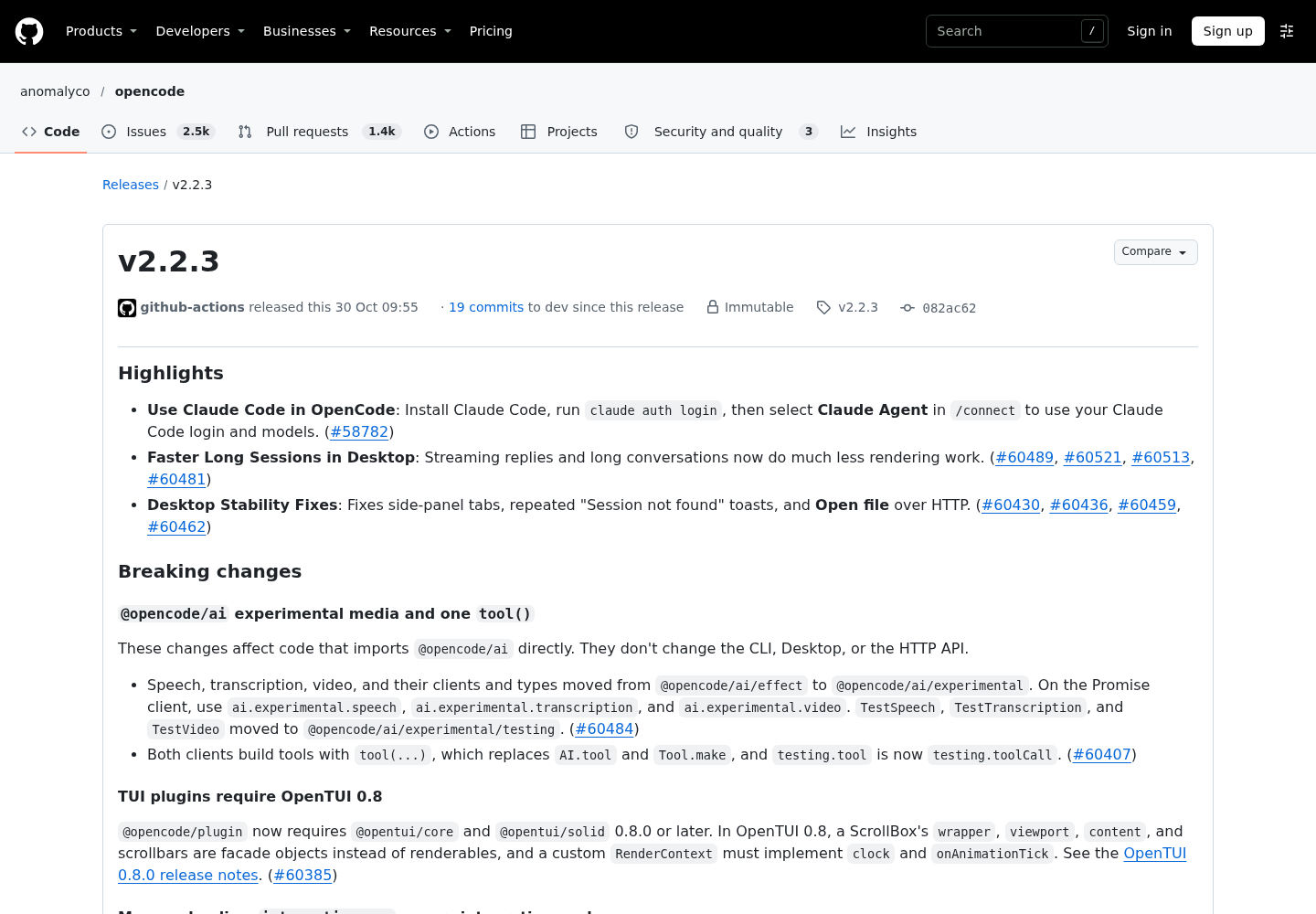
OpenCode v2.2.3, published October 30, ships one headline change that matters to anyone choosing a coding-agent harness: a built-in Claude Agent provider. After a one-time setup, an existing Claude Code login and its models become selectable inside OpenCode — the open-source, third-party harness — instead of requiring a separately billed Anthropic API key.
What shipped
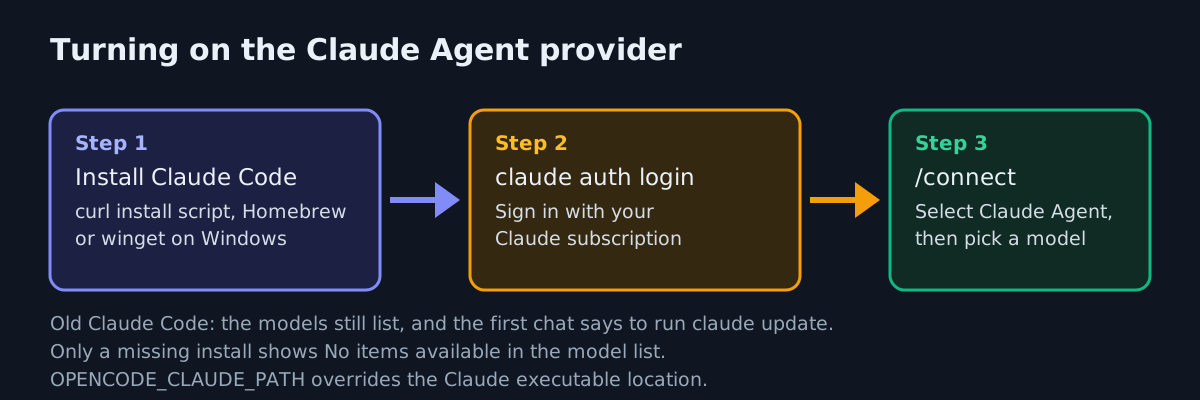
The release notes describe the setup in three steps:
- Install Claude Code.
- Run
claude auth login. - Select Claude Agent in OpenCode’s
/connectmenu.
From then on, the models tied to that Claude Code login appear in OpenCode’s model picker. An OPENCODE_CLAUDE_PATH environment variable can point OpenCode at a non-default Claude executable. That is a genuinely new capability rather than a version bump: subscribers who prefer OpenCode’s TUI, Desktop app, plugins and multi-provider model picker — the trade-offs we covered in open-source coding agents — can now run Claude on the plan they already pay for.
The implementing pull request #58782, contributed by Tarquinen and merged October 30, explains the mechanics. The provider runs Claude models through the user’s own Claude Code login using the Claude Agent SDK, adding an optional @anthropic-ai/claude-agent-sdk peer dependency to @opencode/core. Provider settings such as baseURL, apiKey and authToken map onto Claude Code environment variables, and OpenCode’s tools reach Claude through a single lazily loaded MCP server.
One detail from the PR is worth flagging for anyone who has tried unofficial bridges before: the provider deliberately stops forwarding OpenCode’s own date and environment system parts, because sending them “made Claude subscriptions reject chat requests as a third-party app.” The integration also handles lifecycle edge cases — keeping the Claude process alive while OpenCode runs its tools, ignoring tool calls Claude Code answers itself, and reporting an outdated Claude Code in chat with a prompt to run claude update rather than failing silently.
How to set it up
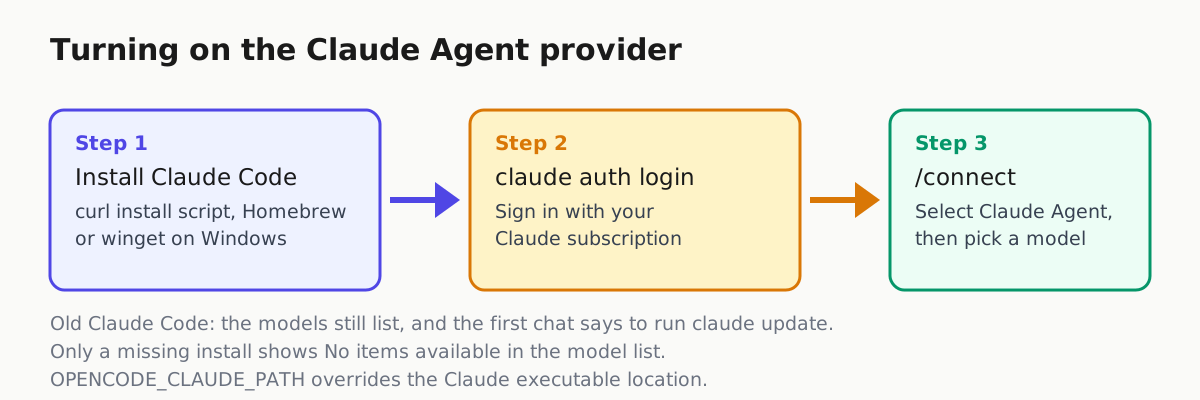
If you do not already have Claude Code, Anthropic’s docs give the native install command for macOS, Linux and WSL:
curl -fsSL https://claude.ai/install.sh | bash
claude --version   # verify the install
claude auth login  # sign in with your Claude subscription
Windows users can install with winget install Anthropic.ClaudeCode or the PowerShell installer, and native installations update themselves in the background. Then move to the 2.x line: the releases feed currently marks the 1.x series (v1.19.5) as Latest, so if you are still on 1.x you have to upgrade to OpenCode 2 explicitly — v2.2.3 is the newest 2.x release. Open /connect, choose Claude Agent, and the subscription models appear alongside your other providers.
Two caveats. First, this is a third-party integration, not an Anthropic endorsement — whether routing a Claude subscription through another harness complies with the subscription’s terms remains each user’s own assessment, and the release notes do not address it. Second, the PR’s automated review flagged a rough edge: in its pre-merge testing, connecting without Claude Code installed still reported success and showed a model list with only “No items available,” so verify claude --version works before blaming OpenCode.
If you run Claude lanes hard, the usual capacity rules still apply — see keeping parallel sessions inside the Claude Code usage limit.
Everything else in 2.2.3
The release also cuts rendering work for streaming replies and long conversations in the Desktop app, and fixes a 2.2.2 regression that broke side-panel tabs, plus repeated “Session not found” toasts and Open file over HTTP.
There are real breaking changes, but only for two audiences. Code importing @opencode/ai directly must move speech, transcription and video APIs from @opencode/ai/effect to @opencode/ai/experimental, and build tools with tool(...) instead of AI.tool or Tool.make. TUI plugin authors must target OpenTUI 0.8. The CLI, Desktop and HTTP API are unaffected. Managed-policy admins should also note that a bare integration.use rule no longer covers MCP servers, skills or plugins — those get separate mcp.use, skill.use and plugin.use actions, with old-prefixed rules converted automatically.
Why it matters
This is the feature’s first shipping version, landing one day after v2.2.2’s image-generation default and v2.2.1’s /goal command. For teams already standardizing on OpenCode as a harness across many providers, the Claude Agent provider puts the subscription lane on the same picker as everything else: you drive Claude from OpenCode’s model picker, while Claude Code stays installed as the authentication and runtime backend. The argument is the one we made in own the loop, rent the model — run one harness, rent the model — and the Claude lane is now a first-class entry in it.