JetBrains Releases Open-Weight Mellum2.1 Instruct for Low-Latency Coding Sub-Agents and Tool Loops
JetBrains releases Mellum2.1 Instruct under Apache 2.0, cutting coding-agent token output in half with GGUF builds and an MTP speculative head for up to 1.8x faster generation.
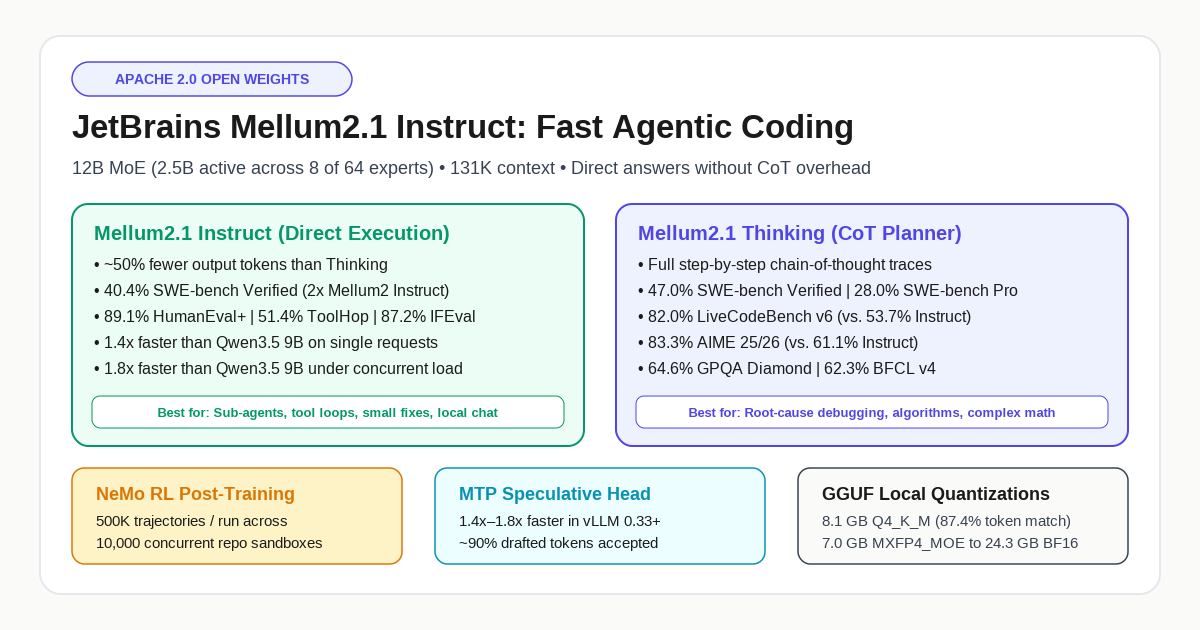
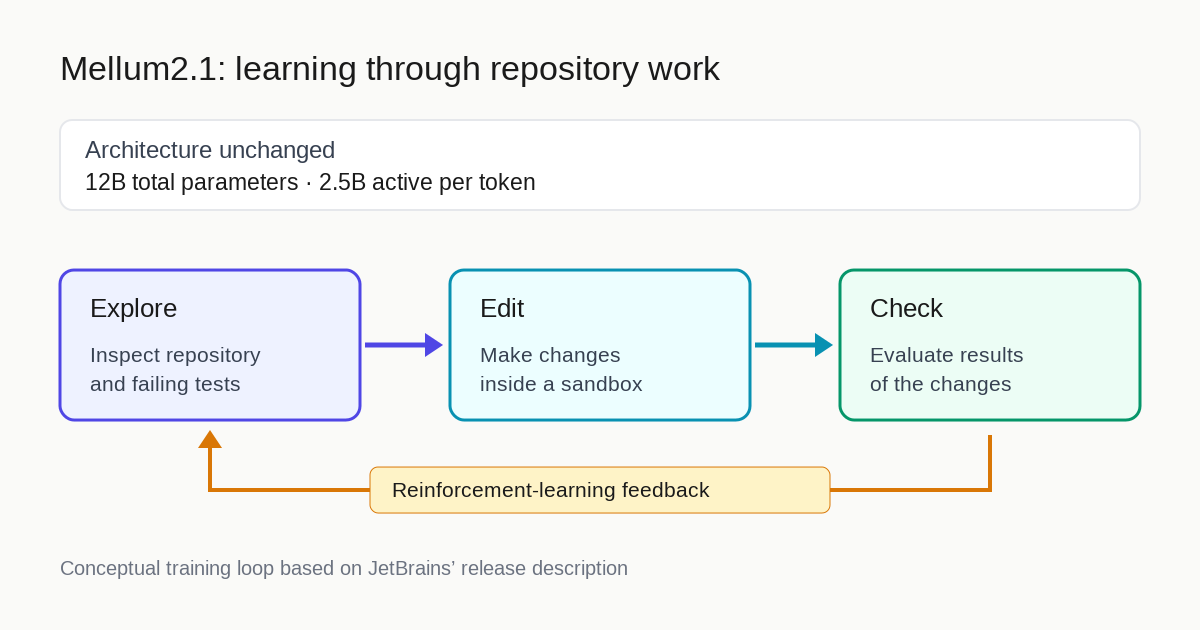
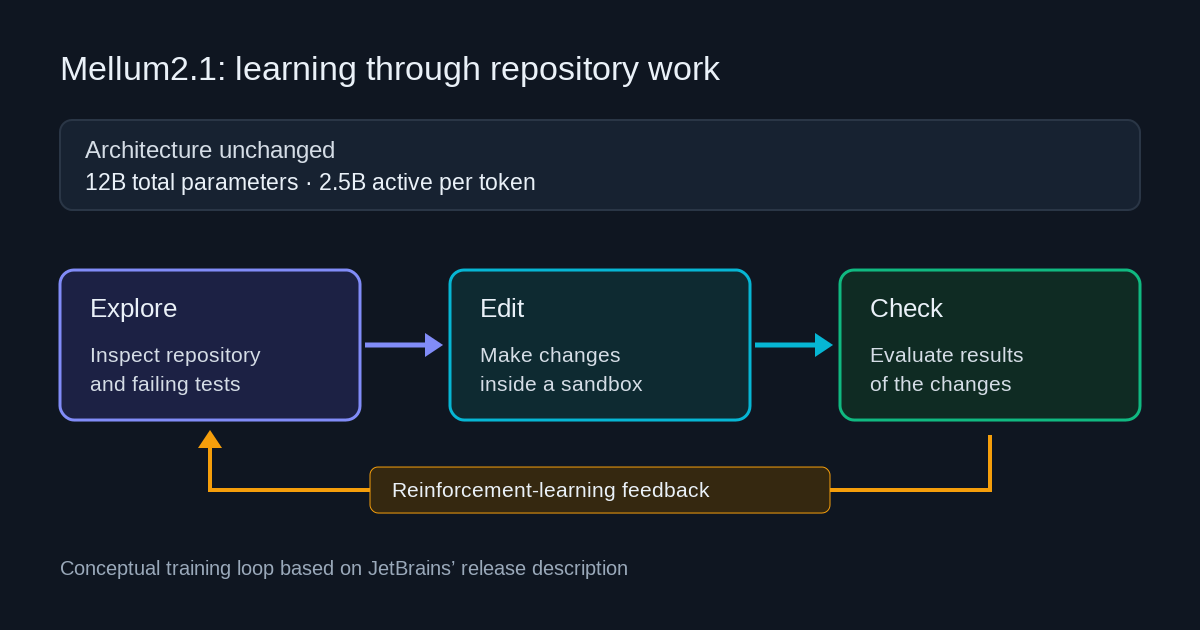
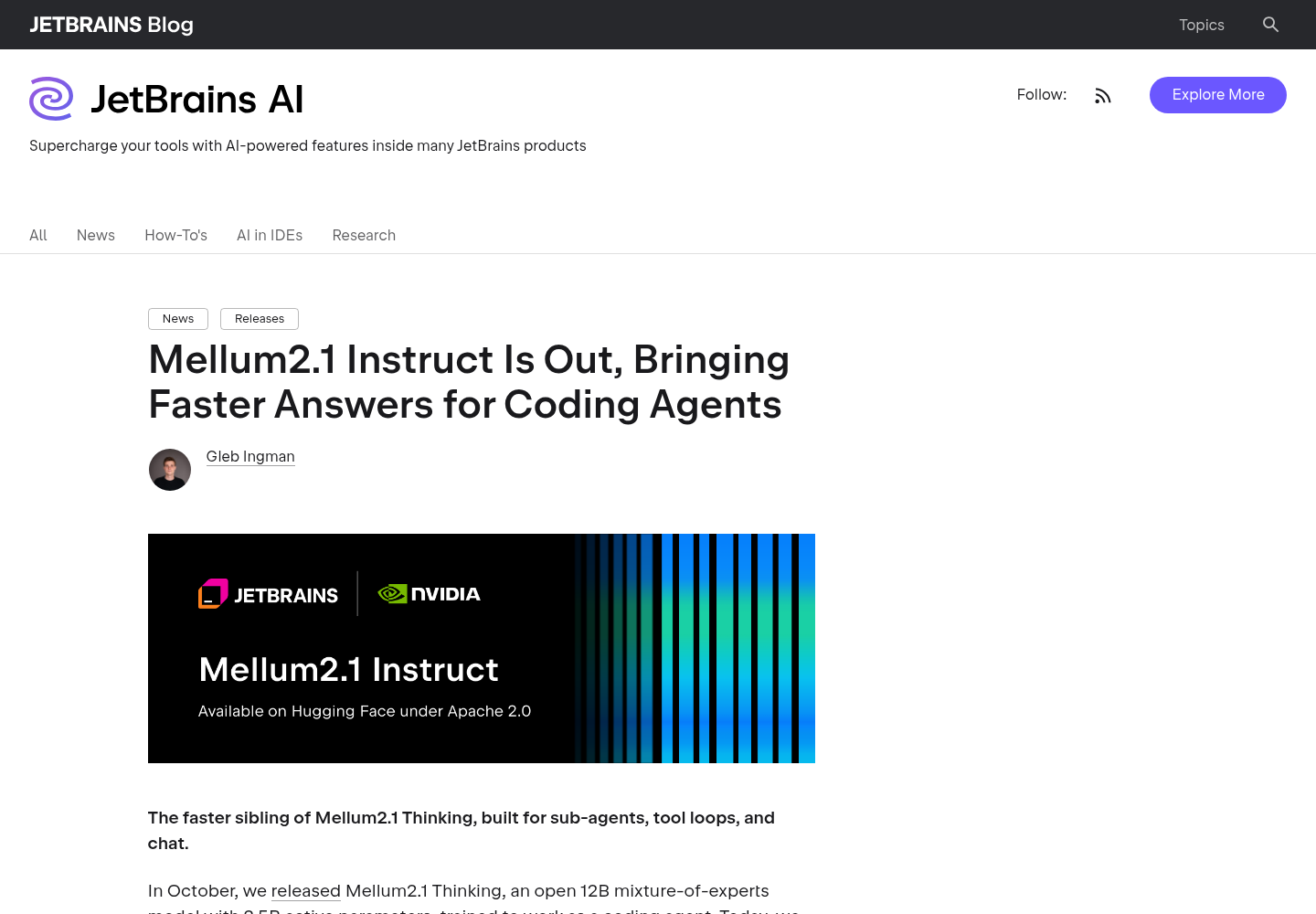
JetBrains has released Mellum2.1 Instruct, an open-weight 12-billion-parameter Mixture-of-Experts (MoE) model under the Apache 2.0 license built for coding sub-agents, tool-calling loops, and low-latency IDE chat. Following October’s launch of Mellum2.1 Thinking—covered when JetBrains released Mellum2.1 for self-hosted coding agents—the Instruct sibling shares the same 2.5-billion-active-parameter architecture and reinforcement learning pipeline but answers directly without externalized chain-of-thought traces.
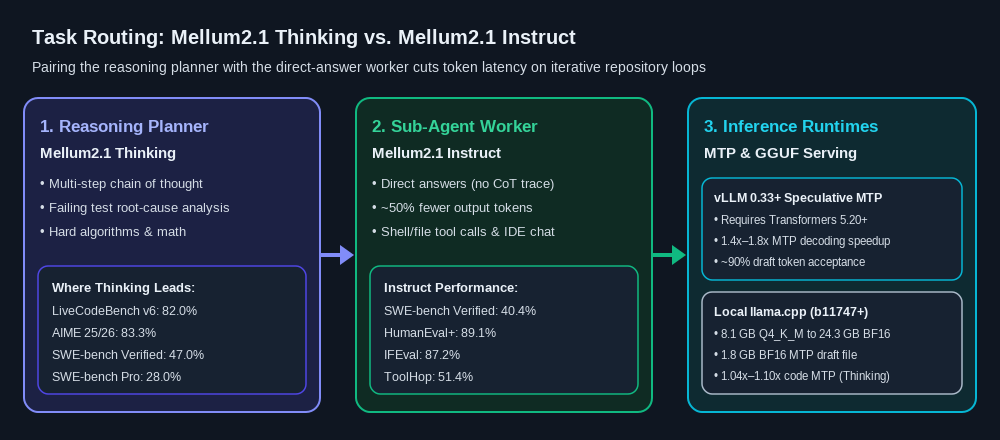
On repository-level agentic tasks, omitting reasoning traces cuts output tokens by roughly half while resolving 40.4% of SWE-bench Verified tasks—doubling Mellum2 Instruct’s 20.2% score and approaching Mellum2.1 Thinking’s 47.0%. JetBrains published the BF16 safetensors weights, a Multi-Token Prediction (MTP) speculative decoding checkpoint, and quantized GGUF builds on Hugging Face. While all checkpoints are downloadable now for self-hosted deployment, no third-party Hugging Face Inference Providers currently host the model as a managed API.
Direct Answers vs. Reasoning in Multi-Agent Coding Loops
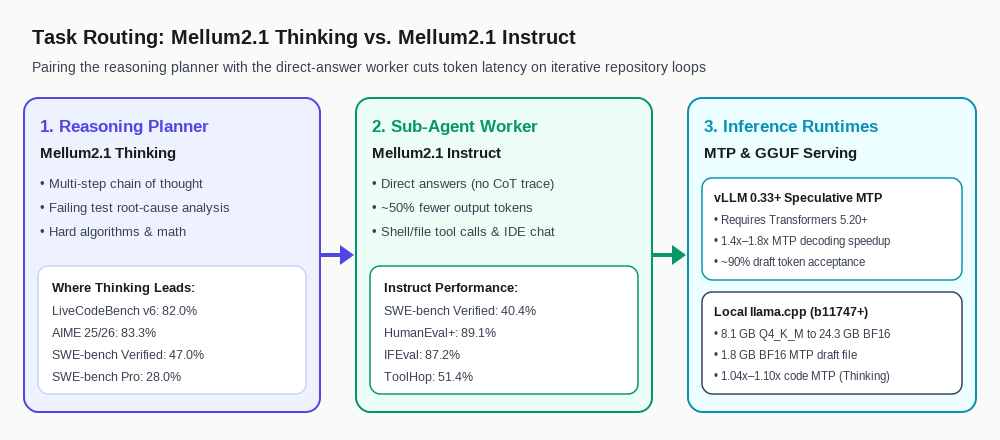
Step-by-step reasoning helps agents diagnose complex test failures, but routine coding subtasks—drafting shell commands, applying small patches, iterating through tool loops, or answering codebase questions—rarely benefit from long deliberation. On local hardware, every extra thinking token adds wall-clock latency. JetBrains built Mellum2.1 Instruct after local-inference users requested a concise model that runs standalone on moderately hard tasks or acts as a fast worker sub-agent beside a reasoning planner.
The model retains the 28-layer Mellum2 architecture with 12B total parameters and 2.5B active parameters per token across 64 experts (8 activated per token), Grouped-Query Attention (32 query and 4 KV heads), a 98,304-token vocabulary, and a 131,072-token context window with a 1,024-token sliding window on three of every four layers.
Post-training uses the same two-stage reinforcement learning pipeline as Mellum2.1 Thinking, powered by NVIDIA’s open-source NeMo RL and NeMo Megatron-Bridge libraries across NVIDIA H200 and B300 GPU clusters. After stage-one training on standalone code, math, tool-use, and instruction tasks, stage two trains the model inside real repositories using sandboxed shell and file tools, rewarding it only when hidden tests pass. A single run collects roughly 500,000 agent trajectories across 10,000 concurrent sandboxes. For Instruct, JetBrains tuned the length penalty to keep direct responses concise without losing quality and aligned generation closer to training updates for stability.
Benchmark Performance and Throughput Trade-Offs
JetBrains compared Mellum2.1 Instruct against Mellum2.1 Thinking, Mellum2 Instruct, Qwen3.5 9B, and Gemma 4 E4B (with thinking disabled on peer models). Agentic benchmarks ran in the open-source Pi v0.73.1 harness with shell and file tools, a 114K-token context budget, and up to 16K tokens per turn.
| Benchmark | Mellum2.1 Instruct | Mellum2.1 Thinking | Mellum2 Instruct | Qwen3.5 9B | Gemma 4 E4B |
|---|---|---|---|---|---|
| SWE-bench Verified | 40.4% | 47.0% | 20.2% | 49.8% | 6.4% |
| SWE-bench Pro | 20.0% | 28.0% | 12.0% | 12.7% | 4.7% |
| HumanEval+ | 89.1% | 91.5% | 84.8% | 84.8% | 85.4% |
| LiveCodeBench v6 | 53.7% | 82.0% | 40.4% | 65.2% | 64.8% |
| AIME 25/26 (avg@8) | 61.1% | 83.3% | 32.3% | 69.2% | 36.7% |
| ToolHop | 51.4% | 49.1% | 47.2% | 51.6% | 39.0% |
On SWE-bench Verified, Mellum2.1 Instruct doubles its predecessor’s score to 40.4% and outperforms non-thinking Qwen3.5 9B on SWE-bench Pro (20.0% vs. 12.7%), HumanEval+ (89.1% vs. 84.8%), MBPP+ (74.3% vs. 63.8%), and MultiPL-E across seven languages (73.7% vs. 66.4%). It also matches Qwen3.5 9B on multi-step tool use (ToolHop 51.4% vs. 51.6%) and instruction following (IFEval 87.2% vs. 87.1%), while improving from 22.2% to 38.0% on WorkBench and scoring 46.5% on BFCL v4.
While Qwen3.5 9B scores higher on SWE-bench Verified (49.8%) and Terminal-Bench 2.1 (17.6% vs. 8.2%), it activates all 9B parameters per token. Activating only 2.5B parameters lets Mellum2.1 Instruct generate tokens roughly 1.4x faster than Qwen3.5 9B on single requests and 1.8x faster under concurrent load. Conversely, large gaps behind Mellum2.1 Thinking on LiveCodeBench v6 (53.7% vs. 82.0%) and AIME 25/26 (61.1% vs. 83.3%) confirm that complex algorithmic synthesis and math still require explicit chain-of-thought reasoning.
Speculative Decoding With MTP and Local GGUF Deployment
JetBrains also shipped a Multi-Token Prediction (MTP) head—one extra transformer block (model-mtp.safetensors, num_nextn_predict_layers: 1) trained jointly to draft the next token. In vLLM 0.33+ with transformers 5.20+, MTP speculative decoding runs 1.4x to 1.8x faster with roughly 90% draft acceptance and identical outputs. Operators on vLLM 0.32 or older must serve the base Instruct checkpoint, as earlier vLLM versions reject mtp. tensor prefixes.
For local runtimes (llama.cpp, Ollama, and LM Studio), the GGUF repository ships five quantizations benchmarked against BF16 on Wikitext-2: BF16 (24.3 GB), Q8_0 (12.9 GB, 96.2% top-token match, 0.010 KLD), Q6_K (10.9 GB, 94.3% match), recommended Q4_K_M (8.1 GB, 87.4% match, 0.100 KLD), and MXFP4_MOE (7.0 GB, 84.3% match), alongside a 1.8 GB BF16 MTP draft file and combined mtp/ bundles requiring llama.cpp build b11747 (October 19, 2026) or newer.
As detailed in our guides to measuring llama.cpp speculative decoding and MTP speedups and configuring llama-server flags for coding agents, local operators should verify MTP gains on their target hardware. In JetBrains’ llama.cpp benchmarks of the Mellum2.1 Thinking MTP head—which shares the exact same layer shape—on an Apple M2 Max (Metal, 512 greedy tokens averaged across ten prompts), drafting one token (--spec-draft-n-max 1) yielded 1.05x BF16 speed overall and 1.04x to 1.10x on code prompts, but 1.00x (no gain) when pairing a Q4_K_M model with a Q8_0 head, while drafting two or more tokens was slower than plain decoding in every configuration.
# Serve on vLLM 0.33+ with Hermes tool calling and MTP speculative decoding
vllm serve JetBrains/Mellum2.1-12B-A2.5B-Instruct-MTP \
  --max-model-len 131072 \
  --enable-auto-tool-choice \
  --tool-call-parser hermes \
  --speculative-config '{"method": "mtp", "num_speculative_tokens": 1}'

# Serve the recommended 8.1 GB Q4_K_M GGUF locally with llama.cpp (b11747+) and MTP
llama-server -hf JetBrains/Mellum2.1-12B-A2.5B-Instruct-GGUF:Q4_K_M \
  --spec-type draft-mtp --spec-draft-n-max 1 \
  --ctx-size 131072 --port 8080 \
  --temp 0.6 --top-p 0.95 --top-k 20
Sources
- Mellum2.1 Instruct Is Out, Bringing Faster Answers for Coding Agents — The JetBrains Blog
- JetBrains/Mellum2.1-12B-A2.5B-Instruct Model Card — Hugging Face
- JetBrains/Mellum2.1-12B-A2.5B-Instruct-MTP Model Card — Hugging Face
- JetBrains/Mellum2.1-12B-A2.5B-Instruct-GGUF Model Card — Hugging Face
- Mellum2.1 Gets to Work: A Fast Open Model for Coding Agents — The JetBrains Blog
Sources
- Mellum2.1 Instruct Is Out, Bringing Faster Answers for Coding Agents - The JetBrains Blog
- JetBrains/Mellum2.1-12B-A2.5B-Instruct · Hugging Face
- JetBrains/Mellum2.1-12B-A2.5B-Instruct-MTP · Hugging Face
- JetBrains/Mellum2.1-12B-A2.5B-Instruct-GGUF · Hugging Face
- Mellum2.1 Gets to Work: A Fast Open Model for Coding Agents - The JetBrains Blog