OpenAI Preprint Claims the Matrix Multiplication Exponent Is Exactly 9/4, With a Lean-Checked Core
A November 24 OpenAI preprint claims the matrix multiplication exponent omega is exactly 9/4, pairing an AI-found lower bound with a matching upper bound and a Lean-checked core. What it says, how to verify it, and why it matters for research agents.
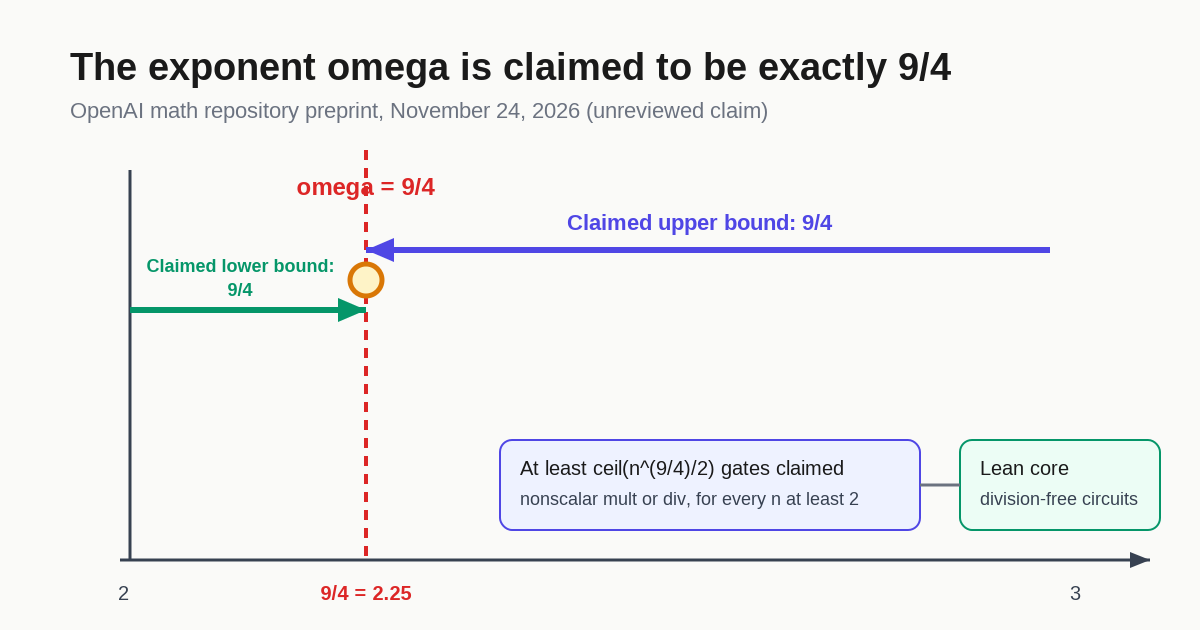
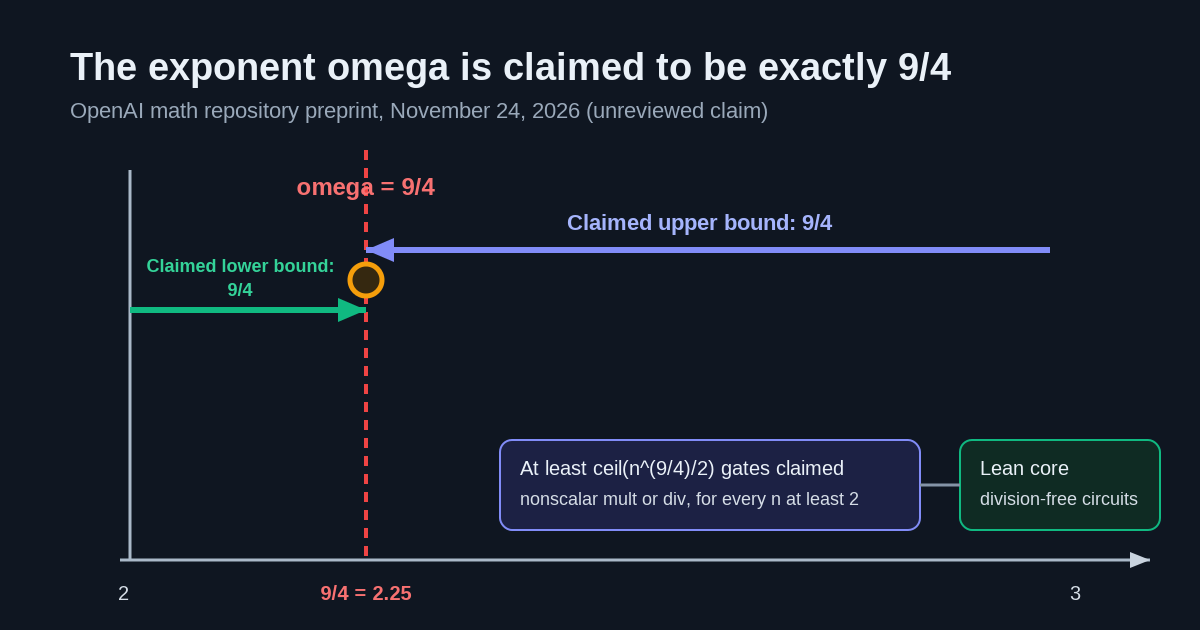
OpenAI’s mathematics repository posted a preprint on November 24, 2026 that, if it survives community review, would close one of the oldest open questions in the mathematics of computation: the exponent of square matrix multiplication, written omega. The manuscript’s README states the result plainly: the exponent of square matrix multiplication is 9/4 over every field, and the paper proves the matching lower bound for formal arithmetic circuits. At every side length n >= 2, at least ceil(n^(9/4)/2) nonscalar multiplication or division gates are required. The geometric border rank of the square multiplication tensor is at least n^(9/4), and its asymptotic rank over the base field equals n^(9/4). These are claims in a preprint, not settled mathematics; the repository says the community decides credit, precedence and status.
Why a number this small is a big deal
Matrix multiplication is the arithmetic heart of linear algebra: nearly every kernel in model training and inference eventually reduces to it. The naive algorithm scales as n^3, and the field has spent decades looking for faster methods and squeezing omega downward. What makes this preprint striking is not another improvement on one side: it claims to pin the value exactly, with a lower bound matching the upper bound. That would settle the question rather than nudge it.
The claimed lower-bound argument is concrete rather than purely abstract. As TLDR AI’s November 25 coverage relays the paper’s own argument, a smaller exponent would compress tensor networks enough to violate a lower bound for testing whether the entries in several independent lists are distinct. That is the manuscript’s claimed hinge; independent readers still have to check it.
The AI provenance, and the reason for caution
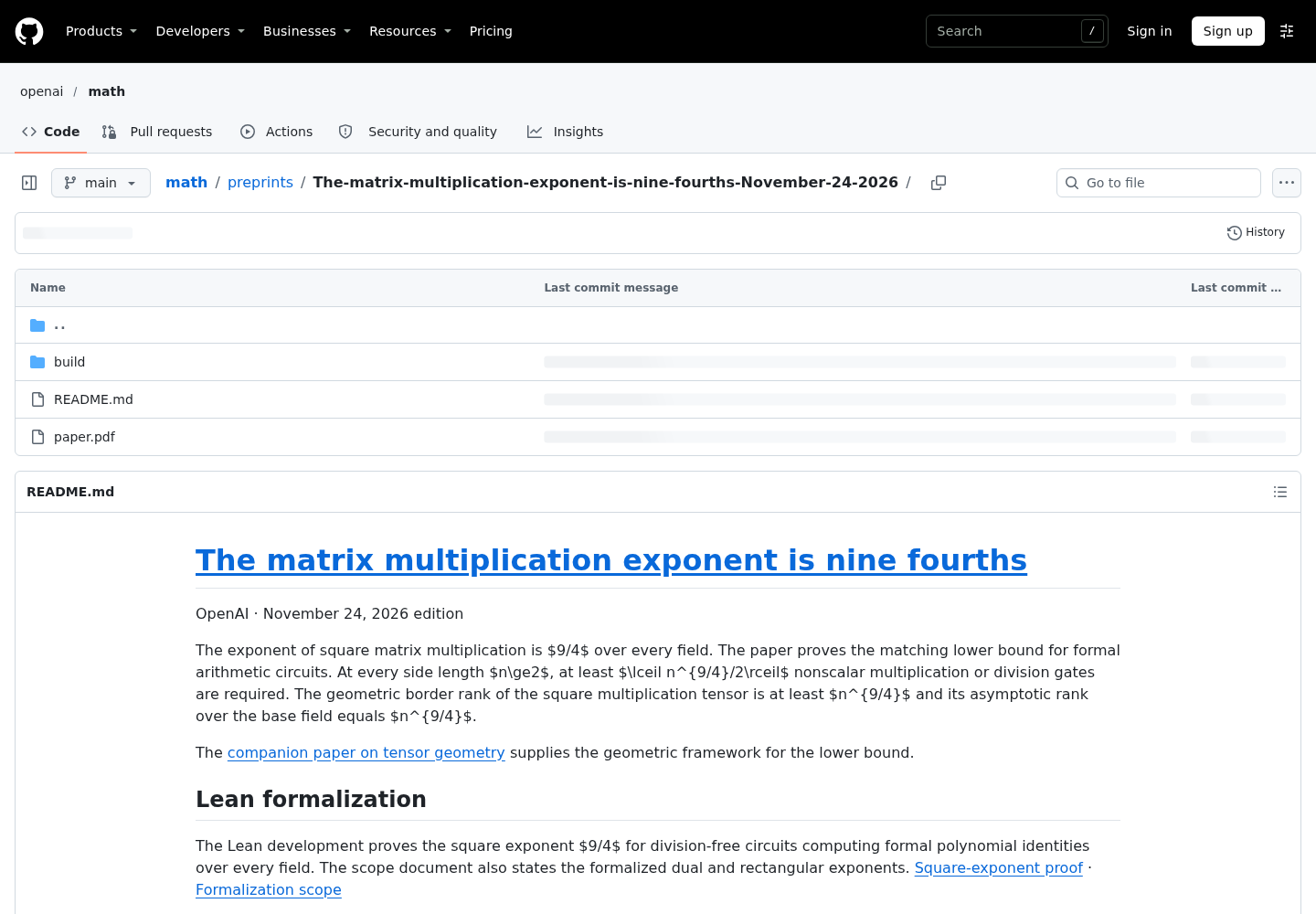
The manuscript lives in OpenAI’s math repository, which describes itself as manuscripts and proof artifacts produced by an unnamed internal OpenAI model, evaluated on open research problems after the organization’s existing mathematical evaluations saturated. Per the repository README, the catalogue holds roughly 730 manuscripts organized into 375 families; the preprints directory lists them, and this paper is one. OpenAI frames the collection as raw research data rather than polished papers, and defers to the math community completely on credit, precedence and concurrent work.
Two caveats from that same README matter here. First, about 42% of top-line results carry Lean formalizations, which means most do not. Second, OpenAI states that some unformalized results could have issues and that fixes will follow quickly as they are found.
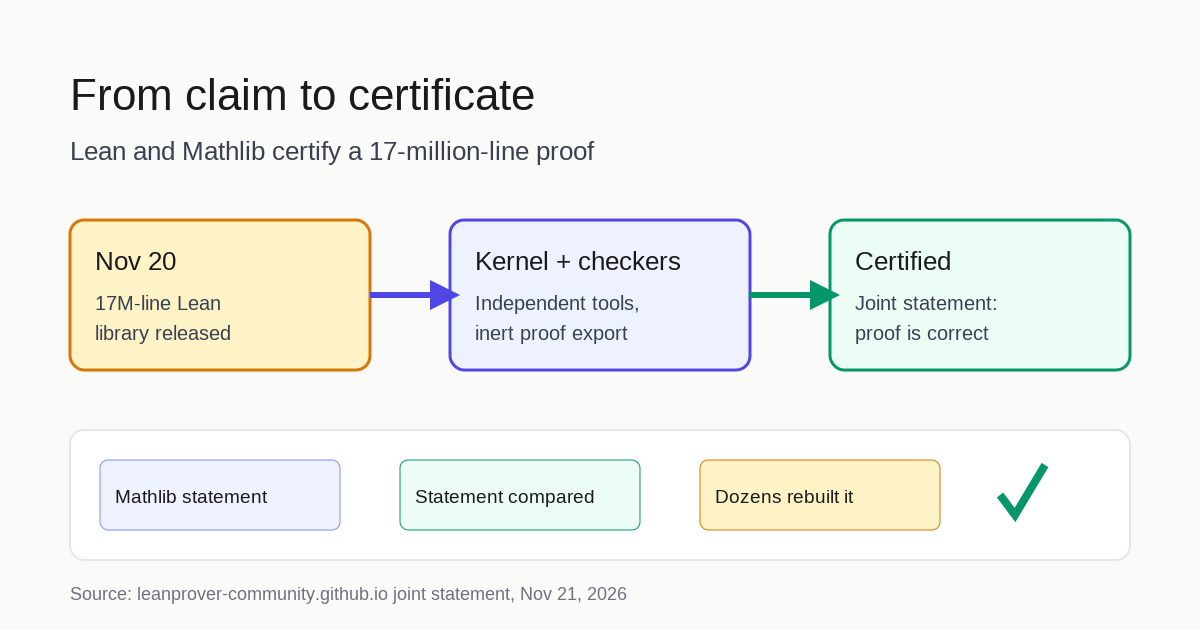
This result sits on the stronger side of that divide, with an important limit. The README reports a Lean development proving the square exponent 9/4 for division-free circuits computing formal polynomial identities over every field, with a scope document that also states the formalized dual and rectangular exponents. That machine-checked core is narrower than the manuscript’s lower bound for circuits that allow division. A restricted formalization is still exactly what you want under a claim of this magnitude. It is the same standard the community applied when Lean and Mathlib reviewers certified the AI-assisted Riemann Hypothesis work as machine-checked — and, as that episode showed, certification is not the same as community acceptance. Independent readers and time come next.
What operators should take from it
For teams running autonomous research agents, this is a notably complete public example of an AI system producing a manuscript that claims a major open problem, paired with source, build instructions and a machine-checked core. The repository is unusually specific about cost: on average across the catalogue, results took about three hours of ChatGPT Pro thinking compute per result with the internal model, drawn from roughly 4,000 posed problems, and the README notes exceptions to that procedure. Nothing establishes what this specific result cost. Even as an average, the pattern is worth studying. It echoes what Microsoft reported on the KLS conjecture, where human-directed AI runs succeeded while unguided runs on the same token budget fell short. Harness design, problem decomposition and verification gates — the same levers we recommend in a research setup that checks citations before submission — decide whether the compute converts into results.
For practitioners, the practical consequence of omega = 9/4 is asymptotic, not immediate. Fast matrix-multiplication algorithms are typically asymptotic constructs whose constants tend to lose to tuned BLAS libraries at realistic sizes, so nothing in today’s inference stack changes this week. If the claim holds, what changes is the ceiling kernel engineers race against: 2.25 would be the point where further compression of these multiplications provably stops in the formal arithmetic-circuit model the README describes — not a claim about every representation of dense linear algebra.
How to check the claim yourself
The repository makes inspection straightforward. The paper’s LaTeX source and bibliography sit in the manuscript’s build directory, and the README gives the rebuild command: cd build, then latexmk -pdf -halt-on-error -interaction=nonstopmode main.tex. The Lean proof and its formalization scope document are linked from the same README, so a skeptical reader with a Lean toolchain can inspect the exact statement that was machine-checked rather than trusting prose.
| Claim in the preprint | Verification status |
|---|---|
| omega = 9/4 over every field | Claimed; Lean-checked for division-free circuits only |
| Matching lower bound for arithmetic circuits | Claimed in the manuscript; not yet independently reviewed |
| Border rank of the square tensor >= n^(9/4) | Stated in the README; companion tensor-geometry paper supplies the framework |
| Community acceptance | Not yet; OpenAI defers to the math community on credit and precedence |
That inspectability is the real story for this audience. Whether or not omega = 9/4 enters the textbooks, the workflow behind it — pose open problems, spend bounded reasoning compute, formalize the strongest results, publish everything with rebuild instructions — is a template worth studying. The model, its compute and the problem-selection process remain internal and unreleased, so copy the verification discipline before you copy the ambition.