Anthropic Fellows Say Single Neurons Are Readable After All — and Can Detect, Steer and Audit Models Without Extra Training
Anthropic Fellows argue individual neurons are readable after all: their two-part study shows open-weight neurons detecting harmful text, steering behavior, exposing hidden finetunes, and reveals that most tested unlearning hides knowledge rather than erasing it.
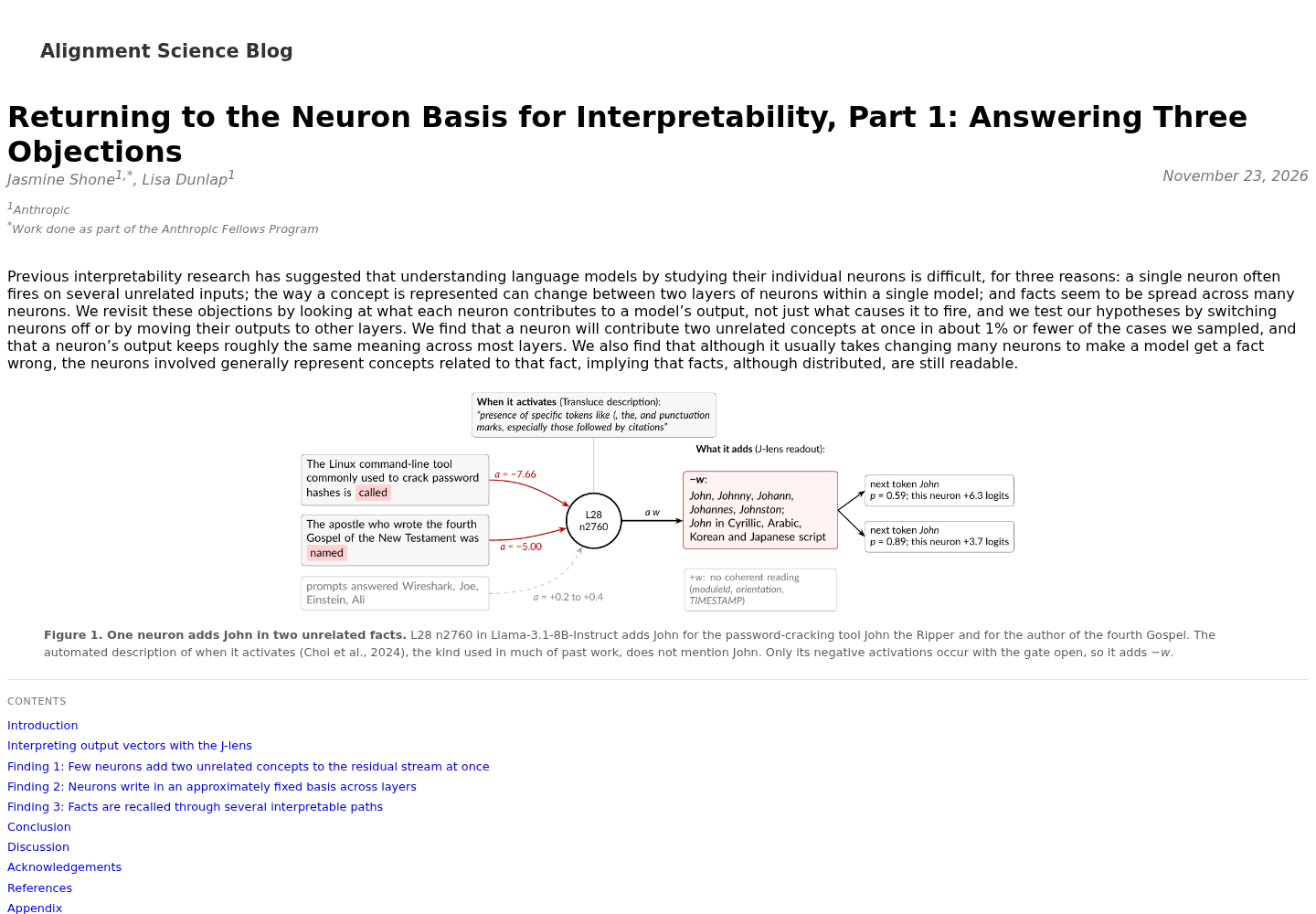
Anthropic on November 23 published a two-part study arguing that individual neurons inside language models are far more readable than the research field has assumed for years — and showing that ordinary neurons in open-weight models can detect harmful text, steer chatbot behavior and expose hidden behaviors planted by finetuning, all without training any new components. The posts, Part 1: Answering Three Objections and Part 2: Using Neurons for Safety Applications, are by Jasmine Shone and Lisa Dunlap of Anthropic, with the work done as part of the Anthropic Fellows Program. Anthropic’s official X account announced the research, summarizing that the three classic objections to neuron-level interpretability “turned out to be smaller than assumed.”
Why the field walked away from neurons
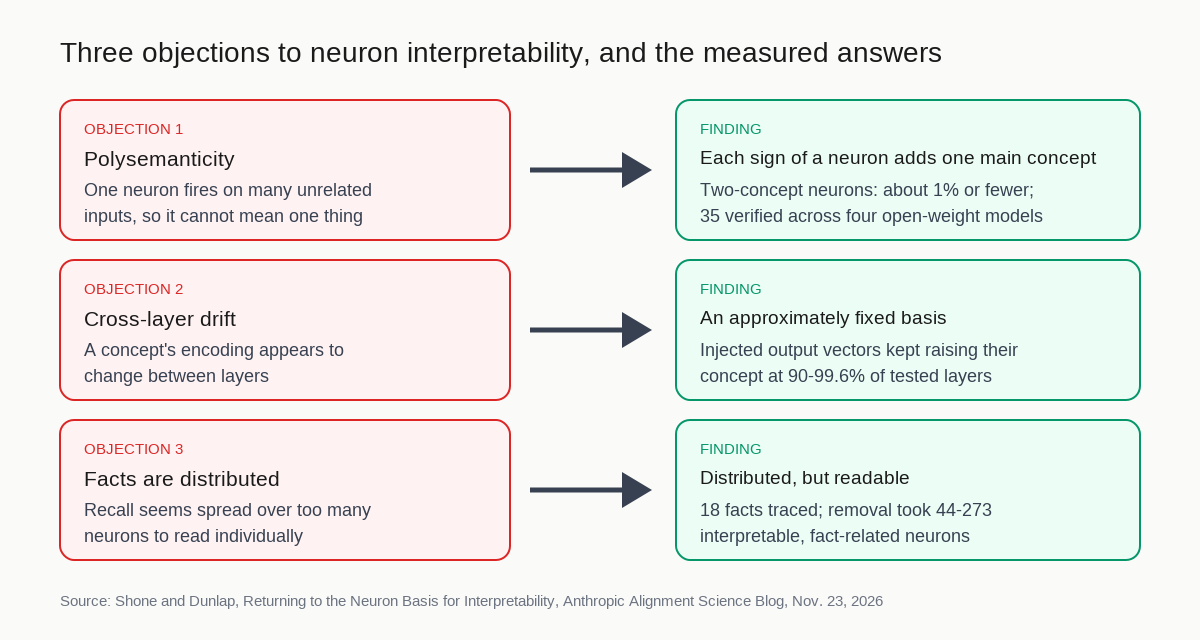
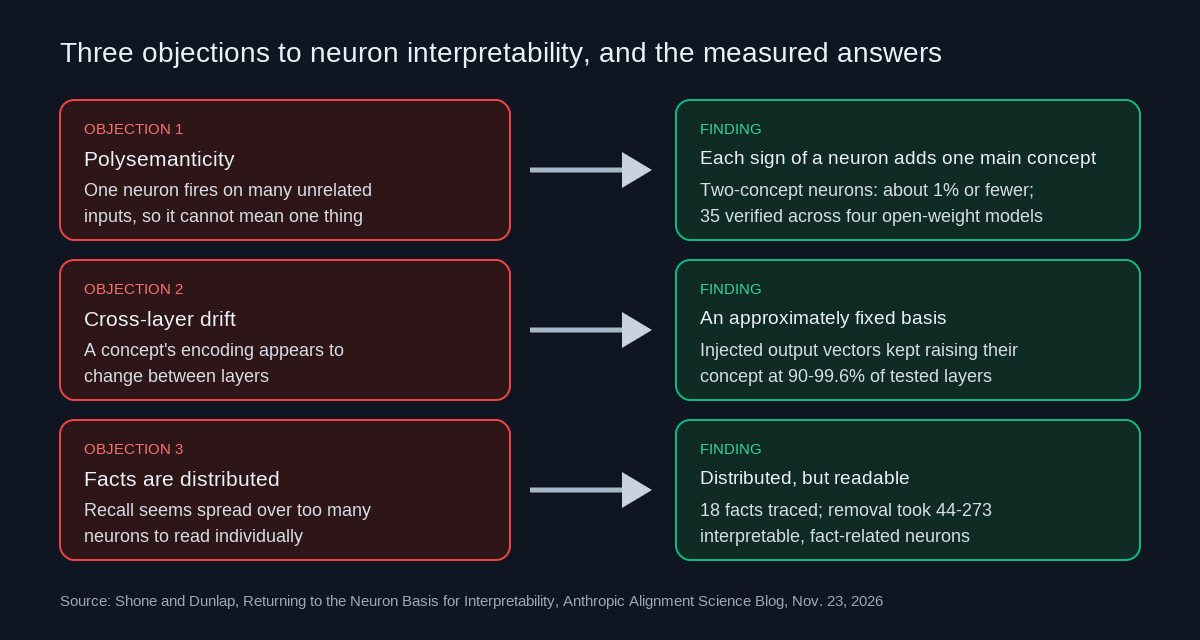
Early interpretability work tried to understand models neuron by neuron. The field largely moved on — toward sparse autoencoders, linear probes and steering vectors, all of which must be trained — for three reasons: a single neuron often fires on several unrelated inputs (polysemanticity), a concept’s representation appears to change between layers, and facts seem spread across too many neurons to read individually.
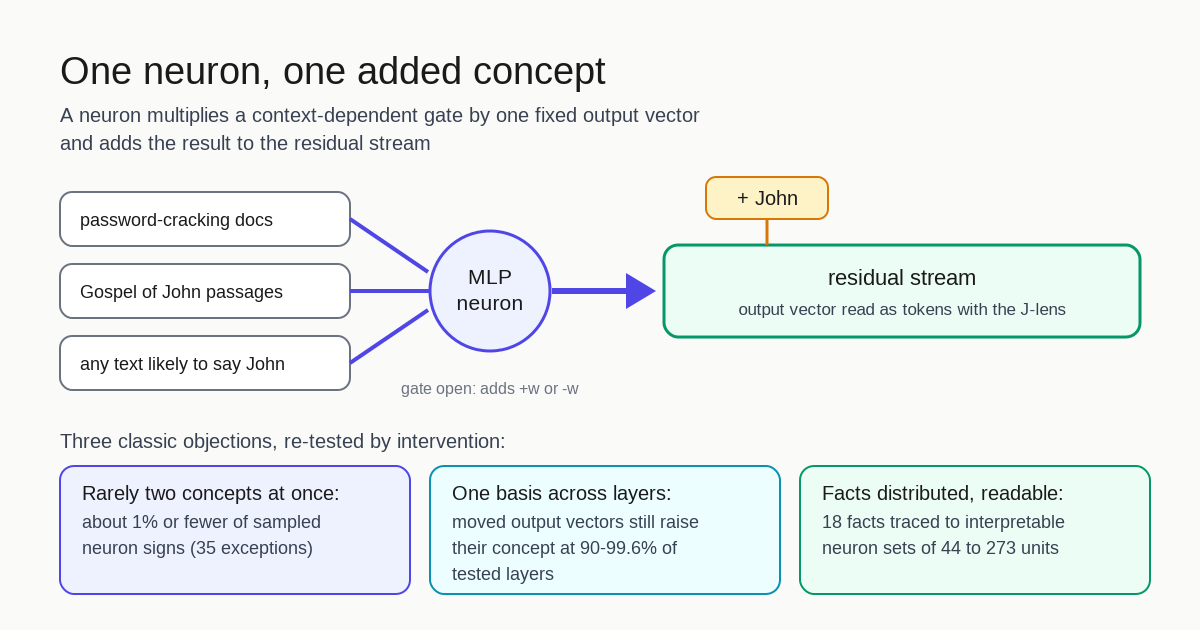
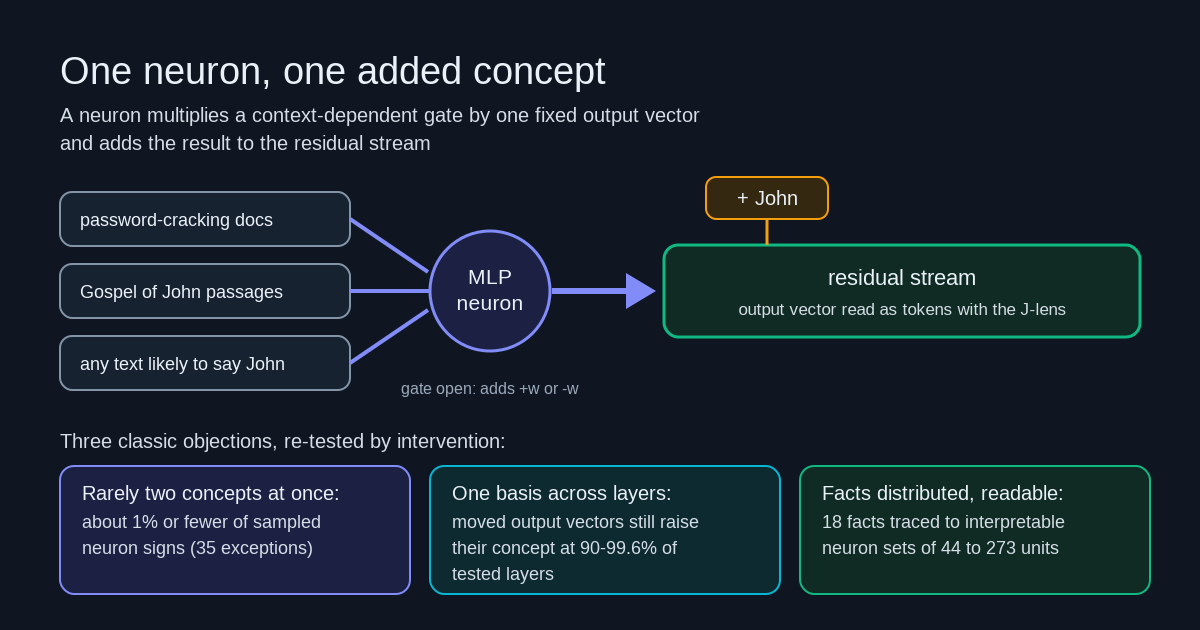
The Fellows’ reframing is simple: a neuron computes one context-dependent scalar and adds that scalar times a fixed output vector to the residual stream. That makes each neuron, in the authors’ phrase, a context-gated steering vector. Instead of asking only what makes a neuron fire, they read what it adds — using the J-lens from Gurnee et al. to map its output vector to the tokens it promotes — and then verify the reading by ablating the neuron, injecting its vector at other layers, or steering with it.
Part 1: the three objections, re-tested
Polysemanticity. The authors propose a taxonomy separating when a neuron fires from what it adds. Neurons that genuinely add two unrelated concepts in a single activation (“type 3”) account for at most about 1% of the signed neuron directions they sampled — though they do exist: screening found 35 across Llama-3.1-8B, Qwen3-8B, Qwen3-14B and OLMo-3-32B, including one neuron that adds “Elon Musk” and “protein translation” with the same sign. In a blind test, a neuron’s automatic readout matched its top-activating passages in 73%, 31% and 19% of ratings (high, middle and low readability tiers), against 4–6% for control readouts.
Cross-layer drift. When the team injected a neuron’s output vector at other layers, it kept raising its concept at 90–99.6% of concept-layer pairs before the model’s last tenth of depth. Concepts that appear to drift, they argue, are really later neurons adding new facets — for “moon,” separate layer-by-layer neurons cover the word itself, night, the crescent shape and space travel.
Distributed facts. Tracing 18 facts in Llama-3.1-8B-Instruct, the authors found that erasing one usually required removing 44 to 273 neurons — which is why facts look distributed. But every removed neuron was interpretable and related to the fact, and after removal the model did not go silent: asked for the author of One Hundred Years of Solitude, it answered Borges, an attribution that fits the attributes left standing. The authors note this fallback pattern “may be how some hallucinations arise.”
Part 2: neurons as free safety tooling
The companion post asks whether raw neurons — selected by a Claude agent or simple similarity search from their readouts and activation descriptions, with no labels and no training — can do practical safety work. The headline numbers:
| Test | Neurons, zero-shot | Best baseline |
|---|---|---|
| AxBench concept detection (AUROC) | 0.903 | 0.888 (best sparse-autoencoder setup) |
| Safety classification, 16 sets | Beat text search on 11 | Matched 400-label trained probes on 4 |
| Steering 15 chatbot behaviors | 21% of responses show behavior | 2% unsteered; trained vectors about equal |
| Blind audit, 58 hidden-behavior adapters | Named behavior in 75% of audits | 40% from outputs alone |
| Backdoor trigger search, 74 models | 54% of trigger words in top 50 | 42% (summed weight change), 3% (embedding shift) |
The auditing results speak directly to a live concern for anyone deploying third-party finetunes. Because finetuning mostly turns up neurons whose output vectors already encode the trained behavior, an auditor reading a finetune’s weight update against base-model neuron readouts identified hidden behaviors — including one triggered only by the year 2027 that no evaluation prompt elicited — far more often than output testing alone. That is a weight-based complement to the dormant-neuron risks highlighted by Microsoft’s Lazarus research on backdooring agents.
The most consequential finding may be the unlearning audit. Across 23 public WMDP-cyber unlearning checkpoints, 14 still ranked the correct answer first, under cloze scoring, for most questions the base model had answered correctly — even where multiple-choice accuracy sat at chance. The methods that score best, the authors argue, behave like backdoors: their most-changed neurons fire 20 to 100 times harder on cyber text than on retain text and inject disruptive noise, and resetting as few as 30 neurons restores about half or more of the “forgotten” answers in several method families. Chance-level benchmark accuracy, in other words, does not prove knowledge was removed — which helps explain why unlearned capabilities keep resurfacing after light finetuning.
What this is — and isn’t
This is research, not a shipped product: the posts describe methods and announce no new model. They lean on existing public artifacts — the J-lens files released with Gurnee et al., Transluce’s automated neuron descriptions, and open-weight models from Meta, Qwen and Ai2 — so replication is at least plausible for outside labs. The stated limitations matter: results cover models of 8 to 32 billion parameters, readability through one lens is a proxy for interpretability, and the label-free selection has known weak spots (on one cyber-news set, zero-shot neuron probes scored 0.49 AUROC versus 0.95 for a probe trained on 40 labels). The model organisms studied were short finetunes and LoRA adapters, not full post-training.
Still, the direction is significant for operators of open-weight agents. If single neurons can serve as zero-shot detectors for brand-new harm categories, as steering handles, and as an audit surface for suspicious finetunes, then meaningful safety monitoring no longer requires a frontier lab’s training budget — a useful counterweight as chain-of-thought monitoring gets harder at the frontier. The claims are specific, intervention-tested and falsifiable, and the authors explicitly invite re-running their analyses as better lenses arrive.
Sources
- Returning to the Neuron Basis for Interpretability, Part 1: Answering Three Objections
- Returning to the Neuron Basis for Interpretability, Part 2: Using Neurons For Safety Applications
- Anthropic on X: "New Anthropic Fellows research: Returning to the neuron basis for interpretability Understanding what’s happening inside an AI model helps to make it safer. One obvious place to look is its neurons, or the simple units it’s built from. Early interpretability work did just that, bu…